If you are searching liposuction before and after photos, you are really asking a harder question: what does a normal, good result actually look like when the marketing is stripped away? Real results are usually noticeable, often satisfying, and rarely instant. Meaningful comparison requires standardized photography, yet modern before-and-after images frequently favor the postoperative shot, so patients need to read galleries critically before they trust them.
What good results actually look like
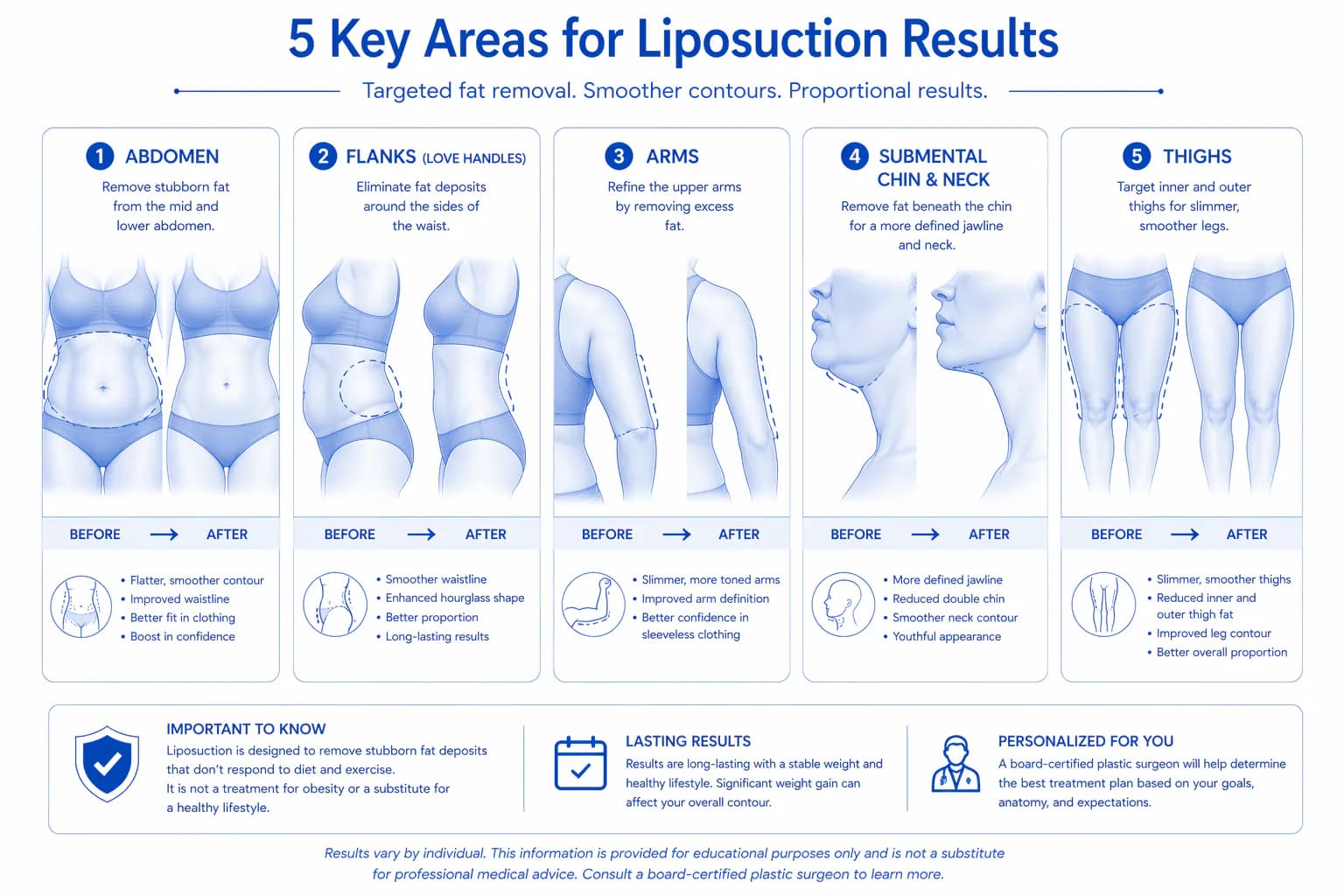
Good liposuction results look smaller, smoother, and more proportional, not magically different. On the abdomen and flanks, that usually means a cleaner waistline and less lower-abdominal fullness. On the arms, it means less bulk through the sleeve line. In the submental area, it means a sharper neck-jaw angle. The best outcomes look natural enough that your clothes fit differently before strangers notice a procedure.
Think in ranges, not miracles. In practice, surgeons aim to remove a substantial share of the safely treatable subcutaneous fat in one treatment area, often discussed as roughly 40% to 90% of the removable layer depending on thickness, skin recoil, and safety limits, not 100%. Published objective data are more conservative: one ultrasound-based abdominal study found mean subcutaneous fat-thickness reductions of about 36% to 44% at 6 months and an average waist reduction of 9.82 cm after abdominal liposuction. In a patient survey, 80% were satisfied and 53% rated their appearance excellent or very good.
What good results do not look like matters just as much. They do not look perfectly identical from side to side. They do not erase cellulite. They do not flatten visceral fullness behind the abdominal wall. They do not reliably create a six-pack unless the patient starts lean, has strong skin recoil, and is treated with very deliberate liposculpture. A natural result leaves enough fat for smooth transition zones instead of hollows and grooves.
Results can also soften if your weight changes after surgery. Liposuction removes fat cells, but the remaining fat cells can still store fat and grow. In that same patient survey, 43% reported weight gain by 6 months and 65% said they noticed some fat return, most often in the abdomen.
Why before/after photos require critical reading
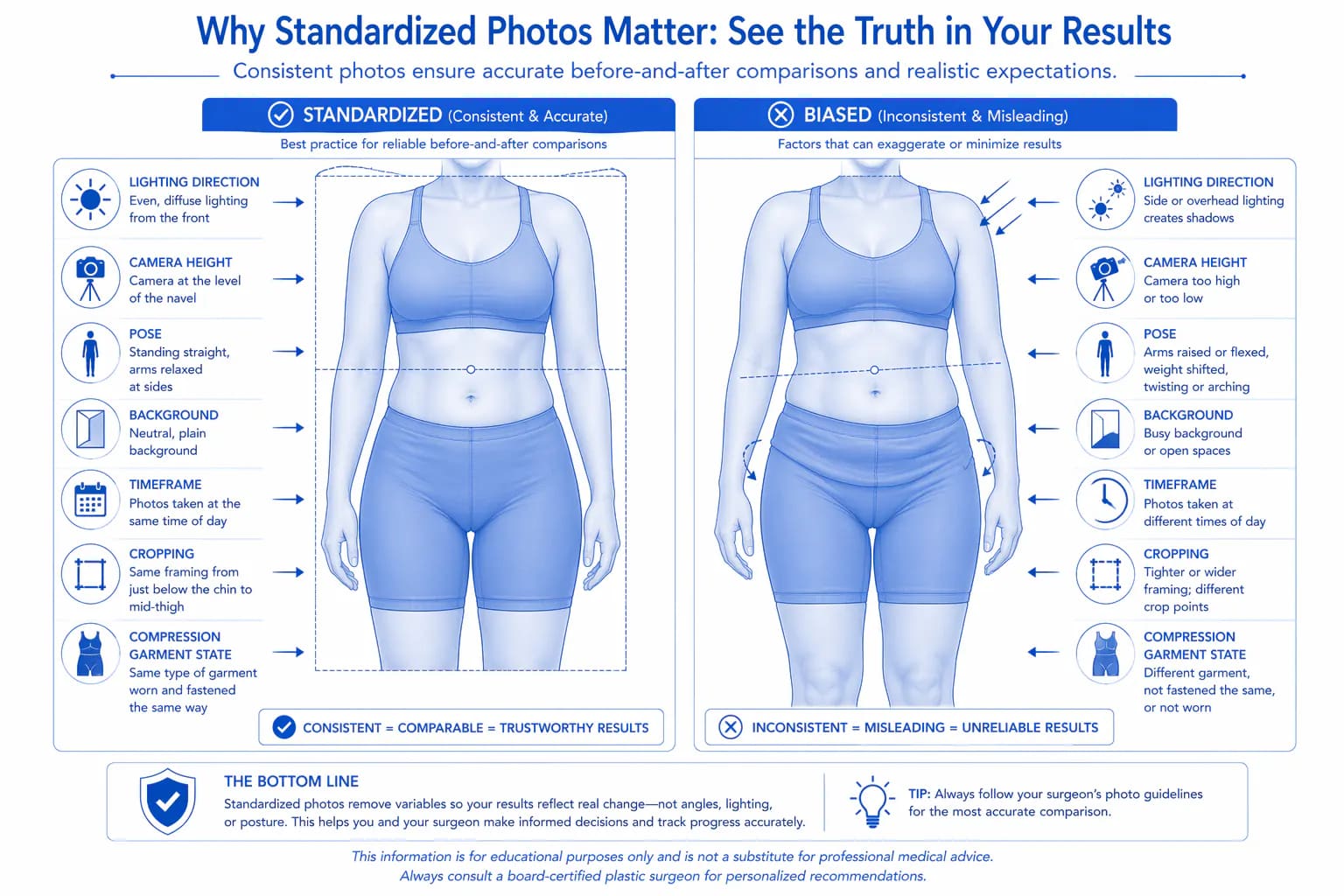
This is the part most gallery pages skip. Before-and-after photos are only useful when the setup is controlled. The ASPS photographic guide exists because standardized poses and views are necessary for meaningful observation. A 2023 analysis of 161 Instagram before-and-after sets found that 70.8% favored the postoperative image; common bias included different backgrounds, different view angles, different coverage, and even postoperative standing compared with preoperative supine positioning.
That bias is not subtle. A 2024 review noted that plastic surgery depends heavily on photography, yet standards have loosened in the smartphone and social media era; the same review highlighted evidence that 70.8% of included images showed bias toward the postoperative photo, often because the postoperative background was more flattering.
| What to check | Why it matters | Red flag |
|---|---|---|
| Lighting | Side-lighting deepens shadows and can fake more definition | The after photo has harder, more directional light |
| Camera height and angle | A slightly overhead shot can narrow the waist and create an hourglass illusion | The navel or chin sits at a different height in the frame |
| Posture | Hip twist, rib flare, flexing, and arms held away from the body change contour | Relaxed before, posed after |
| Compression garment state | A just-removed garment can temporarily mold tissue and create misleading indentations or smoothness | No note on whether compression was worn |
| Timeframe | A 2-week photo shows healing, not outcome | No postoperative month listed |
| Views shown | Front-only photos hide flanks, thighs, back contour, and asymmetry | No side or back views |
These problems are common, not hypothetical. Different background, view, and coverage were among the frequent sources of postop-favoring bias in the Instagram study.
A six-point photo evaluation checklist
Confirm the same lighting, background, camera height, and framing. Confirm the same posture, with no hip twist, flexing, or breath-holding. Confirm the postoperative timeline. Confirm whether the patient was still in compression or had just removed the garment. Ask for front, oblique, side, and back views. Then ask to see patients with your body type, skin elasticity, and treatment area, not just the surgeon's most dramatic result.
Immediate post-op appearance
Usually worse than patients expect. Right after tumescent liposuction, the treatment area is swollen, bruised, numb, and often uneven. Small cannula entry sites may leak diluted, blood-tinged anesthetic fluid for the first day, and the compression garment can create temporary lines and pressure marks. Early photos can look puffy rather than sculpted.
The emotional low point is often week 2, not day 1. Swelling can continue to increase mildly for 10 to 14 days, and honest recovery guides note that days 1 to 3 can make you look larger than before surgery while weeks 2 to 3 can still look lumpy, asymmetric, and worse than the final contour. That does not mean the result failed. It means you are still in the inflammatory phase of the recovery timeline.
Immediate on-table photos are not outcome photos. They show what the area looked like under surgical conditions, before swelling fully declares itself and before normal day-to-day posture, fluid shifts, and garment use change the surface contour.
The results timeline
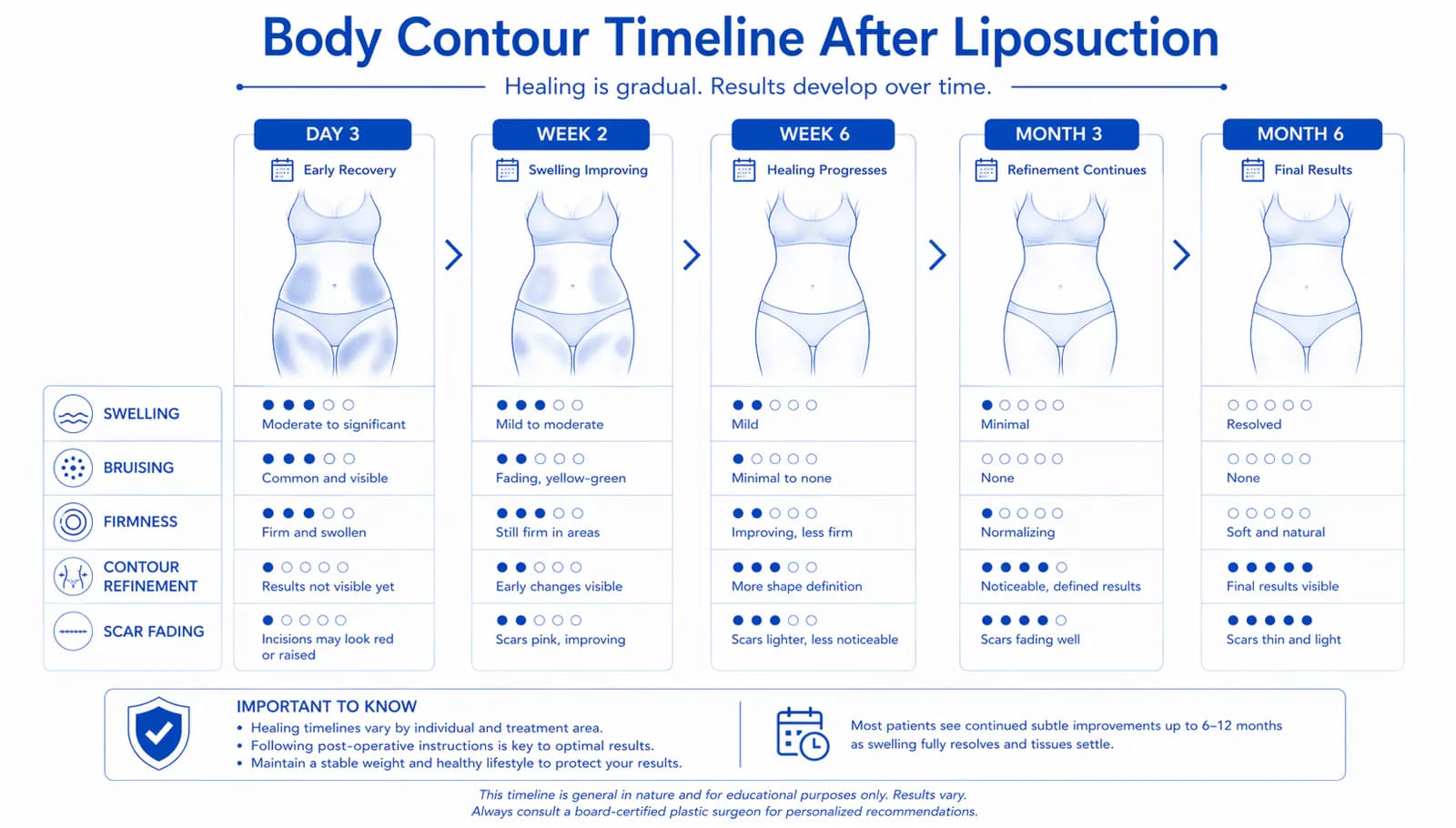
Most patients can see the direction of the result before they can see the finish. Swelling usually starts to come down by the end of the first week. Many surgeons counsel that roughly 70% to 80% of swelling is gone by 6 to 8 weeks, and the final contour typically appears between 3 and 6 months. ASPS patient guidance also notes that it can take several months for swelling and fluid retention to fully settle.
| Timepoint | What you usually see | What it means |
|---|---|---|
| Days 1-7 | Swelling, bruising, drainage, garment lines, and sometimes a larger-than-before look | Too early to judge |
| Weeks 2-3 | Firmness, lumpiness, asymmetry, and the classic "ugly duckling" phase | Still normal healing |
| 6-8 weeks | About 80% of swelling resolved for many patients | You can judge the direction of the result |
| Month 3 | Clearer contour in most treatment areas | Reasonable point for an early honest comparison |
| Months 4-6 | Final contour for many patients; scars start looking flatter and paler | Best window for honest portfolio photos |
Smaller areas can read "finished" sooner in photos. Larger abdomen, flank, and 360 liposculpture cases often keep refining longer. In published and clinic-reported examples, submental cases are commonly photographed around 4 months, arms and back around 6 months, and abdomen and flanks around 9 months. For a deeper week-by-week guide, see liposuction recovery timeline.
How much change to expect
Enough to change proportions. Not enough to change anatomy. Liposuction can make a waist look cleaner, reduce sleeve tightness, sharpen the chin-neck angle, and smooth a flank or thigh transition. It cannot remove visceral fat behind the abdominal wall, fix muscle separation, erase cellulite, or reliably tighten significantly loose skin.
That is why dramatic means different things on different bodies. A lean patient with good skin recoil may look more etched after liposculpture or VASER-assisted contouring. A patient with thicker subcutaneous fat, postpartum laxity, or central visceral fullness may still get a good result, but it will look more like a smoother silhouette than a carved one. Outcomes vary with age, body type, skin elasticity, procedure type, surgeon expertise, and adherence to postoperative care.
The most honest way to think about change is this: liposuction can move you one or two contour categories, not create a different skeleton. Staying weight-stable protects the result. Gaining weight afterward can enlarge the remaining fat cells and partially reverse the improvement.
Results by body area: what realistic expectations look like
By body area, good results look different. A strong abdomen result is not the same as a strong arm or submental result.
| Treatment area | What a good result looks like | What commonly limits the result |
|---|---|---|
| Abdomen | Flatter lower abdomen, smoother upper-to-lower transition, less protrusion in profile | Visceral fat, skin laxity, and diastasis can keep the belly round |
| Flanks | Narrower waist in front and three-quarter view, less overhang at the waistband | Over-aggressive removal can create hollows or step-offs |
| Arms | Smaller circumference and a cleaner sleeve line | Loose skin can remain, especially after weight loss or with age |
| Submental chin and neck | Sharper cervicomental angle and less fullness in profile | Skin recoil and neck heaviness determine how crisp the result looks |
| Thighs | Less rubbing, smaller outer bulge, smoother fit in pants | Swelling lasts longer and asymmetry is easier to notice |
Abdomen and flanks usually deliver the clearest visual payoff because they change the waist from multiple angles. Arms often improve more in clothing than in mirror close-ups. Submental photos are very sensitive to neck position, so a slightly extended neck can fake a better jawline. Thighs often improve functionally, with less rubbing and easier clothing fit, even when the visible change is subtler than a patient imagined.
Matching cases to your starting point
Look for cases that match your starting point, not your goal photo. The best comparison patient has similar fat distribution, skin elasticity, age range, sex, pregnancy history, and treatment areas. If you carry more visceral fat in the abdomen, liposuction can slim the outer layer but not flatten the inner abdominal wall. If your skin is lax, a conservative contour may look better than aggressive suction because it avoids waviness and unnatural shadowing.
Scars and entry sites
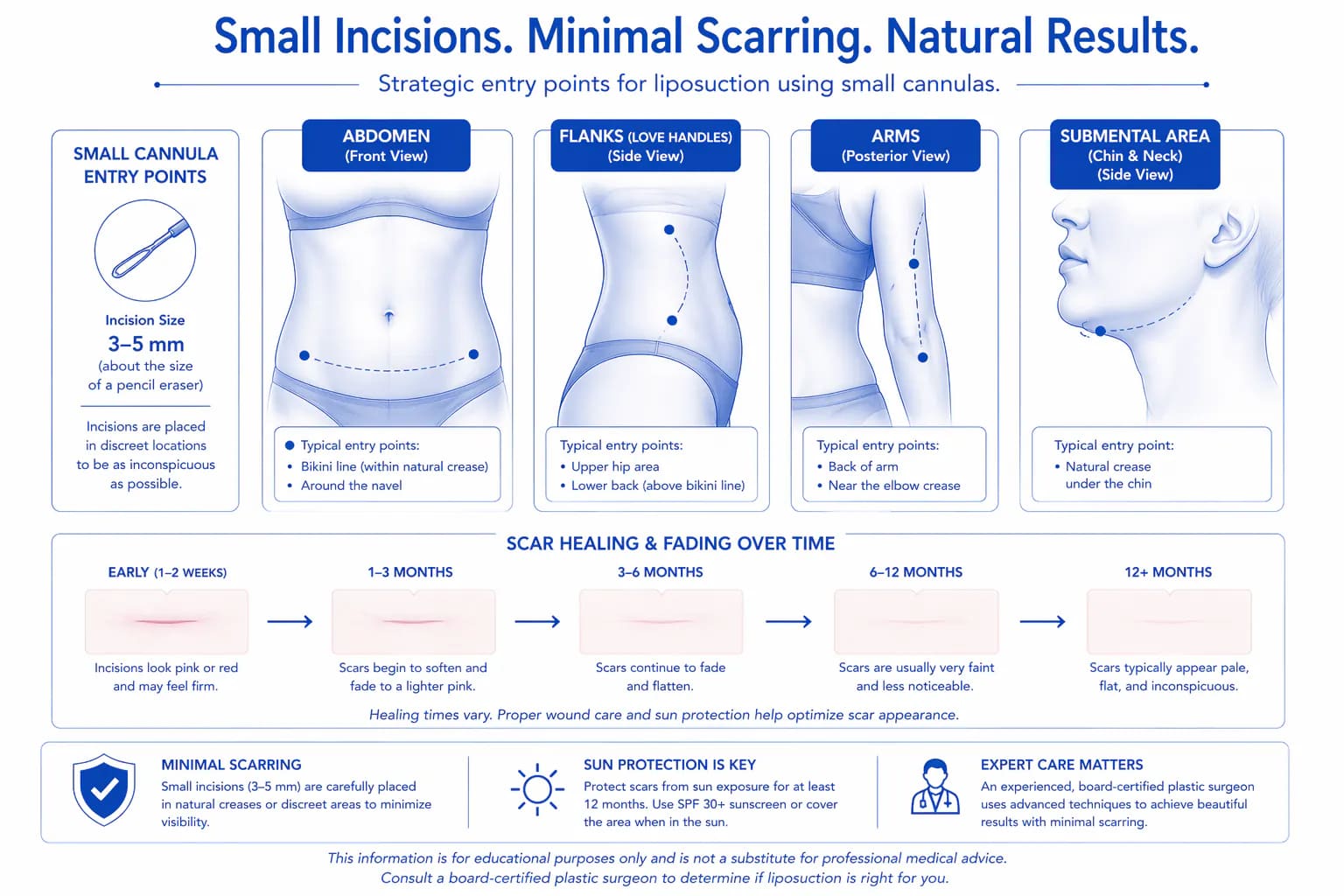
Yes, but usually only tiny ones. Liposuction uses small cannula entry sites, often described as about 2 to 3 mm and commonly around 3 to 5 mm in practice, placed in natural creases, the navel, underwear lines, or other hidden folds when possible. Standard photos often do not show them clearly by late follow-up because they usually fade to flat, pale marks by 6 to 12 months.
The honest caveat is that scar visibility still varies. Darker skin types, a history of hyperpigmentation or keloids, smoking, sun exposure, and friction can make entry sites more noticeable. If a gallery is softly lit or slightly cropped, the scars may look even less visible than they do in person.
Factors that affect result quality
Three variables matter most: candidate quality, surgical precision, and healing behavior. Candidate quality means enough localized subcutaneous fat to treat and enough skin elasticity to shrink down afterward. Surgical precision means the surgeon places the cannula in the correct plane, treats transition zones evenly, and does not chase every last millimeter at the cost of ripples. Healing behavior means wearing the garment as instructed, keeping follow-up appointments, walking early, and staying weight-stable.
Technique names matter less than operator judgment. VASER, power-assisted liposuction, and high-definition liposculpture can be useful tools in selected patients, but none of them rescue poor candidate selection. If a surgeon talks only about technology and not about skin recoil, transition zones, or how much correction your body can support safely, that is a warning sign.
This is why credentials matter more than the watermark on a gallery. Choose a board-certified plastic surgeon, ideally board-certified by the ABPS, who performs liposuction regularly in your treatment area. Ask what technique they recommend, why it fits your anatomy, and what result they think is realistic on your body, not on their best social media case. For a full screening framework, see how to choose a liposuction surgeon.
Revision and touch-up rates
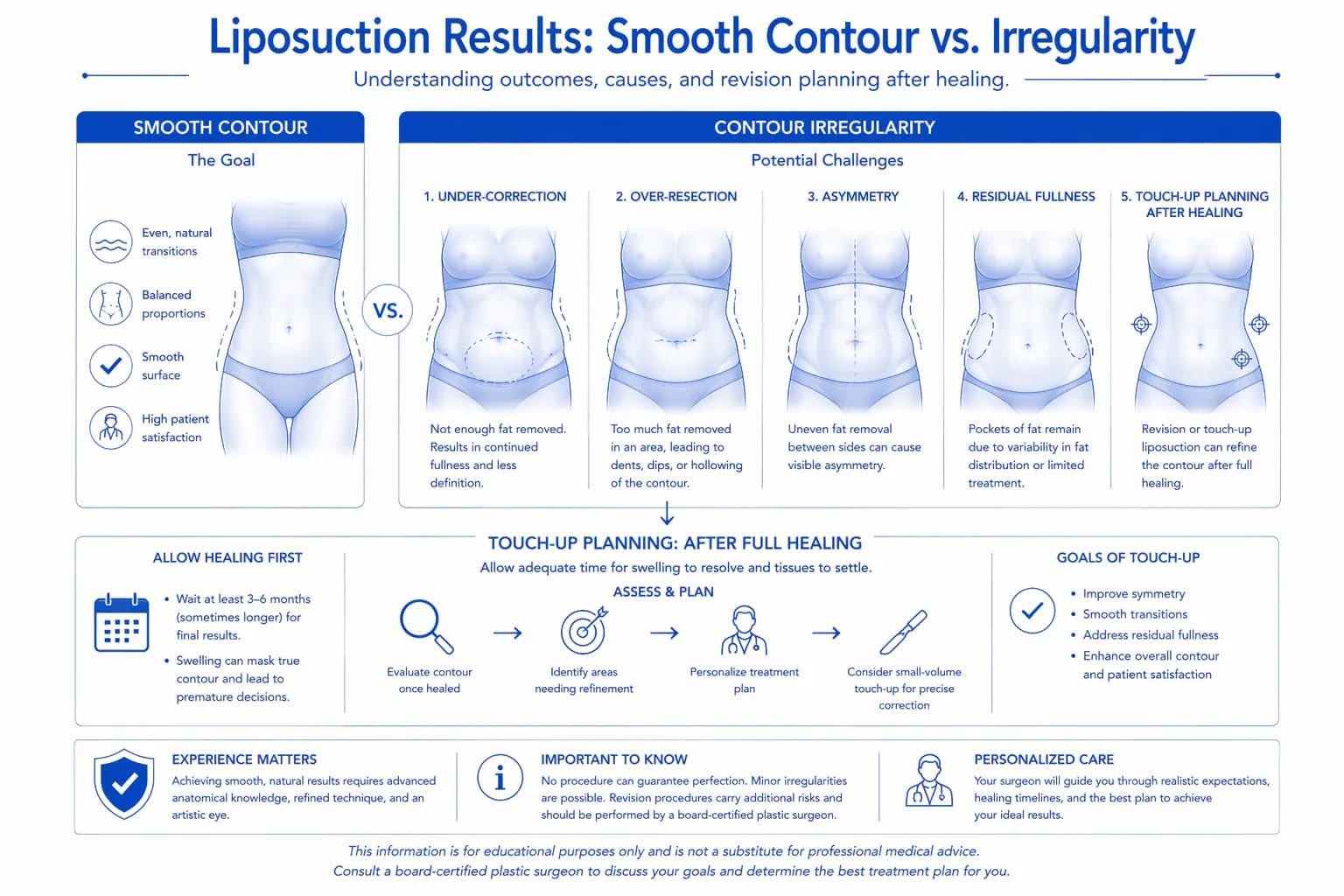
This is the number almost no before-and-after gallery discusses. Published liposuction data show contour deformity is the most common complication, with a pooled absolute risk of 2.35% in a meta-analysis of 39 studies and 29,368 patients. The same review reported an overall complication rate of 2.62% and noted that complication reporting is inconsistent across the literature.
Revision is not the same thing as a reported complication. Minor contour irregularities, residual fullness, and asymmetries are not coded consistently across studies, so real-world touch-up rates are harder to pin down. A fair counseling range is about 5% to 10% for some form of revision or touch-up after liposuction for contour issues, especially when minor office-based corrections are included. That range fits the broader literature better than a zero-revision fantasy: the liposuction meta-analysis notes contour deformity rates in the literature in roughly the 3% to 9% range, and one academic cosmetic surgery program reported an 8.4% revision rate across aesthetic procedures for cosmetic dissatisfaction.
When results need correction, most surgeons wait until swelling has largely settled before deciding what is real and what is temporary. Correction may mean a small touch-up suction, fat grafting to fill a divot, or in some patients a skin-tightening or excisional procedure. Not every irregularity needs another surgery, and not every revision means the original surgery was negligent. For a fuller discussion of complication patterns, see liposuction risks and safety.
What to ask when reviewing a surgeon's before-and-after portfolio
A strong portfolio does not just show the best result. It shows consistency, honesty, and relevance to your body.
| Ask this question | Why it matters |
|---|---|
| Were these photos taken with the same lighting, camera height, distance, and background? | Without standardization, comparison is weak |
| How many months postop is each image? | Month 1 and month 6 do not show the same result |
| Was the patient still in compression or just out of a garment? | Garment state can temporarily change surface contour |
| Can I see front, oblique, side, and back views? | One angle can hide residual fullness or asymmetry |
| Can I see patients with my body type and treatment area? | Your best predictor is a matched case |
| What is your touch-up or revision rate, and how do you handle it? | Honest counseling beats perfect-gallery marketing |
| Are you board-certified by the ABPS, and who performs the surgery? | Credentials and operator consistency matter |
Photography standards exist for a reason. If every abdomen is shot from a slightly overhead angle, every submental case uses a more extended neck in the after photo, or every patient is shown only in their best three-quarter pose, you are looking at a marketing gallery, not a teaching file. For more screening questions, see how to choose a liposuction surgeon.
They usually look smaller, smoother, and more proportional rather than dramatically different in every view. Published objective abdominal data suggest measurable contour change, and patient satisfaction is generally high, but perfect symmetry and total flatness are not realistic goals.
Many patients see the direction of the result by 6 to 8 weeks, when roughly 80% of swelling has resolved for many cases. Final results usually appear between 3 and 6 months, with some areas refining longer.
It can meaningfully reshape one treatment area, but it is not weight-loss surgery. It improves outer contour, not visceral fat, and weight gain afterward can enlarge the remaining fat cells and partially soften the result.
Expect swelling, bruising, drainage from small entry sites, numbness, and a compression garment. Week-2 photos often look worse than before surgery because swelling can rise for 10 to 14 days before it starts to settle.
Check for identical lighting, angle, posture, background, and clothing, and make sure the postoperative timeframe is clearly labeled. Honest portfolios also show multiple views and patients with body types similar to yours.
A practical counseling range is about 5% to 10% for some form of touch-up or revision related to contour irregularities, asymmetry, or residual fullness. Published pooled complication data show contour deformity at 2.35%, but revision reporting is less standardized than complication reporting.
Yes, but they are usually tiny 3 to 5 mm cannula entry marks placed in hidden or low-visibility areas. By 6 to 12 months, many fade to pale, flat marks that are difficult to see in standard photos.
The best predictor is a patient with similar fat distribution, skin elasticity, and treatment areas. Leaner patients with good skin recoil usually show sharper definition, while lax skin, visceral fullness, and older tissue quality make the result more subtle.
