Choosing a liposuction surgeon is not complicated — if you know what to look for. The problem is that the most important distinction in surgeon selection is one that almost no patient is told about before they start searching. For help determining whether you are a good candidate first, see our liposuction candidacy guide.
"Board certified" sounds straightforward. It is not. Two surgeons can both advertise "board certified" on their websites, with vastly different training — six years versus one — and only one of those certifications is recognized by the national body that oversees medical specialty boards. Most patients never know to ask which one they are looking at.
This guide covers how to verify what matters, what to ask at consultation, the specific red flags that should end a conversation, and how the lipo.com directory works to make this easier.
The Board Certification That Actually Matters
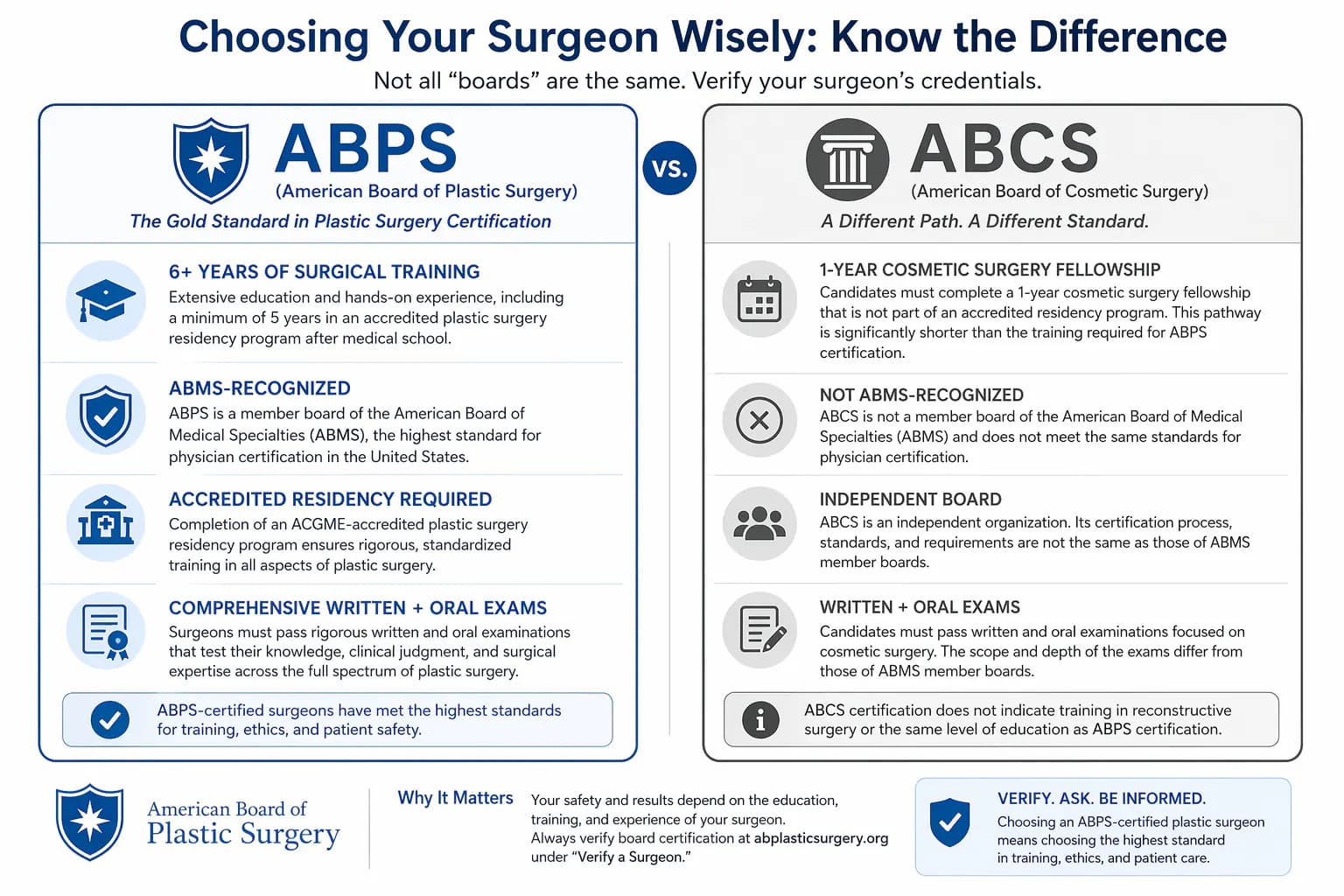
For liposuction — and for any body contouring surgery — one board certification is the standard: the American Board of Plastic Surgery (ABPS).
ABPS is the only plastic surgery board recognized by the [American Board of Medical Specialties](https://www.abms.org/) (ABMS) — the umbrella organization that accredits medical specialty boards in the United States. ABPS certification requires:
- A minimum of six years of surgical training after medical school
- Completion of an accredited plastic surgery residency program
- Comprehensive written and oral board examinations
- Ongoing continuing medical education requirements
Membership in the American Society of Plastic Surgeons (ASPS) requires ABPS certification, which makes ASPS membership a reliable secondary signal.
How to verify in under 60 seconds:
1. Go to abplasticsurgery.org
2. Use the "Find a Surgeon" or "Verify Certification" tool
3. Search the surgeon's name and confirm their ABPS status
Do not rely on a surgeon's own website or marketing materials to confirm certification. Verify independently. It takes less than a minute and is the single most important step in this process.
Why "Board Certified" Alone Means Nothing
Here is what most patients never find out: "board certified" is not a protected phrase. Any certifying body can use it to describe its diplomates, regardless of what that certification actually requires.
The American Board of Cosmetic Surgery (ABCS) certifies surgeons who can then advertise themselves as "board certified cosmetic surgeons." ABCS is not recognized by the ABMS. The training requirements are substantially different from ABPS:
| ABPS | ABCS | |
|---|---|---|
| Training required | 6+ years (surgical residency) | 1 year |
| ABMS recognized | Yes | No |
| Accredited residency required | Yes | No |
| Board examinations | Comprehensive written + oral | Single weekend exam |
| CME requirements | Ongoing | None specified |
Research has found that nearly 10% of ABCS members were not trained in a surgical discipline at all. More than half had advertised surgical operations beyond the scope of their residency training. In 2018, the California Medical Board concluded that ABCS certification is not equivalent to ABMS board certification and that ABCS diplomates cannot legally advertise themselves as "board certified" in California.
Why this matters for patients: ABCS-certified surgeons frequently market themselves using language that implies plastic surgery training they do not have. A patient searching for a "board certified cosmetic surgeon" may not realize they are not looking at an ABPS-credentialed physician. The confusion is not accidental.
The question to ask — specifically: "Are you certified by the American Board of Plastic Surgery?" Not "Are you board certified?" The specific board name is what matters.
The Facility Question Most Patients Never Ask
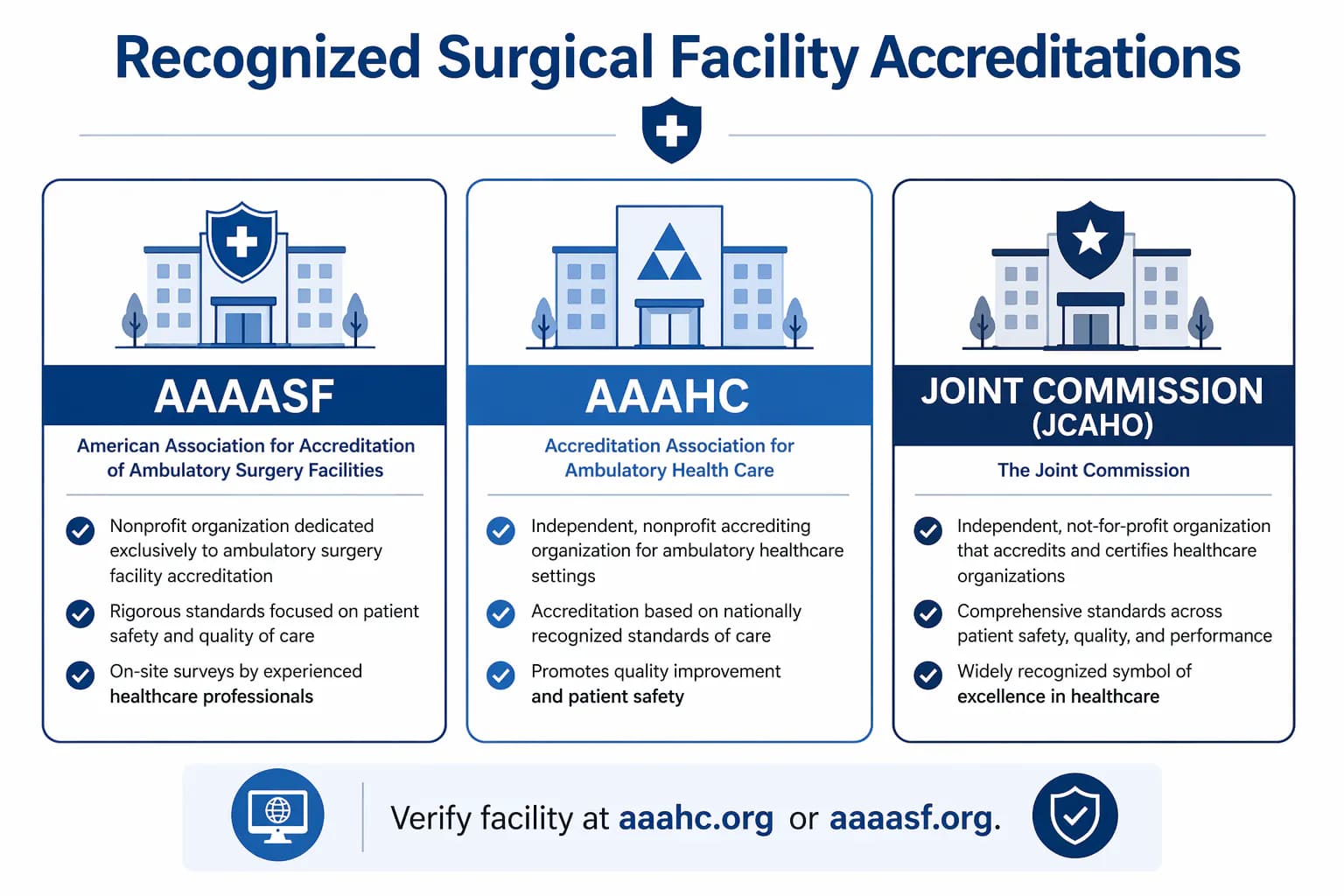
Where a procedure is performed matters as much as who performs it — and most patients do not think to ask until after they have already booked.
Accredited surgical facilities are regulated for patient safety. The three recognized accreditation bodies for ambulatory surgical facilities in the United States are:
- AAAASF — American Association for Accreditation of Ambulatory Surgery Facilities
- AAAHC — Accreditation Association for Ambulatory Health Care
- The Joint Commission (JCAHO)
The outcomes data for accredited facilities is clear: serious complication rates below 0.5%, mortality rates below 1 in 57,000. Unaccredited settings carry higher risk — not necessarily because the surgeon is worse, but because the infrastructure, emergency protocols, and oversight are different.
You can verify a facility's accreditation status at aaahc.org or aaaasf.org.
One specific rule worth knowing: large-volume liposuction — procedures removing more than 5,000 cc of fat — should be performed in a hospital or equivalently accredited facility, not a standard outpatient surgical center. If you are planning extensive multi-area liposuction and your surgeon is proposing to perform it in an unaccredited office setting, that is worth a direct conversation.
The anesthesia question: Ask who will administer your anesthesia. The answer should be either a Certified Registered Nurse Anesthetist (CRNA) or a board-certified anesthesiologist. A surgeon who acts as both surgeon and anesthesiologist for the same procedure — which can occur in some office-based settings — is a meaningful safety concern. Two separate qualified people for two separate roles is the standard.
How to Evaluate Liposuction Experience Specifically
Board certification tells you a surgeon has the foundational training. It does not tell you how much of their practice is actually liposuction.
Liposuction is a skill that improves with volume. A surgeon who performs hundreds of liposuction cases per year has a different level of technical refinement than one who does a dozen as a side offering alongside facelifts and rhinoplasties. Neither is unqualified, but the difference in routine exposure matters — particularly for complex cases, multi-area treatments, and techniques like VASER Hi-Def or lipo combined with BBL.
Ask directly: "How many liposuction procedures do you perform per year?" A surgeon who treats this as a rude question is not the right fit. A surgeon who answers specifically and can contextualize what that volume means for your case is worth continuing the conversation with.
Hospital privileges: Ask whether the surgeon has hospital privileges to perform liposuction. Hospital credentialing involves independent review of a physician's training, outcomes, and competence. A surgeon who maintains hospital privileges — even if your procedure will be performed in an outpatient setting — has passed that external review process.
Before-and-after photos: Ask specifically to see before-and-after photographs of patients with a similar body type, anatomy, and treatment areas to yours. A curated highlight reel of ideal outcomes from ideal patients is less useful than photos of people who look like you. If a surgeon cannot produce relevant comparisons, that may indicate limited volume in cases matching your profile.
The Consultation: What to Ask
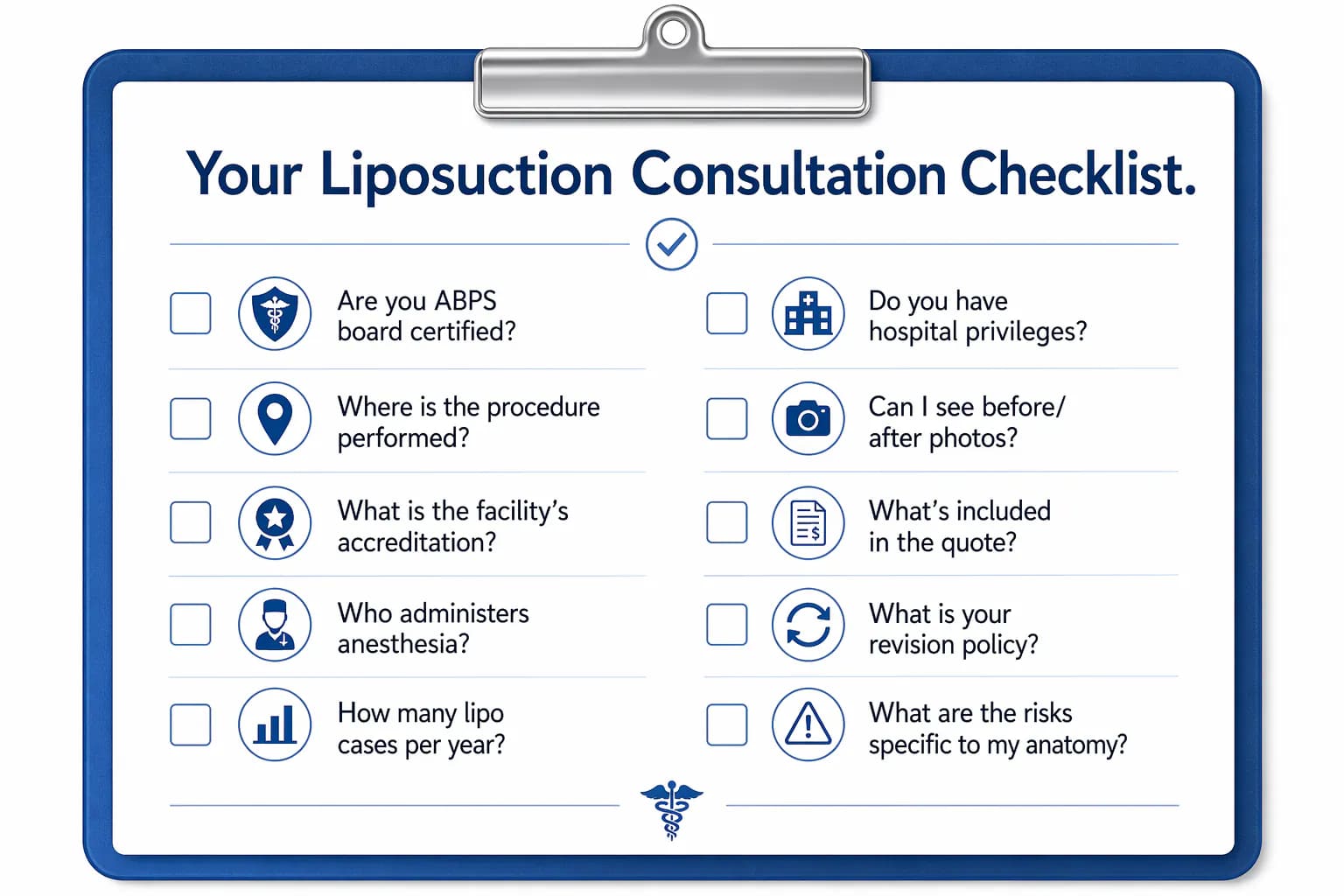
A liposuction consultation is a job interview. You are evaluating the surgeon, not the other way around. An ethical, experienced surgeon will welcome thorough questions. A surgeon who seems defensive, rushed, or dismissive when you ask about credentials is telling you something important.
Credential questions:
- Are you certified by the American Board of Plastic Surgery?
- Are you a member of the American Society of Plastic Surgeons?
- Do you have hospital privileges to perform liposuction?
Facility and anesthesia questions:
- Where will this procedure be performed?
- What is that facility's accreditation status?
- Who will administer my anesthesia, and what are their credentials?
Experience questions:
- How many liposuction procedures do you perform per year?
- How many cases have you done involving my specific treatment areas?
- Can you show me before-and-after photos of patients with a similar body type to mine?
Procedure-specific questions:
- What technique do you recommend for my goals, and why?
- How much fat do you estimate removing, and is that within outpatient procedure guidelines?
- What are the specific risks for my anatomy and the areas I want treated?
- What happens if I am not satisfied with the results — what is your revision policy?
Financial questions:
- Can you provide a fully itemized written quote that separates surgeon fee, anesthesia, facility fee, garments, and post-op visits?
- Are follow-up appointments and post-op care included in the quoted price?
- What would trigger additional costs not covered in the quote?
The financial question is more important than it sounds. Vague or bundled pricing is a red flag — covered in detail in the next section.
Red Flags That Should End a Consultation
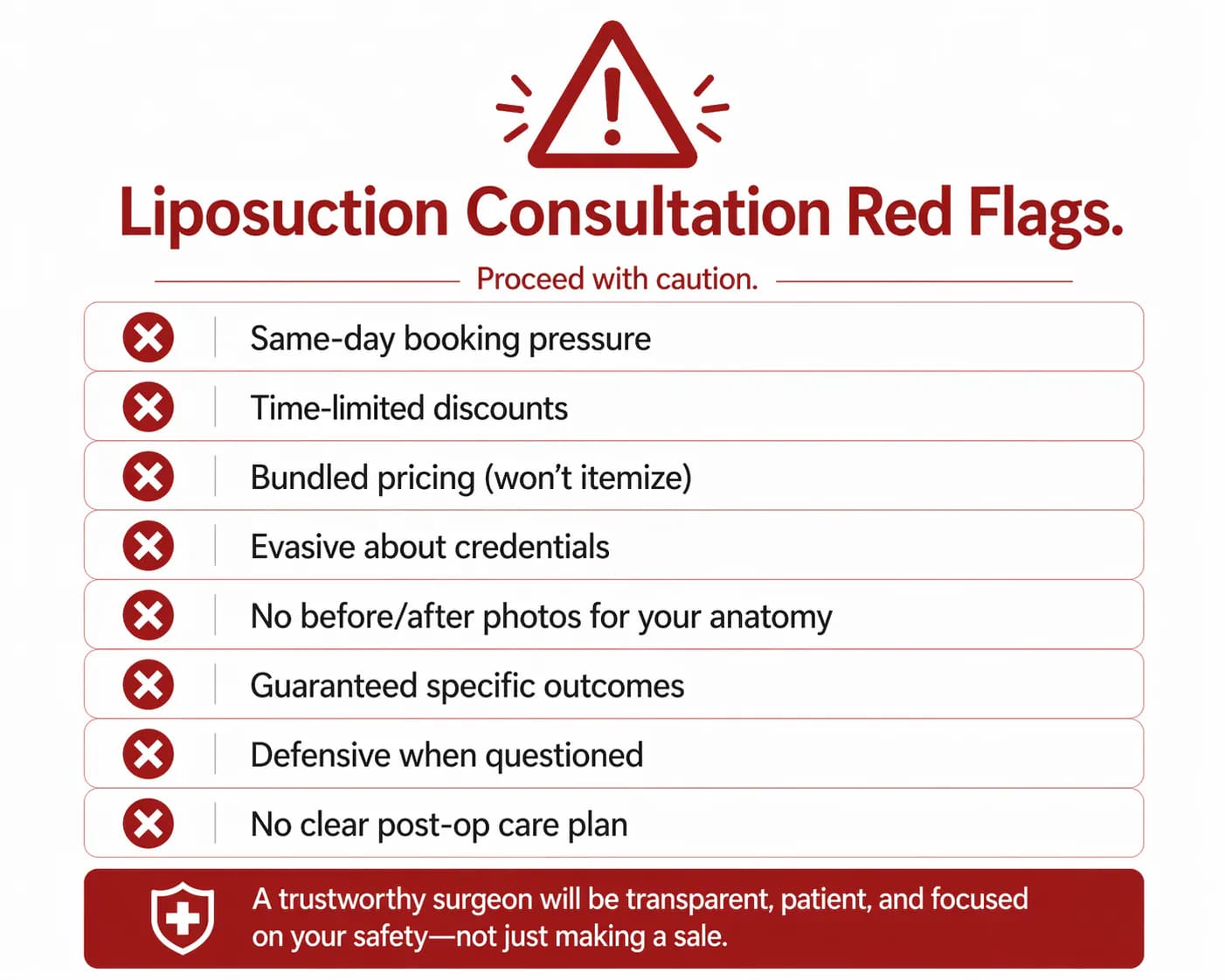
Liposuction is surgery. The stakes are real. These behaviors, from any surgeon or their staff, warrant serious reconsideration:
Pressure to book immediately. "This price is only good today" or "we have a limited opening next week" are sales tactics, not medical practice. A surgeon who is good at what they do does not need to pressure patients into committing on the same day as a consultation.
Time-limited discounts. Similarly, a price that goes up tomorrow is a retail tactic. Legitimate surgical pricing does not work this way.
Bundled pricing. If a surgeon quotes you a single total number without breaking out the surgeon fee, anesthesia, facility fee, and post-op care separately, ask for the itemization. If they are evasive about it, that is worth noting. Hidden costs — additional sessions, revision fees, garment costs — should be disclosed upfront, not discovered later.
Evasiveness about credentials or facility. A surgeon who deflects, minimizes, or seems uncomfortable when you ask about board certification or where the procedure will be performed is a concern. These are basic questions that should have immediate, direct answers.
Inability to show relevant before-and-after photos. Every surgeon should be able to show you their own patients' outcomes. If they cannot, or if the photos shown do not match your anatomy or treatment areas, that is meaningful.
Guaranteed outcomes. No surgeon can ethically guarantee a specific result. Bodies respond differently. Fat distribution, skin elasticity, healing — all vary. A surgeon who promises exactly what you will look like afterward is either overconfident or telling you what you want to hear. Neither is a good sign.
Dismissiveness toward your questions. A surgeon who seems annoyed, rushed, or condescending when you ask detailed questions is demonstrating how they will treat you throughout the process. Your comfort level in the consultation is a real signal.
Understanding the Quote
Request a written, itemized quote before making any decision. It should include:
- Surgeon fee — the surgeon's professional fee for the procedure
- Anesthesia fee — separate, for the CRNA or anesthesiologist
- Facility fee — the cost of using the surgical facility
- Pre-operative testing — lab work, medical clearance
- Compression garments — often required post-op but not always included
- Post-operative visits — follow-up appointments through recovery
- Revision policy — what is covered and for how long if results need adjustment
The total of these items is the real cost of the procedure. A quoted price that does not include all of them is not the full cost.
Liposuction costs in the US vary significantly by market, surgeon experience, and number of areas treated. Our full liposuction cost guide covers national and city-level ranges in detail so you can calibrate whether a quote you receive is reasonable for your market.
Getting a Second Opinion
If a consultation leaves you with any unresolved discomfort — about the surgeon's credentials, the facility, the pricing, the plan for your specific anatomy — get a second opinion. This is standard medical practice for elective surgery.
A surgeon who discourages you from seeking a second opinion is telling you something. A surgeon who welcomes it — and is confident enough in their recommendation to say "go hear what someone else has to say, then decide" — is telling you something too.
For procedures with significant aesthetic and physical consequences, the few hours spent at a second consultation are rarely wasted.
Finding a Vetted Surgeon
The lipo.com directory lists board-certified liposuction surgeons across the US, organized by city and procedure specialization. Surgeons in the directory are ABPS-certified and have been reviewed for relevant experience in the procedures they are listed for.
To search independently:
- ASPS member lookup: plasticsurgery.org/find-a-surgeon (requires ABPS certification)
- ABPS verification: abplasticsurgery.org
- Facility verification: aaahc.org or aaaasf.org
Schedule consultations with at least two surgeons before deciding. Bring your question list. Verify credentials before you go, so you can spend the consultation time evaluating fit and results rather than starting from scratch on the basics.
What board certification should a liposuction surgeon have?
The credential that matters for liposuction is certification by the American Board of Plastic Surgery (ABPS) — the only plastic surgery board recognized by the American Board of Medical Specialties (ABMS). ABPS certification requires a minimum of six years of surgical training after medical school, including an accredited plastic surgery residency, plus comprehensive written and oral examinations. Surgeons certified by the American Board of Cosmetic Surgery (ABCS) hold a different credential that requires only one year of training and is not ABMS-recognized — a distinction most patients never know to ask about.
How do I verify a surgeon's board certification?
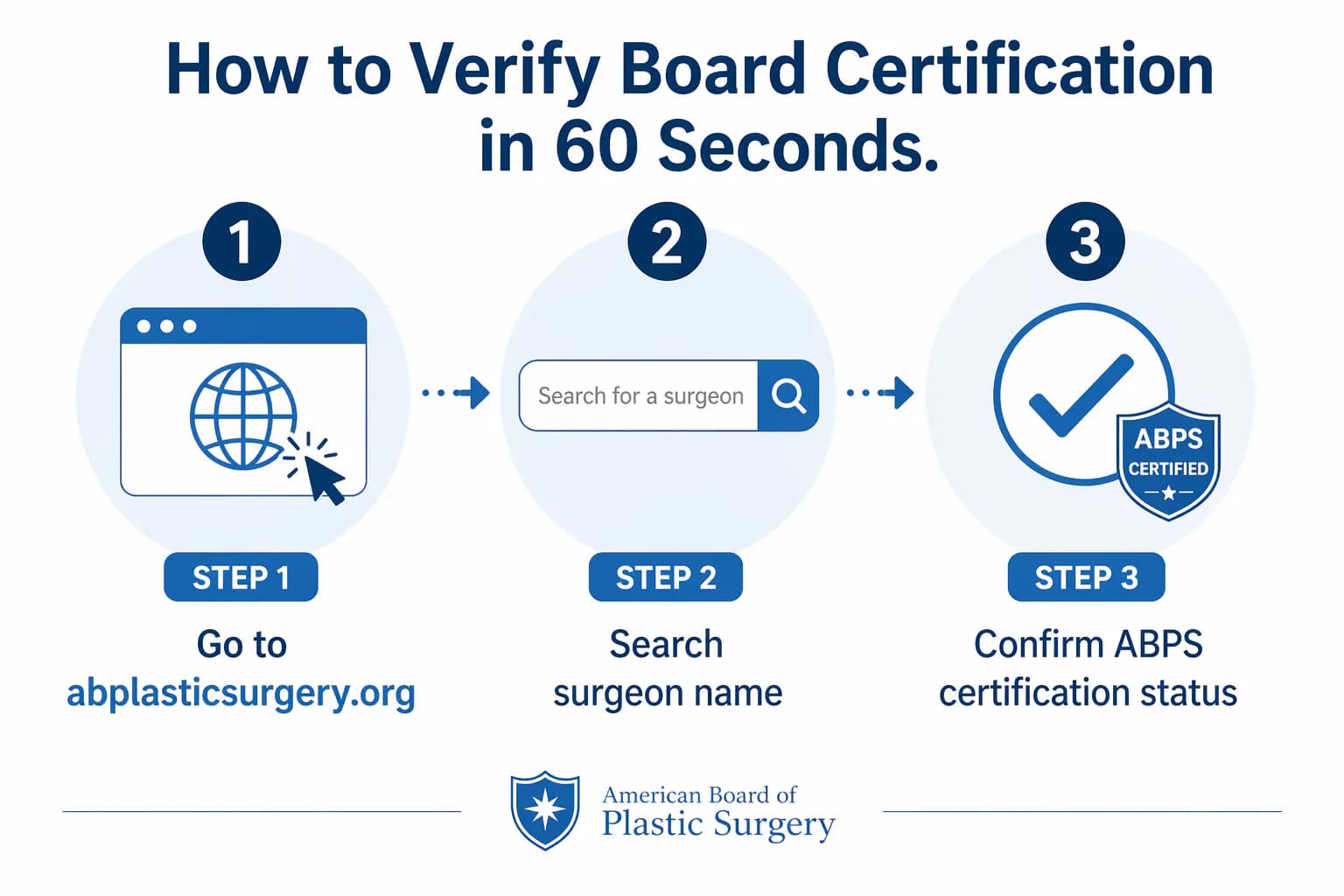
ABPS certification can be verified directly at abplasticsurgery.org — search the surgeon's name and confirm their status. ASPS membership, which requires ABPS certification, can be verified at plasticsurgery.org. Do not rely on a surgeon's own website or marketing materials to confirm board certification status. Verify independently before booking a consultation.
What questions should I ask at a liposuction consultation?
Ask: Are you certified by the American Board of Plastic Surgery? Where will the procedure be performed and what is the facility's accreditation? Who administers anesthesia and what are their credentials? How many liposuction procedures do you perform per year? Do you have hospital privileges? Can you show me before-and-after photos of patients with my anatomy? What is fully included in the quoted price? What is your revision policy? What are the specific risks for my anatomy and goals?
What are red flags when choosing a plastic surgeon?
Red flags: pressure to book the same day; time-limited discount offers; pricing presented as a single bundled number; evasiveness about board certification or facility accreditation; inability to show before-and-after photos matching your anatomy; guaranteeing specific outcomes; defensiveness or annoyance when you ask detailed questions; and no clear post-operative care plan.
What does "board certified" mean for a plastic surgeon?
"Board certified" is not a protected term — different certifying bodies have vastly different requirements. For liposuction, the credential that matters is ABPS certification (6+ years training, ABMS-recognized). The American Board of Cosmetic Surgery also uses the phrase "board certified" but requires only one year of training and is not ABMS-recognized. The California Medical Board has ruled that ABCS diplomates cannot legally advertise as "board certified." Always ask specifically: "Are you certified by the American Board of Plastic Surgery?"
How many liposuction procedures should a surgeon perform per year?
There is no single published minimum, but volume is a meaningful proxy for experience. Ask directly how many liposuction cases the surgeon performs annually. A surgeon who does liposuction as a primary focus performs differently than one who does it occasionally alongside other procedures. For specialized techniques like VASER Hi-Def or lipo combined with BBL, higher volume is particularly important.
What facility should liposuction be performed in?
Liposuction should be performed in a facility accredited by AAAASF, AAAHC, or The Joint Commission. Accredited ambulatory facilities have a serious complication rate below 0.5% and a mortality rate below 1 in 57,000. Large-volume liposuction (more than 5,000 cc of fat removed) should be performed in a hospital or equivalently accredited facility. Verify facility accreditation at aaahc.org or aaaasf.org before your procedure.
How do I find a good liposuction surgeon near me?
Search for ABPS-certified plastic surgeons in your city using the ASPS finder at plasticsurgery.org or the lipo.com directory, which lists board-certified surgeons organized by city and procedure specialization. Verify board certification independently at abplasticsurgery.org, research the proposed facility's accreditation, and schedule consultations with at least two surgeons before making a decision.
Internal links:
- How Much Does Liposuction Cost?
- VASER Liposuction: The Complete Guide
- Laser Liposuction Guide
- 360 Lipo and BBL: The Complete Combo Guide
