A liposuction consultation should not feel like a sales appointment. It should answer three questions: are you a good candidate, is this surgeon qualified to treat your anatomy safely, and what exactly will the plan cost. ASPS and Cleveland Clinic both describe a real consultation as a medical evaluation that includes history, exam, options, risks, and recovery discussion.
Most "questions to ask your surgeon" articles stop too early. The part patients actually need is this: which answers should make you leave. If a surgeon cannot name their board certification, pressures you to book the same day, or cannot explain the technique they would use and why it fits your treatment area, that is not confidence. That is a warning sign.
What to cover in your consultation
Ask about exact board certification, recent liposuction volume, facility accreditation, technique, realistic results, complication handling, after-hours coverage, revision policy, and the full all-in cost. ASPS patient-safety guidance specifically recommends asking whether you are a good candidate, where and how the procedure will be performed, how complications are handled, and what results are reasonable for you.
What a quality consultation looks like
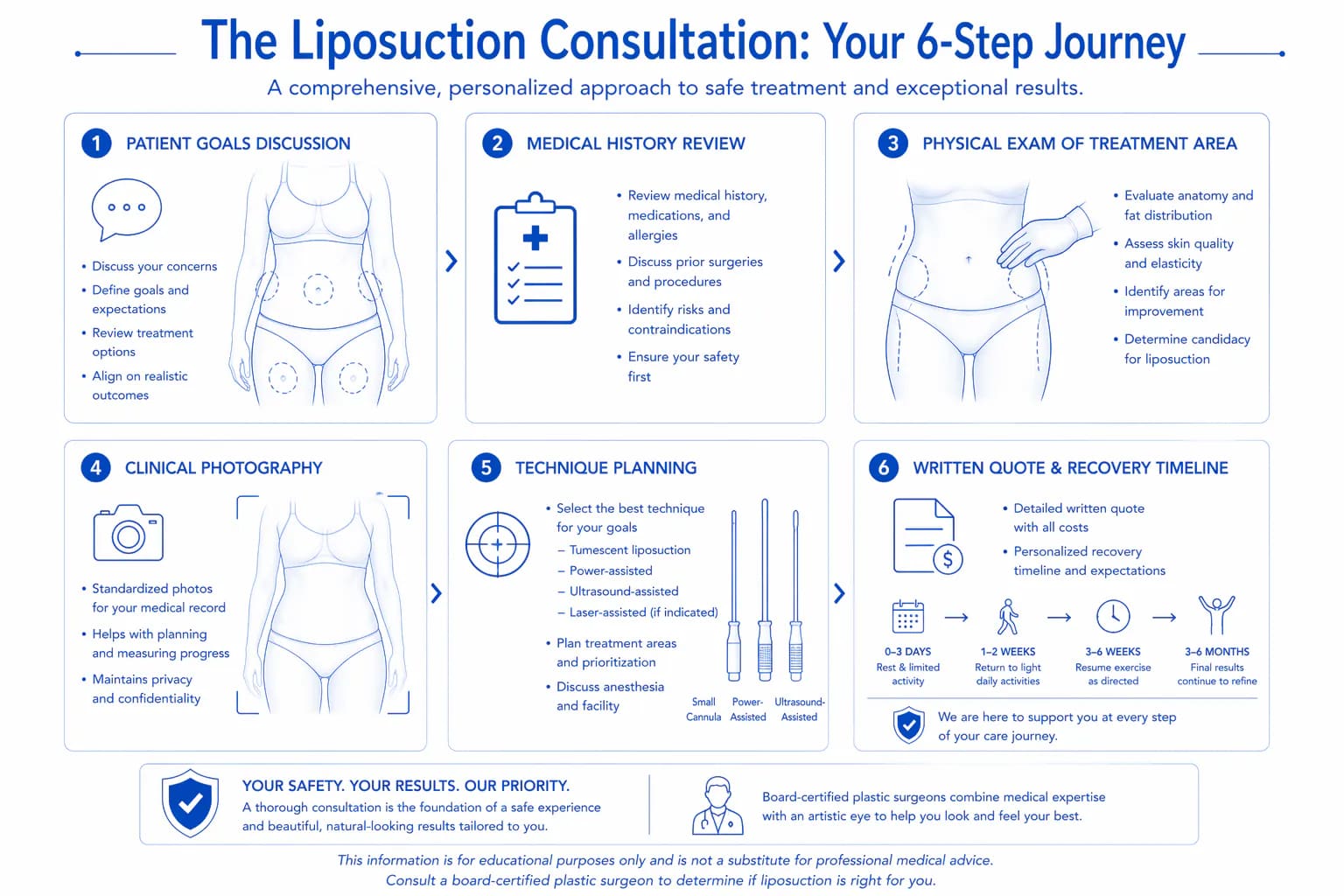
A good liposuction consultation is structured. The surgeon should review your goals, medical history, current medications and supplements, previous surgeries, and risk factors. Then they should examine the area you want treated, assess skin quality and contour, discuss options, outline likely outcomes, review risks, and explain the recovery timeline. You should leave with a plan, not just a price.
| Consultation step | What should happen | What you should leave with |
|---|---|---|
| Goals discussion | You explain what bothers you and what result you want | A clear definition of success |
| Medical review | Surgeon reviews conditions, allergies, meds, supplements, smoking/vaping, prior surgery | A candid safety assessment |
| Physical exam | Surgeon evaluates fat distribution, skin elasticity, muscle tone, scars, and each treatment area | A realistic candidacy opinion |
| Surgical planning | Discussion of tumescent, power-assisted, VASER, or other liposculpture approach if relevant | A technique matched to your anatomy |
| Risk and recovery review | Compression garment plan, activity limits, follow-up, complication plan | A practical recovery timeline |
| Cost review | Written quote with surgeon, anesthesia, facility, garments, tests, and revision terms | A true all-in number |
A consultation should also answer whether liposuction is even the right tool. ASPS says ideal candidates are generally healthy nonsmokers within 30% of their ideal weight who have firm, elastic skin and specific body contouring goals. If you have significant loose skin, muscle laxity, or weight instability, lipo alone may not give you the result you want.
What the surgeon should ask you
A strong surgeon asks a lot of questions. ASPS says you should be prepared to discuss your goals, medical conditions, allergies, medications, vitamins, herbal supplements, alcohol, tobacco and drug use, and previous surgeries; the surgeon should then evaluate your overall health and risk factors before recommending treatment. If they skip that step, they are not assessing candidacy thoroughly enough.
That matters more than patients realize. A careful surgeon is not just deciding whether they can do liposuction. They are deciding whether they should do it, whether you need another procedure instead, and whether your recovery support, medication list, and risk profile make the plan reasonable.
What to bring
Bring four things: a short medical history summary, a current medication and supplement list, photo goals, and a written question list. ASPS consultation guidance centers the first two because your surgeon needs them to assess safety; the last two help you make the visit useful instead of emotional or rushed.
Photo goals help when they show shape, not fantasy. Bring images that communicate proportion or contour you like, then let the surgeon explain what is and is not realistic for your body type.
The 15 questions to ask your surgeon
1. What board are you certified with?
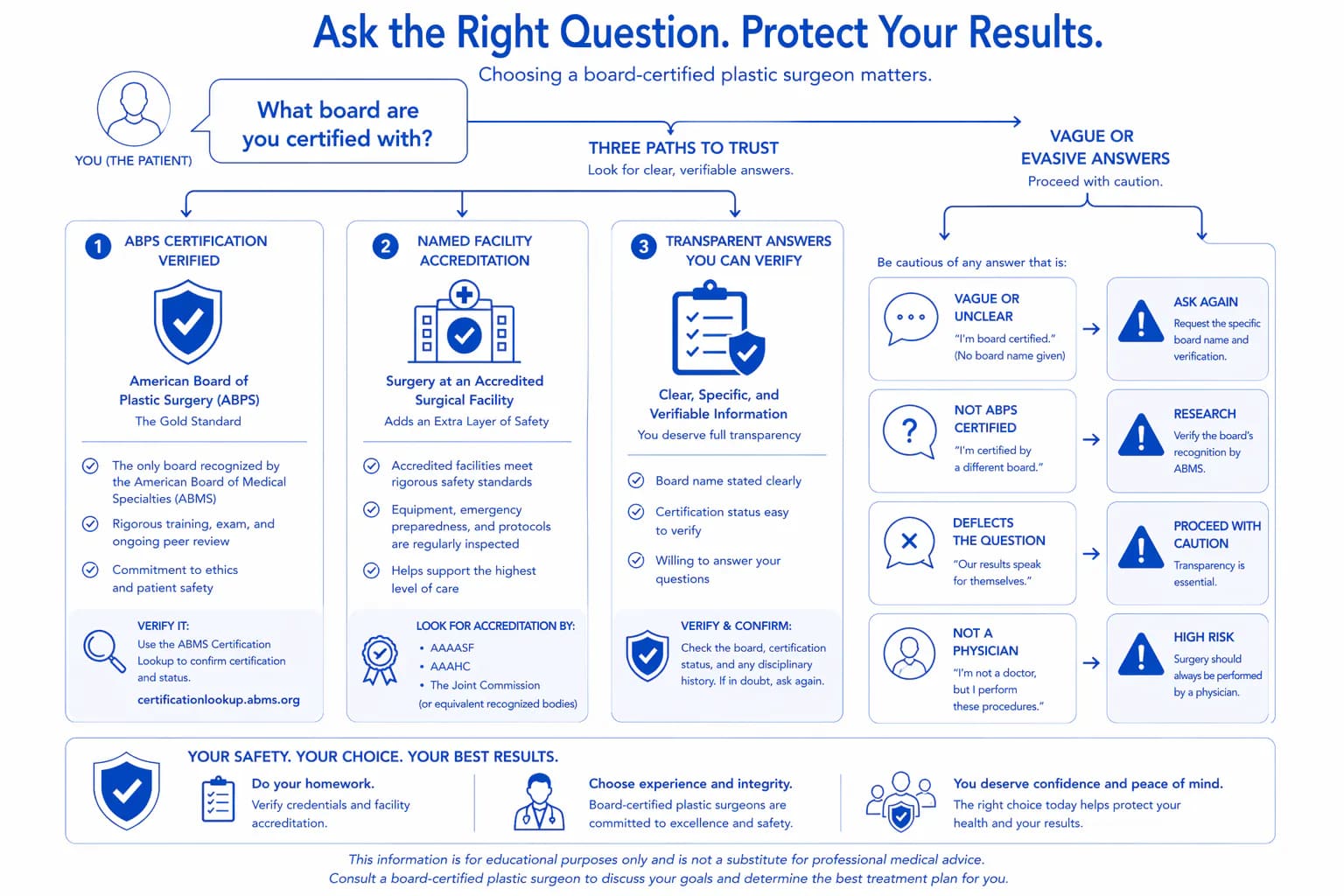
Do not stop at "board-certified." For plastic surgeons, ABPS is the American Board of Medical Specialties member board for plastic surgery; ABCS is a separate cosmetic surgery certifying board. Those are not interchangeable credentials, and a good surgeon should name the board clearly and tell you how to verify it.
2. How many liposuction procedures do you perform per year?
You want recent, procedure-specific experience. Ask how often the surgeon performs liposuction in the exact area you want treated, whether that is abdomen, flanks, arms, thighs, or submental contouring under the chin. ASPS consultation advice emphasizes how often the surgeon performs the procedure, not just how long they have been in practice.
3. What facility will this be performed in, and is it accredited?
A safe answer names the exact location and its status: hospital, licensed ambulatory surgery center, or accredited office-based facility. ASPS says liposuction should be performed in an accredited office-based surgical facility, licensed ambulatory surgical center, or hospital; common accrediting bodies include Joint Commission, AAAHC, and QUAD A.
4. Which technique will you use for my anatomy and why?
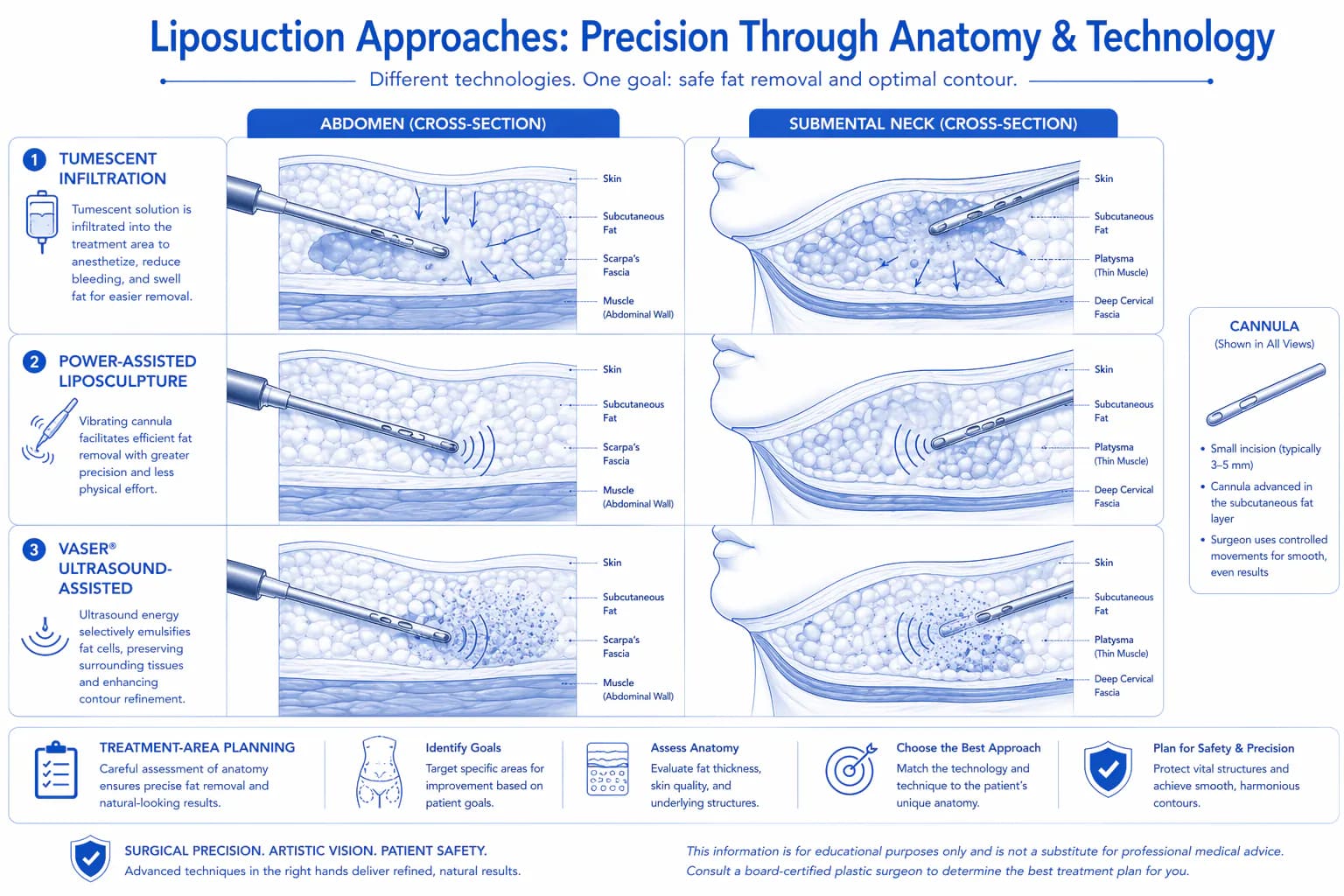
A real answer is individualized. The surgeon should explain whether a standard tumescent approach, power-assisted liposuction, VASER, or another method gives the right balance of body contouring and surgical precision for your tissue quality, skin recoil, and treatment area, and how the cannula choice affects the plan. A vague "this is what we always do" answer is weak.
5. How much fat do you expect to remove?
You want a range, not a promise. QUAD A notes that total aspirate means the combined fat and fluid removed, and that large-volume liposuction over 5,000 cc total aspirate should be done in an acute-care hospital or appropriately accredited or licensed facility with staff experienced in that level of care.
6. What complications have you personally encountered, and how did you handle them?
Honest surgeons can answer this calmly. In a 2024 systematic review covering 29,368 patients, the overall complication rate was 2.62%, with contour deformity the most common issue at 2.35%; telling you complications never happen is not credible. A better answer explains what they have seen, how they responded, and what follow-up system they use.
7. What results can I realistically expect for my body type?
Liposuction reshapes. It does not replace weight loss, tighten major skin laxity, or create an entirely different body. ASPS describes ideal candidates as generally healthy nonsmokers with firm, elastic skin and body contouring goals, which is exactly why the best surgeons speak in terms of improvement, not perfection.
8. Will I need a compression garment, and for how long?
Usually, yes. ASPS says compression garments are part of standard liposuction recovery to reduce swelling and support healing, and it specifically advises patients to ask how long they will need to wear them. A solid consultation gives you a real recovery timeline, not "we'll decide later."
9. What is your revision policy if I'm unhappy with the result?
Ask this before you book, not after you need it. A useful answer explains how long swelling must settle before final judgment, what counts as a revision, and whether you would owe only facility and anesthesia fees or also a new surgeon fee. ASPS patient-safety guidance explicitly includes asking what your options are if you are dissatisfied with the outcome.
10. What should I stop taking before surgery?
This should come up early. ASPS says patients may need medication adjustments, smoking cessation, and avoidance of aspirin, anti-inflammatory drugs, and herbal supplements that can increase bleeding. If the surgeon has not asked about medications, vitamins, smoking, or vaping, the consultation is incomplete.
11. What happens if I have a complication after hours?
Ask who answers nights and weekends, what number you call, when you go to the ER, and whether the surgeon has hospital privileges or a transfer plan. This is one of the fastest ways to separate a real surgical practice from a marketing-heavy practice.
12. Can I see before-and-after results for patients similar to my anatomy?
Similar means similar body type, skin quality, and treatment area. ASPS recommends before-and-after photos as part of consultation decision-making, and its consultation guidance notes that not having them available is a red flag. Look for standardized lighting, positions, and timing, not social-media glamour shots.
13. Am I a better candidate for liposuction or should I consider a different procedure?
This is one of the most important questions in the room. ASPS consultation guidance includes discussing alternatives and whether you are a good candidate at all. If skin excess, muscle separation, or neck laxity are the real issue, lipo alone may underdeliver.
14. How many touch-up or revision sessions are included in the quoted price?
Do not assume anything is included. Ask whether minor contour refinements, extra garments, added follow-ups, or revision sessions are built into the quote or billed separately. This is also a good place to ask whether post-op scar care or recovery support costs extra.
15. What is the full all-in cost, including facility and anesthesia?
ASPS lists the average liposuction surgeon's fee at $4,711, but that number excludes anesthesia, operating room or facility fees, garments, prescriptions, and tests. Ask for an itemized written quote that includes every likely charge. If cost is your main concern, review liposuction financing options before you decide.
Red flags to watch for
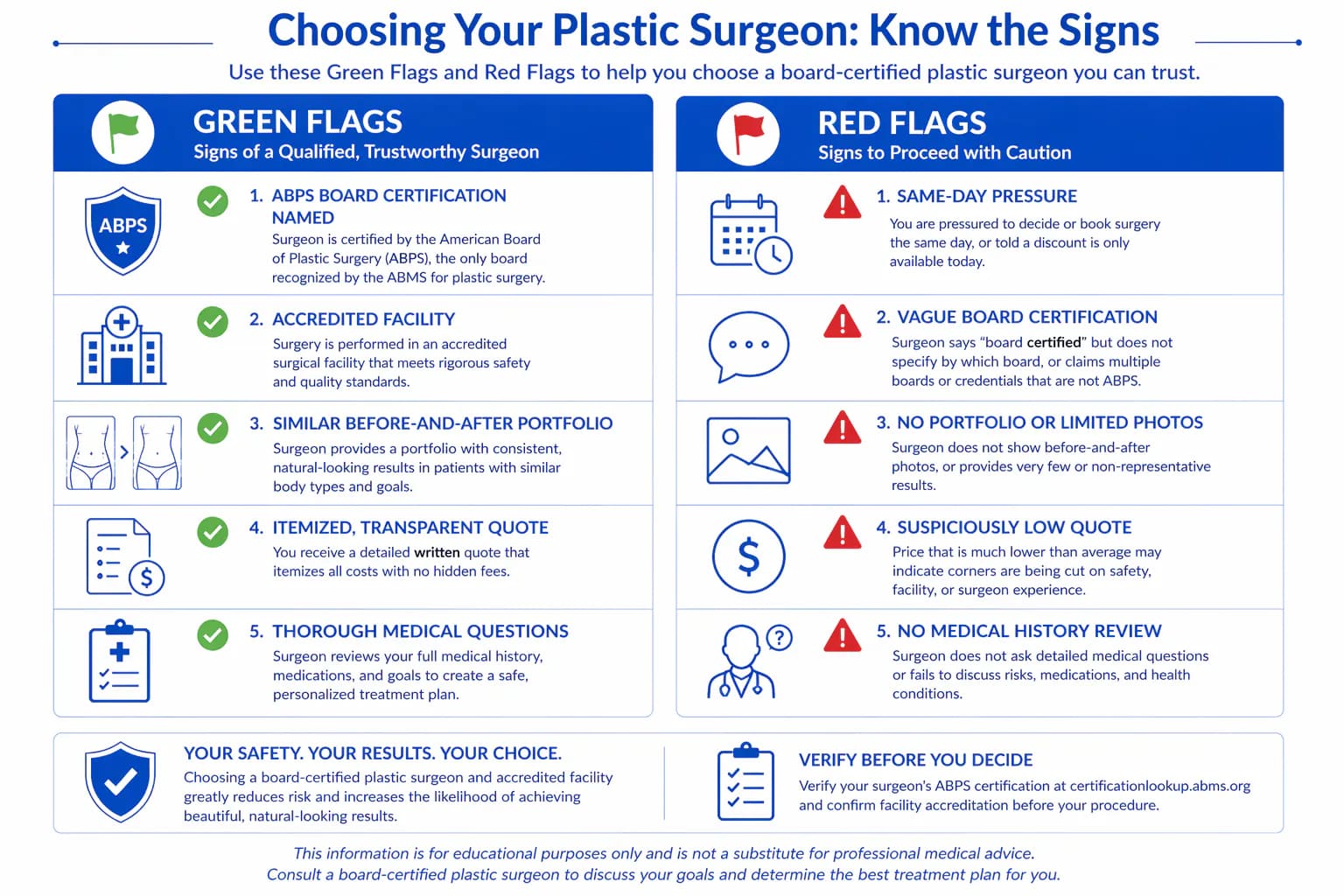
These are the red flags that matter most:
- The surgeon says "board-certified" but will not name the board or show you how to verify it. For plastic surgery, ABPS verification is straightforward.
- You feel pushed to book the same day, especially if the "best price" disappears immediately. The Aesthetic Society warns that impulse buys are never wise and that too-good-to-be-true deals may sacrifice quality or safety; Royal College guidance is even more direct: if you feel pressure, go somewhere else.
- The surgeon cannot explain which technique they would use and why it fits your anatomy. "We do VASER on everyone" is not individualized planning.
- There is no before-and-after portfolio for patients similar to you. ASPS consultation guidance treats missing photos as a red flag.
- The quote is dramatically below comparable surgeons and not itemized. Hidden facility or anesthesia charges often surface later, and bargain shopping is a poor safety strategy.
- The surgeon does not ask you about medications, smoking, prior surgery, or medical conditions. ASPS specifically says those questions belong in consultation.
How to evaluate the surgeon's answers
Listen for specificity. Strong surgeons answer with details about your anatomy, your treatment area, and your recovery timeline. Weak surgeons answer with brand names, slogans, or urgency.
| Topic | Reassuring answer | Leave-the-consult answer |
|---|---|---|
| Credentials | "I'm ABPS-certified. Here's how to verify it." | "I'm board-certified" with no board named |
| Technique | "Because your tissue is fibrous and your skin recoil is good, I'd use…" | "We use the same method on everyone" |
| Candidacy | "Lipo will help contour, but loose skin will remain" | "We'll make you skinny" |
| Safety | Names facility, accreditation, and after-hours plan | Vague on where surgery happens |
| Cost | Itemized quote and revision terms in writing | Discount ends today |
Those standards line up with current ASPS patient-safety checklists, accredited-facility guidance, and cost guidance. For a deeper surgeon-vetting framework, read how to choose a liposuction surgeon. For a fuller breakdown of complication rates, read liposuction risks and safety.
How many consultations you need
For most patients, two to three consultations is a reasonable target. One may be enough for a very straightforward case with an obviously qualified surgeon and a clear, individualized plan. More than three can help for revision liposuction, multiple areas, or conflicting recommendations, but too many opinions can create analysis paralysis.
After each visit, compare the same points: exact board certification, facility accreditation, technique choice, realistic limits, similar before-and-after photos, after-hours complication coverage, itemized cost, and whether you felt heard. The right surgeon is not always the cheapest or the friendliest. The right surgeon is the one whose plan makes the most medical sense and who communicates it without pressure.
Ask about board certification, experience, facility accreditation, technique, realistic outcome, complication handling, after-hours care, revision policy, and full all-in cost. ASPS also recommends asking whether you are a good candidate and what results are reasonable for you.
Two to three consultations is usually enough for most patients. That gives you a basis for comparing qualifications, treatment plans, and pricing without getting buried in too many conflicting opinions.
It should include your goals, a medical and medication review, a physical exam, discussion of risks and likely outcomes, and a recovery and cost discussion. You should leave with a plan, not just a date on the calendar.
The right surgeon can name their certification clearly, explain why a certain technique fits your anatomy, show similar before-and-after cases, and give realistic limits. You should feel informed and respected, not sold.
A good surgeon asks about medical conditions, allergies, medications, vitamins, supplements, tobacco use, previous surgeries, and your goals. If they do not assess candidacy carefully, they are not doing a real consultation.
Sometimes. Many practices offer free consultations, while paid consults commonly run around $100 to $200 and may be credited toward surgery; broader cosmetic surgery consultation ranges often fall around $75 to $250 depending on the market and surgeon.
Bring your medication and supplement list, a short medical history, details of prior surgeries, goal photos, and your questions. The more organized you are, the easier it is to judge the surgeon's answers later.
Major red flags include same-day booking pressure, vague board certification, no before-and-after portfolio, a suspiciously low non-itemized quote, and a surgeon who does not ask about your medical history. If they cannot explain technique choice for your anatomy, leave.
