Most people researching liposuction spend weeks studying before-and-after photos and cost estimates. Far fewer research what happens between the operating table and those final photos.
The recovery period is where expectations are set or shattered. Patients who understand what's coming — the week-two swelling spike, the fibrosis lumps, the months-long wait for final results — tend to have far better experiences than those who don't.
This guide covers the actual recovery experience week by week, the compression garment schedule, when you can return to exercise, what's normal versus concerning, and why the "I look worse at week two" phenomenon is not a sign that something went wrong.
Two Recovery Timelines You Need to Understand
Liposuction has two distinct recovery arcs, and conflating them is the most common source of post-op anxiety:
Functional recovery: How long before you feel normal and can return to daily life. This is typically 2 to 6 weeks.
Aesthetic recovery: How long before you see final results. This is 3 to 6 months — sometimes longer for lower-body procedures.
Most patients are surprised to learn that the shape they see at week two is not their result. It is not even close to their result. The body's healing response involves significant swelling, fluid redistribution, and a process called fibrosis — internal scar tissue formation that feels lumpy and looks uneven before it softens. All of this resolves over months. What you see at week two is an early draft.
Day-by-Day: The First 48 Hours
In recovery: You will wake from surgery in a compression garment, which you'll wear home. Fluid may continue draining from the small incision sites for the first day or two — this is expected and intentional (surgeons often leave access points slightly open to allow drainage).
Pain level: Most patients describe it as severe muscle soreness — not sharp surgical pain. Prescription pain medication is typically provided for the first few days.
Activity: Walking is encouraged immediately. Short, gentle walks prevent blood clots in the legs — this is particularly important for lower body and abdominal procedures. Walking does not need to be strenuous; a few laps around the house every hour is sufficient.
Drainage: Incision sites may leak reddish tumescent fluid. This is the saline infiltrated during surgery. Lay a towel under you when resting. Drainage typically stops within 24 to 48 hours.
Sleeping: Many patients are most comfortable sleeping in a recliner or with pillows elevating the treated area. Lying flat with pillows under the knees (for abdominal lipo) or under the thighs (for flank/back work) reduces pressure on treated areas.
Week 1: Swelling Peaks — This Is the Hardest Week
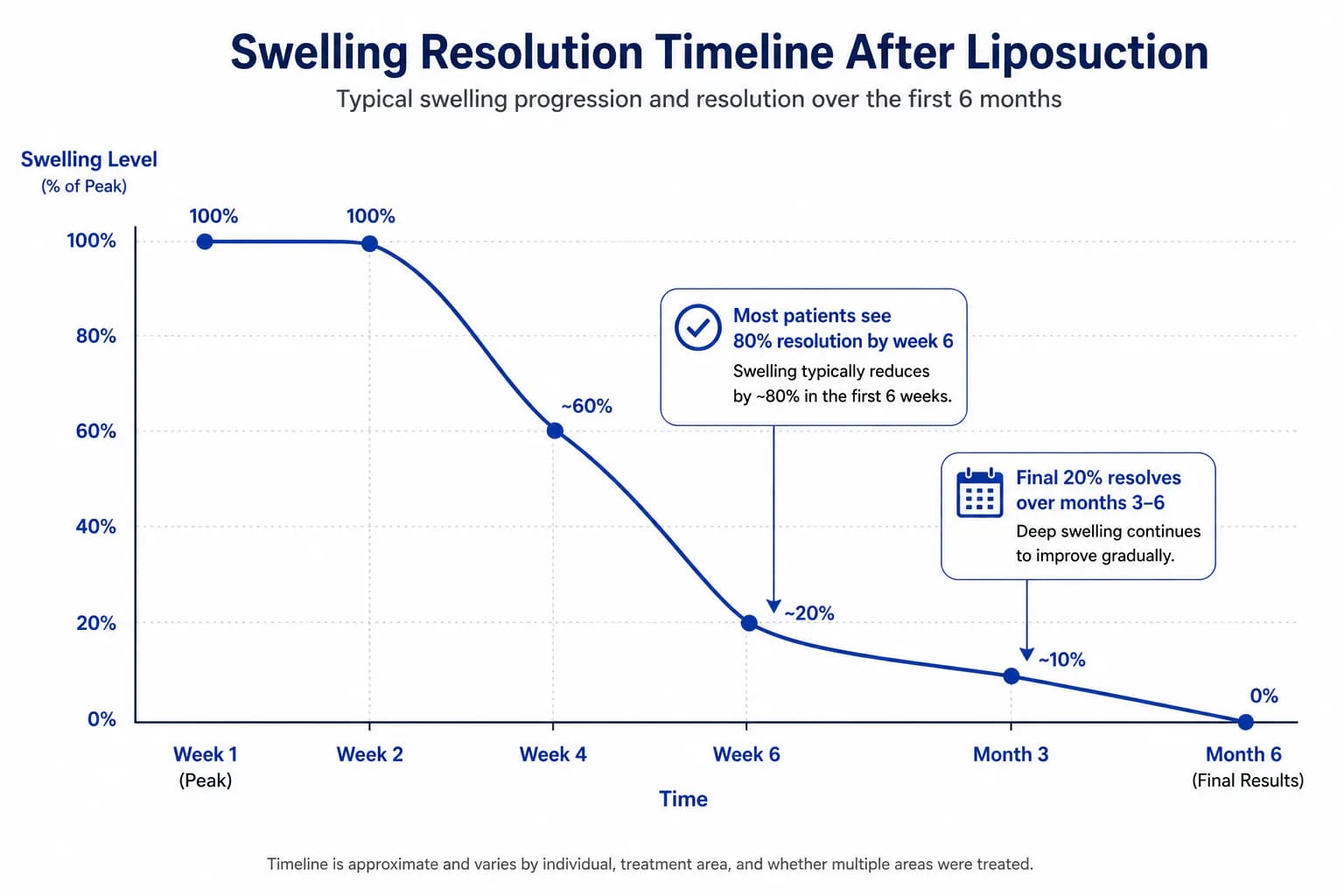
The first week is the hardest. Swelling peaks between days 3 and 5, and many patients look larger in the treated area than they did before surgery. This is normal, expected, and temporary. For detailed strategies to manage it, see our swelling management guide.
What's happening inside: The body is mounting an inflammatory response to the tissue disruption. Fluid accumulates in the spaces where fat was removed. Bruising develops as blood disperses under the skin. Treated areas feel firm, tight, and sometimes hot to the touch.
Pain: Gradually decreasing throughout the week. Most patients find they no longer need prescription medication by day 3 to 5 and transition to ibuprofen or acetaminophen.
Numbness: Areas of numbness or altered sensation are common — the procedure disrupts superficial nerves, which regenerate over weeks to months. Tingling, burning, or pins-and-needles are normal parts of nerve healing.
Compression garment: Worn 24 hours per day. Remove only to shower, then reapply immediately. The garment applies even pressure to help push fluid out, supports the skin as it contracts, and reduces discomfort.
Activity: Short walks, light household tasks. No lifting more than 5 to 10 lbs. No bending repeatedly at the waist for abdominal procedures.
Return to desk work: Many patients with sedentary jobs return at the end of week one or early in week two. Physical or active jobs typically require 2 to 3 weeks.
Weeks 2–3: Swelling Starts Declining — But You Still Don't See Results
By week two, most of the acute pain is gone. Swelling begins declining, though it remains significant. Most patients now look about the same as they did before surgery — not better, not noticeably worse. This is the "patience phase."
The week-2 phenomenon: Many patients experience a low point around week two when they expect to look better but still see significant swelling and bruising. Some patients convince themselves the surgery failed. This is an extremely common experience. It is caused by the resolution of very early post-op swelling being replaced by deeper, longer-lasting swelling. The shape at week two is not the result.
Fibrosis: From weeks 2 to 4, you may notice firm lumps or uneven texture under the skin of treated areas. This is fibrosis — internal scar tissue that forms as the body heals. It is normal. It softens over months and does not indicate a problem.
Lymphatic massage: Many surgeons recommend manual lymphatic drainage (MLD) massage starting around week 2, performed by a trained lymphatic therapist. This technique moves fluid through the lymphatic system, reducing swelling and softening fibrosis. It is not medically required but can accelerate recovery. Sessions typically cost $75 to $150 each.
Activity: Continue walking. Limit bending, lifting, and any activity that strains treated areas. Light grocery shopping and gentle errands are usually fine. Driving is typically permitted when you're off prescription pain medication.
Compression garment: Still 24 hours per day through week 3 for most protocols.
Weeks 4–6: Starting to See Real Change
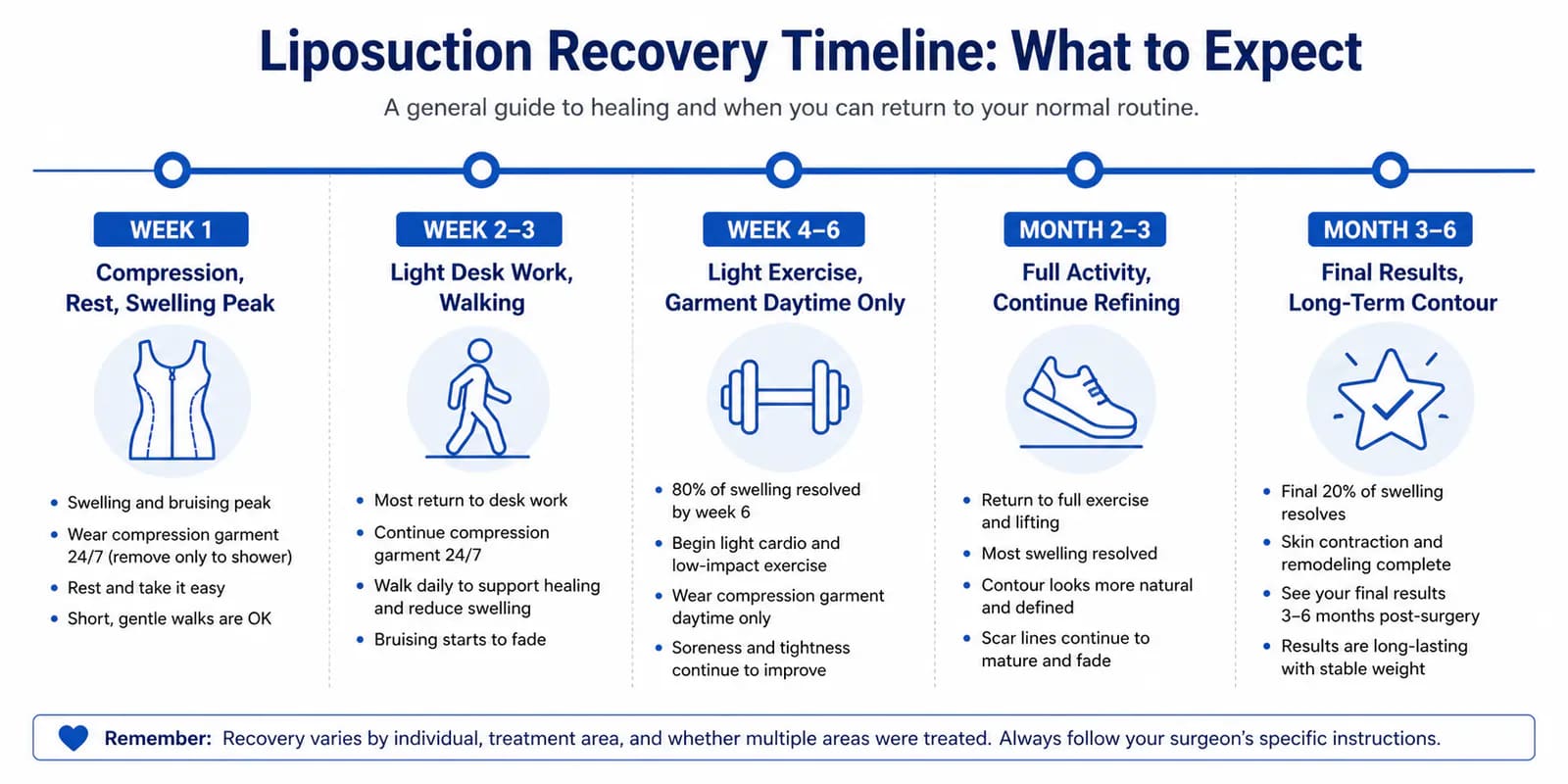
By week 4, the improvement becomes visible and consistent. Swelling continues declining daily. The treated areas begin to show the shape underneath the healing tissue. Clothes start fitting differently.
The 80/20 rule: By weeks 6 to 8, approximately 80% of your swelling has resolved. What you see in the mirror is a reasonable preview of your final result — though still not quite there.
Fibrosis: Continues softening. Gentle massage, time, and lymphatic therapy all accelerate this process. Most fibrotic lumps are substantially softer by month 3.
Compression garment: Transition to 12 to 18 hours per day (wearing during the day and removing at night) through weeks 4 to 6, per your surgeon's protocol.
Exercise: Low-impact cardio — walking, swimming, elliptical — is typically cleared at weeks 3 to 4. Start at reduced intensity and build back up gradually.
Sensation: Numbness and altered sensation continue resolving. Some areas may still feel numb at 6 weeks, particularly in areas where more fat was removed. This is normal.
Months 2–3: Most Patients Feel Back to Normal
By month 2, daily life feels normal. Most people at this stage feel like themselves again, are exercising regularly, and are seeing consistent improvement in their treated areas.
Exercise: Full exercise including strength training and high-impact cardio is typically permitted at week 6 post-op with surgeon clearance.
Skin: The skin continues contracting and conforming to the new contour. The final tightness of the skin isn't determined until month 3 to 6.
Compression garment: Most patients have tapered off or stopped wearing the compression garment by month 2.
Months 3–6: Final Results
This is when the true result becomes visible. Residual swelling resolves, fibrosis completes its softening process, and skin fully remodels around the new contour.
The last 20%: The final 20% of swelling resolves slowly and unevenly. Some days the treated area looks more swollen than others — particularly after salty meals, air travel, or alcohol, all of which cause temporary fluid retention. This day-to-day variation is normal and does not mean results have changed.
For lower-body procedures: Inner thigh, outer thigh, calf, and ankle liposuction takes longer due to gravity pulling fluid downward. Final results for these areas may not be complete until month 9 to 12.
Weight stability: Maintaining stable weight from month 3 onward preserves results long-term. The fat cells removed are gone permanently. Weight gain causes remaining fat cells to enlarge, which can partially soften the result. To understand whether your body is ready for the procedure, review our candidacy guide.
Compression Garment Schedule at a Glance
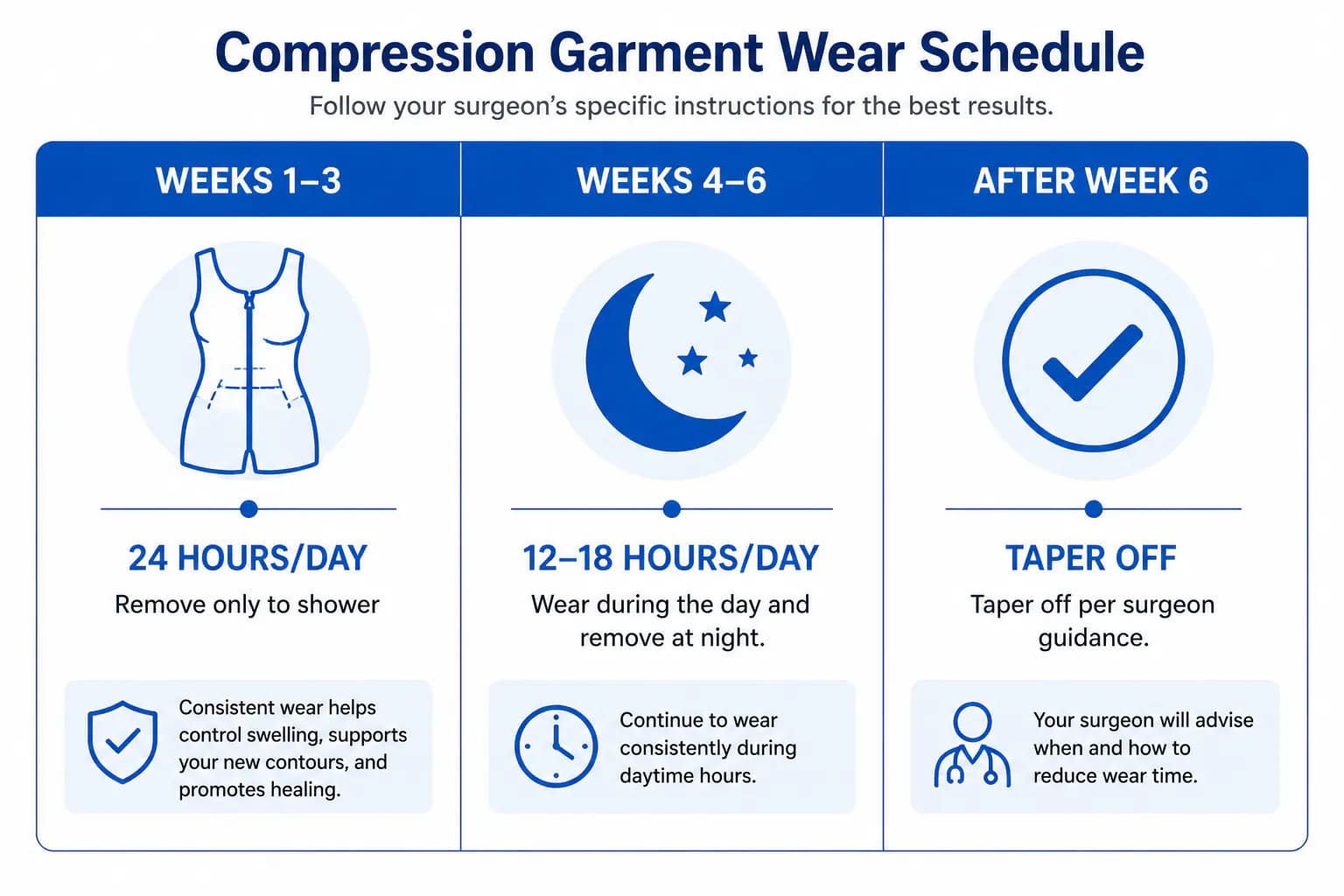
| Phase | Duration | Wear Time |
|---|---|---|
| Weeks 1–3 | First 3 weeks post-op | 24 hours/day (shower only break) |
| Weeks 4–6 | Transition phase | 12–18 hours/day |
| Week 6+ | Taper | Per surgeon guidance |
Different surgeons have different protocols — follow your surgeon's specific instructions, not a generic schedule. Larger procedures and lower-body treatment typically require longer compression periods.
Exercise Return Schedule
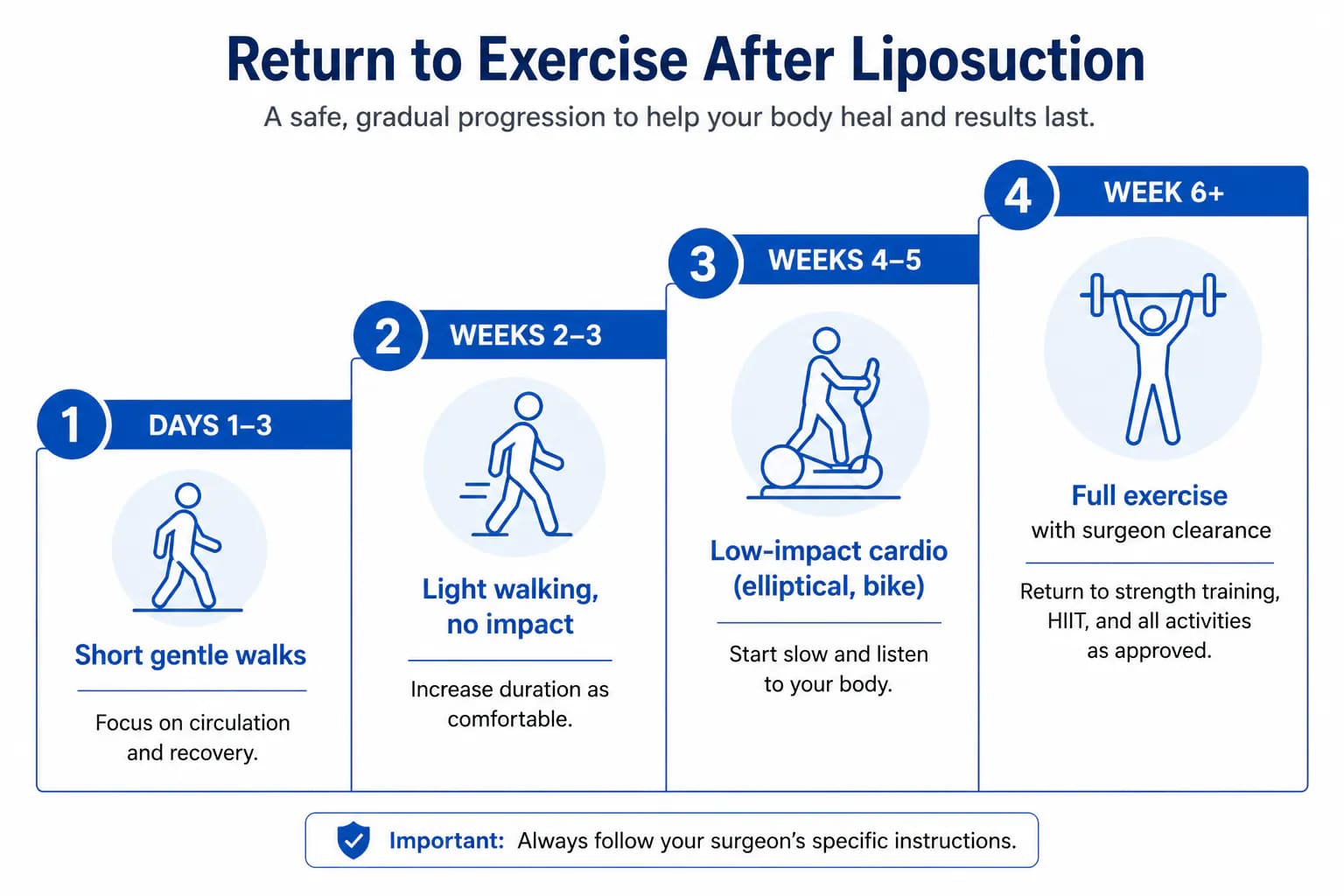
| Timeline | Permitted Activity |
|---|---|
| Days 1–3 | Short, gentle walks (required) |
| Week 1–2 | Longer walks, light household activity |
| Weeks 3–4 | Low-impact cardio (swimming, elliptical, walking) |
| Weeks 4–5 | Light resistance training at reduced intensity |
| Week 6+ | Full exercise with surgeon clearance |
Never return to exercise before your surgeon clears you. Early exercise increases swelling, risks seroma formation, and can disrupt the healing tissue in ways that affect final results. For a detailed exercise timeline, see our returning to exercise guide.
What Body Area You Treated Affects Your Timeline
Recovery is not uniform across body areas:
Abdomen and flanks: Moderate swelling duration. Most functional recovery in 2 to 3 weeks, final results at 3 to 6 months.
Inner and outer thighs: Slower swelling resolution due to gravity. Expect the compression garment phase to feel longer, and final results to take 6 to 9 months in some cases.
Arms: Upper arm swelling is noticeable and drains more quickly than lower body. Many patients see early results at 4 to 6 weeks.
Chin and neck: Among the fastest-recovering areas. Many patients see significant improvement within 2 to 3 weeks, with final results at 3 months.
Back and bra rolls: Moderate recovery, results typically clear by 3 to 4 months.
What's Normal vs. When to Call Your Surgeon
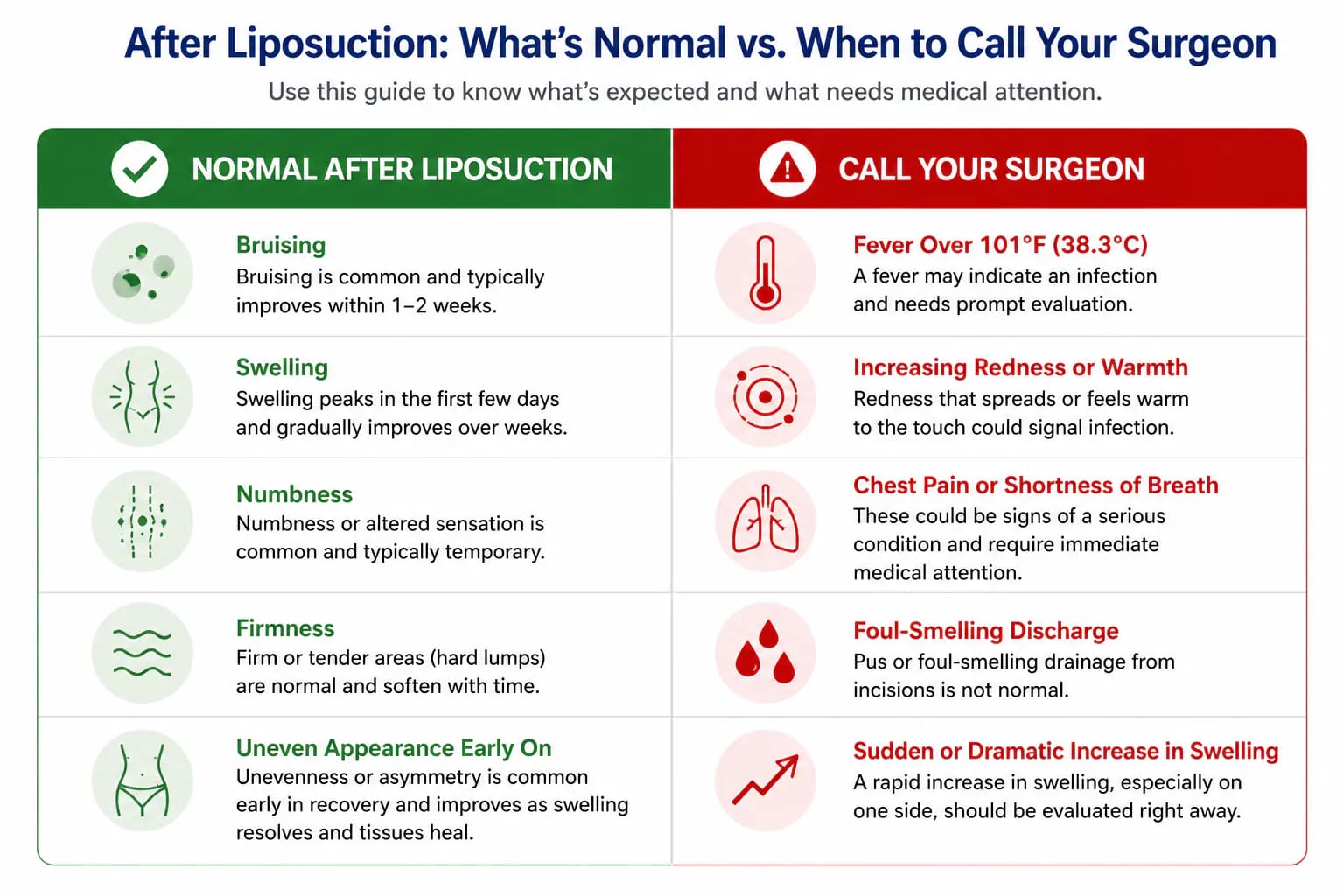
Normal — expect these:
- Bruising (resolves in 2 to 4 weeks)
- Swelling, including looking larger than pre-surgery in week 1 to 2
- Numbness, tingling, or burning sensations in treated areas
- Firm lumps or uneven texture under the skin (fibrosis)
- Temporary wavy or rippled appearance that smooths as healing progresses
- Day-to-day variation in swelling throughout the recovery period
- Feeling tired and emotional in the first 1 to 2 weeks
Contact your surgeon promptly for:
- Fever above 101°F (38.3°C)
- Increasing rather than decreasing redness or warmth at incision sites
- Foul-smelling discharge from incisions
- Sudden dramatic increase in swelling in a localized area (may indicate seroma)
- Severe pain that is worsening, not improving
Seek emergency care immediately for:
- Chest pain, shortness of breath, or coughing up blood (signs of pulmonary embolism)
- Leg pain, redness, and warmth with swelling in a limb (signs of deep vein thrombosis)
- Loss of consciousness, extreme confusion, or difficulty breathing
Blood clots are rare but serious. Walking from day one, staying hydrated, and avoiding long periods of immobility significantly reduce this risk.
Post-Op Care That Actually Helps
Sleep position: Elevate treated areas when possible. Abdominal lipo patients often benefit from sleeping with a pillow under the knees. Thigh patients can elevate legs slightly on pillows.
Hydration: Drink water regularly. Dehydration can worsen swelling and slow healing.
Nutrition: Avoid high-sodium foods for the first 4 to 6 weeks — sodium causes fluid retention and temporarily worsens swelling. Adequate protein (0.8 to 1g per pound of goal body weight) supports tissue healing.
Alcohol: Avoid for the first 2 to 4 weeks. Alcohol causes vasodilation and fluid retention, increasing swelling.
Lymphatic massage: Typically recommended 1 to 3 times per week starting at week 2. A trained lymphatic therapist can significantly accelerate fluid clearance and fibrosis softening.
Arnica gel/tablets: Many surgeons recommend arnica montana supplements or topical gel to reduce bruising. Evidence is mixed but anecdotal experience suggests benefit. Start only after confirming no contraindications with your surgeon.
How long is liposuction recovery? Functional recovery — returning to light daily activities — takes 2 to 6 weeks. Aesthetic recovery — seeing final results — takes 3 to 6 months. These are two different timelines and both matter.
When will I see results? About 80% of swelling resolves by weeks 6 to 8. Final results are visible at 3 to 6 months. Lower-body procedures may take up to 9 to 12 months for complete resolution.
How long do I have to wear a compression garment? Typically 4 to 6 weeks total — 24 hours/day for the first 2 to 3 weeks, then 12 to 18 hours/day. Follow your surgeon's specific protocol.
When can I exercise? Walking from day 1. Low-impact cardio at weeks 3 to 4. Full exercise at week 6 with surgeon clearance. Never return to exercise before your surgeon clears you.
Is it normal to look worse at week 2? Yes. Swelling peaks around days 3 to 5 and can make treated areas look larger than before surgery. This is temporary. Most patients look noticeably improved over their pre-surgery state by weeks 3 to 4.
How much pain is there? Most patients describe it as severe muscle soreness — manageable with medication and significantly improved by day 3 to 5. Sharp pain is not typical; persistent aching and tightness is.
What are normal symptoms? Bruising, swelling, numbness, tingling, firmness, lumpiness (fibrosis), and temporary uneven texture are all normal parts of healing. They resolve over weeks to months.
When should I call my surgeon? For fever above 101°F, increasing incision site redness, foul-smelling discharge, sudden swelling increase, or worsening pain. Seek emergency care for chest pain, shortness of breath, or signs of blood clots.
Ready to consult with a board-certified liposuction surgeon? lipo.com's directory lets you search verified ABPS-certified specialists by body area, city, and procedure type.
