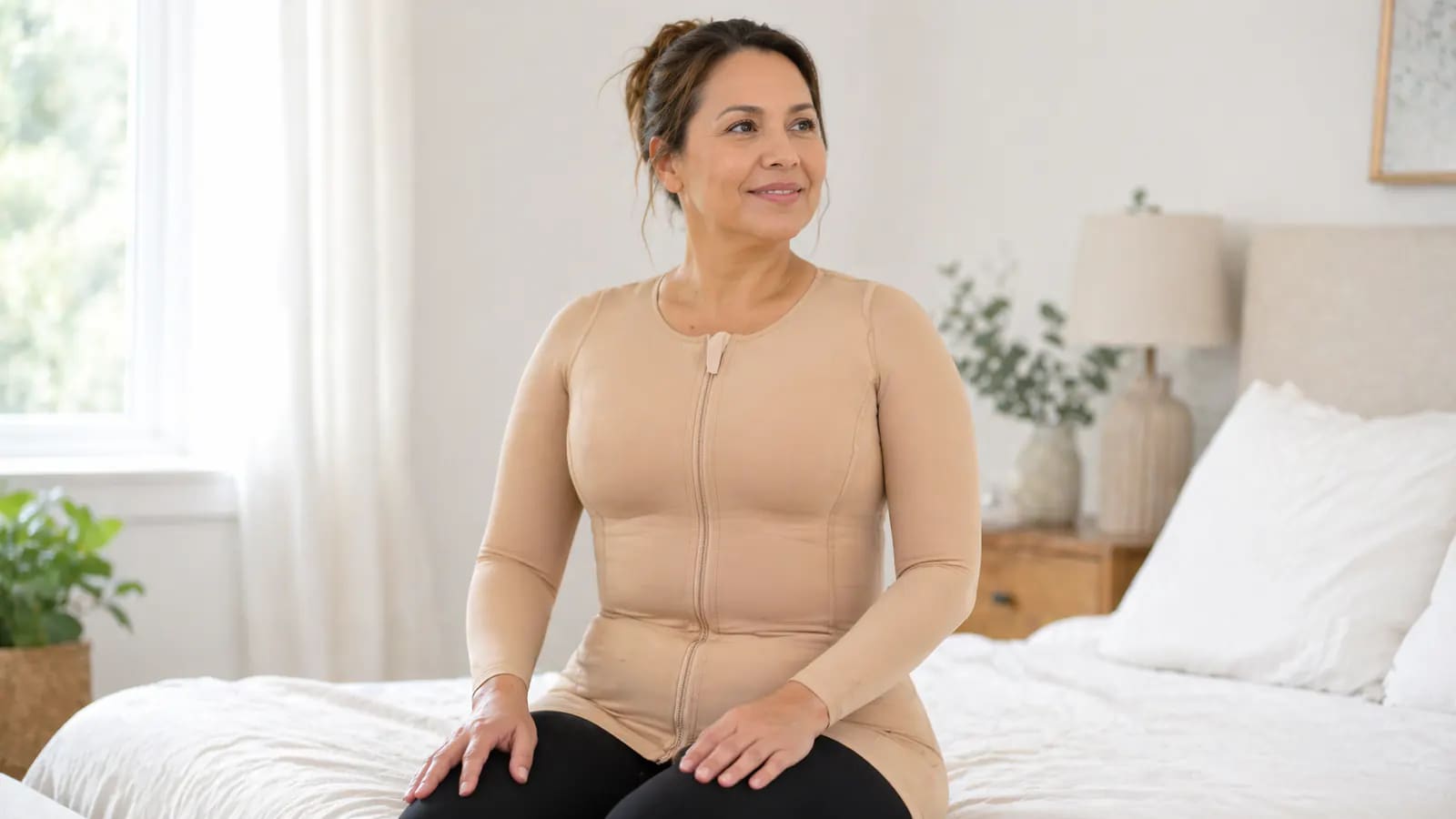
If you're reading this at 11pm wondering whether you can take your compression garment off, here's the short answer: probably not yet.
The general guideline from board-certified plastic surgeons:
- Stage 1 faja: 23 hours/day for the first 3–4 weeks
- Stage 2 faja: 12 hours/day from weeks 4 through 12
That's the baseline. Your surgeon may adjust the timeline based on how much fat was removed, which areas were treated, and how your recovery is progressing. But if you can't reach your surgeon and you're in the first six weeks — keep it on.
Here's the complete breakdown of what each stage means, why the timing matters, and what actually happens if you skip it.
What Is a Faja — and Why Do You Need It After Lipo?
A faja is a Colombian-style compression garment — historically shaped differently than standard post-surgical binders, with more contouring structure. In US plastic surgery, "faja" and "compression garment" are used interchangeably for the same purpose: to apply consistent pressure to the treated area during recovery.
After liposuction, the space where fat was removed doesn't immediately fill with tissue. There's a void — and fluid will rush in to fill it. That's normal. What compression does is manage that fluid, direct it toward the drainage pathways your surgeon created, and keep the skin pressed against the underlying tissue as it begins to heal.
Without that pressure, fluid pools. Skin heals away from the tissue instead of against it. The contour your surgeon worked for becomes harder to achieve.
There's also a skin-retraction element. The skin over a treated area needs to adapt to its new shape. Compression holds it there while that remodeling happens, rather than letting it settle loosely.
Stage 1 Faja: The First 3–4 Weeks
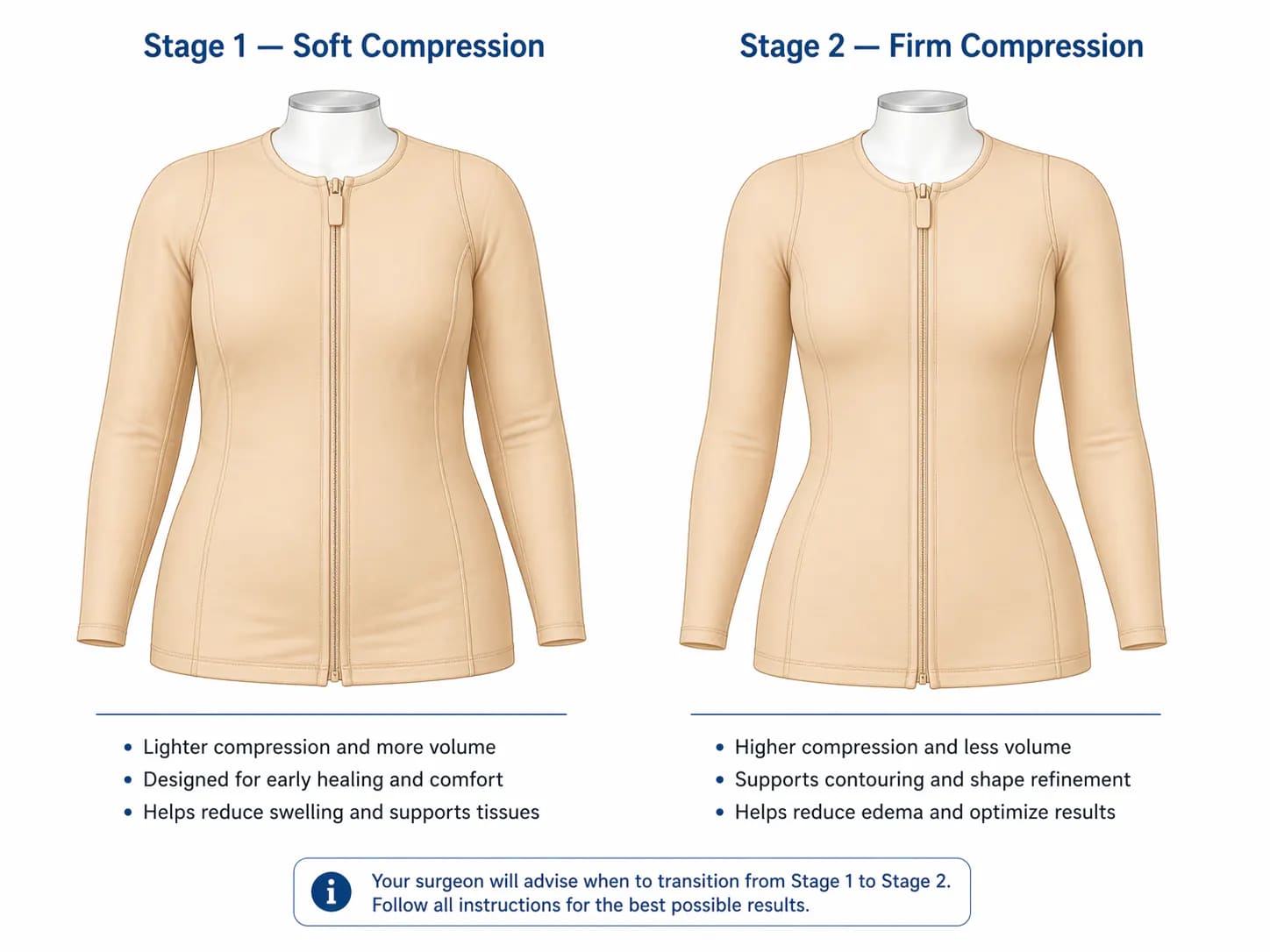
You'll leave the surgical facility wearing your Stage 1 faja. It goes on before you leave. Swelling management in these first weeks is also where lymphatic drainage massage after liposuction fits, if your surgeon recommends it.
Stage 1 garments are softer and more forgiving than what comes later — and intentionally so. In the first 72 hours, tumescent fluid (the saline solution used during the procedure) drains from your incision sites. A rigid, high-compression garment at this stage would interfere with drainage and potentially compress tissue that's still acutely inflamed.
Stage 1 fajas are designed to accommodate the initial swelling, protect the tissue, and keep enough pressure on the area to reduce fluid accumulation — without restricting circulation.
The schedule:
- Hours 1–14 post-surgery: Wear it without removal
- Days 2–7: 23 hours/day, removing only to shower
- Weeks 2–4: 23 hours/day, continuing until your surgeon clears transition
What it looks like: Stage 1 garments often have an open-crotch design for bathroom convenience, hook-and-eye or zipper closures, and softer boning than Stage 2. They're not meant to be tight — they should feel firm but not constricting.
Stage 2 Faja: Weeks 4 Through 12
Once the initial swelling has resolved enough — typically around weeks 3–4, though your surgeon will confirm — you transition to a Stage 2 faja.
Stage 2 garments are firmer, offer higher compression, and have a sleeker profile that fits under clothing. The job has changed: instead of protecting acutely inflamed tissue, the faja is now actively shaping. The skin is still adaptable; it hasn't fully set into its final position. Consistent compression during this window is what helps it conform cleanly to your new contour.
The schedule:
- Weeks 4–6: 20+ hours/day for most patients
- Weeks 7–12: 12 hours/day, typically daytime
Some surgeons extend Stage 2 wear beyond 12 weeks for large-volume procedures, or if the treated area continues to swell with activity. At that point, it's less about wound healing and more about managing residual edema as your body fully reabsorbs inflammation.
Full Timeline at a Glance
| Phase | Stage | Hours/Day | Primary Purpose |
|---|---|---|---|
| Days 1–3 | Stage 1 | 24 hours | Protect tissue, manage drainage |
| Weeks 1–4 | Stage 1 | 23 hours | Reduce swelling, support healing |
| Weeks 4–6 | Stage 2 | 20+ hours | Shape and contour as swelling resolves |
| Weeks 7–12 | Stage 2 | 12 hours | Maintain compression, reduce edema |
| Weeks 12+ | Stage 2 or none | Per surgeon | Residual swelling management |
Can You Sleep Without Your Faja?
For the first 4–6 weeks: no.
Swelling doesn't take a break when you sleep. Fluid continues to accumulate in the treated area overnight, and without compression, it distributes unevenly rather than draining. In the early weeks, a night without the garment is often visible the next morning — patients wake up noticeably puffier and firmer in the treated area. For the full recovery arc, see the complete week-by-week recovery timeline.
After week 6, most surgeons allow sleeping without the garment once daytime swelling has consistently resolved. The tissue has firmed up enough that overnight gaps are less consequential.
One missed night in the first six weeks is unlikely to affect your final result. A week of sleeping without it regularly during that window — particularly in weeks 2–4 — can extend your recovery and increase the risk of uneven swelling. It's the consistency over time that matters, not any single night.
How Tight Should a Faja Be?
Firm. Snug. But never painful.
A properly fitted faja should feel like consistent, even pressure — similar to firm athletic compression wear, but covering more area. You should be able to take a full breath without restriction. You should not feel sharp pressure at any specific point.
Signs it's too tight:
- Numbness or tingling in the treated area
- Skin turning white or developing purple patches at garment edges
- Difficulty taking a deep breath
- Pain (soreness is expected — pain is not)
Signs it's too loose:
- Visible swelling above or below the garment edges (fluid "escaping" around the compression)
- Puffiness that shifts when you change positions
- The garment moving or rolling during normal activity
If your Stage 1 faja feels dramatically looser after the first week, that's normal — it's the swelling resolving. This is exactly when you start thinking about Stage 2. If it feels impossibly tight at any point, contact your surgeon before adjusting it yourself.
What Happens If You Don't Wear Your Faja?
The consequences aren't hypothetical — they're well-documented, and they're proportional to how early and how long you skip it.
Seroma. The most common complication from skipping compression. A seroma is a pocket of fluid that accumulates where fat was removed. Small seromas resolve on their own. Larger ones require your surgeon to drain them with a needle — a simple but avoidable procedure if compression is worn consistently.
Prolonged swelling. Tissue that isn't compressed takes longer to resolve inflammation. Patients who are inconsistent with their faja routinely have swelling that extends months beyond what's typical.
Irregular contour. The skin over a treated area needs to adhere to the underlying tissue as it heals. Without compression holding it there, it can heal unevenly — leaving surface irregularities or a less defined contour than the procedure produced.
Hematoma risk. Less directly linked, but reduced circulation from inconsistent compression can contribute to bleeding complications in the early days post-surgery.
Skipping one night or taking the garment off briefly for hygiene doesn't cause these outcomes. Skipping days or weeks during the Stage 1 phase often does.
BBL and 360 Lipo: The Faja Is Different
If you had a Brazilian butt lift (BBL) or a 360 lipo procedure that included fat transfer to the buttocks, the garment design matters as much as the timeline.
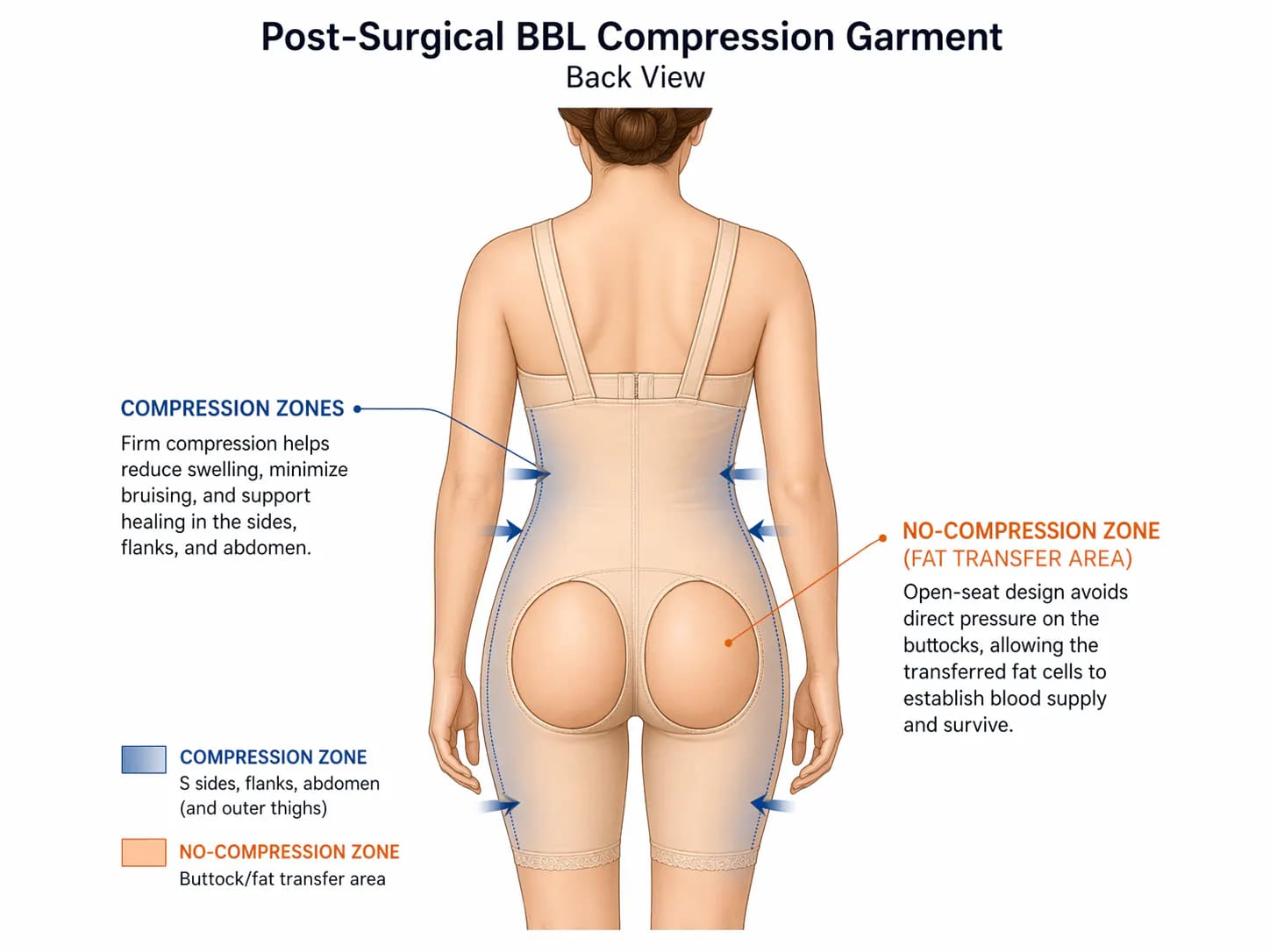
A standard faja compresses the buttocks. For BBL patients, that's dangerous — the transferred fat cells are fragile and dependent on surrounding tissue for vascularization during the first 6–8 weeks. Compressing them directly can damage the graft and reduce how much fat survives.
BBL fajas have an open-seat cutout — an oval absence of material over the buttock area — that applies compression to the flanks, abdomen, and thighs (the liposuction zones) while leaving the grafted area completely uncompressed.
The timeline is the same. The garment is not. A standard lipo faja worn after BBL is not appropriate. If you weren't given a BBL-specific garment and had fat transfer, ask your surgeon before wearing anything over the buttock area.
For 360 lipo without fat transfer, a standard faja is appropriate — there's no graft to protect.
See our complete 360 lipo and BBL guide for more on BBL recovery specifics.
Practical Tips for Wearing a Faja
Get a backup garment. You cannot wash your Stage 1 faja and wear it at the same time. Buy a second one in the same size before your procedure. Alternating daily lets you keep both clean without gaps in compression.
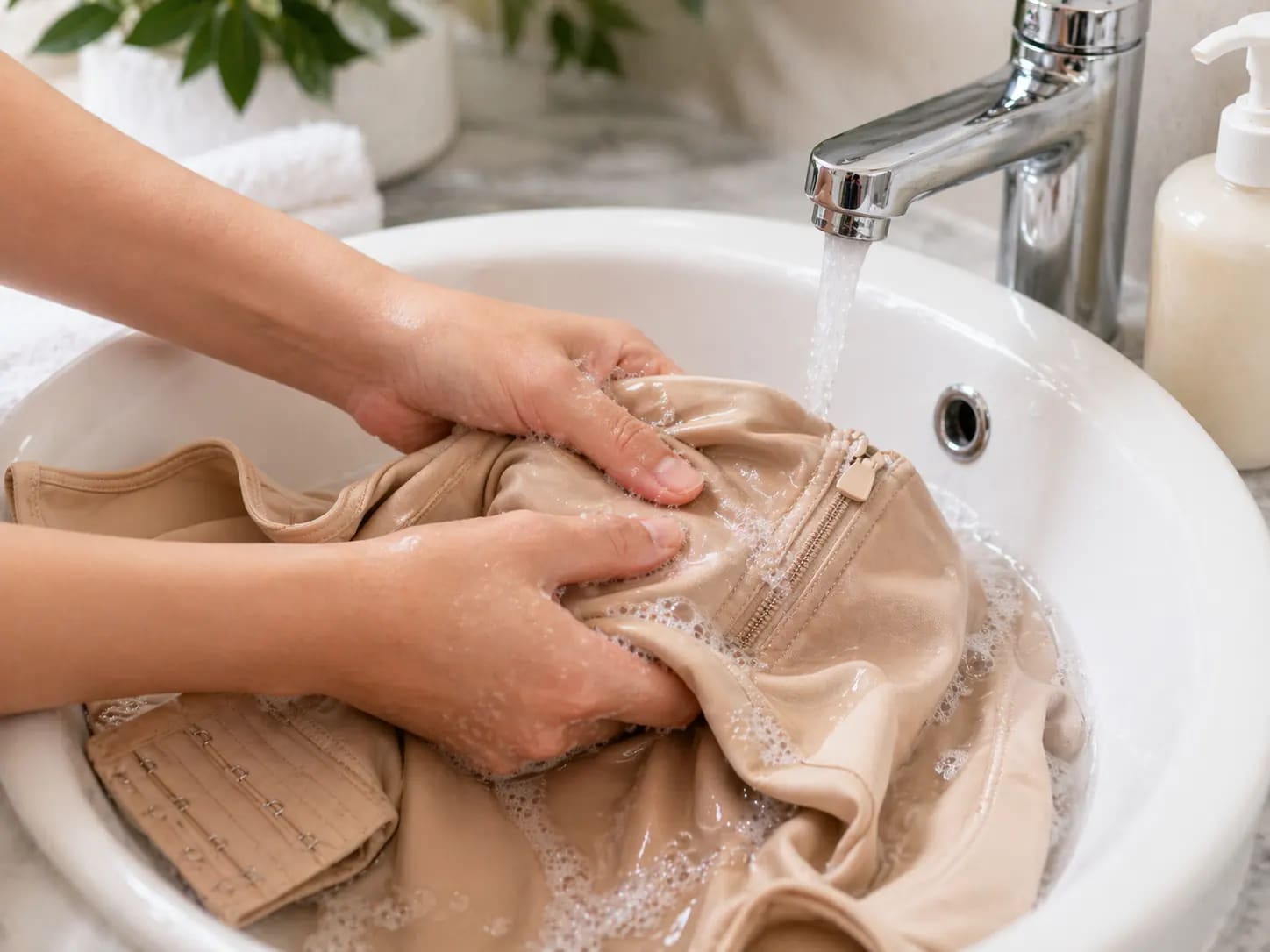
Hand-wash only, cold water. Machine washing degrades the elastic faster. Most Stage 1 and Stage 2 fajas should be hand-washed with mild detergent and air-dried flat. A stretched-out garment that's lost its compression is effectively no garment.
Skin care under compression. Extended garment wear against skin can cause irritation, particularly in sweat-prone areas. Keep skin clean and dry at each removal. If you develop a rash or skin breakdown, contact your surgeon — do not push through pain under the garment.
Compression socks. If your lipo included legs or thighs, your surgeon may recommend compression socks in addition to the faja. Same principle: consistent wear during the first six weeks.
Your surgeon's instructions take precedence over everything here. This guide reflects standard practice across most board-certified plastic surgeons. Individual recovery protocols vary. If your surgeon told you six weeks at 23 hours, that's your protocol — not the four weeks referenced above.
When to Call Your Surgeon
Contact your surgeon if:
- The treated area develops sudden, localized swelling that doesn't resolve after a few hours (possible seroma)
- You feel increasing pain rather than decreasing pain after the first week
- The skin under the garment shows signs of breakdown — open areas, infection, unusual redness
- The treated area feels firm, hard, or asymmetrical weeks into recovery (possible fluid accumulation)
- You're unsure whether to transition to Stage 2
You should not be guessing at these questions. If your surgeon's office doesn't respond within 24 hours to non-urgent questions, that's worth noting — and a good reason to find someone who does.
How long should you wear a compression garment after liposuction?
Most patients wear a Stage 1 faja 23 hours/day for the first 3–4 weeks, then transition to a Stage 2 faja worn 12 hours/day through weeks 4–12. Larger-volume procedures may extend Stage 2 wear to 6 months. Your surgeon's specific protocol takes precedence over any general guideline.
What is a Stage 1 vs Stage 2 faja?
Stage 1 fajas are softer and more accommodating — worn immediately post-surgery when the tissue is swollen and draining, typically 23 hours/day for weeks 1–4. Stage 2 fajas are firmer and higher-compression, worn once initial swelling has resolved. They actively shape the treated area during weeks 4–12, typically 12 hours/day.
Can I sleep without my faja after lipo?
Not for the first 4–6 weeks. Swelling continues overnight, and compression is needed around the clock during the critical healing window. After week 6, most surgeons allow sleeping without the garment once daytime swelling has consistently resolved.
How tight should a faja be after liposuction?
Firm and snug — but you should breathe normally without restriction. Signs it's too tight include numbness, skin color changes at the garment edges, or sharp pain (as distinct from soreness). Signs it's too loose include visible fluid pooling above or below the garment edges.
What happens if you don't wear a faja after lipo?
Seroma (fluid pockets), prolonged swelling, and irregular contour are the main risks. The consequences are proportional to how early and how long compression is skipped. Missing one night is unlikely to cause lasting harm. Inconsistent wear during the Stage 1 phase meaningfully increases the risk of complications and extended recovery.
Does wearing a faja improve lipo results?
Yes. Compression reduces post-operative swelling, encourages drainage, and helps the skin conform to the new contour while tissue is still adaptable. Patients who are consistent with compression wear generally achieve smoother, more defined results than those who aren't.
Is the faja different for BBL or 360 lipo?
For BBL, the garment design is critical. BBL fajas have an open-seat cutout to avoid compressing transferred fat cells during the 6–8 week graft-survival window. The timeline is the same as standard lipo — the garment is not. A standard lipo faja that compresses the buttocks is not appropriate after a BBL.
Medically reviewed by Dr. Rebecca Marsh, MD. Content is for educational purposes only and does not constitute medical advice. Consult your board-certified plastic surgeon for guidance specific to your procedure and recovery.
Ready to plan your liposuction procedure? Find board-certified surgeons near you on browse board-certified liposuction surgeons — verified credentials, real before-and-after photos, and genuine patient reviews.
Internal links:
- 360 Lipo and BBL: The Complete Combo Procedure Guide
- How Much Does Liposuction Cost? The 2026 National Guide
- Laser Liposuction: How It Works, What It Costs, and Whether It's Right for You
