Stomach liposuction permanently removes subcutaneous abdominal fat — the layer between your skin and your muscle wall. It does not address loose skin, stretch marks, or separated abdominal muscles. If your concern is fat and your skin quality is good, liposuction is likely the right procedure. If loose skin or muscle separation is part of the picture, a tummy tuck may serve you better than lipo alone.
That distinction determines more outcomes than anything else in abdominal body contouring. Getting it wrong before surgery is far more costly than taking the time to understand it first.
Stomach liposuction in the US costs $3,500–$9,000 for the abdominal area. Recovery takes 1–2 weeks back to desk work, with final results visible at 3–6 months.
What Stomach Liposuction Actually Does
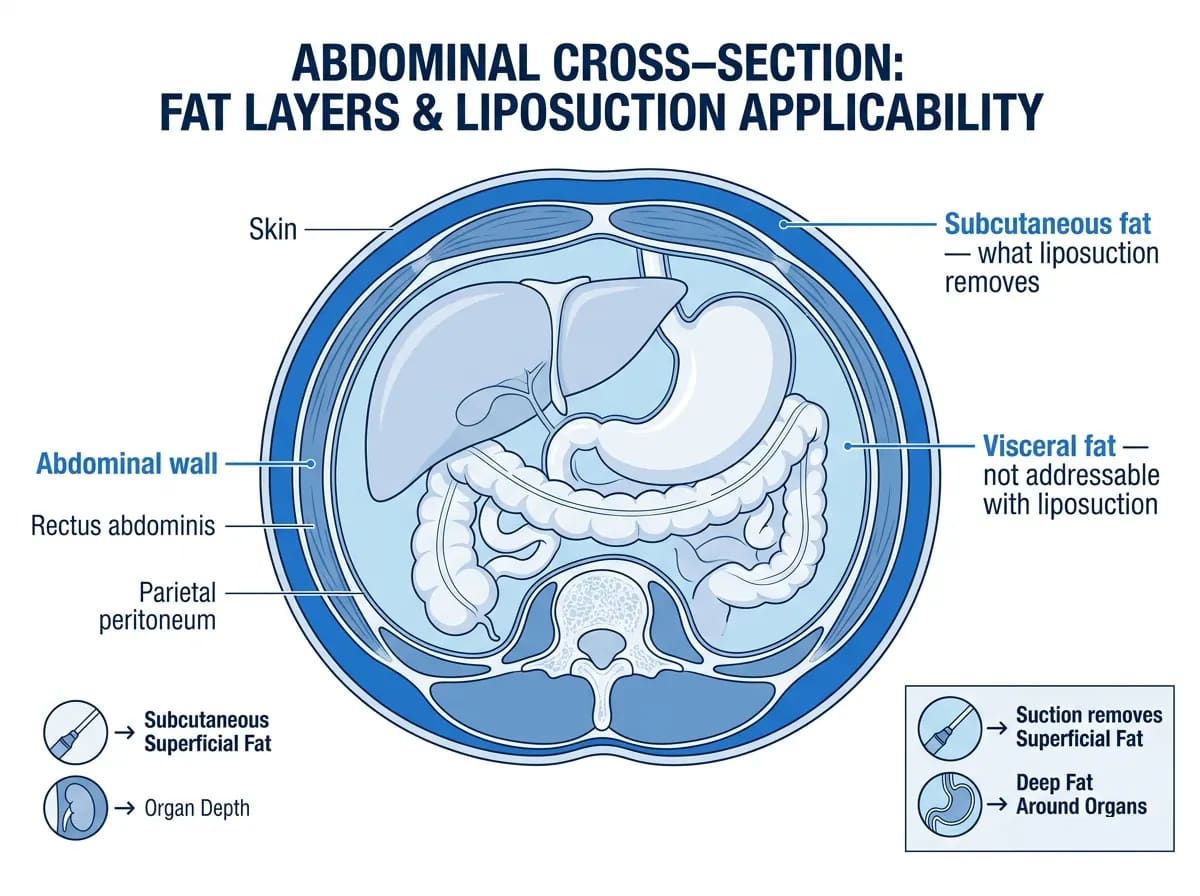
The abdomen has two layers of fat. The first — subcutaneous fat — sits between your skin and the muscle wall. This is what liposuction removes. It is the fat you can pinch, the kind that tends to accumulate around the lower belly and love handles even in otherwise lean people.
The second — visceral fat — surrounds the internal organs, beneath the abdominal muscle wall. It is not reachable with any liposuction cannula. Patients with predominantly visceral fat often have a hard, rounded abdomen that feels full and tight rather than soft and pinchable. Liposuction cannot address this. Diet, exercise, and weight loss are the only ways to reduce visceral fat.
This distinction matters because a surgeon cannot assess it accurately from a photo — or even a basic consultation. If you press your abdomen and it is hard and unyielding, your fullness is predominantly visceral. If it is soft and moveable, the subcutaneous component is likely significant and liposuction will be effective.
Liposuction removes subcutaneous fat through small incisions using a cannula. In the abdomen, surgeons typically treat upper and lower quadrants, often extending to the flanks for a comprehensive result. The removed fat is gone permanently — those cells do not regenerate.
Stomach Liposuction vs. Tummy Tuck: The Decision That Matters Most
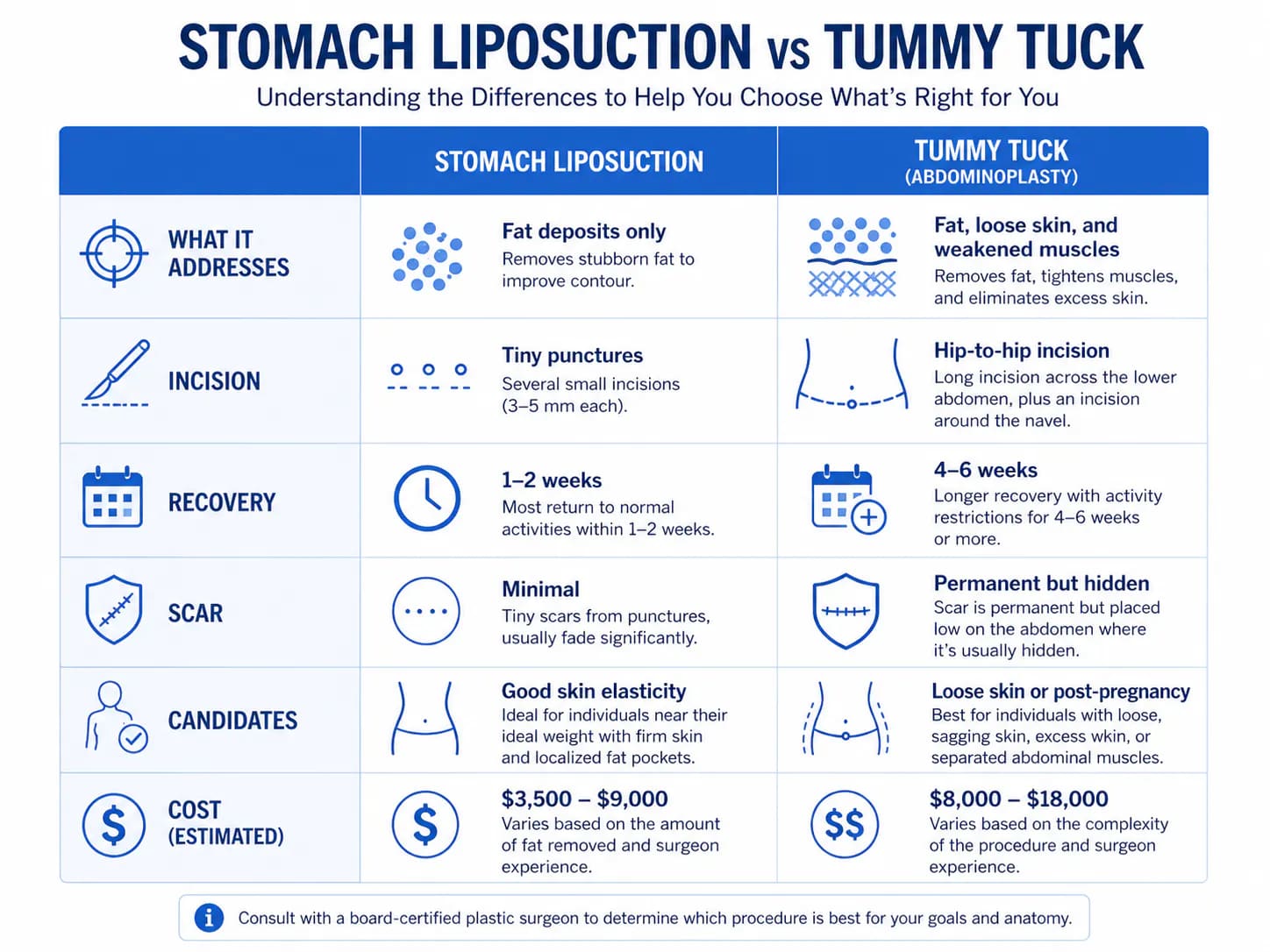
Most patients who come in asking about stomach liposuction actually have a different question: "What is going to work for my abdomen?" The honest answer depends on what you are actually trying to fix.
| Stomach Liposuction | Tummy Tuck (Abdominoplasty) | |
|---|---|---|
| Addresses excess fat | Yes | Yes |
| Addresses loose skin | No | Yes |
| Addresses stretch marks | No | Partially (lower abdomen) |
| Addresses muscle separation | No | Yes |
| Incision | Tiny punctures | Hip-to-hip incision |
| Recovery | 1–2 weeks | 4–6 weeks |
| Scar | Minimal | Permanent (hidden below waistline) |
| Cost | $3,500–$9,000 | $8,000–$18,000 |
Liposuction is the right choice when:
- Your skin quality is good — it will retract after fat is removed
- Your concern is localized fat deposits, not skin volume
- You have not had significant weight fluctuations or pregnancies that stretched the abdominal skin
- You are within 20–30 pounds of your target weight
A tummy tuck is the right choice when:
- You have loose or hanging abdominal skin
- You have significant stretch marks (particularly lower abdominal)
- You have abdominal muscle separation (diastasis recti) — common after pregnancy or major weight loss
- Liposuction alone would leave you with more visible loose skin, not less
Both combined: Many patients benefit from liposuction performed simultaneously with a tummy tuck, using lipo to address fat in areas the tummy tuck skin excision does not cover. This combination requires a surgeon experienced in both procedures.
The critical point: liposuction performed on a patient with significant skin laxity can make the skin look worse — not better. Removing fat from underneath loose skin leaves more loose skin with less support beneath it. This is one of the most common sources of dissatisfaction after abdominal liposuction, and it is entirely preventable with correct candidate selection.
Am I a Good Candidate for Stomach Liposuction?
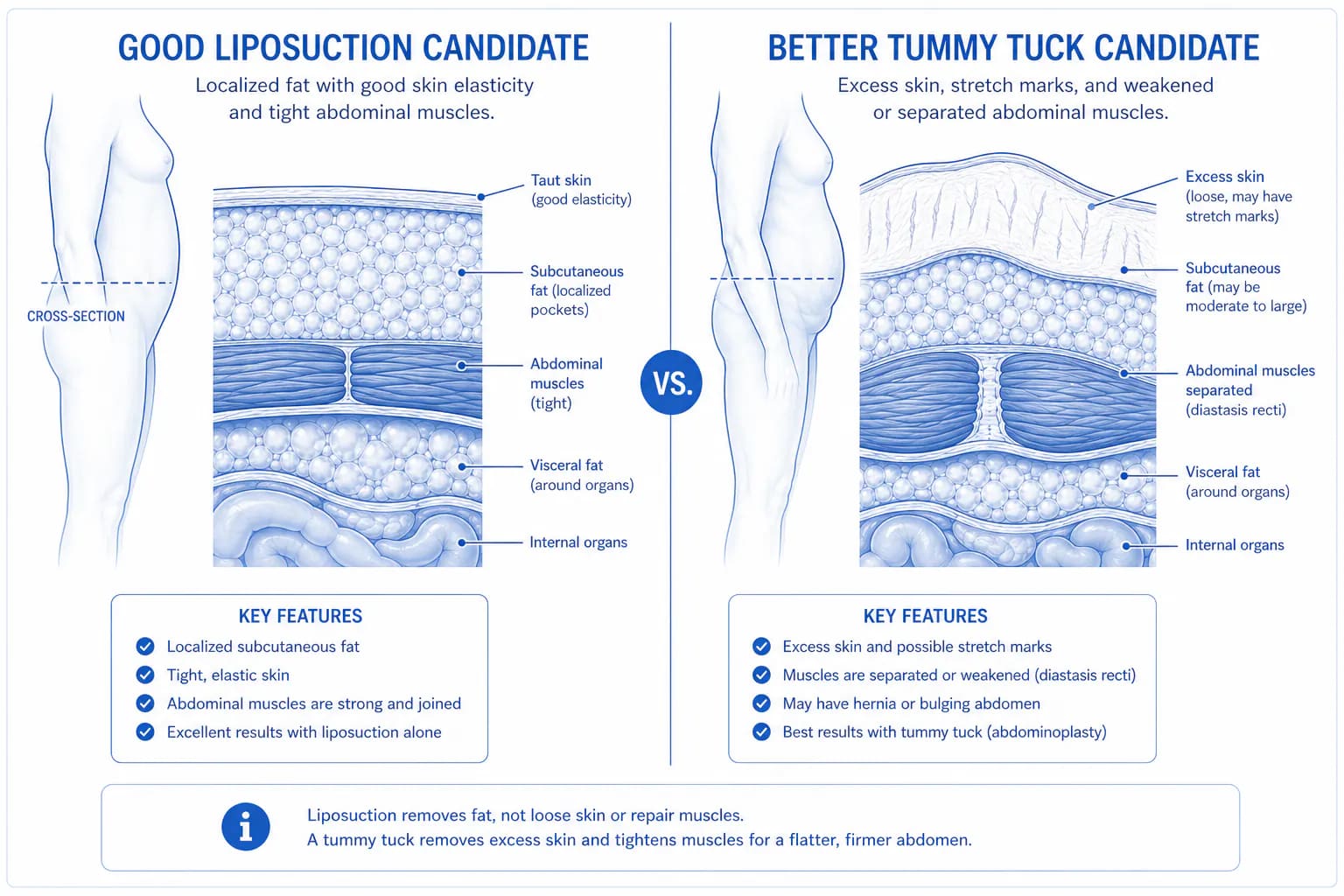
The strongest candidates share a consistent profile:
- Near target weight. Within 20–30 pounds of your goal. Liposuction is a contouring procedure, not weight loss. Patients expecting dramatic scale changes will be disappointed.
- Good skin elasticity. The skin over the treatment area will need to retract after the fat beneath it is removed. Younger patients and those without significant pregnancy or weight gain history tend to have better elasticity. A pinch test during consultation helps assess this.
- Localized fat deposits. Fat that is resistant to diet and exercise specifically in the abdominal area — despite being at or near a healthy weight overall — is the classic liposuction indication.
- No significant muscle separation. Diastasis recti causes the belly to protrude even in the absence of excess fat. A surgeon can assess this at consultation. If present, liposuction alone will not flatten the abdomen.
- Non-smoker. Smoking impairs healing and increases surgical risk. Most surgeons require stopping smoking at least 4–6 weeks before and after surgery.
- Stable weight. Patients still actively losing weight should wait until their weight has stabilized before undergoing liposuction. Surgery during weight loss disrupts results.
How the Procedure Works
Stomach liposuction is typically performed under general anesthesia or local anesthesia with sedation, depending on how many areas are being treated. An outpatient accredited surgical facility is the standard setting.
Tumescent infiltration. A solution of saline, lidocaine, and epinephrine is injected into the abdominal fat to constrict blood vessels (reducing bleeding), provide local anesthesia, and expand the fat compartment for easier access.
Cannula-based extraction. Small incisions — typically 3–5mm — are made at strategic points (often within the navel, along the lower bikini line, or on the sides). A thin hollow tube (cannula) is inserted and moved in controlled passes to break up and suction the fat.
360 treatment option. Surgeons performing circumferential abdominal liposuction will also treat the flanks, love handles, and lower back through the same session. This produces a more complete waist contour than treating only the front. See our 360 lipo guide for the full circumferential approach.
Surgical time: 1–3 hours depending on the number of areas treated. You go home the same day.
Recovery: What to Expect
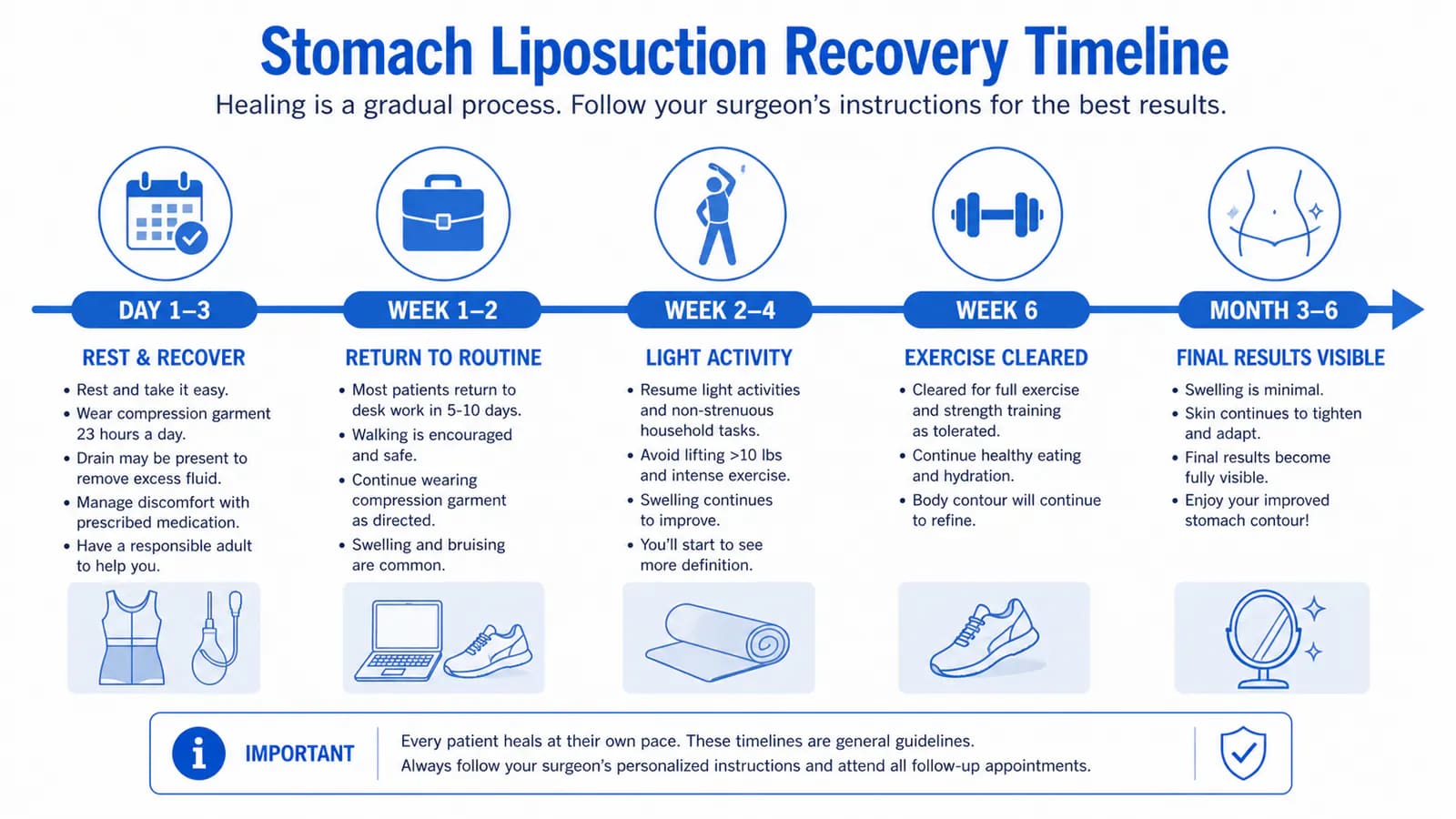
Days 1–3. Soreness, swelling, and bruising in the abdominal area. A compression garment is worn continuously. Some fluid drainage is normal. Most patients manage pain with over-the-counter medication or a short course of prescription pain relief.
Week 1–2. Most patients return to desk work within 7–14 days. Walking is encouraged early for circulation. Avoid lifting, bending, or any activity that strains the abdominal wall.
Weeks 2–4. Swelling continues to improve. The compression garment transitions from 24-hour wear to daytime-only in many protocols. Light activity is permitted.
Weeks 4–6. Most surgeons clear patients for exercise at 4–6 weeks. Abdominal exercises specifically may require additional clearance.
Months 3–6. Final contour is visible as residual swelling resolves and the skin completes its retraction. Many patients see continued improvement through the six-month mark.
How Much Does Stomach Liposuction Cost?
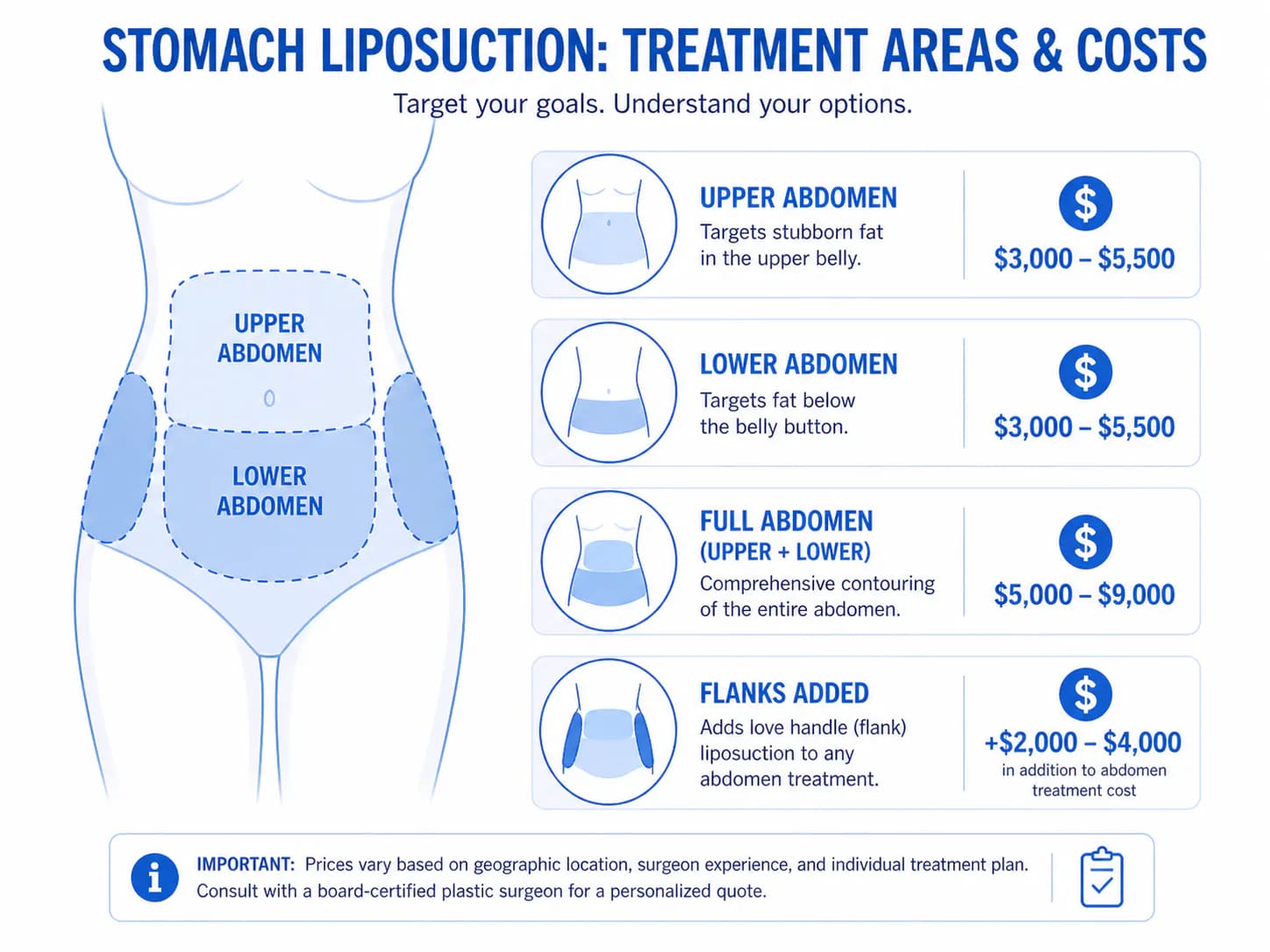
Abdominal liposuction costs vary by how much of the abdomen is treated, your geographic market, and the surgeon's experience level.
| Treatment Area | Typical US Range |
|---|---|
| Upper abdomen only | $3,000 – $5,500 |
| Lower abdomen only | $3,000 – $5,500 |
| Full abdomen (upper + lower) | $5,000 – $9,000 |
| Abdomen + flanks | $7,000 – $13,000 |
| Abdomen + flanks + back (360) | $8,000 – $15,000 |
These are all-in estimates including surgeon fee, anesthesia, facility fee, and post-op care. The average surgeon's fee for liposuction reported by ASPS is $4,711 — but this is the surgeon fee alone, not total cost.
High-cost markets (New York, Los Angeles, San Francisco) run toward the upper end of these ranges. Secondary markets (Dallas, Houston, Atlanta, Phoenix) typically run 20–30% lower.
Financing through CareCredit, Alphaeon, or in-house practice plans is widely available and commonly used.
Results: What to Expect and What Lasts
Stomach liposuction produces a flatter, more defined abdominal contour. The fat cells removed are permanently gone — they do not regenerate. Results are visible within weeks as swelling resolves, with the final contour apparent at 3–6 months.
What you will and will not see:
- You will see: Reduced abdominal fullness, flatter profile, improved contour from the front and sides, better waist definition when flanks are included.
- You will not see: Tighter skin from liposuction alone, reduced stretch marks, muscle definition that was not there before (liposuction removes fat, it does not tone muscle), or changes to the deep abdominal shape if visceral fat is the primary issue.
Maintaining results requires stable weight. The removed fat cells cannot return — but the remaining fat cells can expand. Patients who maintain weight within a few pounds of their post-surgery weight typically see long-lasting results. Those who gain 20+ pounds after surgery will notice redistribution, including back to the abdominal area.
How much does stomach liposuction cost?
Stomach liposuction in the US typically costs $3,500–$9,000 for the abdominal area depending on whether upper abdomen, lower abdomen, or both are treated, plus surgeon experience, geographic market, and facility fees. Treating both the abdomen and flanks together runs $7,000–$13,000. These figures represent all-in costs at an accredited facility with a board-certified plastic surgeon.
Does stomach liposuction remove belly fat permanently?
Yes — the fat cells removed by liposuction are permanently gone. They do not regenerate. However, remaining fat cells can still expand with weight gain. Maintaining a stable weight after liposuction preserves results long-term. Significant weight gain after the procedure redistributes fat to remaining cells throughout the body.
Is stomach liposuction or a tummy tuck better?
Liposuction addresses fat. A tummy tuck addresses fat, loose skin, stretch marks, and separated abdominal muscles. If your concern is localized fat with good skin elasticity, liposuction is appropriate. If you have loose skin, significant stretch marks, or abdominal muscle separation, a tummy tuck is more likely to give you the result you want. Liposuction on a patient with loose skin can make the skin appear worse.
What is the recovery time for stomach liposuction?
Most patients return to desk work within 7–14 days. A compression garment is worn for 2–4 weeks. Strenuous exercise is cleared at 4–6 weeks. Significant swelling resolves by weeks 8–12, with final abdominal contour visible at 3–6 months.
Can liposuction remove visceral fat?
No. Liposuction only removes subcutaneous fat — the layer between the skin and abdominal muscle wall. It cannot reach visceral fat, which surrounds the internal organs beneath the muscles. Patients with predominantly visceral fat (a hard, tight abdomen) are not good liposuction candidates — the source of their stomach fullness cannot be addressed surgically.
Am I a good candidate for stomach liposuction?
Good candidates are within 20–30 pounds of their target weight, have localized abdominal fat that doesn't respond to diet and exercise, have good skin elasticity, are in good overall health, are non-smokers, and have no significant abdominal muscle separation. Poor candidates include those with significant loose skin, prominent stretch marks, diastasis recti, or predominantly visceral fat.
What is 360 liposuction of the abdomen?
360 liposuction treats the full circumference of the torso — abdomen, flanks, love handles, upper and lower back — in a single procedure. Unlike isolated abdominal liposuction, lipo 360 creates contour change from every angle. It is commonly combined with a BBL, which uses the harvested fat for gluteal augmentation.
How long does stomach liposuction last?
Stomach liposuction results are permanent for the fat cells removed. Those cells do not grow back. If you gain significant weight after the procedure, the remaining fat cells in the abdomen and throughout the body will expand. Patients who maintain a stable weight after liposuction typically keep their results for many years.
Internal links:
- How Much Does Liposuction Cost?
- 360 Lipo and BBL: The Complete Combo Guide
- Liposuction vs. Tummy Tuck
- How to Choose a Board-Certified Liposuction Surgeon
