
Arm liposuction removes stubborn fat from the upper arms and underarm area through small incisions, typically in 1–2 hours under local anesthesia with sedation. National cost range: $3,000–$7,000 for both arms combined. Recovery is among the fastest of any body liposuction procedure — most patients return to desk work within 3–5 days and final results appear by 6 months.
But arm liposuction is not the right procedure for every patient who wants slimmer arms. If your concern is loose, sagging skin — the condition often called "bat wings" — liposuction alone usually cannot fix it. This guide covers how to know whether arm liposuction will actually solve your problem, what a realistic result looks like, and how to find a board-certified surgeon who treats the arm well.
Arm Liposuction at a Glance
Key points:
- What it does: Removes localized fat from the upper arms and underarm region (the pocket that can overhang a bra strap).
- What it doesn't do: Tighten significantly loose or sagging skin. That requires an arm lift (brachioplasty).
- Procedure time: 1–2 hours
- Anesthesia: Typically tumescent local anesthesia plus IV sedation. General anesthesia is rarely required.
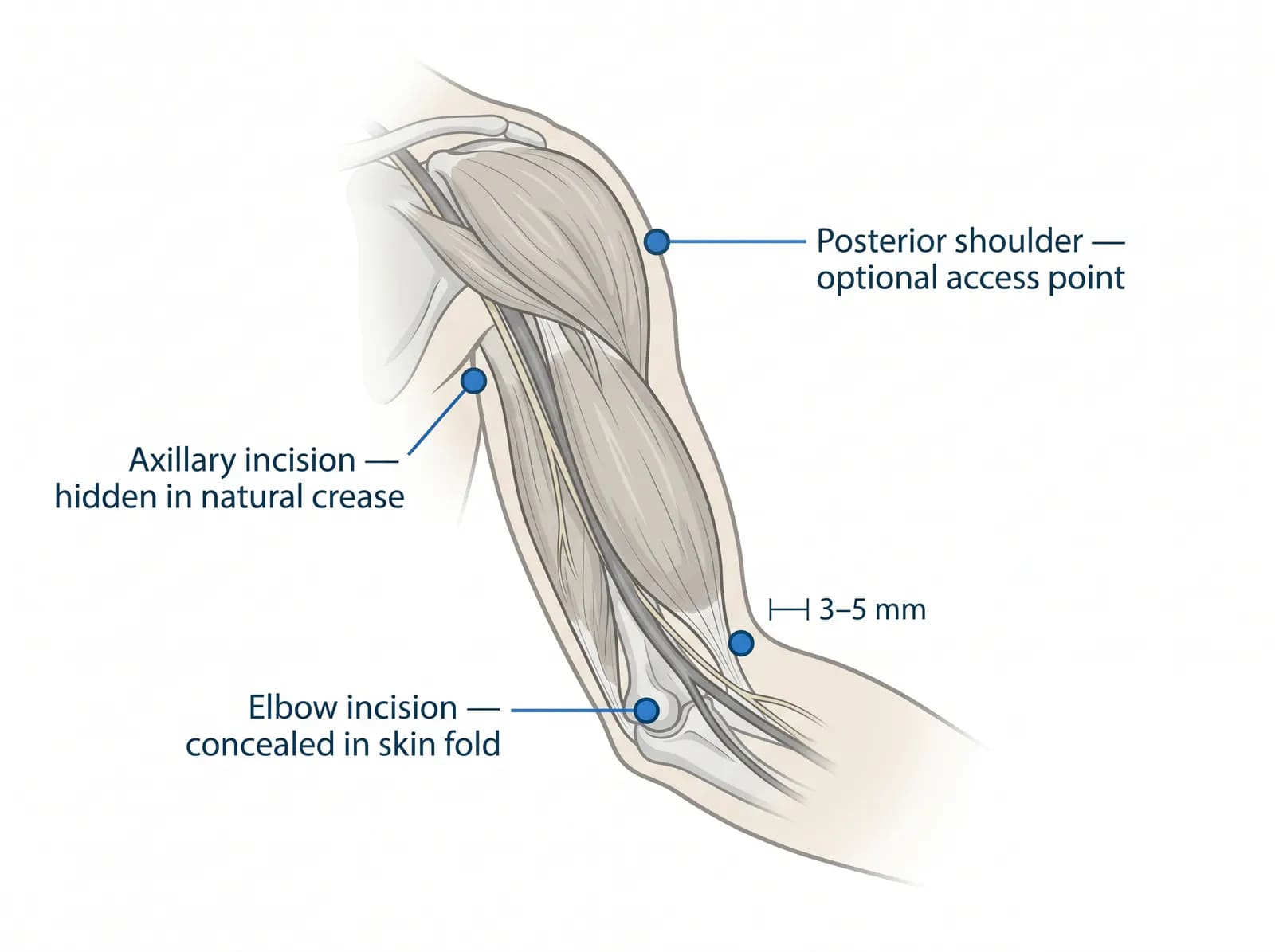
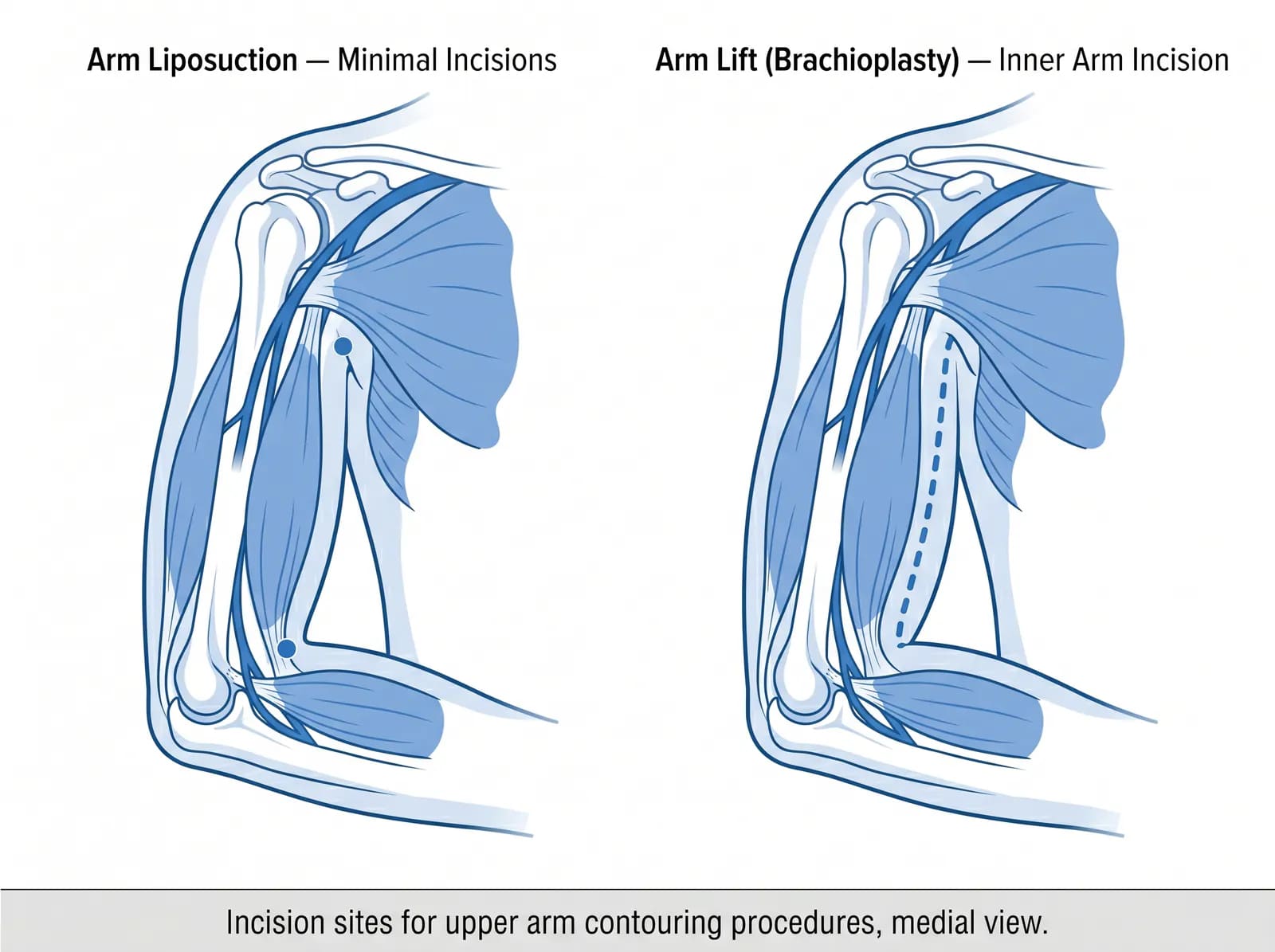
- Incisions: 2–3 per arm, 3–5 millimeters each, placed in the underarm crease or inner elbow where scars are least visible.
- Recovery: Desk work in 3–5 days; light exercise at 4–6 weeks; final results at 3–6 months.
- Cost: $3,000–$7,000 for both arms (national range across the lipo.com network).
- Ideal candidate: Stable weight, good skin elasticity, localized fat rather than loose skin.
What Is Arm Liposuction?
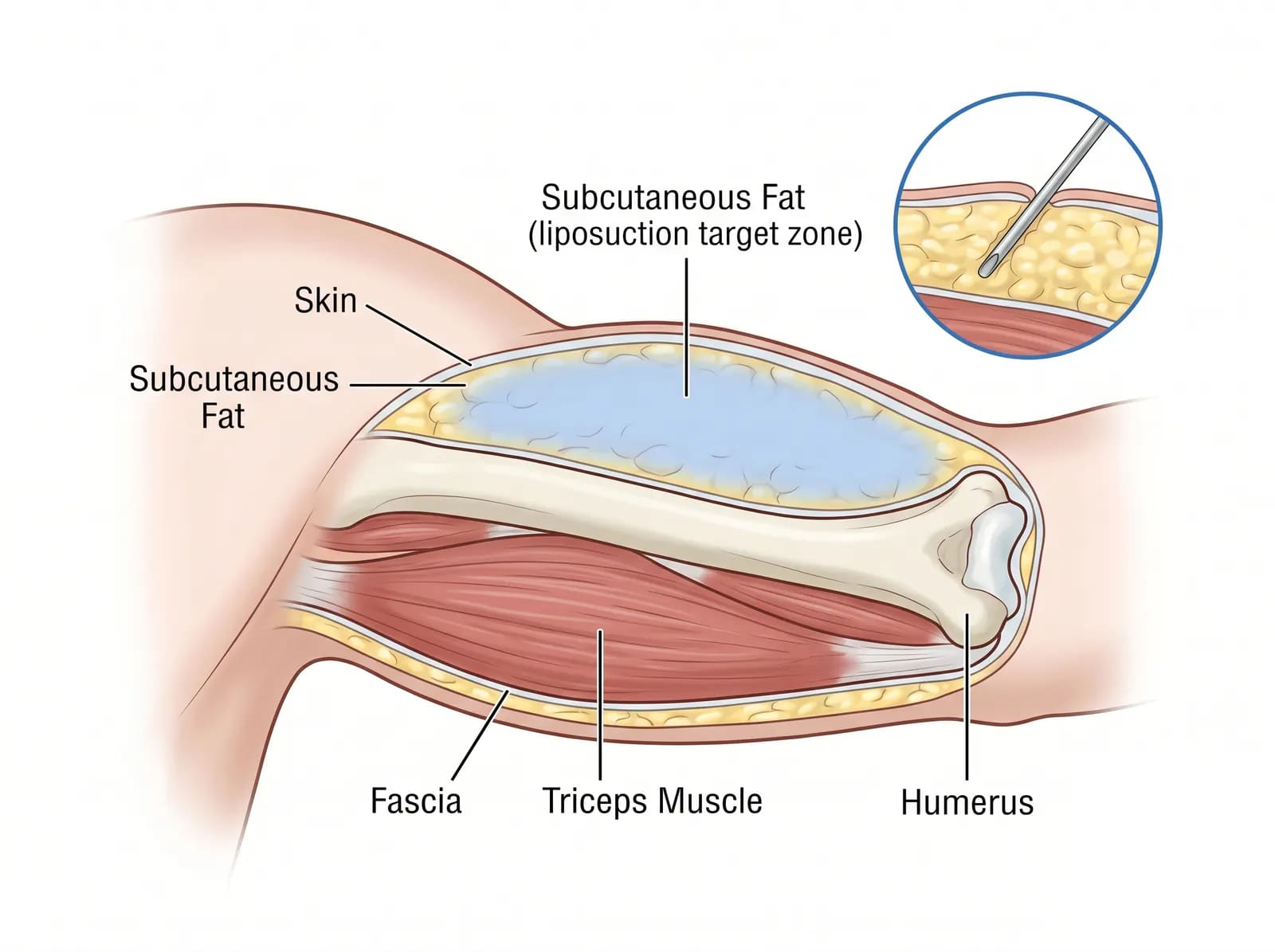
Arm liposuction is a surgical body contouring procedure that removes fat deposits from the upper arm — most commonly the posterior upper arm (over the triceps) and the axillary region (the area around and just below the armpit). A board-certified surgeon makes 1–2 small incisions, infiltrates the treatment area with tumescent fluid, and suctions the fat through a thin cannula. The result is a more defined upper-arm contour.
The target tissue is subcutaneous fat — the layer directly beneath the skin and above the muscle. Liposuction cannot remove visceral fat (deeper fat around organs), and the procedure is not weight-loss surgery. It is a contouring procedure for patients who are already at or near their goal weight and have a specific fat pocket they cannot resolve with diet and exercise.
Several techniques are used on the arms:
- Traditional (tumescent) liposuction — the standard approach, using suction alone.
- Laser-assisted liposuction (SmartLipo) — popular for arms because laser energy also stimulates collagen for modest skin tightening.
- VASER (ultrasound-assisted) — breaks up fat with ultrasonic energy before suction; often chosen when a more sculpted contour is the goal.
- Power-assisted liposuction (PAL) — a vibrating cannula that removes fat more efficiently, especially in denser fat.
For arms specifically, laser-assisted liposuction is a common choice because upper-arm skin tends to be slightly less elastic than, say, abdominal skin. The collagen stimulation from laser energy adds mild skin tightening that can improve outcomes in patients with borderline elasticity. For a fuller comparison of how laser lipo works and when it's the right call, see our complete guide to laser liposuction.
Can Liposuction Remove Bat Wings?
"Bat wings" is the colloquial term for the loose, saggy tissue that hangs from the underside of the upper arm and moves when you wave. It's one of the most common reasons patients come in asking about arm liposuction — and one of the most common reasons they need to be honestly redirected.
Here is the honest answer: if your bat wings are caused by excess fat, arm liposuction can fix them. If they are caused by loose, inelastic skin — from aging, significant weight loss, or genetics — liposuction alone will not fix the problem, and may even make the appearance slightly worse by removing underlying volume that the skin was resting on.
The skin pinch test is a rough first screen. If you can pinch more than an inch of tissue that feels mostly soft and compressible, fat is a meaningful component of the problem, and liposuction is likely to help. If the loose tissue is thin and primarily skin, the surgery that actually addresses the cause is an arm lift (brachioplasty), not liposuction.
Only a consultation with a board-certified surgeon reliably answers this question. A thorough assessment includes photographs in several arm positions, a physical evaluation of skin tone and elasticity, and a realistic discussion of outcomes for each available approach.
Am I a Good Candidate for Arm Liposuction?
The ideal arm liposuction candidate has:
- Stable weight for at least 6 months
- A localized, pinchable fat pocket on the upper arm or underarm area
- Good skin elasticity — skin that bounces back when released from a pinch
- Realistic expectations about what fat removal alone can achieve
- Overall good health, including non-smoker status and no uncontrolled medical conditions
Patients who are often better served by a different approach include:
- Those with significant loose or sagging skin, particularly after large weight loss — an arm lift addresses this directly.
- Those still in the process of losing weight — it's better to stabilize first.
- Those hoping for a dramatic transformation when the underlying concern is muscle tone — strength training is the actual solution.
- Those with unrealistic expectations about arm shape after surgery.
A surgeon may also recommend a combined approach — liposuction plus a limited skin excision — for patients with moderate skin laxity who want more than liposuction alone can deliver but less scarring than a full arm lift.
A Realistic Expectation Check
Arm liposuction produces its best results in patients who are already fit and whose upper arms are the one stubborn area that has not responded to diet and exercise. If that describes you, the procedure often delivers exactly what patients envision.
If your upper arms are one of several areas of concern, or if significant skin laxity is present, your outcome may look different from the best-case before-and-after photos you've seen online. The honest conversation about realistic results is the most valuable part of a good consultation.
Arm Liposuction vs Arm Lift (Brachioplasty)
This is the most important decision point in arm contouring — and it's not a question most patients come in prepared to answer. Here is a clear framework.
| Arm Liposuction | Arm Lift (Brachioplasty) | |
|---|---|---|
| Addresses | Excess fat | Excess skin (and some fat) |
| Incisions | 2–3 small (3–5 mm) | Long scar along inner upper arm |
| Recovery | 1–2 weeks to light activity | 4–6 weeks limited activity |
| Scarring | Minimal, well-hidden | Visible inner-arm scar (permanent) |
| Cost range (US) | $3,000–$7,000 | $5,000–$12,000 |
| Best for | Good skin elasticity, localized fat | Significant loose skin, often post–weight loss |
The trade-off is clear. An arm lift produces more dramatic shape change because it addresses both fat and skin — but it leaves a long, visible scar along the inner upper arm that most patients will see in the mirror for the rest of their lives. Liposuction leaves scars so small they are often essentially invisible within a year, but it cannot correct loose skin.
For the patient with borderline skin elasticity, it's worth having a detailed discussion about laser-assisted liposuction, radiofrequency skin tightening, or a combined procedure. No technology fully closes the gap between lipo and brachioplasty — but for the right anatomy, laser-assisted liposuction plus a disciplined compression garment protocol can produce surprisingly tight results.
How Arm Liposuction Works
Arm liposuction is performed in an accredited outpatient surgical facility. Here is what the day typically looks like.
Anesthesia
Most arm liposuction is performed under tumescent local anesthesia with oral or IV sedation. General anesthesia is usually not required. The tumescent technique involves infiltrating the treatment area with a large volume of dilute lidocaine and epinephrine solution, which numbs the area, reduces bleeding, and makes fat removal more precise. Patients are relaxed but typically awake or lightly sedated.
Incision Placement
Incisions for arm liposuction are intentionally small — usually 3–5 millimeters — and placed in locations where they are least visible:
- In the underarm crease (axilla)
- At the inside of the elbow, within a skin fold
- Occasionally at the posterior shoulder
Most arm procedures use 2–3 incisions per arm, giving the surgeon multiple angles for smooth fat removal and even contouring.
The Procedure
Once the area is numbed and the tumescent solution has taken effect, the surgeon inserts a thin cannula through each incision and works it through the fat layer in a controlled, fan-shaped pattern. The cannula is connected to a vacuum system that extracts loosened fat. For laser-assisted approaches, a laser fiber is inserted first to heat and liquefy fat before suction. For VASER, ultrasonic energy accomplishes the same goal.
The procedure typically takes 1–2 hours. Because the arm is a smaller area with less fat volume than the abdomen or thighs, arm liposuction often finishes faster than liposuction of larger regions.
Immediately After
Patients are placed in a compression garment — typically long-sleeved arm compression sleeves — immediately after the procedure. Most patients walk out of the facility on the same day, wearing their compression garment and accompanied by a family member or friend. Driving on the day of surgery is not permitted.
Arm Liposuction Results: What to Expect
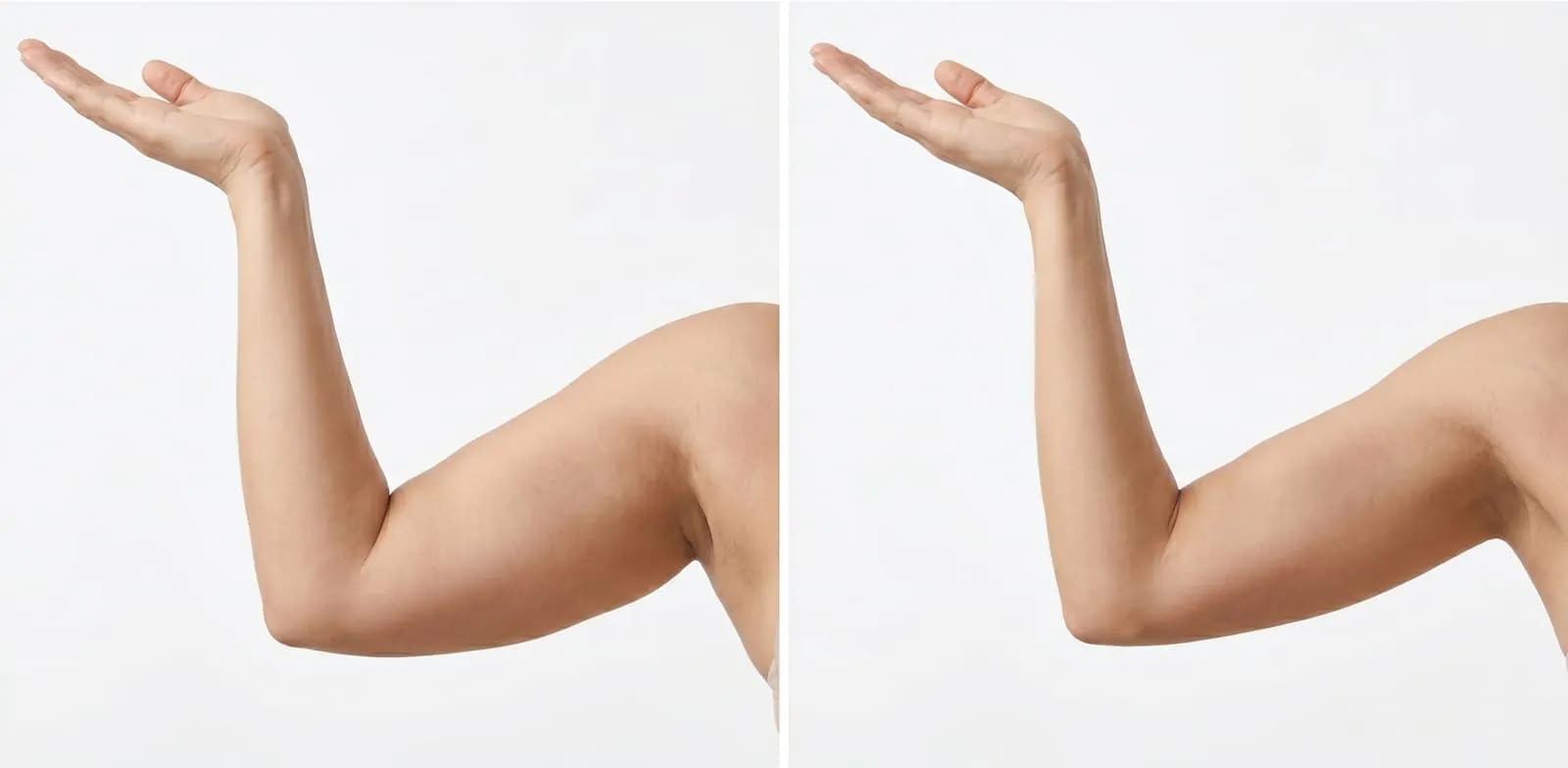
Results appear gradually as swelling subsides. Here is the typical timeline.
- Immediately after: The arms look swollen and bruised, and the compression garment is in place. Movement is limited but possible. It's too early to judge results.
- Week 1–2: Swelling is still significant. Bruising starts to fade. Still too early for a visible shape change.
- Weeks 3–4: Most visible bruising has resolved. Swelling begins to come down. A new contour begins to emerge.
- Weeks 6–8: The arms look noticeably smaller. Most swelling has resolved, though subtle fluid can linger in deeper tissue.
- 3 months: Roughly 80% of the final result is visible.
- 6 months: Final result. Shape is stable, scars are fading, and the contour you see is what you keep.
How Long Do Arm Liposuction Results Last?
Arm liposuction results are permanent, with an important caveat. The fat cells removed during the procedure do not grow back — but the remaining fat cells in the treated area can expand with significant weight gain. If you stay within roughly 10 pounds of your pre-procedure weight, the contour improvement is stable for life. Significant weight gain changes the result.
Some patients notice that post-liposuction weight gain distributes differently than before, often settling in untreated areas. This is a known pattern and a reason to maintain steady weight post-procedure: the body still has fat cells elsewhere, and they store the excess.
Recovery Week by Week

Arm liposuction has one of the fastest recoveries of any body liposuction procedure. Here's what most patients experience.
Days 1–3
Soreness, swelling, and light drainage from incisions are normal. The compression garment stays on 23 hours per day. Sleep on your back with arms gently elevated on pillows to reduce swelling. Most patients manage discomfort with over-the-counter pain medication. Walk around the house regularly to reduce clot risk.
Days 4–7
Returning to desk work is usually possible in this window. Driving resumes once you're off narcotic pain medication and can comfortably move your arms. Bruising and tightness are still present but clearly improving.
Weeks 2–4
Most patients resume light daily activity. The compression garment stays on most of the day. Swelling is coming down but still affects how the arms look in the mirror. For the timeline on when to switch from a Stage 1 to Stage 2 garment, see our compression garment guide.
Weeks 4–6
Light cardio — walking, stationary biking — is usually cleared. Upper-body exercise, including any weight lifting or resistance training that involves the arms, is typically delayed until week 6 at the earliest and only with surgeon approval.
3 Months and Beyond
Most restrictions lift. You can resume full workouts, lift weights, swim, and return to all normal activities. The compression garment is no longer required. The arm shape continues to refine for another 3–6 months.
What Recovery Actually Feels Like
Most patients describe arm lipo recovery as soreness rather than sharp pain. The sensation is often compared to the day after an intense upper-body workout — sore, tight, stiff — but not incapacitating. The compression garment, combined with post-surgical swelling, can make the arms feel heavy for the first 1–2 weeks. Almost every patient is surprised at how quickly they feel normal enough to return to light daily activity.
Arm Liposuction Scars: What to Know
Arm liposuction incisions are small and strategically placed. Most patients are surprised by how inconspicuous the scars become once healing is complete.
Scar Size and Placement
Key points:
- Incision size: 3–5 millimeters (roughly the size of a grain of rice)
- Location: Typically the underarm crease, the inside of the elbow, or a skin fold at the posterior arm
- Number: 2–3 per arm
Healing Timeline
Key points:
- Weeks 1–2: Incisions are slightly red with minor scabbing.
- Weeks 3–6: Scabs have fallen off. Scars appear pink and flat.
- 3–6 months: Scars continue to fade. Most look like small dots or faint lines.
- 1 year: Scars are typically barely visible in most skin tones.
Scar Minimization That Actually Helps
Following your surgeon's wound-care protocol matters more than any over-the-counter scar product. For most patients, silicone sheets or silicone gel applied from weeks 2–12 produce the best results. Sun protection on incisions for the first year is critical — UV exposure permanently darkens healing scars.
How Much Does Arm Liposuction Cost?
Arm liposuction is one of the more moderately priced body liposuction procedures. The treatment area is relatively small, and the procedure takes less time than larger regions like the abdomen or thighs.
National Cost Range
$3,000 to $7,000 for both arms combined, across the lipo.com network.
What Drives the Range
Key points:
- Surgeon experience and board certification: Board-certified plastic surgeons with extensive arm contouring experience charge at the higher end. This is not the area to cut cost.
- Technique used: Traditional liposuction is typically the least expensive option. Laser-assisted and VASER add $500–$1,500 to the total for the same area.
- Geography: Major metro markets — New York, Los Angeles, Miami, San Francisco — tend toward the top of the range. Mid-size cities fall toward the middle.
- Facility and anesthesia fees: Accredited surgical facilities charge facility and anesthesia fees on top of the surgeon's fee. These add roughly $1,000–$2,500 to the total.
- Combined procedures: Many patients combine arm lipo with other areas — flanks, bra rolls, upper back. Combining procedures usually reduces the per-area cost because anesthesia and facility fees are shared across the whole operation.
City-Level Variation
Approximate ranges by market:
- New York, Los Angeles, Miami, San Francisco: $5,000–$7,000+
- Chicago, Dallas, Houston, Atlanta, Boston, Seattle: $4,000–$6,000
- Smaller metros and secondary markets: $3,000–$5,000
For the full picture of how liposuction is priced across procedures, techniques, and cities, see our complete 2026 national cost guide.
Is Arm Liposuction Worth It?
Whether arm liposuction is "worth it" is a personal decision, but the data is relatively clear on who gets the best outcome. Published satisfaction rates for arm liposuction in the right candidate — stable weight, good skin elasticity, localized fat — are among the highest in body contouring, consistently above 85% in patient-reported outcome studies. For patients whose upper arms have remained out of proportion despite consistent diet and exercise, arm liposuction is one of the more reliably satisfying procedures available.
For patients who expected surgery to fix loose skin, or who assumed a surgical result could replace significant weight loss, satisfaction rates are meaningfully lower. This is exactly why the candidate assessment at consultation matters so much — and why an honest surgeon will redirect the wrong candidates toward a different procedure rather than operating.
How to Find a Surgeon for Arm Liposuction
The upper arm is a delicate area. Scar placement, contour smoothness, and skin management all matter. Here's what to look for.
Credentials
Key points:
- Board certification by the American Board of Plastic Surgery (ABPS)
- Fellowship training in body contouring or aesthetic surgery
- Active membership in ASPS (American Society of Plastic Surgeons) or ASAPS (American Society for Aesthetic Plastic Surgery)
- Hospital privileges for comparable procedures — a marker that a local hospital has vetted their credentials and outcomes
Experience With Arms Specifically
Arm liposuction is not the same procedure as abdomen or flank liposuction. Volume is lower, scar visibility is higher, and skin elasticity plays a larger role. At consultation, ask:
- How many arm procedures do you perform per year?
- Can I see before-and-after galleries of your arm cases specifically?
- What technique do you recommend for my anatomy, and why that one?
- How do you handle patients with borderline skin elasticity?
- What is your revision rate for arm liposuction?
A surgeon who performs dozens of arm procedures annually will have a meaningfully different skill level from one who performs a handful. When you review before-and-after photos, look for patients with similar anatomy to yours — similar age, skin type, and starting condition.
Questions to Ask at Consultation
Key points:
- Am I a good candidate for liposuction alone, or should we consider an arm lift or a combined procedure?
- What realistic outcome should I expect given my anatomy?
- What technique will you use, and why?
- Where exactly will the incisions be placed?
- What does your post-op protocol look like, and what is my role in recovery?
- What complications have you seen in arm liposuction, and how were they managed?
Red Flags
Key points:
- A surgeon who does not evaluate or discuss skin elasticity during the physical exam
- Before-and-after photos that all look identical, use heavy filters, or show only best cases
- Pressure to combine many areas or add modalities without clear reasoning
- Pricing that is dramatically below local market without a clear explanation
- No mention that liposuction might not be the right procedure for you
Start Your Search
Our national network of board-certified surgeons includes specialists who perform arm liposuction as a primary treatment area. Every surgeon on lipo.com has been vetted against consistent standards — board certification, procedure volume, facility accreditation, and outcomes review.
Find a board-certified arm liposuction specialist near you and book consultations. Most surgeons offer complimentary or low-cost consultations, and seeing two or three before making a decision is a reasonable standard of care — especially for a procedure that will affect how your arms look for the rest of your life.
How much does arm liposuction cost?
Arm liposuction typically costs $3,000 to $7,000 for both arms combined in the United States. The range reflects surgeon experience, technique used (traditional, laser, or VASER), geographic location, and facility fees. Major metros like New York and Los Angeles are at the top of the range; secondary markets tend toward the middle.
How long does arm liposuction take?
Most arm liposuction procedures take 1 to 2 hours. Timing depends on how much fat is removed, whether one or both arms are treated, and which technique is used. Laser-assisted and VASER procedures typically add 15–30 minutes to the total.
Is arm liposuction painful?
Most patients describe arm liposuction recovery as soreness rather than sharp pain — often compared to the feeling after an intense upper-body workout. The procedure itself is performed under tumescent local anesthesia with sedation, so patients feel pressure but not pain during surgery. Post-op discomfort is usually manageable with over-the-counter pain medication.
What is the recovery time for arm liposuction?
Most patients return to desk work within 3–5 days, resume light exercise at 4–6 weeks, and return to full activity including weight training at roughly 6 weeks. Final results appear at 3–6 months as residual swelling resolves.
Can liposuction remove bat wings?
Liposuction can fix bat wings caused by excess fat, but not bat wings caused by loose, inelastic skin. For patients with significant skin laxity — usually from aging or large weight loss — an arm lift (brachioplasty) addresses the actual cause. A board-certified surgeon can determine which condition applies to your anatomy.
Am I a good candidate for arm liposuction?
Good candidates are at or near a stable weight, have localized fat pockets on the upper arms, have good skin elasticity, and have realistic expectations. Patients with significant loose skin, ongoing weight fluctuation, or those expecting a dramatic weight-loss-style transformation are usually better served by a different procedure or a combined approach.
Does arm liposuction leave scars?
Arm liposuction leaves small scars — typically 3–5 millimeters each, placed in the underarm crease or near the elbow where they are least visible. Most scars fade to barely visible dots within 6–12 months. Sun protection on incisions during the first year is critical for the best cosmetic outcome.
How long do arm liposuction results last?
Arm liposuction results are permanent provided you maintain a stable weight. The fat cells removed do not grow back. However, remaining fat cells in the treated area can expand with significant weight gain, which can affect the contour over time. Staying within roughly 10 pounds of your pre-procedure weight keeps the contour stable.
Medically reviewed by Dr. Rebecca Marsh, MD. Last updated April 16, 2026.
Related reading:
- How Much Does Liposuction Cost? (2026 National Price Guide)
- Laser Liposuction: How It Works, What It Costs, and Whether It's Right for You
- How Long Should You Wear a Faja After Liposuction?
