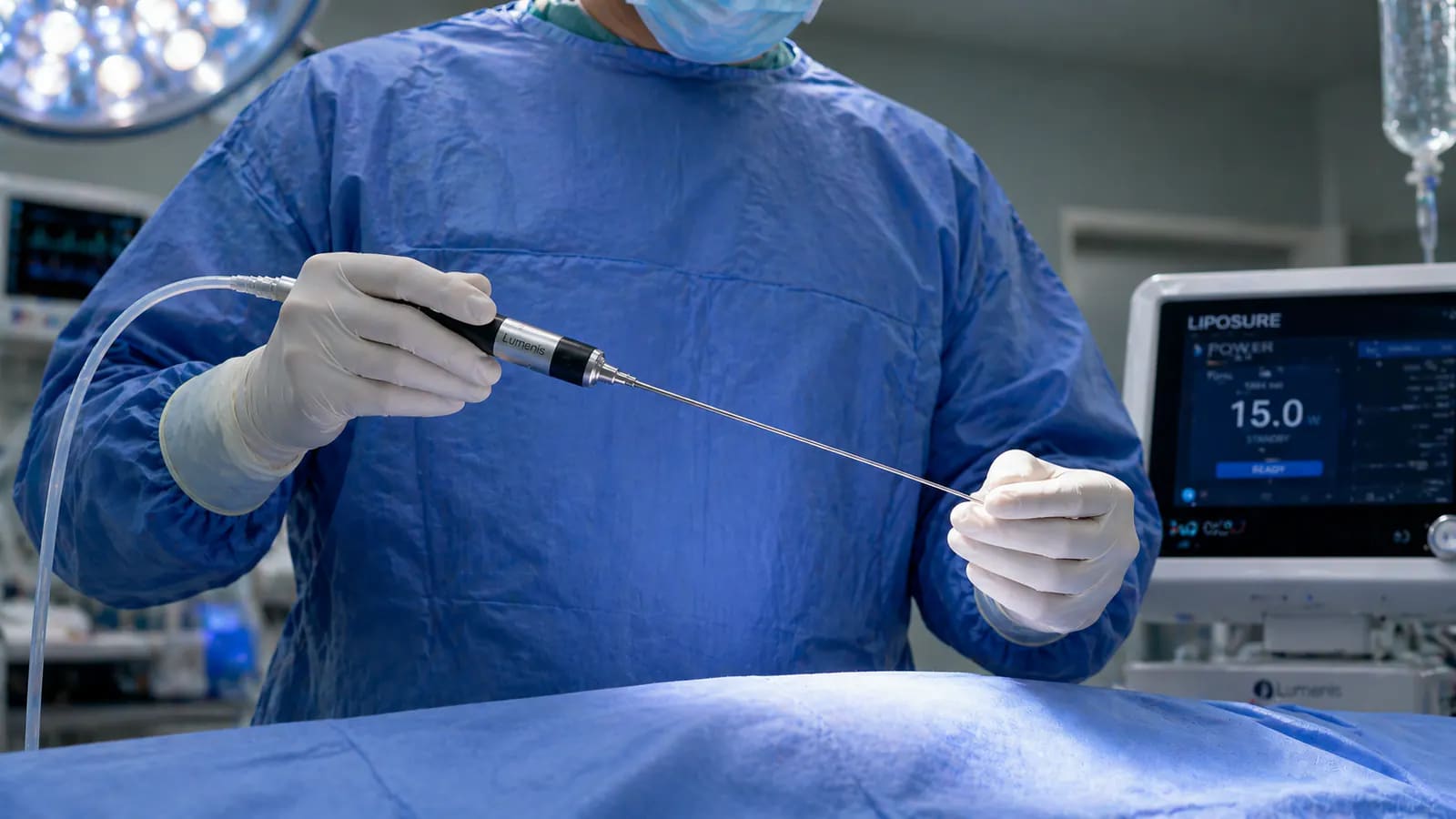
Before anything else: "laser liposuction" refers to two entirely different procedures, and the internet does a poor job of separating them.
Surgical laser-assisted liposuction (SmartLipo, SlimLipo, ProLipo) is a real surgical procedure. A board-certified surgeon makes small incisions, threads a laser fiber through fatty tissue to liquefy fat cells, and suctions them out. You're treated in a proper surgical facility under local anesthesia. Results are permanent. Recovery takes a few days to a few weeks.
Non-invasive laser lipolysis (LightRx, i-Lipo, Zerona) is something else entirely. No incisions. No cannulas. A device sits on your skin and delivers low-level laser energy to disrupt fat cells, which your body metabolizes over several weeks. It's a med-spa treatment with modest, temporary results.
This guide covers surgical laser liposuction — the one with lasting outcomes.
What Is Laser Liposuction?
Laser liposuction is a minimally invasive fat-removal procedure that uses concentrated laser energy to liquefy fat cells before they're suctioned out. The key distinction from traditional liposuction: the fat is melted first, which allows smaller cannulas, requires less physical force — and, uniquely, triggers collagen production that firms the skin over the treated area.
The best-known brand is SmartLipo, developed by Cynosure and FDA-cleared for fat removal since 2006. Other systems include SlimLipo (Palomar), ProLipo Plus (Sciton), and CoolLipo. These platforms use slightly different laser wavelengths but operate on the same principle.
Laser lipo is classified as minimally invasive because it does require small incisions — typically 1–2mm, smaller than a grain of rice. It is, however, less invasive than traditional tumescent liposuction: the incisions are finer, the cannulas are smaller, and most procedures can be completed under local anesthesia without general anesthesia or sedation.
How Laser Liposuction Works: Step by Step
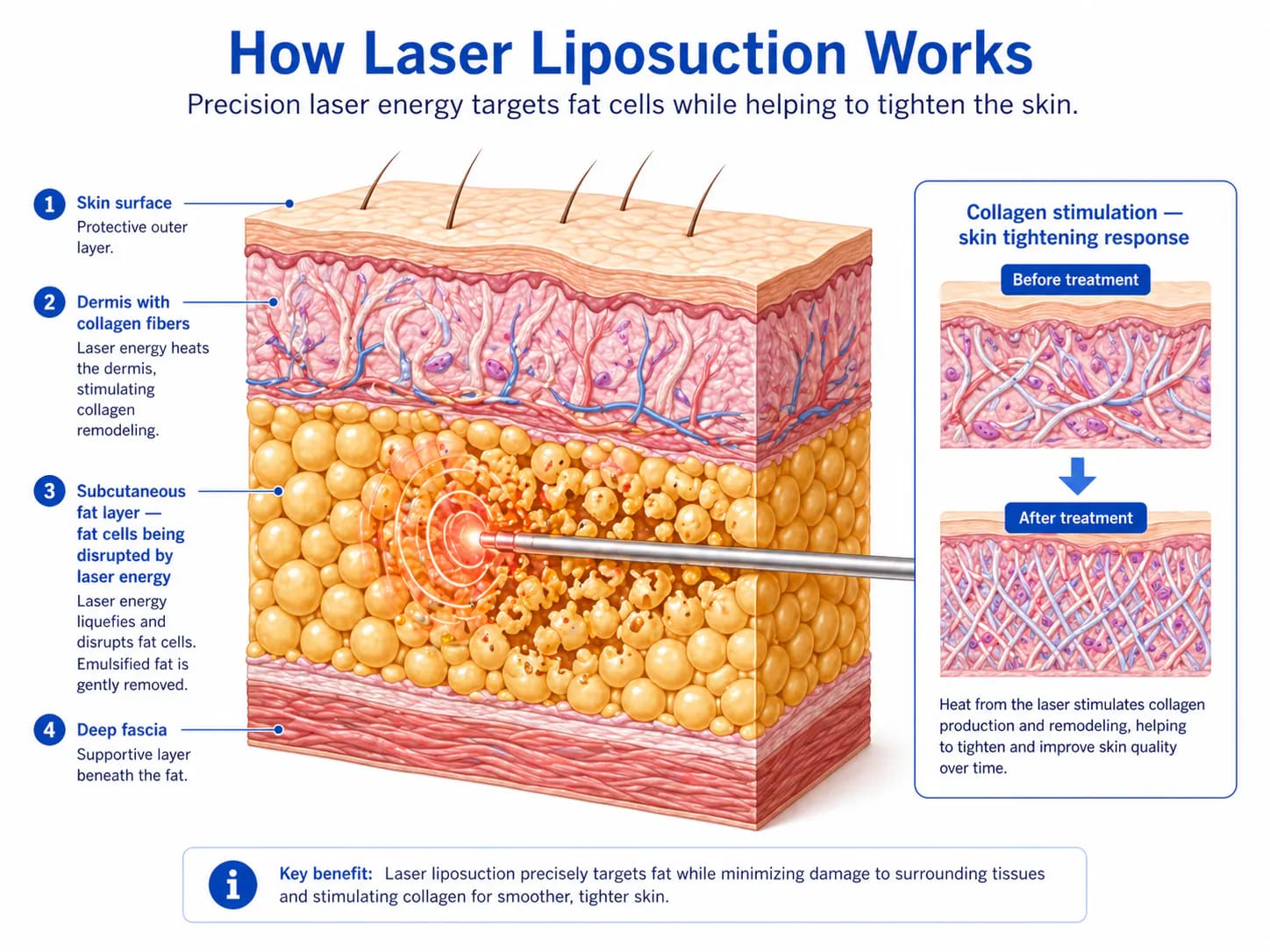
Understanding the mechanics helps you have a better consultation. Here's what actually happens during a procedure.
Step 1: Tumescent anesthesia
The surgeon injects a solution of saline, lidocaine (local anesthetic), and epinephrine into the treatment area. This numbs the tissue, constricts blood vessels to reduce bleeding, and begins to loosen the fat. Most laser lipo procedures are performed entirely under tumescent local anesthesia. IV sedation is available at most facilities for anxious patients, but general anesthesia is rarely required.
Step 2: Laser fiber insertion
A thin fiber-optic laser is threaded through a tiny incision and guided beneath the skin into the fatty layer. The surgeon moves it in controlled passes through the target tissue.
Step 3: Fat liquefaction
The laser fires at specific wavelengths — typically 1064nm, 1320nm, or a combination — generating thermal energy that ruptures fat cell membranes and converts solid fat to liquid form. This is the defining mechanism of laser lipo. It's also what separates it from VASER (which uses ultrasound) and from traditional lipo (which relies on mechanical disruption by a blunt-tipped cannula).
Step 4: Suctioning
A small cannula removes the liquefied fat. Because the fat is already in liquid form, less suction force and less physical movement are required — which is why bruising and post-operative swelling tend to be less severe than with traditional liposuction.
Step 5: Collagen stimulation
This is the part most patients don't anticipate. The thermal energy from the laser doesn't just liquefy fat — it also heats the dermis, stimulating collagen production. Over 3–6 months post-procedure, the skin over the treated area gradually tightens and firms. Multiple peer-reviewed studies have confirmed this collagen response is real and measurable. It's the primary clinical reason patients choose laser over traditional lipo for areas like the neck, arms, and inner thighs.
Total procedure time: a single area (chin or inner knees) typically takes 45–90 minutes. Multiple areas together can run 2–3 hours.
Laser vs Traditional Liposuction: The Honest Comparison
Laser lipo marketing often frames it as a straight upgrade over traditional liposuction. That's not quite right.
| Laser Liposuction | Traditional Tumescent Lipo | |
|---|---|---|
| Mechanism | Heat + suction | Mechanical disruption + suction |
| Anesthesia | Local (usually) | Local or general |
| Incision size | 1–2mm | 3–5mm |
| Fat volume per session | Moderate (1–2 liters ideal) | High (up to 5+ liters safe) |
| Skin tightening | Yes — collagen stimulation | Minimal |
| Return to work | 2–5 days typically | 5–10 days typically |
| Risk of thermal injury | Present (small but real) | Absent |
| Cost | Higher (technology fee) | Lower per area |
| Best for | Smaller areas, skin laxity | Large-volume, multi-area |
The honest conclusion: if you need to remove a substantial amount of fat — a full abdomen, large flanks, multiple major areas — traditional liposuction or VASER is usually the better tool. Laser lipo performs best in smaller, more defined zones where precision and skin tightening matter more than raw volume.
For chin and neck? Laser lipo is hard to beat. For arms, inner thighs, knees? Strong candidate. For full-body contouring with aggressive fat removal across multiple large areas? Traditional or VASER gives surgeons more clinical range.
Laser vs VASER Liposuction: A More Meaningful Comparison
At the premium end of the market, this is the comparison that actually matters. Both technologies are less traumatic than traditional lipo. Both allow greater precision. The difference is in energy type — and that difference has real clinical implications.
Laser uses thermal energy. The fiber generates heat that melts fat cells and heats surrounding tissue. The skin-tightening response is laser lipo's strongest clinical argument. The tradeoff: heat carries a small but real risk of thermal injury to surrounding tissue if the surgeon is inexperienced or moves the fiber too slowly in a given area.
VASER uses ultrasonic energy — sound waves at precise frequencies that selectively disrupt fat cell membranes without generating the same tissue heat. VASER causes less overall tissue trauma, which typically means less bruising, less swelling, and somewhat faster healing. VASER is also the preferred technology for high-definition liposculpture — etching athletic musculature onto the abdomen or chest — because it allows surgeons to work closer to the muscle fascia safely.
Where laser wins: skin tightening. The collagen response from laser energy is more reliable and pronounced than what VASER produces in most studies. For patients with meaningful skin laxity in a smaller area — loose skin under the chin, slightly sagging inner arms — laser lipo has a genuine clinical advantage.
Where VASER wins: large-volume cases, fibrous tissue (back, flanks), high-definition sculpting goals, and overall tissue preservation across multi-area procedures.
Neither technology is universally superior. The right choice depends on your anatomy, the treatment area, how much fat needs to come out, and the condition of your skin. This is the exact conversation to have at a board-certified consultation — ideally with a surgeon who offers both techniques and has no financial stake in steering you toward one.
Results: What Laser Liposuction Actually Delivers
Fat removal is permanent. The liquefied, suctioned fat cells don't grow back. That said, remaining fat cells in the treated area can still expand if you gain significant weight — so maintaining your weight is essential to preserving results long-term.
Volume: Laser lipo is effective for moderate fat removal in targeted areas. It's not the right tool for removing large volumes; for that, traditional lipo or VASER (or a combination) is more appropriate.
Skin tightening: The evidence here is solid. Studies published in peer-reviewed journals have confirmed laser-assisted liposuction produces measurable dermal thickening and skin retraction not seen with traditional techniques. The effect builds over 3–6 months as collagen remodels — you won't see it immediately, but most patients notice significant improvement by the 3-month mark.
Result timeline:
- Days 1–7: Swelling prominent, bruising developing — no visible final result
- Weeks 2–4: Most bruising resolved, emerging contour visible through residual swelling
- Months 1–2: Majority of swelling gone, shape clearly emerging
- Months 3–6: Final results — including full skin-tightening effect
What laser lipo is not: It's not a weight-loss procedure. The amount of fat removed is measured in liters, not pounds — most patients see minimal change on the scale. What changes is the shape and contour of specific areas, not total body weight.
Recovery: What to Expect Week by Week

Recovery from laser liposuction is lighter than traditional lipo. Most patients are surprised by how functional they feel within the first 72 hours.
Days 1–3:
Soreness and swelling — roughly similar to a hard workout in the treated area, but without sharp pain. Over-the-counter pain medication is usually sufficient. A compression garment goes on immediately post-procedure and stays on for 2–4 weeks; this is not optional. It reduces swelling, supports healing tissue, and helps the skin conform to the new contour.
You'll likely notice drainage from the incision sites on day one — tumescent fluid leaving the body. This is expected and usually resolves within 24–48 hours.
Week 1–2:
Most patients return to desk work or light activity within 2–5 days, depending on how many areas were treated. Bruising peaks around days 3–5 then fades. Swelling is the main issue during this period — the treated area will look swollen, not yet like the final result. Managing expectations here matters. Patients who expect to see their result at week two are disappointed. Those who know week two is still the healing phase are not.
Weeks 3–6:
Significant improvement in bruising and swelling. The emerging contour becomes visible. Compression garment wear typically transitions to daytime-only or stops, per surgeon's instructions. Light exercise — walking, low-impact cardio — is usually cleared by weeks 3–4.
Months 2–6:
Residual swelling fully resolves. Fat distribution settles into final position. Skin tightening builds during this period as collagen remodels. Most patients see their final result at 3 months; for areas with more pronounced laxity improvement, 6 months is more accurate.
One thing most recovery guides skip: the swelling is psychologically frustrating. The body takes time to resolve it, and the results don't look "done" for weeks. Surgeons who prepare patients for this — and patients who go in knowing it — have a much better experience of recovery. The result is worth the wait. But knowing the timeline upfront makes that wait easier.
How Much Does Laser Liposuction Cost?

Laser liposuction in the US typically costs $2,500–$8,000 per treatment area. Most patients treat one to three areas in a single procedure.
By treatment area:
| Area | Typical Cost Range |
|---|---|
| Chin / neck | $2,000–$4,000 |
| Arms (per arm) | $2,500–$5,000 |
| Inner / outer thighs | $3,000–$6,000 |
| Abdomen (localized zone) | $3,000–$6,500 |
| Flanks / love handles | $2,500–$5,500 |
| Knees | $1,500–$3,500 |
What drives the price:
- Number of areas: Multi-area procedures are usually discounted per additional area — the $999/area add-on model is common
- Surgeon experience: Board-certified plastic surgeons with high case volumes in body contouring charge more, and it's usually worth it
- Geographic market: NYC, Beverly Hills, and Miami typically run 20–40% higher than the national average
- Facility: Accredited surgical centers and hospitals carry higher overhead than office procedure rooms — both can be safe, but check accreditation status
- Anesthesia type: Tumescent local anesthesia keeps costs down; adding IV sedation or general anesthesia adds $500–$2,000+
Why laser costs more than traditional lipo:
SmartLipo and similar systems are expensive capital equipment — units run $80,000–$150,000. Practices with laser systems pass a technology fee to patients, on top of the surgeon's fee and facility costs. The premium is real. Whether it's worth it depends on whether the skin-tightening benefit is clinically meaningful for your specific case.
What's often not included in the quoted fee:
Pre-operative labs, compression garments ($50–$150 out of pocket), post-operative follow-up visits beyond the initial included set, and any revision work. Ask specifically what's included before you sign a consent form.
Insurance: Laser liposuction is elective cosmetic surgery and is not covered by health insurance in any standard plan. CareCredit and Alphaeon are the most common financing options available at plastic surgery practices.
For full cost breakdowns by city, body area, and comparison across procedure types, see our complete liposuction cost guide.
Is Laser Liposuction Right for You?
The ideal candidate isn't defined by a body type. It's defined by a clinical picture.
You're a strong candidate if:
- You're within 25–30 lbs of your goal weight (lipo is not a weight-loss tool)
- You have specific, localized fat deposits that haven't responded to diet and exercise
- You have mild to moderate skin laxity in the target area, where tightening would be beneficial
- You're in good overall health, non-smoking or willing to stop 4+ weeks before surgery
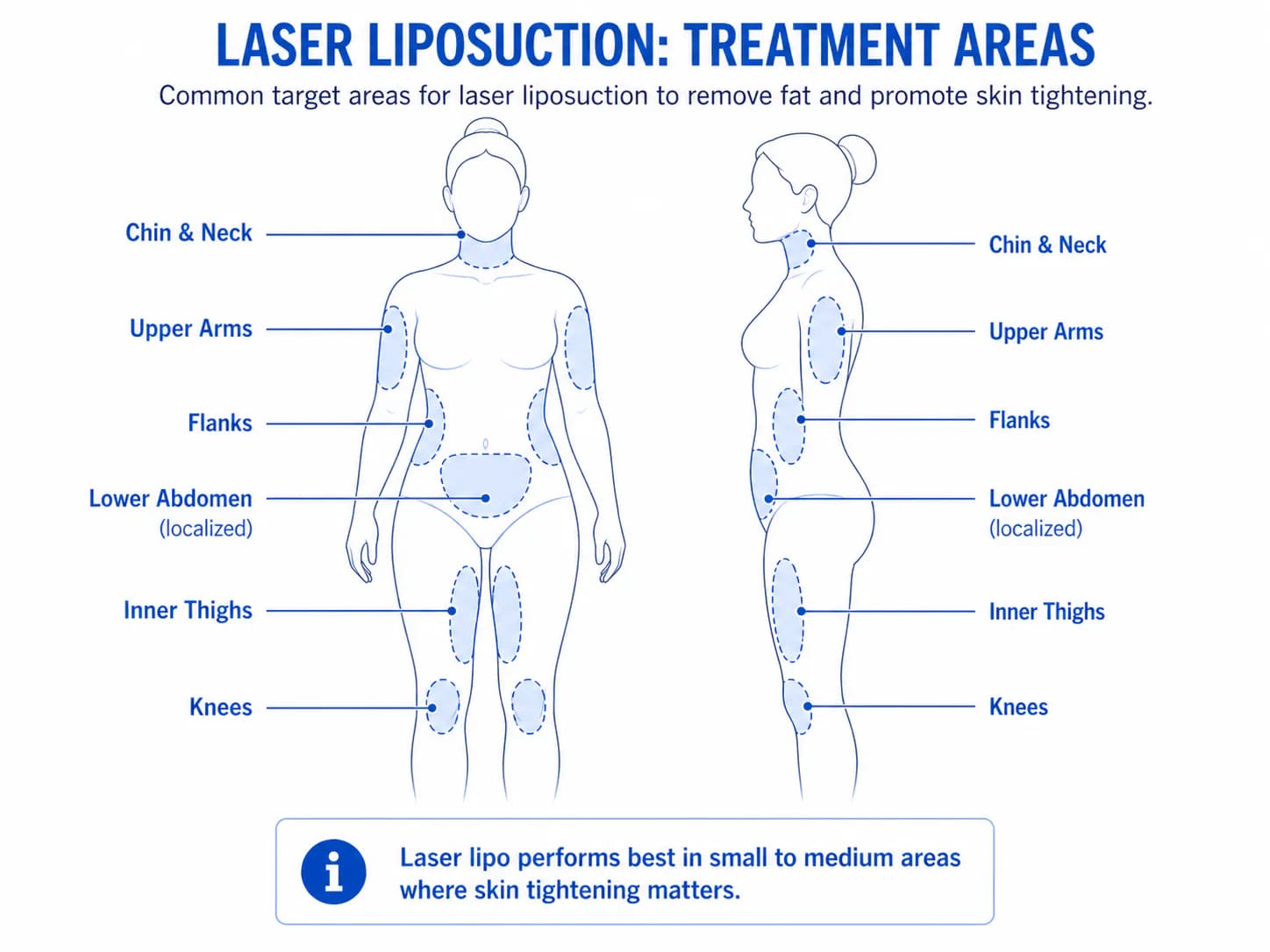
- The target areas are small to medium in size — chin, arms, inner thighs, localized abdominal zones
When traditional lipo or VASER is likely a better fit:
- Large-volume fat removal — Laser lipo sessions are typically capped at 1–2 liters to manage thermal exposure; traditional or VASER lipo offers more range
- High-definition sculpting — VASER is the preferred technology for HD liposculpture and muscular definition
- Severe skin laxity — Laser lipo's skin-tightening effect is real but limited; significant excess skin usually requires a surgical excision procedure (tummy tuck, arm lift, thigh lift)
- Multiple large areas in one session — Full-body contouring with aggressive fat removal across major zones is better served by traditional techniques
The most important thing to understand before choosing: laser lipo is a tool, not a universal solution. A board-certified surgeon who offers multiple techniques will tell you honestly which one fits your anatomy. One who offers only laser lipo will, predictably, tell you that laser lipo is best for you.
Questions to Ask at Your Consultation
Get clear answers to these before you book any procedure.
1. Are you board-certified by the American Board of Plastic Surgery? The ABPS is the relevant certifying body for plastic surgeons. "Board-certified" without specifying which board is a red flag — there are dozens of boards, and not all of them reflect meaningful training standards.
2. How many laser liposuction procedures have you performed? For isolated areas like the chin or knees, 50–100 cases is reasonable. For multi-area or complex body contouring, ask for higher case volume.
3. Do you offer multiple liposuction techniques? A surgeon who offers only laser lipo will consistently recommend laser lipo. A surgeon with multiple tools in the kit will tell you which one actually fits your anatomy — including when laser lipo is not the right choice.
4. Where will the procedure be performed? Accredited surgical centers (AAAASF, AAAHC, or JCAHO accredited) have passed independent safety reviews. Office-based procedure rooms may or may not be accredited. Ask.
5. What does the quoted fee include? Compression garments, follow-up appointments, and any touch-up procedures are sometimes separate costs. Get the full picture before you decide.
How to Find a Board-Certified Laser Liposuction Surgeon
The American Board of Plastic Surgery maintains a verified database of board-certified plastic surgeons at abplasticsurgery.org. The ASPS (American Society of Plastic Surgeons) and ASAPS (American Society for Aesthetic Plastic Surgery) also publish member directories — surgeons in these organizations have met specific training and ethics requirements.
When evaluating individual surgeons, before-and-after photos are your most useful tool. Look specifically at cases on patients with similar anatomy to yours — similar body type, similar treatment areas, similar starting skin laxity. Consistent, natural-looking results across multiple patients tell you far more than one exceptional case ever can.
lipo.com's surgeon directory lets you search by procedure technique and geographic area — so you can filter specifically for surgeons with laser liposuction training and verified board certification.
What is laser liposuction?
Laser liposuction is a minimally invasive fat-removal procedure that uses concentrated laser energy to liquefy fat cells before they're suctioned out through a thin cannula. The most common brand is SmartLipo. Unlike non-invasive laser treatments, surgical laser lipo requires small incisions and produces permanent fat removal — with a skin-tightening bonus from thermal collagen stimulation.
Is laser liposuction better than traditional liposuction?
It depends on the case. Laser lipo is better for smaller, more precise areas where skin tightening is a goal — chin, arms, inner thighs. Traditional lipo is generally better for high-volume fat removal across large areas. Neither is universally superior; the right choice depends on anatomy, treatment area, and desired outcome.
How long do laser liposuction results last?
Permanently, as long as you maintain your weight. The removed fat cells don't come back. However, remaining fat cells in the treated area can expand with significant weight gain, which can affect the result.
Is laser lipo painful?
Most patients describe recovery as sore rather than sharply painful. The procedure itself is performed under tumescent local anesthesia — patients feel pressure but not pain. Post-operative discomfort is generally manageable with over-the-counter pain medication. The compression garment is often reported as the most uncomfortable part of recovery.
How much does laser liposuction cost?
Laser liposuction typically costs $2,500–$8,000 per treatment area in the US. Chin and neck procedures tend toward the lower end ($2,000–$4,000). Larger areas like the abdomen or thighs run $3,000–$6,500. Total cost for multi-area procedures is usually less than the per-area rate multiplied out, as most practices discount additional areas.
What is the recovery time for laser liposuction?
Most patients return to desk work or light activity within 2–5 days. A compression garment is worn for 2–4 weeks. Bruising and swelling resolve over 3–6 weeks. Final results — including the full skin-tightening effect from collagen remodeling — are typically visible at 3–6 months.
Does laser liposuction tighten skin?
Yes, in a real and measurable way. The thermal energy from the laser stimulates collagen production in the dermis, producing skin tightening over 3–6 months post-procedure. This is one of the main clinical advantages over traditional liposuction, which produces minimal skin tightening. The effect is significant for areas with mild to moderate laxity — but significant excess skin still requires a surgical skin-excision procedure.
What areas can laser liposuction treat?
Laser lipo is well-suited for the chin and neck, arms, inner and outer thighs, flanks, localized abdominal zones, and knees. For large-volume fat removal across major body areas, traditional or VASER liposuction is generally preferred.
Medically reviewed by Dr. Rebecca Marsh, MD. Content is for educational purposes only and does not constitute medical advice. Consult a board-certified plastic surgeon for personalized guidance.
Internal links:
- How Much Does Liposuction Cost? (2026 National Guide)
- Arm Liposuction: The Complete Guide
- Find Board-Certified Laser Liposuction Surgeons Near You
