Most liposuction marketing presents technique as the primary differentiator — as if choosing VASER over a cannula determines your result. The reality is more nuanced: all three main techniques remove fat permanently, all produce good outcomes in appropriate patients, and the surgeon using the tool matters far more than which tool is used.
That said, the techniques do differ in meaningful ways — and those differences matter for specific patients and goals. Here's an honest comparison.
How Each Technique Works
Traditional Tumescent Liposuction
The foundation of all modern liposuction. A large volume of dilute tumescent solution — saline, lidocaine (local anesthetic), and epinephrine (which constricts blood vessels) — is infiltrated into the treatment area. This hardens the fat, reduces bleeding, and provides local anesthesia.
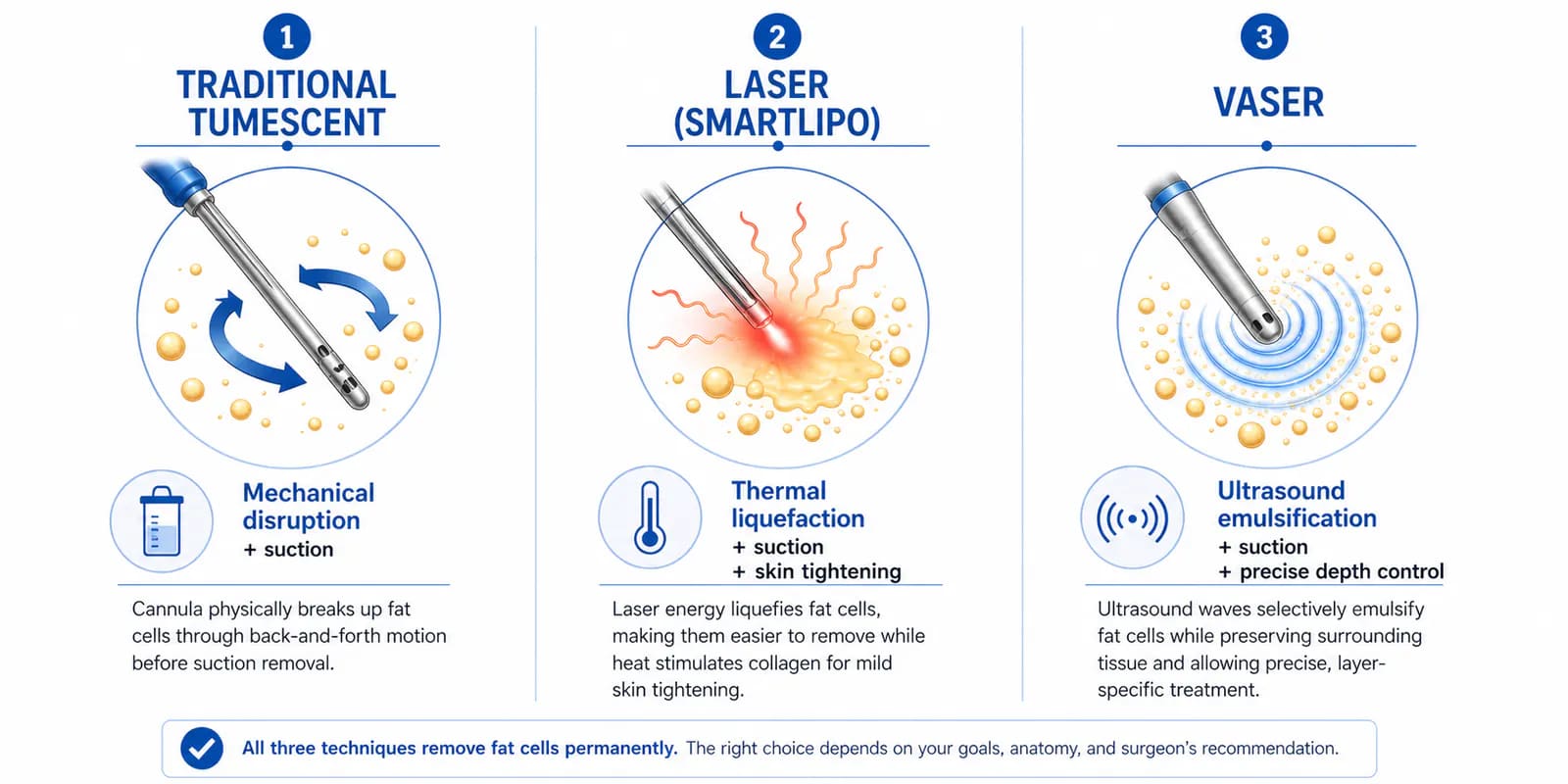
A thin cannula (hollow tube) is then inserted through small incisions and moved back and forth mechanically to break up fat and suction it out. The surgeon's hand motion, angle, and technique determine how evenly the fat is removed.
What it's best at: Straightforward fat reduction in areas with soft, easily accessible fat. Simple, well-understood, decades of evidence. The least expensive technique.
Limitations: Less effective in fibrous fat (common in male patients and certain body areas). No skin-tightening effect. Requires more physical force, which can increase bruising in some areas.
Laser-Assisted Liposuction (SmartLipo, SlimLipo, ProLipo)
A laser fiber is passed through small incisions into the fat layer. The laser energy thermally disrupts the fat cell membranes, liquefying fat before aspiration. The same thermal energy stimulates collagen contraction in the overlying skin — providing a mild tightening effect.
After laser application, the liquefied fat is suctioned out through a cannula (some surgeons allow some of it to drain naturally).
What it's best at: Areas where mild skin tightening is beneficial — inner arm, inner thigh, and areas with borderline skin elasticity. Also effective for fibrous fat areas.
Limitations: The thermal energy that tightens skin can also burn skin or deeper tissue if the probe is held too close to the surface or used too aggressively. Skin tightening effect is modest — not a substitute for surgery in patients who genuinely need a skin lift. Multiple branded devices (SmartLipo, SlimLipo, ProLipo) use different laser wavelengths with slightly different tissue effects.
VASER Liposuction (Ultrasound-Assisted)
VASER uses ultrasound energy delivered through a grooved titanium probe. The sound waves selectively disrupt fat cell membranes while largely preserving surrounding blood vessels, nerves, and connective tissue. The disrupted, emulsified fat is then aspirated.
VASER's key technical advantage is tissue selectivity: it targets fat cells preferentially without the collateral disruption to adjacent structures that mechanical or thermal methods produce. This allows more precise work — including sculpting at specific depths within the fat layer.
What it's best at: Fibrous fat areas (male flanks, back, fibrous chest fat), HD/high-definition liposculpture (muscle definition work), larger volume procedures where reduced blood loss matters, and revision liposuction where scarred tissue needs to be addressed.
Limitations: Introduces a VASER-specific risk — thermal injury from the probe if it contacts tissue incorrectly or is applied too aggressively. Costs more than traditional tumescent. Requires a learning curve to use optimally.
Head-to-Head: Where Each Technique Leads
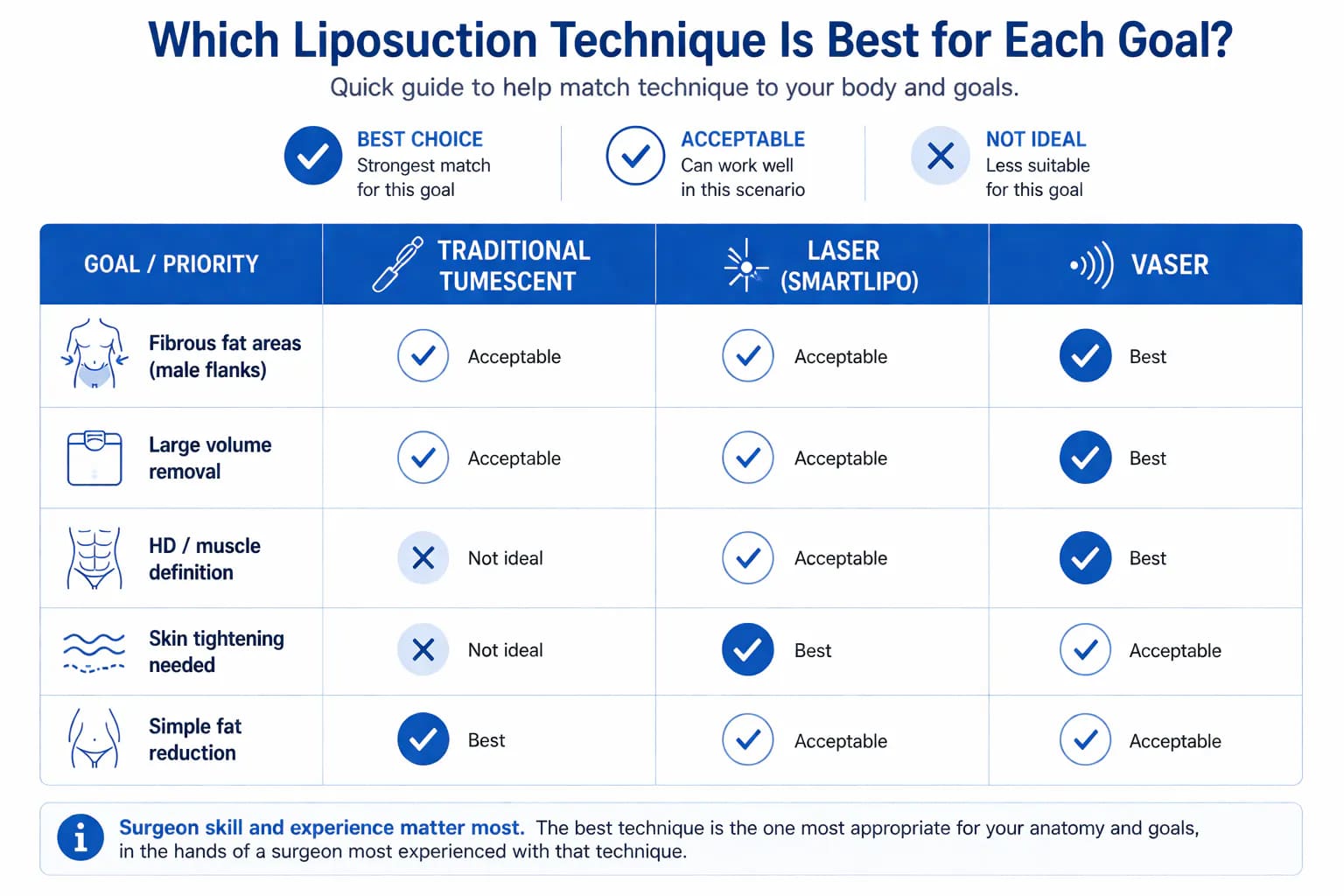
| Scenario | Best Technique |
|---|---|
| Simple fat reduction, soft tissue | Traditional tumescent |
| Fibrous fat (male flanks, back) | VASER |
| HD / muscle definition sculpting | VASER Hi-Def |
| Borderline skin elasticity | Laser-assisted |
| Revision / scarred tissue | VASER |
| Large volume (> 3,000cc) | VASER or traditional |
| Cost-conscious patient, good anatomy | Traditional |
The Skin-Tightening Question
Laser liposuction is heavily marketed on its skin-tightening benefit. This benefit is real — but often overstated.
What laser skin tightening does: The thermal energy denatures collagen in the dermis and subdermal layer, stimulating some contraction and new collagen formation. In patients with borderline skin elasticity, this can mean the difference between an acceptable and a very good result.
What it doesn't do: It cannot substitute for a surgical skin lift in patients with genuinely loose skin. Patients who need a tummy tuck, thigh lift, or arm lift based on significant skin laxity will not get equivalent results from laser liposuction — regardless of what marketing materials suggest.
VASER also produces some secondary skin tightening through heat generated during the ultrasound process, though this effect is less reliable and less specifically studied than laser skin tightening.
The Evidence: Does Technique Actually Change Outcomes?
A 2025 nationwide analysis of 69,424 liposuction patients found that laser-assisted and VASER liposuction showed approximately 50% lower complication rates than conventional (infusion-assisted) liposuction. However, this finding likely reflects the patient population and facility differences: VASER and laser procedures are disproportionately performed at high-volume specialist centers by experienced body contouring surgeons — the same factors that reduce complications independently of technique.
No well-designed head-to-head randomized controlled trials demonstrate consistently superior patient-reported outcomes for VASER or laser over traditional tumescent liposuction in appropriately matched patients. The studies that exist tend to show equivalent satisfaction with differences in specific secondary metrics (bruising, recovery, skin quality).
The most reliable predictor of outcome across all technique comparisons: surgeon volume and experience with the specific procedure.
Cost: The Real Price Difference
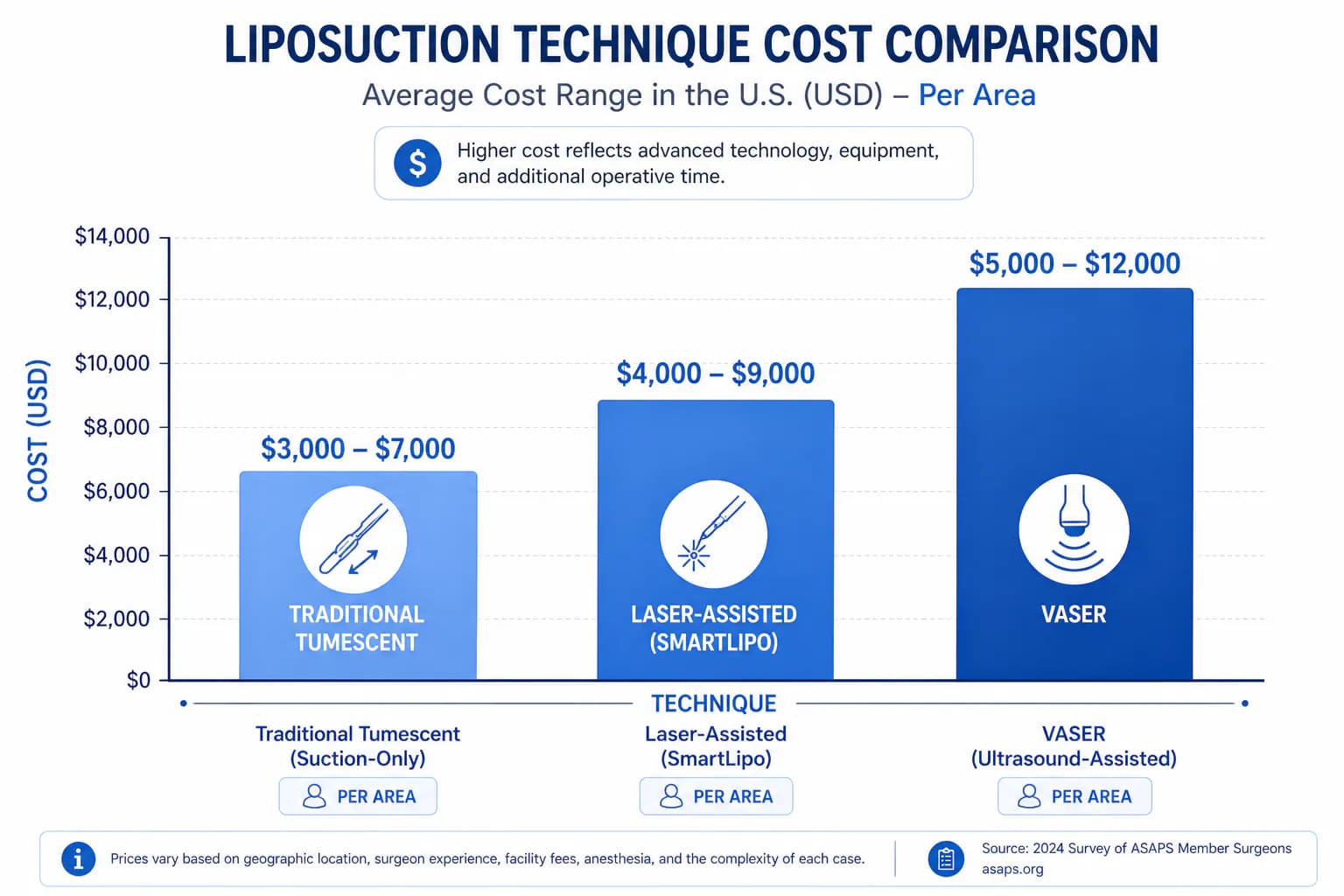
Technique choice affects your cost, and for patients without anatomy that specifically requires VASER or laser advantages, paying the premium may not be warranted.
| Technique | Typical Per-Area Cost Range |
|---|---|
| Traditional tumescent | $3,000 – $7,000 |
| Laser-assisted (SmartLipo, etc.) | $4,000 – $9,000 |
| VASER liposuction | $5,000 – $12,000 |
| VASER Hi-Def / HD liposculpture | $8,000 – $25,000+ |
The cost difference for the same body area between traditional and VASER can be $1,500 to $5,000. When VASER's specific advantages apply to your anatomy and goals, that premium is often worth it. When your anatomy doesn't require those advantages, you're paying for technology that won't change your result.
Red Flags in Technique Marketing
"VASER produces better results than traditional liposuction" — Without specifying the patient profile and surgeon, this claim is not supported by evidence. In the right hands with the right anatomy, VASER has specific advantages. Universally better? No.
"Laser liposuction tightens skin so you don't need a tummy tuck" — False for patients with significant skin laxity. Modest tightening for borderline cases; no substitute for surgery in genuine excess-skin patients.
"Our technique means no downtime" — All liposuction involves tissue trauma and requires a real recovery period. Any technique marketed as "no downtime" is overstating the case.
"We use the latest technology" as the primary selling point — The surgeon's experience with a technique matters more than how new the device is. A surgeon who performs 200 traditional tumescent procedures per year will produce more consistent results than one who does 20 VASER cases per year.
What Actually Matters More Than Technique
In order of impact on outcomes:
1. Surgeon board certification and experience: ABPS board-certified surgeons with high procedure volume produce consistently better results across all techniques. This single factor outweighs technique choice.
2. Candidacy selection: The best technique applied to the wrong candidate produces a poor result. A surgeon who honestly assesses your skin quality, fat distribution, and candidacy factors is more valuable than one with the best equipment.
3. Technique match to anatomy: VASER for fibrous tissue. Laser for borderline skin laxity. Traditional for straightforward soft-tissue fat reduction. Appropriate selection.
4. Post-operative care: Compression garment compliance, lymphatic massage, hydration, and activity restrictions all affect final results regardless of technique.
5. The specific device/technique: Meaningful in edge cases; less important than the four factors above.
What's the difference between the three techniques? Traditional: mechanical cannula disruption. Laser: thermal liquefaction + mild skin tightening. VASER: ultrasound emulsification, tissue-selective, depth-precise. All remove fat permanently.
Is VASER better than traditional? For specific scenarios (fibrous fat, HD sculpting, larger volumes) — yes, meaningfully. For soft, straightforward fat in good-candidate patients — the difference is modest and surgeon experience matters more.
Does laser lipo tighten skin? Mildly — useful for borderline skin elasticity. Not a substitute for a tummy tuck, thigh lift, or arm lift in patients with significant laxity.
Which technique has the best results? The one that matches your anatomy, performed by a surgeon experienced with that specific technique. No technique universally outperforms the others for all patients.
Is VASER safer? It's tissue-selective, which reduces collateral trauma. But it introduces a thermal injury risk from the probe. A 2025 study found lower complication rates with VASER/laser — likely reflecting the specialist centers that use these technologies.
How much more does VASER cost? Roughly 20–40% more than traditional for the same area. VASER $5,000–$12,000 vs. traditional $3,000–$7,000 per area.
Which technique is best for HD liposculpture? VASER — its depth-selective emulsification is what enables precise muscle-definition sculpting. Traditional tumescent cannot match VASER's depth control for HD work.
Does technique matter more than surgeon? No — surgeon expertise consistently outweighs technique choice in outcomes. Choose the most experienced board-certified surgeon you can find, then discuss which technique they recommend for your anatomy.
Sources & References
The technique comparisons, complication-rate findings, and outcome predictors discussed in this article reflect current peer-reviewed liposuction literature and American Society of Plastic Surgeons (ASPS) clinical guidance. Key sources: Safety Studies in the Field of Liposuction: A Systematic Review (PubMed, NIH) · Liposuction Complications in the Outpatient Setting — Cross-Sectional Analysis (PubMed Central, NIH) · ASPS — Liposuction Safety Patient Resource. Last medically reviewed July 2026 by Dr. Rebecca Marsh, MD, board-certified plastic surgeon.
