SmartLipo can be worth it. But not because it is automatically better than regular liposuction. SmartLipo is Cynosure's branded laser-assisted lipolysis platform, and the best evidence supports it as a selective body contouring tool rather than a universal upgrade over well-done tumescent liposuction.
The honest version is the one most competitor pages skip: SmartLipo's skin-tightening effect is real but modest, and it does not replace surgery when you truly need a lift. It also adds a heat-related risk profile, including thermal burns, that patient-facing marketing content often downplays.
What SmartLipo Actually Is
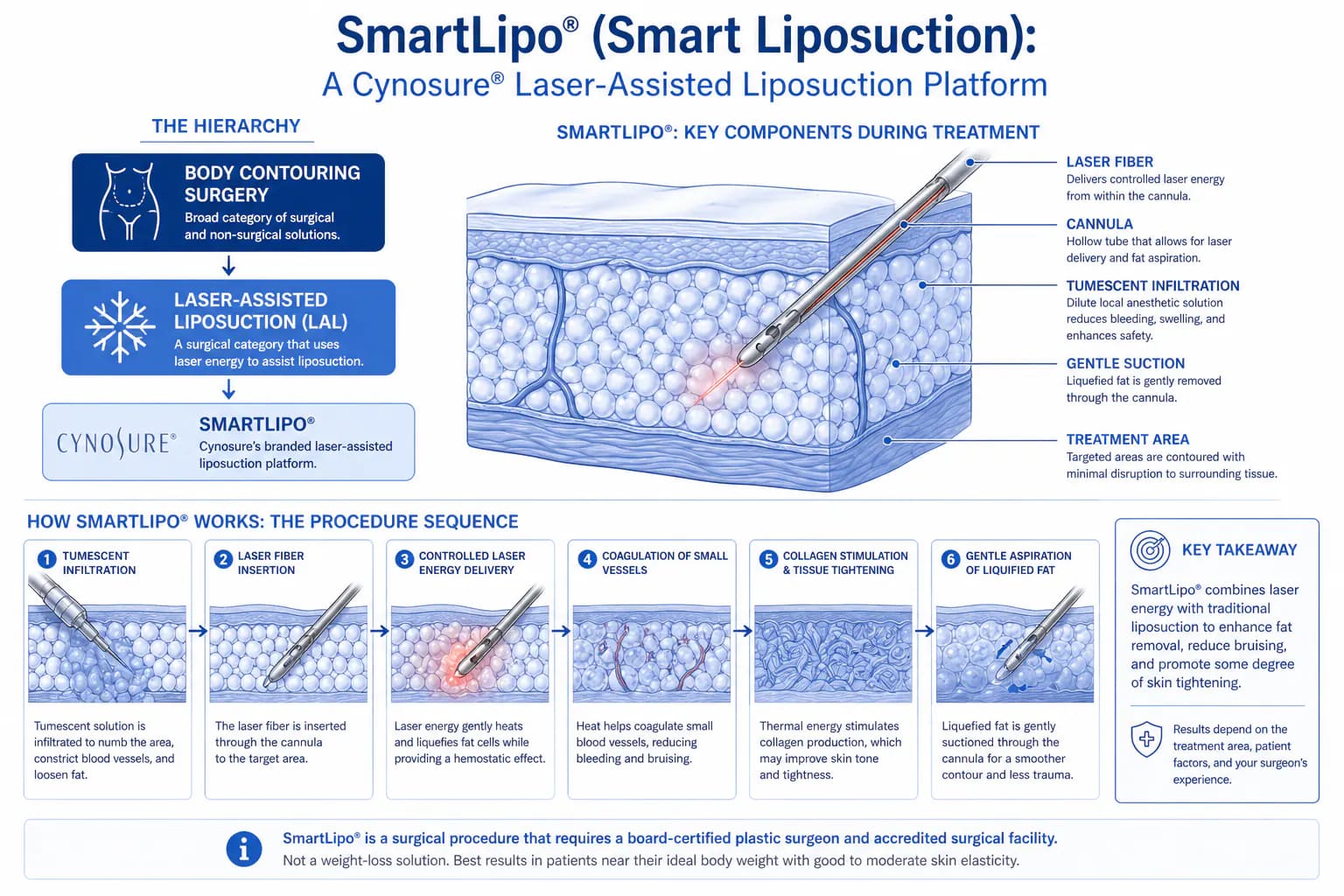
SmartLipo is not a generic term for every laser-lipo treatment. It is a Cynosure brand. Current Smartlipo Triplex systems offer laser lipolysis with 1064 nm, 1320 nm, and 1440 nm wavelengths that can be used in single or blended mode. Older SmartLipo discussions often focus on 1064 nm or 1064/1320 nm because those were the wavelengths used in earlier published studies.
In plain English, smart liposuction is still liposuction. The surgeon infiltrates tumescent solution into the treatment area, passes a thin laser fiber under the skin through a cannula, then removes the disrupted tissue with suction. The laser helps — it does not magically replace aspiration.
For the broader category rather than the brand, see our laser-assisted liposuction guide.
How the Technology Works
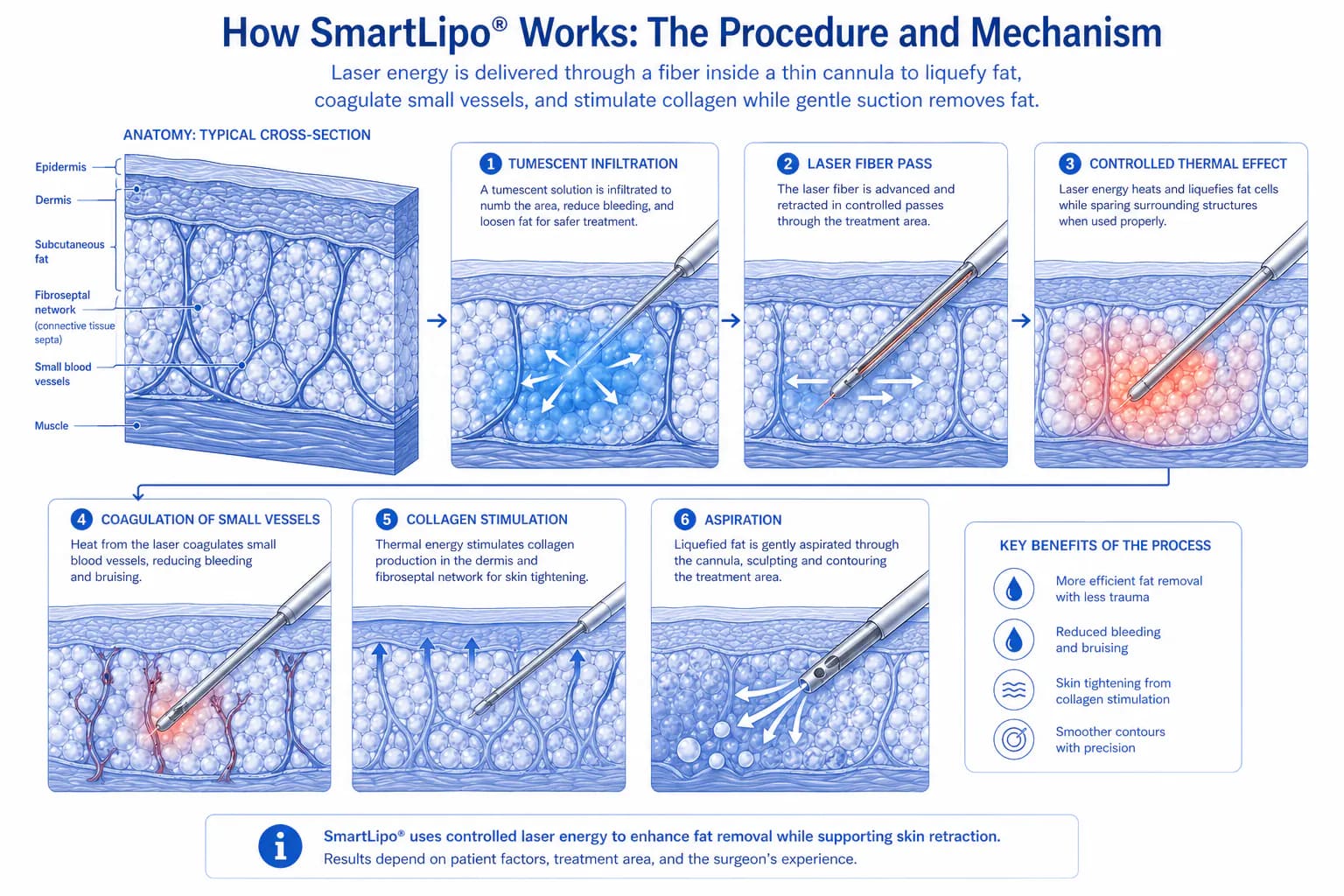
SmartLipo creates three useful effects at once: it disrupts adipose tissue, coagulates small blood vessels, and heats the fibroseptal network enough to produce some collagen remodeling. The real issue is not the logo on the machine but how precisely the surgeon controls depth, motion, and temperature.
| Step | What the surgeon does | Why it matters |
|---|---|---|
| Tumescent infiltration | Infuses fluid with local anesthetic and epinephrine into the treatment area | Improves comfort, reduces bleeding, and creates a safer working plane |
| Laser fiber pass | Advances a fiber inside a cannula beneath the skin | Delivers controlled thermal energy to disrupt tissue and coagulate vessels |
| Aspiration | Removes the treated material with suction | This is what actually creates the body contour |
| Compression and aftercare | Uses garments and recovery protocols | Helps manage swelling and supports smoother healing |
This sequence is why SmartLipo is technique-dependent. A surgeon who understands tumescent infiltration, cannula motion, and thermal control will usually matter more than the specific brand name on the console.
SmartLipo vs Traditional Liposuction
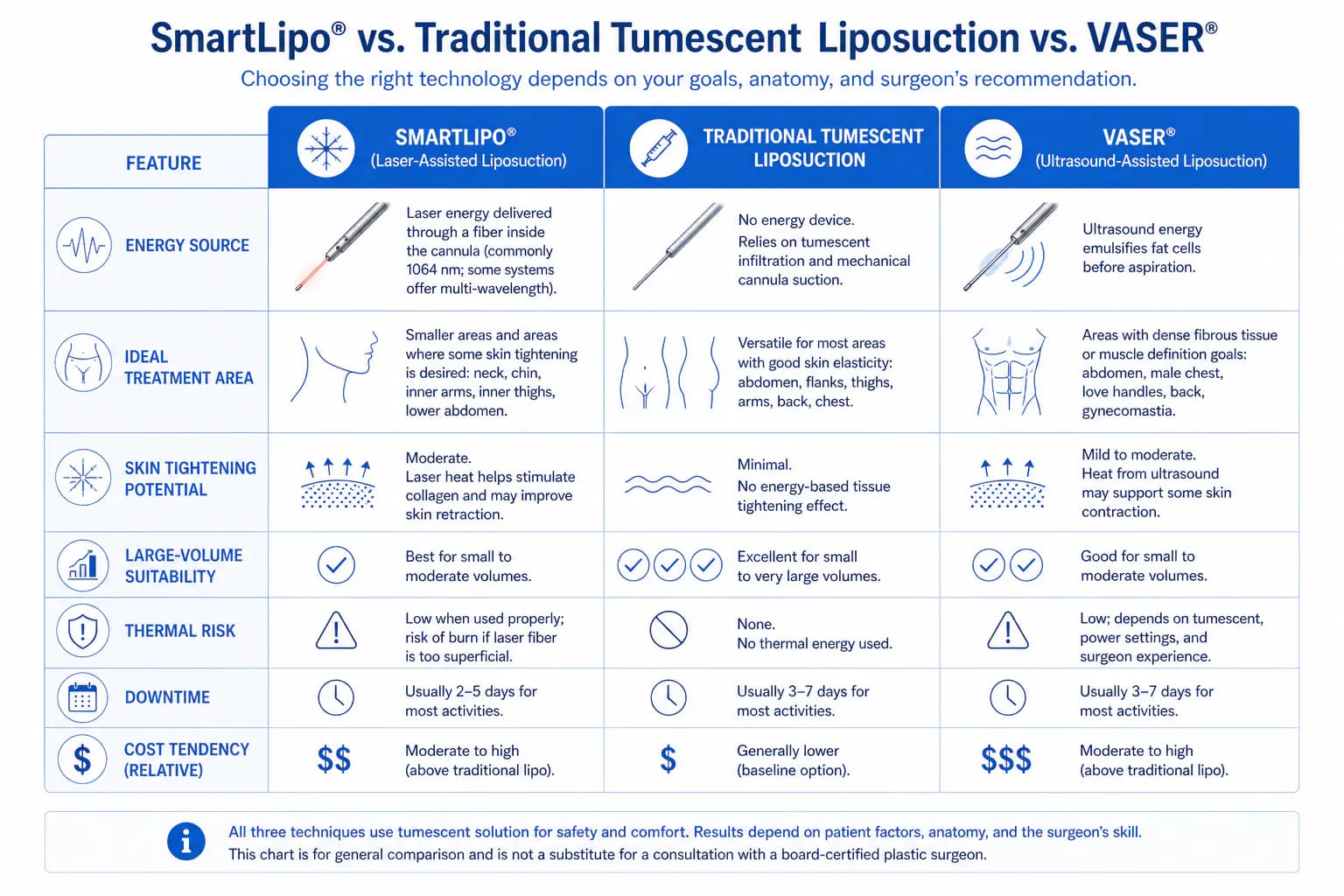
Usually not better — different. Reviews comparing laser lipolysis with tumescent liposuction show the technique can work for localized contouring, but the evidence does not show consistent superiority over standard tumescent liposuction. One review concluded that laser lipolysis is effective for localized fat reduction but that data is lacking to show it is superior to tumescent liposuction. Another review was blunter: no advantage over tumescent liposuction had been demonstrated.
| Feature | SmartLipo | Traditional tumescent liposuction |
|---|---|---|
| Primary mechanism | Internal laser energy plus suction | Mechanical suction after tumescent infiltration |
| Best fit | Smaller to moderate areas, selected borderline-laxity cases, some revision or fibrous areas | Larger-volume debulking, straightforward multi-area body contouring |
| Skin tightening | Possible modest edge | Relies mostly on natural skin recoil |
| Thermal burn risk | Yes | No laser-specific burn risk |
| Evidence base | Promising but mixed | Long-established surgical workhorse |
| Cost tendency | Often somewhat higher | Often somewhat lower in comparable cases |
| Recovery | Similar overall | Similar overall |
The right framing: SmartLipo is a tool, not an automatic upgrade button. For many abdomen, flank, or larger-volume cases, traditional tumescent liposuction in skilled hands produces equivalent results. For a full device-by-device comparison, see VASER vs laser vs traditional liposuction.
Skin Tightening — What It Actually Delivers
Laser liposuction is heavily marketed on its skin-tightening benefit. The benefit is real but often overstated.
In a five-patient study using sequential 1064/1320-nm treatment, average skin elasticity improved 26% and average skin shrinkage was 17% at three months. In a randomized split-abdomen study of 10 women with mild to moderate laxity, the laser-treated side showed significantly greater skin shrinkage and tightening than liposuction alone.
Here is what competitors miss: modest tightening is not the same thing as a lift. Mayo Clinic notes that after liposuction, skin can look loose when elasticity is poor, and that loose skin may still require additional surgery. The firming effect can be mild, but it will not match surgical skin removal such as a tummy tuck.
If a surgeon says SmartLipo may give you a bit more contraction in a borderline case, that is credible. If a surgeon says SmartLipo will replace a neck lift, brachioplasty, thigh lift, or abdominoplasty in a patient with obvious skin excess, that is sales language, not good candidate selection.
Best Body Areas for SmartLipo
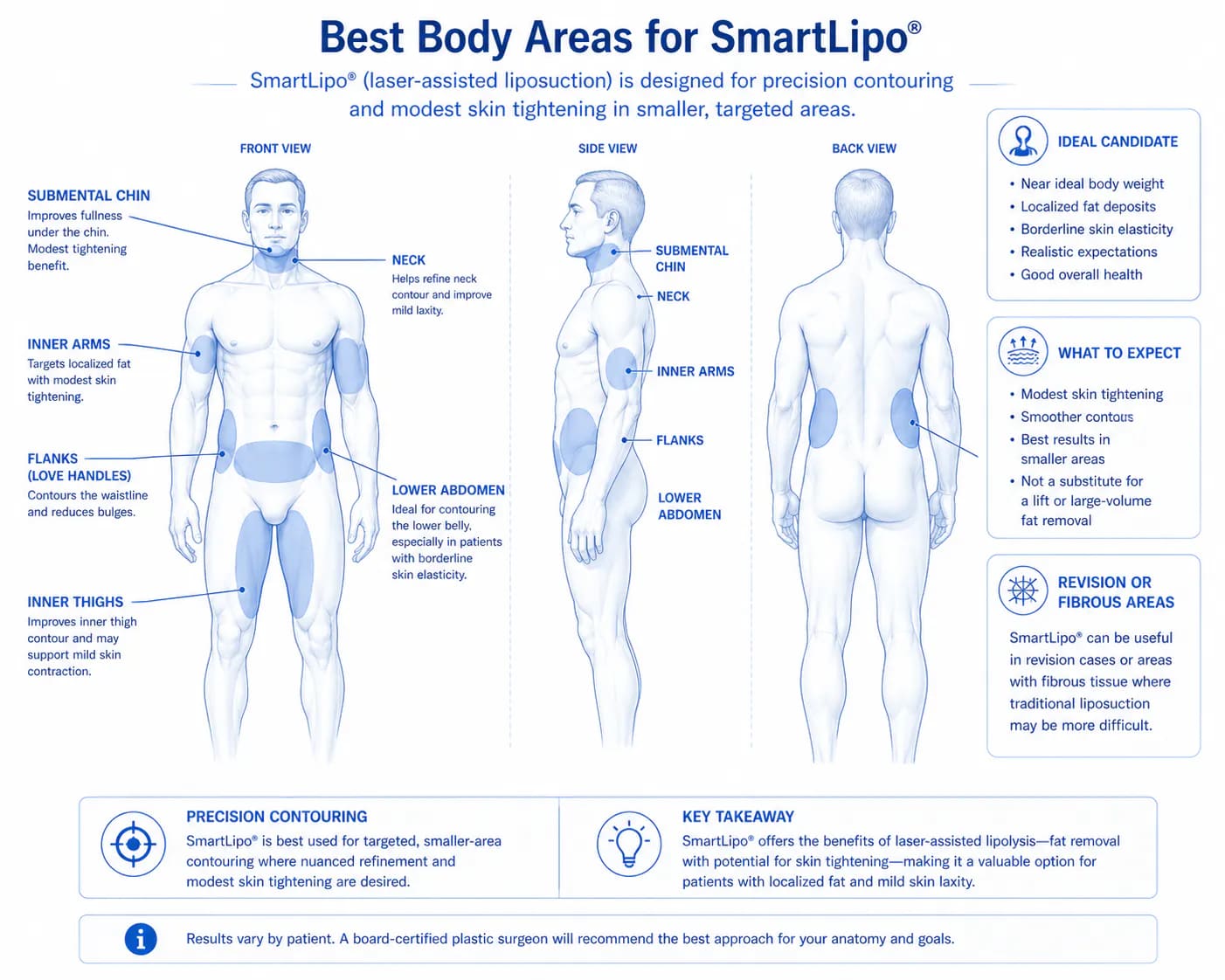
SmartLipo can treat most standard liposuction areas. Mayo Clinic lists the abdomen, upper arms, chest, back, hips, thighs, chin, and neck among common liposuction zones. Published Nd:YAG data also supports submental use, including an 82-subject report on neck and jowl laser-assisted liposuction. For area-by-area detail, see our stomach liposuction, thigh liposuction, and arm liposuction guides.
Where SmartLipo tends to earn its premium is where surgical precision and borderline skin elasticity matter at the same time — submental fullness, the inner arm, the inner thigh, and selected smaller revision or fibrous areas. Full cost context: SmartLipo cost by body area and the 2026 liposuction price guide.
| Treatment area | Why SmartLipo can make sense | When it is a poor fit |
|---|---|---|
| Submental chin and neck | A little extra contraction can matter a lot in a small space | Significant neck skin excess or lift-level laxity |
| Inner arms | Small-volume contouring plus borderline skin recoil | Heavy skin drape that really needs brachioplasty |
| Inner thighs | Modest tightening can help the contour read cleaner | Loose skin that points toward a thigh lift |
| Flanks or lower abdomen | Useful for selected contour cases | Large-volume debulking with major redundancy |
| Revision or fibrous areas | Heat may help in tougher tissue planes | Patients expecting major lifting instead of contour refinement |
SmartLipo can treat a wide range of areas. But it is not equally valuable in all of them.
What SmartLipo Can't Do
SmartLipo is body contouring. It is not weight-loss surgery. It does not treat obesity, and it does not fix cellulite or stretch marks.
It cannot out-laser bad skin quality. If your main issue is hanging skin, not localized adiposity, the right answer may be a lift, not smarter liposculpture. And if your main issue is bigger-volume contouring over several areas, the literature does not support treating SmartLipo as universally better than standard tumescent liposuction.
Cost Breakdown
Most patients should budget roughly $3,500 to $8,000 per area. Smaller treatment areas often sit near the lower end. Larger areas, multi-area liposculpture plans, or surgeon-skill premiums can push the total higher. Consumer pricing data places many cases in the mid-$3,000s to mid-$6,000s — CareCredit lists average SmartLipo costs by area around $3,065 to $5,196, with abdomen quotes from $3,984 to $9,107. RealSelf reports an average Smart Lipo cost of $6,530 with an observed range from $2,900 to $13,467.
For comparison, ASPS's current surgeon-fee range for liposuction overall is $4,300 to $7,500, while submental/chin liposuction is listed at $3,000 to $5,500. SmartLipo is not always dramatically more expensive than traditional liposuction, but it typically carries at least a modest premium in like-for-like cases.
| Cost driver | Why it changes the quote |
|---|---|
| Number of treatment areas | More areas means a larger total bill |
| Area size and complexity | Abdomen usually costs more than a small submental case |
| Surgeon credentials | ABPS board-certified, high-volume surgeons often charge more |
| Facility and anesthesia | Office-based local anesthesia can price differently than OR-based care |
| Revision or fibrous tissue | Harder cases often take longer and cost more |
When comparing quotes, confirm what is included: surgeon fee, anesthesia, facility fee, pre-op testing, post-op supplies, compression garments, medications, and follow-up care. Lowest quote is not the same as best value.
Recovery Timeline
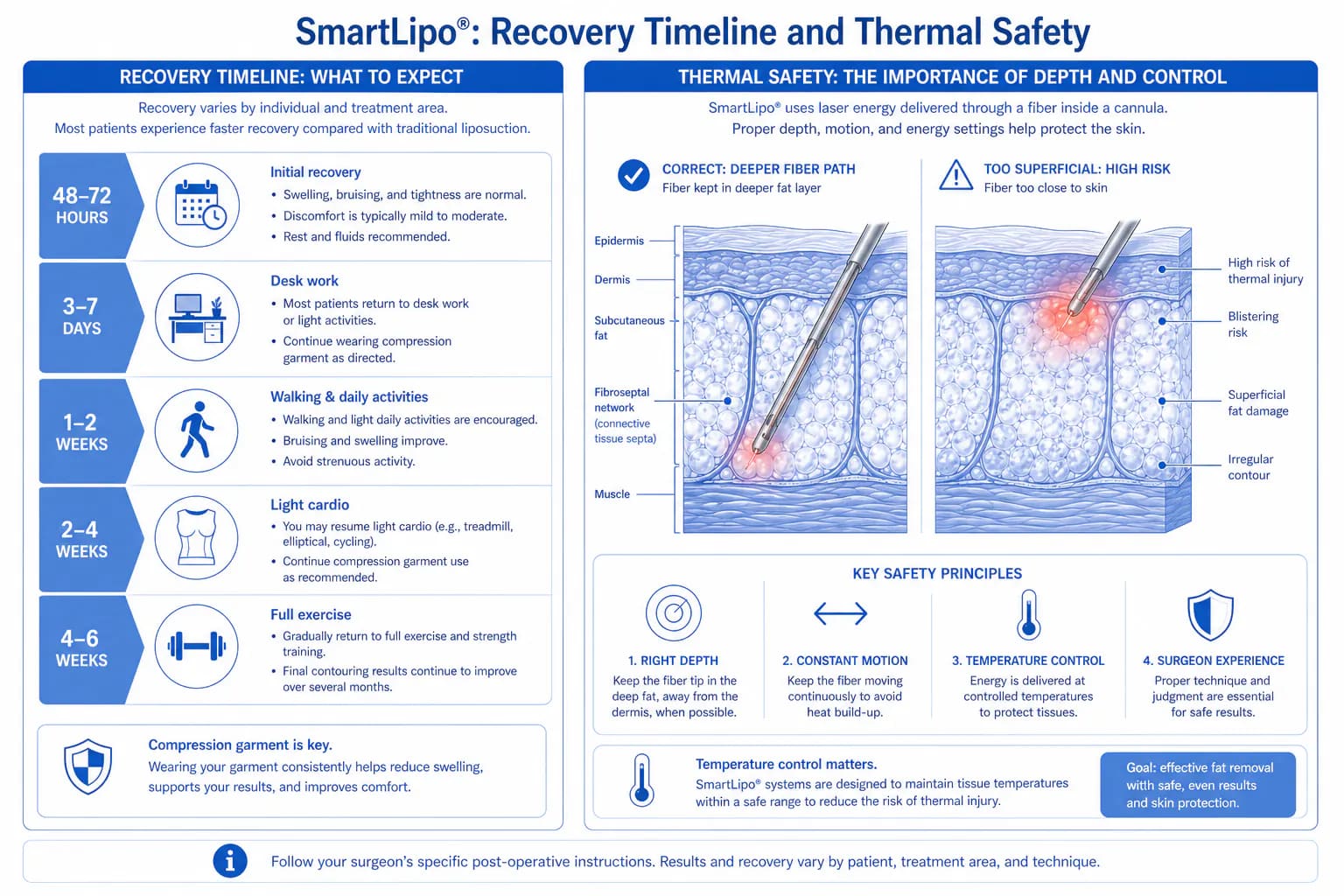
The recovery timeline is closer to traditional liposuction than most SmartLipo marketing pages suggest. Many patients resume normal daily activities within a day or two, but bruising, swelling, and compression garments are still part of recovery regardless of technique. For a week-by-week breakdown, see the complete liposuction recovery timeline.
A realistic planning range for uncomplicated SmartLipo: 48 to 72 hours for desk work, about 1 to 2 weeks before light cardio when cleared, and roughly 4 to 6 weeks for full exercise.
| Time after surgery | What most patients can expect |
|---|---|
| Days 1–3 | Swelling, drainage, soreness, compression garment, frequent walking |
| Week 1 | Desk work often possible, but bruising and swelling are still obvious |
| Weeks 2–3 | Daily life feels easier, light activity may restart if cleared |
| Weeks 4–6 | Gradual return to harder workouts and fuller activity |
| Months 3–6 | Swelling continues to settle and contour looks sharper |
SmartLipo should still be planned like surgery. Arrange time off. Expect compression. Do not book your social calendar based on the most optimistic ad copy.
The removed fat cells are gone, so results can last for years. Mayo Clinic puts it plainly: liposuction results usually last a long time if you maintain your weight. The practical caveat: remaining fat cells can still enlarge if you gain weight after surgery, which is why weight maintenance matters for long-term contour.
Risks — Including Thermal Injury
SmartLipo adds heat. Heat can help with coagulation and collagen response, but it also creates a device-specific complication that suction-only liposuction does not have: thermal injury.
This is not theoretical. In a 537-case laser-assisted lipolysis series performed under tumescent anesthesia, investigators reported five local complications including four skin burns, for an overall complication rate of 0.93%. In a 2024 meta-analysis covering 29,368 liposuction patients across techniques, contour deformity was 2.35% and superficial burn prevalence was 0.25%. A 2025 review of liposuction-assisted energy devices again identified skin burns among the most common complications reported in the literature.
The mechanism matters. Research on 1064/1320-nm laser-assisted lipolysis found that skin-surface temperatures above 47°C typically caused epidermal and dermal injury, with blistering above 58°C. Superficial subdermal heating within about 5 mm of the surface should limit skin-surface temperature to 42°C. Burns become more likely when the fiber runs too superficially, pauses in place, or delivers energy too aggressively.
| Risk | What it means for patients | Why surgeon selection matters |
|---|---|---|
| Thermal burn or blistering | Can lead to pigment change, delayed healing, or scar | Laser depth and temperature control are skill-dependent |
| Contour irregularity | Lumps, waviness, undercorrection, overcorrection | Planning and aspiration pattern matter more than branding |
| Seroma or hematoma | Fluid or blood collection under the skin | Technique and aftercare affect risk |
| Numbness, scarring, pigment change | Local healing issues that may linger | Skin quality and conservative settings matter |
| VTE, infection, anesthesia-related problems | Rare but important surgical risks | Good screening and safe systems reduce risk |
Current Smartlipo Triplex systems include SmartSense motion-based delivery and a ThermaGuide temperature-sensing cannula. Those features help — but safety still depends on the surgeon using them correctly. Before booking, read how to choose a liposuction surgeon.
What is SmartLipo? SmartLipo is Cynosure's branded version of laser-assisted liposuction. It uses an internal laser fiber — historically centered on 1064 nm and in current Smartlipo Triplex systems offering 1064, 1320, and 1440 nm options — to deliver controlled heat before aspiration through a cannula.
How much does SmartLipo cost? Most patients pay about $3,500 to $8,000 per area, with smaller cases at the lower end and larger or multiple areas higher. Consumer pricing data clusters many cases in the mid-$3,000s to mid-$6,000s, but abdomen and combined-area cases can exceed that.
Is SmartLipo better than traditional liposuction? Not across the board. It can be useful in selected smaller or borderline-laxity areas, but published reviews have not shown consistent superiority over standard tumescent liposuction.
Does SmartLipo tighten skin? Yes, modestly. Small studies showed measurable improvement in skin shrinkage and elasticity, but the effect is not equivalent to a tummy tuck, neck lift, arm lift, or thigh lift when there is real excess skin.
What is the recovery time for SmartLipo? Many patients return to desk work in 48 to 72 hours, but bruising, swelling, and compression garments still make the recovery feel surgical. Full exercise usually returns gradually around 4 to 6 weeks when the surgeon clears you.
What are the risks of SmartLipo? Risks include burns, contour irregularities, seroma, hematoma, infection, scarring, numbness, pigment change, and rare complications like venous thromboembolism. The risk most glossy pages underplay is thermal burn if the laser is used too superficially or too aggressively.
How long do SmartLipo results last? The removed fat cells are gone, so the contour change can last for years. But remaining fat cells can still enlarge if you gain weight, which is why weight maintenance matters for long-term results.
What body areas can SmartLipo treat? Common treatment areas include the submental chin and neck, upper arms, thighs, abdomen, flanks, chest, and back. SmartLipo tends to make the most sense in smaller to moderate treatment areas where surgical precision and a little extra contraction both matter.
