VASER liposuction uses ultrasound waves to break apart fat cells before they are removed — a fundamentally different approach from traditional liposuction, which relies on mechanical force. The result is less tissue trauma, less bruising, faster recovery, and more precise body sculpting. In the US, VASER costs between $5,000 and $15,000 depending on treatment areas, surgeon experience, and market.
This guide covers the full spectrum: how VASER works, where it outperforms traditional liposuction (and where it does not), what VASER Hi-Def means, what recovery actually looks like, and what to look for in a surgeon who knows how to use this technology correctly.
What Is VASER Liposuction?
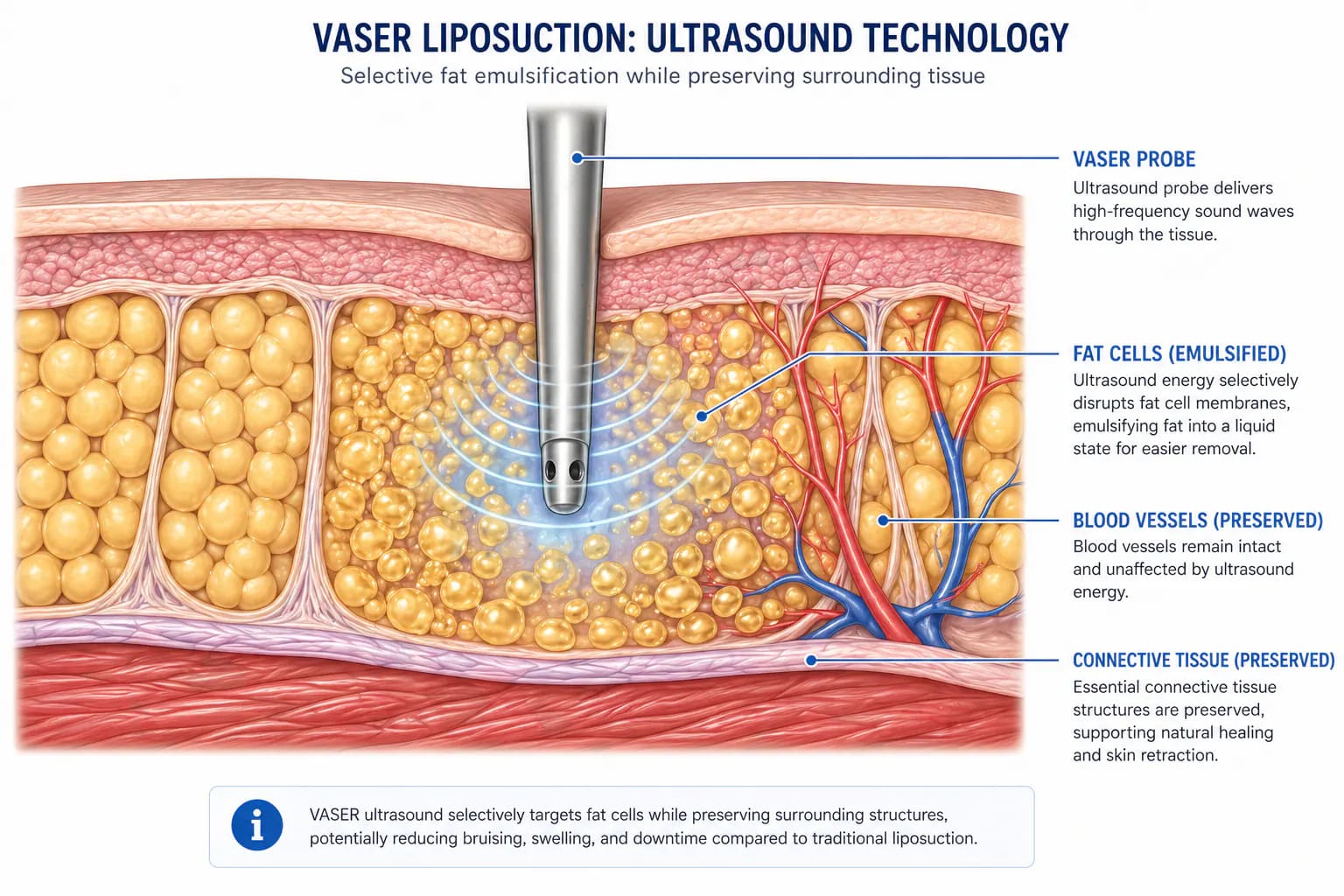
VASER stands for Vibration Amplification of Sound Energy at Resonance. The name describes what it does: an ultrasound probe inserted through small incisions emits high-frequency sound waves that selectively disrupt the bonds between fat cells, liquefying them while leaving the surrounding tissue largely intact.
That selectivity is what makes VASER different from everything else.
Traditional liposuction uses a cannula — a thin tube — to physically break apart and suction fat. The mechanical force is effective, but it is not selective. Blood vessels, connective tissue, and nerves in the treatment area take collateral damage, which is a primary reason for the bruising, swelling, and longer recovery traditional patients experience.
VASER's ultrasound energy targets fat cells specifically. Because the surrounding tissue — vasculature, connective tissue, nerve fibers — is spared from the same degree of disruption, the body's inflammatory response is less intense. Less trauma. Less swelling. Faster healing. And because the fat is emulsified (liquefied) before extraction rather than mechanically torn away, the extracted fat is in better condition — which matters significantly when fat transfer (like a BBL) is part of the plan.
The technology was developed and refined over the past two decades and is now widely used across the US by board-certified plastic surgeons and body contouring specialists for procedures ranging from standard fat removal to high-definition muscle sculpting.
VASER vs. Traditional Liposuction: What's Actually Different
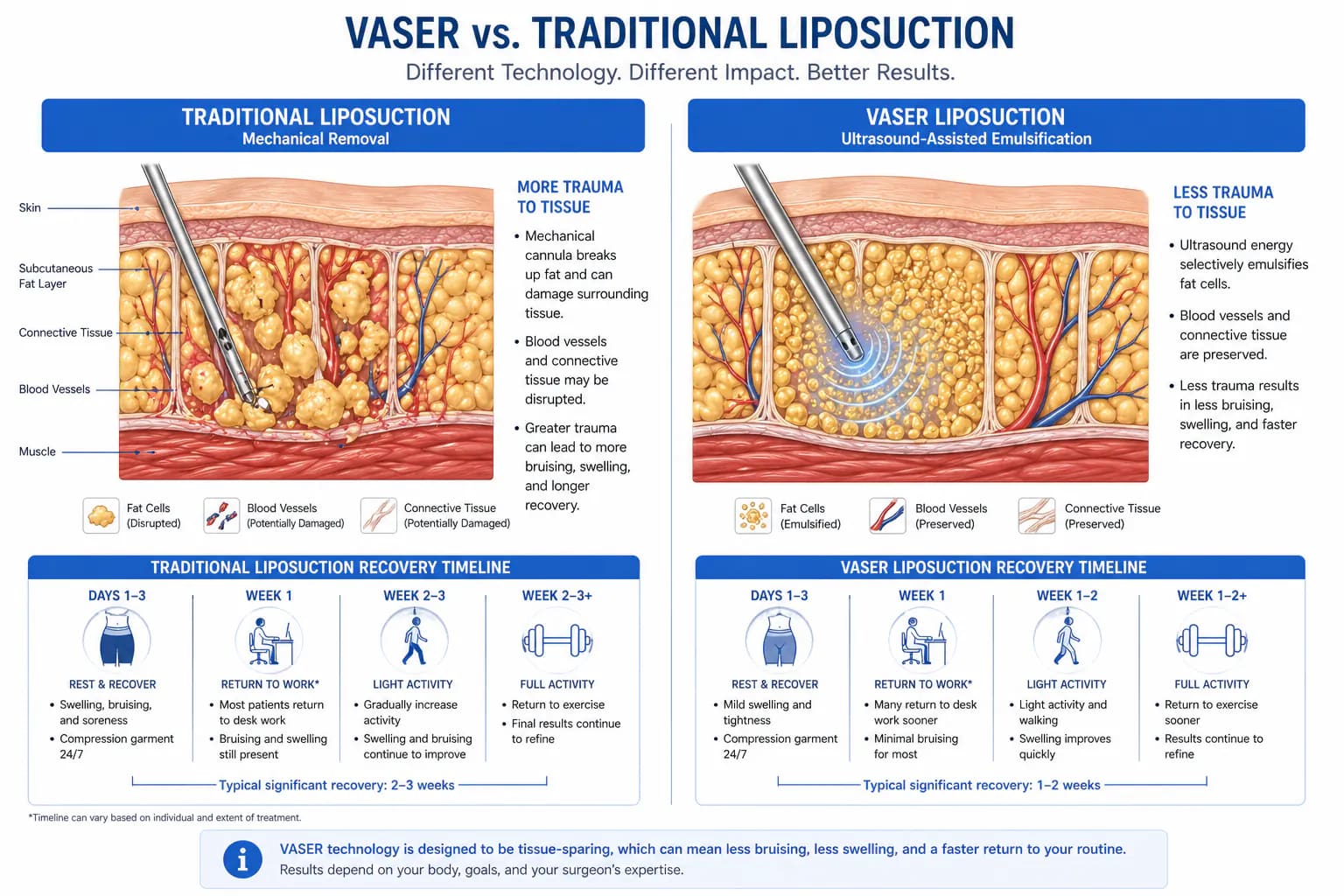
The honest answer is that neither technique is universally better. Each has a specific use case.
| Factor | VASER | Traditional |
|---|---|---|
| Mechanism | Ultrasound emulsification + suction | Mechanical disruption + suction |
| Tissue trauma | Lower (selective) | Higher (non-selective) |
| Bruising/swelling | Less | More |
| Recovery — return to work | 3–7 days | 7–14 days |
| Recovery — exercise | 2–3 weeks | 4–6 weeks |
| Precision/contouring | Higher | Lower |
| Skin tightening | Better (collagen stimulation) | Less reliable |
| Large volume removal | Slower, less efficient | Faster, more efficient |
| Hi-Def sculpting | Yes (superficial layer access) | No |
| Cost | Higher | Lower |
When VASER wins:
For patients who want precise contouring, faster recovery, and better skin tightening — especially in areas like the abdomen, arms, and back — VASER is the stronger choice. It is also the only technique that enables true Hi-Def body sculpting (more on that below). For patients banking removed fat for a BBL, the better-preserved fat cells from VASER suction may improve graft survival rates.
When traditional liposuction wins:
For patients removing a large volume of fat, or for whom cost is a significant factor, traditional liposuction is often the more practical choice. It extracts high volumes more efficiently and in less operating time. It also does not require specialized ultrasound equipment or the corresponding surgeon training, which is part of why it is less expensive.
The honest verdict: A surgeon who tells you VASER is always better has equipment to justify. A surgeon who tells you it never matters is behind the curve. The right answer depends on your goals, anatomy, and how many areas you are treating.
VASER Hi-Def: When You Want Visible Muscle Definition
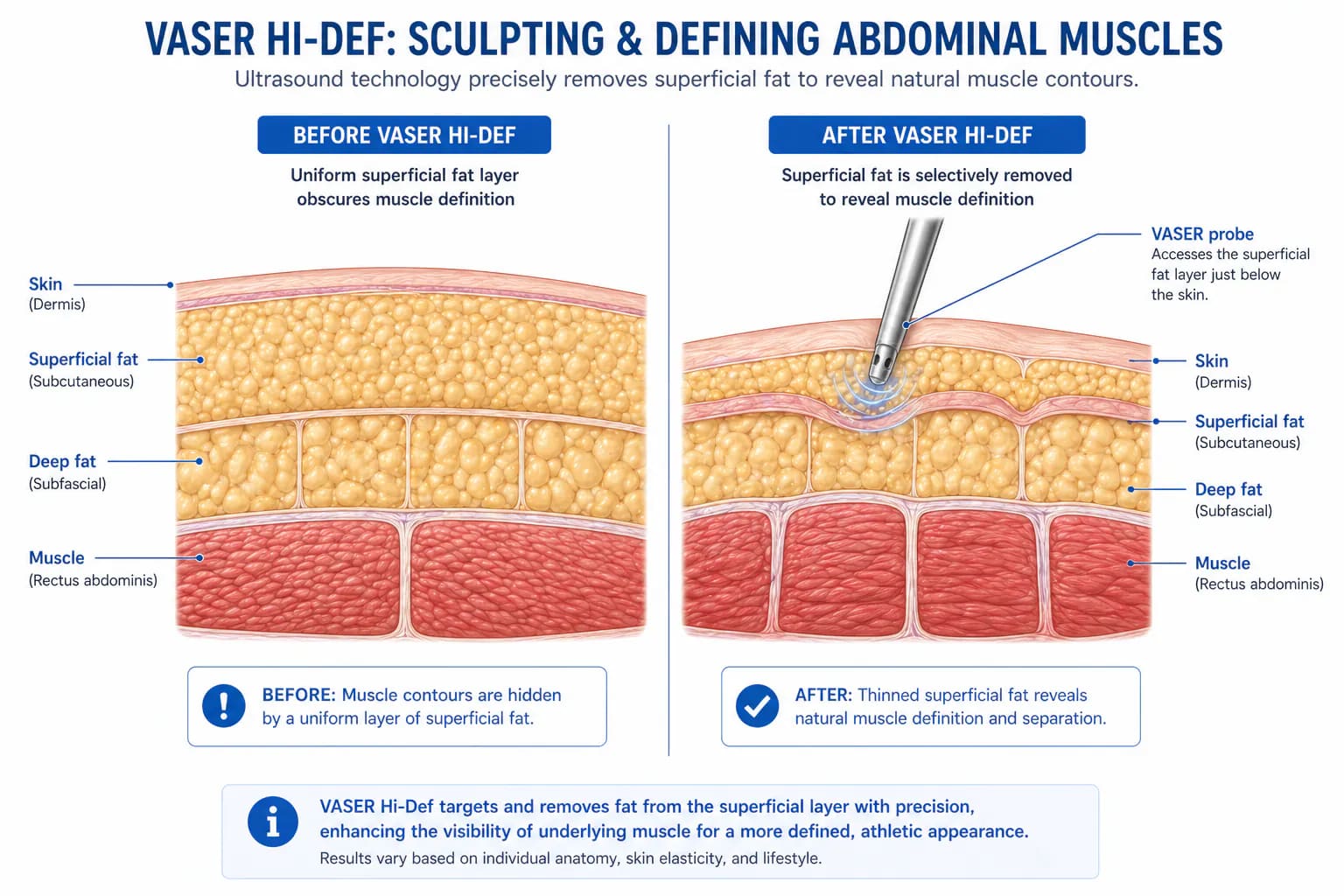
Standard VASER removes fat from the deep fat layer — the layer beneath the skin that constitutes most of the body's subcutaneous fat. VASER Hi-Def goes a step further.
Hi-Def liposuction (also called HD Lipo or high-definition liposculpture) targets the superficial fat layer — the thinner stratum of fat that sits directly beneath the skin's surface. Removing and sculpting fat at this depth allows surgeons to reveal the contours of the muscles below. The most common application is abdominal etching: surgically creating visible definition along the obliques and rectus abdominis to reveal what looks like a trained midsection.
This is where the term "liposculpture" is most accurately applied. The surgeon is not just removing fat — they are sculpting the body's surface the way an artist works with negative space.
What Hi-Def requires of the patient:
Hi-Def is not appropriate for everyone. To get visible muscle definition from superficial fat sculpting, the muscle has to be there to reveal. Patients with significant body fat or minimal core development will not see the same results as someone who is already lean with developed underlying musculature. Most surgeons who offer Hi-Def recommend candidates have a BMI under 28 and a body fat percentage below 25% (men) or 30% (women).
Hi-Def also demands a surgeon with substantial artistic skill and VASER-specific training. The margin for error in the superficial layer is narrower. Overcorrection causes visible contour irregularities that are difficult to revise. This is one procedure where surgeon selection matters at least as much as technique selection.
How VASER Liposuction Works
The procedure follows a consistent sequence:
Step 1 — Tumescent infiltration. A solution of saline, lidocaine, and epinephrine is injected into the treatment area. The epinephrine constricts blood vessels (reducing bleeding). The lidocaine provides local anesthesia. The saline volume expands the fat compartment, making it easier to access.
Step 2 — Ultrasound emulsification. A thin probe connected to the VASER system is inserted through small incisions. The probe emits ultrasound energy at the treatment depth, breaking apart fat cell membranes while leaving the surrounding tissue intact. The fat becomes a fluid emulsion rather than solid tissue — significantly easier to remove.
Step 3 — Extraction. A standard cannula is used to suction the emulsified fat. Because the fat has already been liquefied, less mechanical force is needed during extraction, which is a key reason for the reduced trauma and faster recovery.
Step 4 — Natural skin tightening. The thermal energy from the ultrasound probe stimulates collagen production in the treatment area. Over the months following surgery, this leads to better skin retraction than traditional liposuction typically produces — a meaningful benefit for patients with some degree of skin laxity who fall short of needing a full skin excision procedure.
Anesthesia: One practical advantage of VASER is that smaller treatment areas can often be done under local anesthesia with sedation (tumescent-only cases) rather than requiring full general anesthesia. Larger cases or multi-area treatments still typically use general anesthesia. Discuss this specifically at your consultation.
Surgical time: Varies considerably by area and volume. A single area like the chin may take 45 minutes. Full torso cases with multiple areas can run 3–5 hours.
Recovery: What to Expect Week by Week
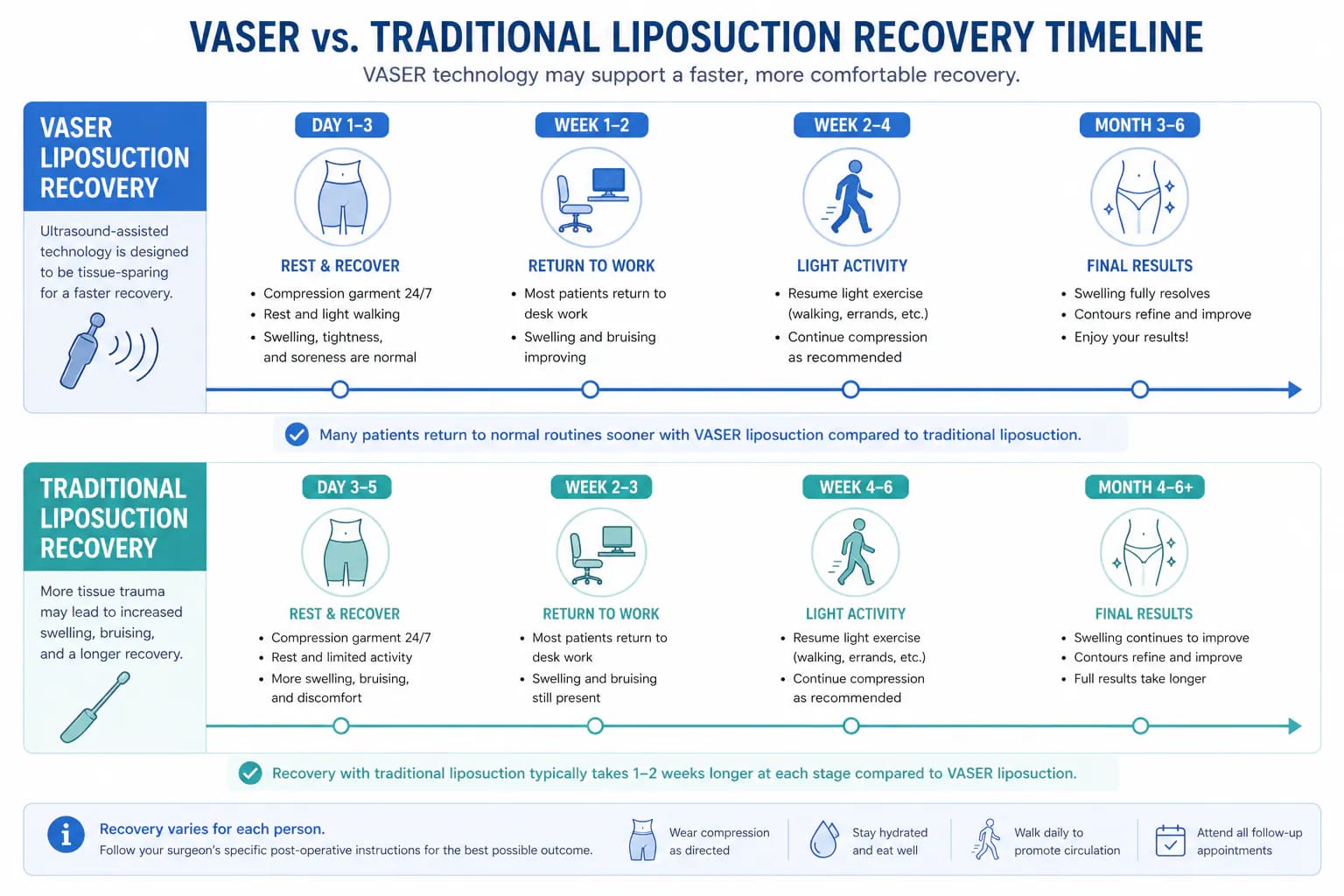
VASER recovery is faster than traditional liposuction at every milestone. But "faster" is relative — this is still a surgical procedure with a real recovery arc.
Days 1–3. Swelling, bruising, and soreness in the treatment area. A compression garment is worn continuously. You will feel the effects of surgery. Most patients manage pain with prescribed medication and rest. Surgical drains may be in place for larger cases.
Week 1–2. Most VASER patients return to desk work within 3–7 days. Bruising peaks and begins to fade. Swelling will make results look worse than they are — this is expected and not an indicator of outcome. Light walking is encouraged to support circulation.
Weeks 2–4. Light physical activity is generally permitted. The compression garment may transition to a lighter garment. Swelling is still present but improving. Most patients feel close to normal during daily activities.
Months 3–6. This is when you see real results. The skin has had time to retract. Collagen remodeling from the ultrasound energy is completing. Swelling is fully resolved. Final contour is visible by the six-month mark for most patients.
VASER vs. traditional recovery at a glance:
| Milestone | VASER | Traditional |
|---|---|---|
| Return to desk work | 3–7 days | 7–14 days |
| Light exercise | 2–3 weeks | 4–6 weeks |
| Strenuous exercise | 4–6 weeks | 6–8 weeks |
| Final results | 3–6 months | 3–6 months |
Final results timeline is similar across techniques. The difference is in the early recovery experience — VASER patients feel better, faster.
Am I a Good Candidate for VASER Liposuction?
VASER liposuction is body contouring, not weight loss. The candidates who see the best results are those who are already near their goal weight and have specific areas of localized fat that do not respond to diet and exercise.
Strong candidate profile:
- Within 20 pounds of target weight
- BMI under 32 (most surgeons; some prefer under 28 for Hi-Def)
- Good overall health — no conditions that impair healing or increase surgical risk
- Non-smoker or willing to stop smoking before and after surgery
- Good skin elasticity — the skin's ability to retract after fat is removed determines how smooth the final result looks
- Realistic expectations about outcome and timeline
Body areas where VASER works well:
Abdomen and flanks are the most common treatment areas. VASER's precision also makes it well-suited for areas where traditional liposuction requires more care: inner thighs, arms, back, chest (including gynecomastia in men), chin and neck, and the superficial layers for Hi-Def cases.
When VASER may not be the best fit:
Patients with significant skin laxity — loose or heavily stretched skin from major weight loss or multiple pregnancies — may see skin irregularities after fat removal that no liposuction technique fully addresses. In those cases, skin excision procedures (like a tummy tuck or body lift) may be more appropriate, either alone or combined with liposuction.
Patients who need to remove very large volumes of fat may also find that traditional liposuction is more efficient and cost-effective for their goals.
Risks and What to Watch For
VASER liposuction carries the same category of risks as any liposuction procedure. The specific profile differs slightly from traditional lipo in a few ways worth understanding.
Standard liposuction risks (apply to VASER):
- Bruising and swelling (less severe with VASER than traditional, but present)
- Temporary numbness in the treatment area (typically resolves within weeks to months)
- Contour irregularities — surface unevenness if fat removal is uneven
- Seroma — fluid accumulation beneath the skin, less common with VASER than traditional
- Infection (rare, managed with antibiotics)
- Anesthesia risks
VASER-specific considerations:
- Thermal injury. The ultrasound probe generates heat. In the hands of an imprecise surgeon, that heat can damage the skin or surrounding tissue. This is technique-dependent — an experienced, trained VASER operator controls probe exposure and movement to prevent heat buildup. A surgeon using VASER equipment without adequate training does not.
- Skin surface irregularities in Hi-Def cases. Superficial fat layer sculpting has a narrower margin of error than deep-layer liposuction. Overcorrection is possible and difficult to revise. Surgeon skill matters considerably more in Hi-Def than in standard lipo cases.
- Skin laxity outcomes. VASER's collagen-stimulating effect improves skin retraction compared to traditional lipo, but it does not overcome poor baseline elasticity. If your skin is significantly lax, adding VASER does not eliminate the need for skin excision to achieve a smooth result.
The surgeon training question: Owning a VASER machine is not the same as being trained to use it well. This technology has a learning curve. Ask your surgeon how many VASER cases they perform per year and whether they have completed formal training in the technique.
How Much Does VASER Liposuction Cost?
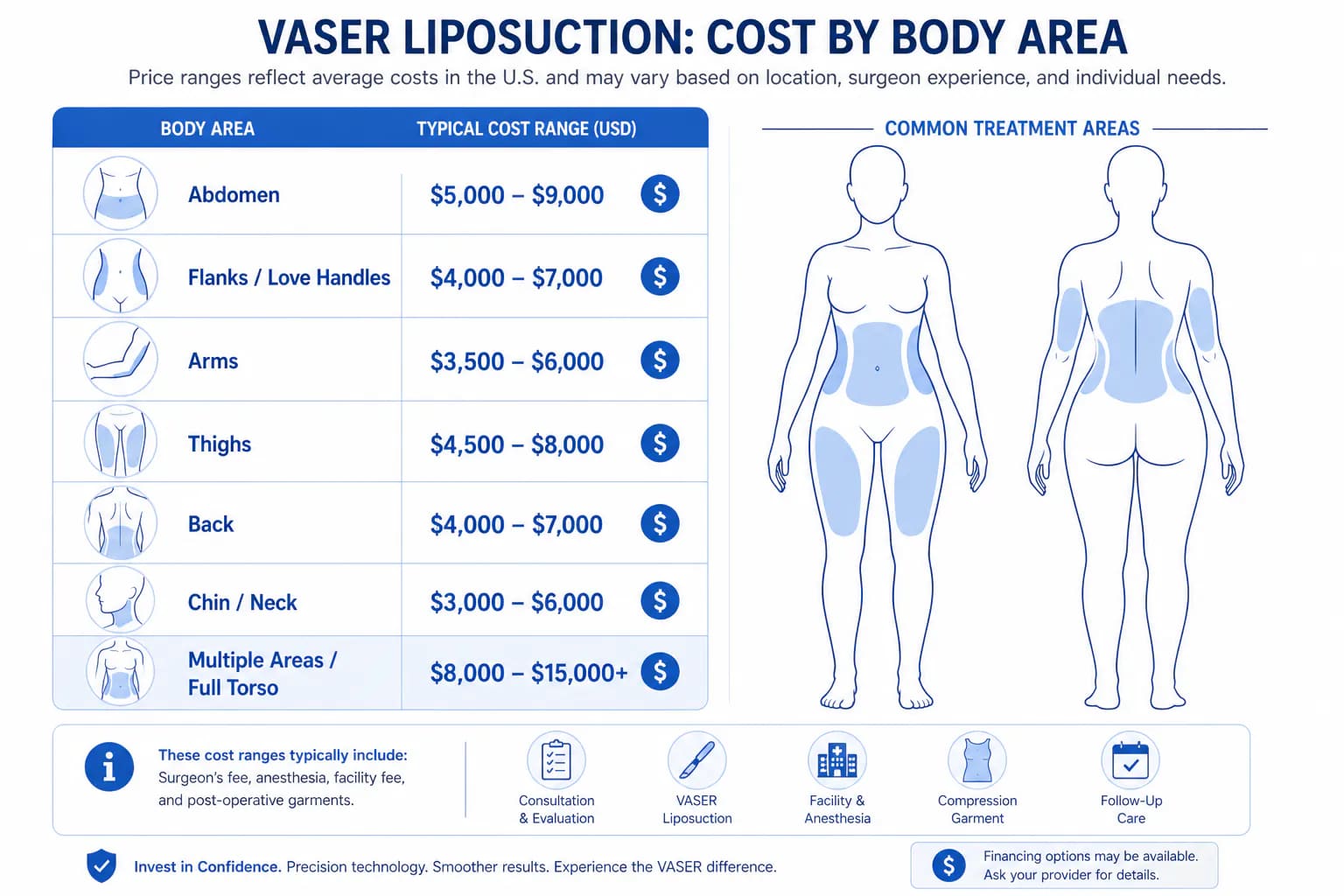
VASER liposuction costs more than traditional liposuction. The premium reflects three things: the equipment itself is expensive to purchase and maintain, the procedure typically takes longer than traditional lipo due to the emulsification step, and surgeons who perform it well invest in specialized training.
Cost ranges by treatment area (US, 2026):
| Treatment Area | Typical Range |
|---|---|
| Abdomen | $5,000 – $9,000 |
| Flanks / Love Handles | $4,000 – $7,000 |
| Arms | $3,500 – $6,000 |
| Thighs (inner or outer) | $4,500 – $8,000 |
| Back | $4,000 – $7,000 |
| Chin / Neck | $3,000 – $6,000 |
| Multiple Areas / Full Torso | $8,000 – $15,000+ |
These ranges represent the all-in procedure cost at an accredited US facility with a board-certified plastic surgeon. Prices outside this range — either significantly above or below — should prompt additional questions about what is and is not included.
Nationally, RealSelf data from early 2026 shows an average reported VASER cost of approximately $5,000 for single-area procedures. Multi-area treatments drive the average up considerably.
What drives the variation:
Geographic market is the largest factor — New York and Los Angeles command the highest prices; markets like Dallas, Houston, and Phoenix tend to run lower. Surgeon experience and case volume also affect pricing. Multi-area discounts are common.
Financing through CareCredit, Alphaeon, or in-house practice plans is widely available and commonly used for VASER procedures.
How to Choose a VASER-Trained Surgeon
The standard qualifications apply here — board certification through the American Board of Plastic Surgery (ABPS), procedures performed in an accredited surgical facility — but VASER adds a specific additional requirement: the surgeon must be trained in the technology, not just in possession of it.
Many plastic surgery practices purchase VASER systems as part of expanding their equipment portfolio. Access to the device and mastery of it are not the same thing. Surgeons who perform VASER regularly as a primary technique will have meaningfully better results than those who use it occasionally as an add-on.
Questions to ask at consultation:
- How many VASER procedures do you perform per year?
- Have you completed formal VASER training beyond the manufacturer's introductory certification?
- Do you perform VASER Hi-Def, and if so, can you show me before-and-after photos for patients with a similar body type to mine?
- For this case specifically — my goals, my anatomy — would you recommend VASER or traditional liposuction, and why?
That last question is the most revealing. A surgeon whose answer is always VASER is selling you the technology. A surgeon who gives you a reasoned comparison and then makes a specific recommendation for your situation is practicing good medicine.
What is VASER liposuction?
VASER liposuction is an ultrasound-assisted liposuction technique. VASER stands for Vibration Amplification of Sound Energy at Resonance. Before fat is extracted, an ultrasound probe emits high-frequency sound waves that selectively break apart fat cell bonds while leaving surrounding blood vessels, nerves, and connective tissue largely intact. The liquefied fat is then removed via a cannula. The result is less tissue trauma, less bruising, and more precise sculpting than traditional mechanical liposuction.
How is VASER different from regular liposuction?
Traditional liposuction uses mechanical force — a cannula physically breaking up and suctioning fat. VASER uses ultrasound waves to emulsify fat before it is removed, making extraction gentler and more selective. VASER results in less bruising and swelling, faster recovery (return to work in 3–7 days vs. 7–14 for traditional), better skin tightening through collagen stimulation, and greater precision for body contouring. Traditional liposuction may be preferable for large-volume fat removal or cost-sensitive patients.
How much does VASER liposuction cost?
VASER liposuction in the US costs approximately $5,000–$15,000 depending on how many areas are treated, the surgeon's experience, geographic market, and facility type. Single-area procedures average around $5,000. Abdomen runs $5,000–$9,000; arms $3,500–$6,000; thighs $4,500–$8,000; chin/neck $3,000–$6,000. VASER costs more than traditional liposuction because of specialized equipment and the training required to use it correctly.
What is the recovery time for VASER liposuction?
Most VASER patients return to desk work within 3–7 days and resume light exercise within 2–3 weeks — notably faster than traditional liposuction's 7–14 day return-to-work and 4–6 week exercise timeline. Final results become visible at 3–6 months as swelling fully resolves and skin retraction completes.
Is VASER liposuction better than traditional liposuction?
VASER is better for precision contouring, faster recovery, better skin tightening, and Hi-Def sculpting where muscle definition is the goal. Traditional liposuction is better for high-volume fat removal and cost-conscious patients. Neither is universally superior — the right choice depends on the patient's goals, anatomy, and how many areas are being treated. A surgeon who always recommends one without regard for individual circumstances is worth questioning.
Am I a good candidate for VASER liposuction?
Good candidates are near their target weight (within 20 pounds), have a BMI under 32, have good skin elasticity, are in overall good health, and are non-smokers. VASER is not a weight-loss procedure. It is body contouring for people with localized fat deposits that do not respond to diet and exercise. Patients with significant skin laxity may need additional skin excision procedures to achieve a smooth result.
What is VASER Hi-Def liposuction?
VASER Hi-Def — also called HD Lipo or high-definition liposculpture — targets the superficial fat layer just beneath the skin to reveal underlying muscle structure. While standard VASER removes fat from the deeper layers, Hi-Def sculpts the surface to create visible muscle definition. Ab etching is the most common application. Hi-Def requires patients to have lower body fat and existing muscle tone — the procedure reveals definition that is already there, it does not build it. It also demands greater surgical precision and a surgeon with extensive Hi-Def experience.
What are the risks of VASER liposuction?
VASER shares the standard risks of liposuction: bruising, swelling, temporary numbness, contour irregularities, seroma, infection, and anesthesia risks. VASER-specific risks include thermal injury from the ultrasound probe if technique is imprecise, and surface irregularities in patients with poor skin elasticity or in Hi-Def cases where the superficial layer is sculpted. Seromas are less common with VASER than traditional lipo. Surgeon-specific training in VASER technique significantly reduces technology-related risk.
Internal links:
- How Much Does Liposuction Cost?
- Laser Liposuction: How It Works, What It Costs, and Whether It's Right for You
- Arm Liposuction: Complete Guide
- Chin & Double Chin Liposuction Guide
