
Liposuction in the US costs between $3,500 and $15,000+, depending on which areas you treat, where you have the procedure done, and who performs it. The average cost per treatment area is $4,711, according to the American Society of Plastic Surgeons — but that number doesn't tell the whole story.
Most patients treat more than one area. Add in anesthesia, facility fees, and post-op care, and a typical liposuction procedure runs $6,000 to $12,000 total. In high-cost markets like New York City or San Francisco, that climbs to $10,000–$20,000 or more.
This guide breaks down what you actually pay — by body area, by city, and by procedure type — using data from lipo.com's national network of board-certified surgeons. Not a single surgeon's price sheet. Not a financing company's estimate. A real picture of what liposuction costs across the country in 2026. If you want a quick-reference summary of ranges by area, see our liposuction price guide overview. For what to budget beyond the surgical quote, see our hidden costs guide.
The Real Cost of Liposuction: What's Actually Included
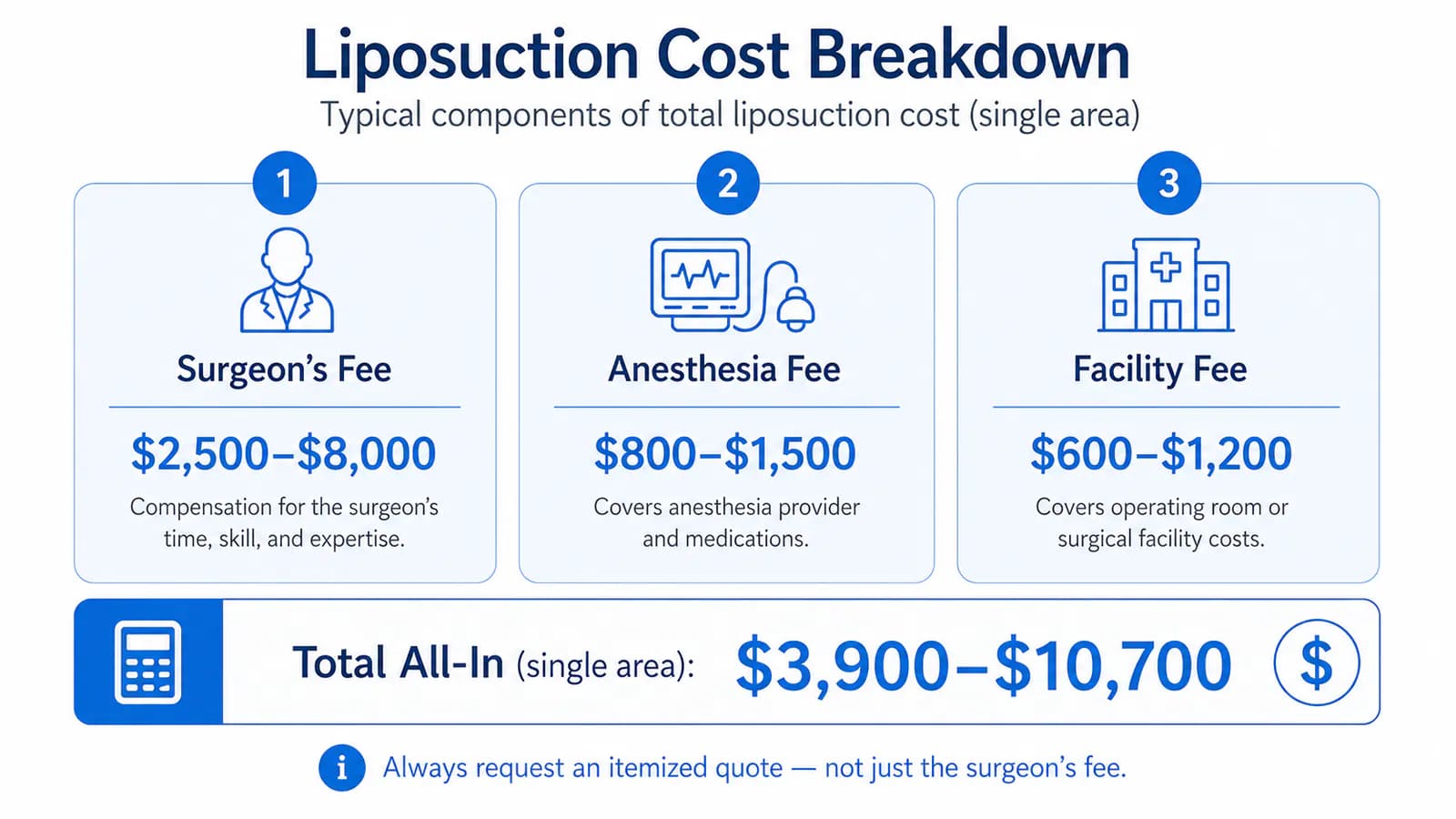
The most common mistake patients make is comparing surgeon's fees without realizing they're incomplete.
A quoted price of "$4,000 for abdominal liposuction" might be the surgeon's fee only. Add the pieces that are always required:
| Cost Component | Typical Range |
|---|---|
| Surgeon's fee | $2,500–$8,000 |
| Anesthesia fee | $800–$1,500 |
| Surgical facility fee | $600–$1,200 |
| Pre-op labs and clearance | $150–$400 |
| Compression garment | $75–$200 |
| Post-op visits (2–3) | Often included, sometimes $100–$300 each |
| All-in total (single area) | $4,500–$12,000+ |
When you see a very low advertised price, ask what it includes. A transparent surgeon will give you an itemized quote before your consultation ends. One who won't is a reason to keep looking.
Liposuction Cost by Body Area
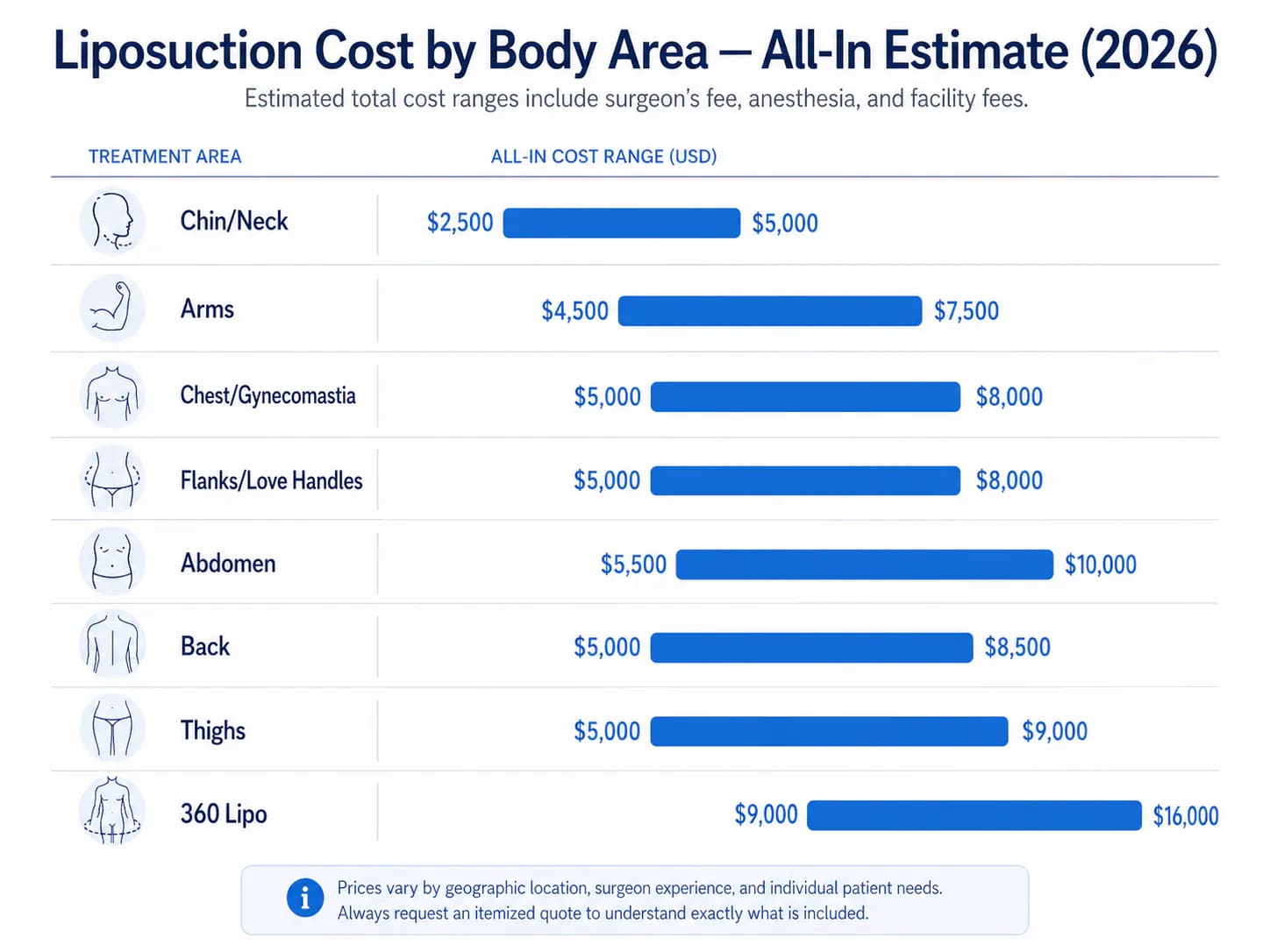
Procedure fees vary significantly based on the size of the treatment area, the complexity of fat removal, and how long the surgery takes. Larger or more technically demanding areas cost more.
| Body Area | Surgeon's Fee Range | All-In Estimate |
|---|---|---|
| Chin / submental | $1,500–$3,500 | $2,500–$5,000 |
| Arms (both) | $2,800–$5,500 | $4,500–$7,500 |
| Chest / gynecomastia (male) | $3,000–$5,500 | $5,000–$8,000 |
| Flanks / love handles | $3,000–$5,500 | $5,000–$8,000 |
| Abdomen / stomach | $3,800–$7,500 | $5,500–$10,000 |
| Back | $3,000–$6,000 | $5,000–$8,500 |
| Thighs (inner or outer) | $3,000–$6,500 | $5,000–$9,000 |
| 360 lipo (full torso) | $6,000–$12,000 | $9,000–$16,000 |
A few notes on these numbers:
Chin liposuction is often the most affordable because it's performed under local anesthesia without a full surgical facility. Many patients are back to work within two days.
Arms are usually quoted as a pair. Very few patients treat only one arm, and most surgeons price accordingly.
The abdomen covers a wide range because the treatment zone varies — some patients want only the upper or lower abdomen, others want the full midline plus flanks. A clear consultation defining the exact zones prevents pricing surprises.
360 lipo is circumferential — the full torso including stomach, waist, flanks, and back. It's more involved than any single area and is frequently combined with a BBL for the hourglass procedure. See our 360 Lipo + BBL guide for full pricing.
Liposuction Cost by City
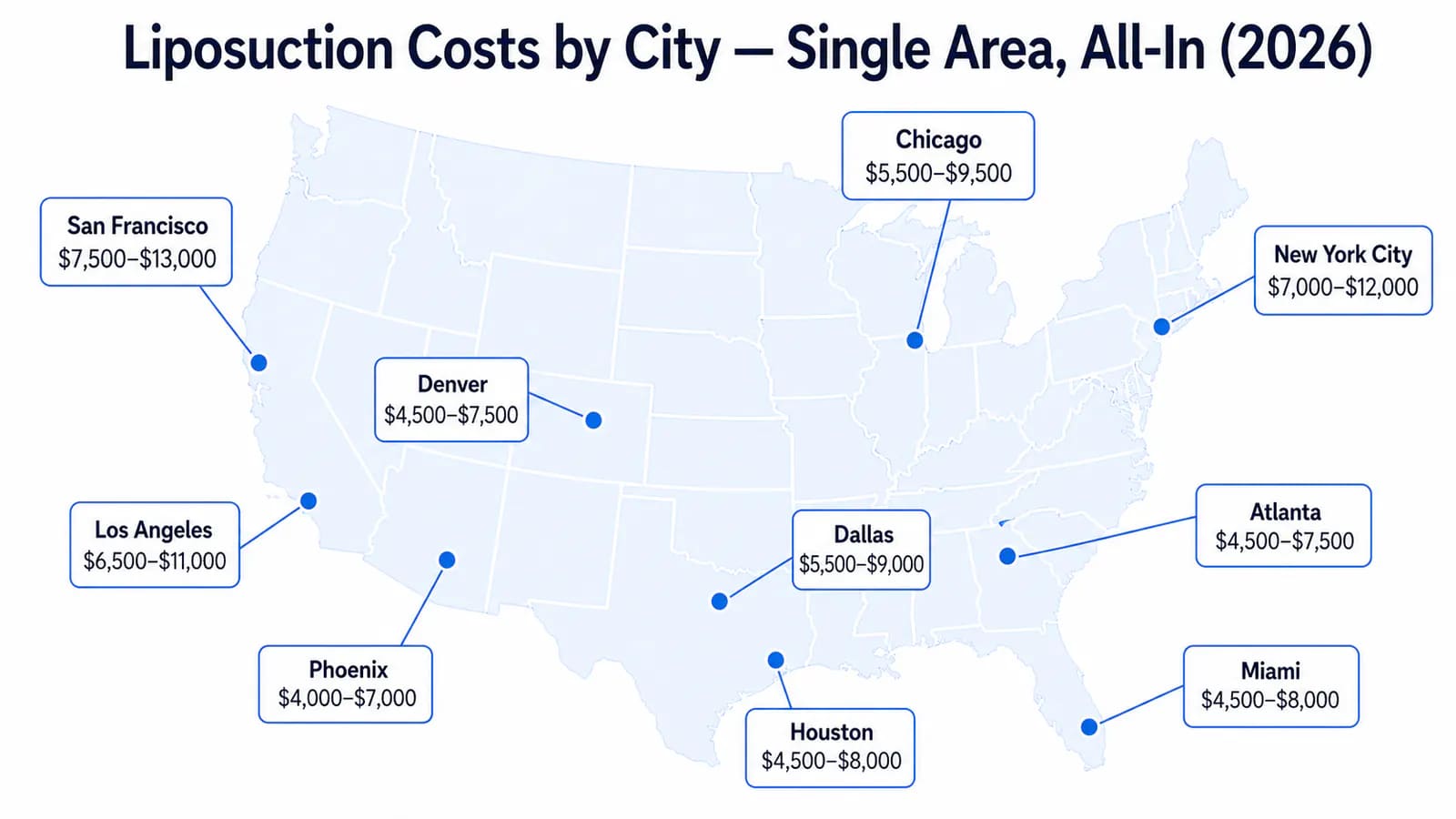
Geographic location is one of the biggest cost drivers in liposuction pricing. Operating overhead, anesthesiologist rates, facility licensing costs, and market demand all vary significantly by city.
| City | Single Area (All-In) | 360 Lipo (All-In) |
|---|---|---|
| New York City | $7,000–$12,000 | $12,000–$20,000+ |
| Los Angeles | $6,500–$11,000 | $10,000–$18,000 |
| San Francisco / Bay Area | $7,500–$13,000 | $12,000–$20,000 |
| Chicago | $5,500–$9,500 | $9,000–$15,000 |
| Miami | $4,500–$8,000 | $7,000–$14,000 |
| Dallas | $5,500–$9,000 | $8,500–$15,000 |
| Houston | $4,500–$8,000 | $7,500–$13,000 |
| Atlanta | $4,500–$7,500 | $7,000–$12,000 |
| Phoenix | $4,000–$7,000 | $6,500–$11,000 |
| Denver | $4,500–$7,500 | $7,000–$12,000 |
Why is Miami cheaper than New York despite its reputation as a cosmetic surgery capital? Volume. Miami has one of the highest concentrations of plastic surgeons per capita in the US, and the intense competition keeps prices accessible relative to markets with fewer providers. This is also why it's important to verify board certification in Miami — the high volume attracts providers with varying credential levels.
Should you travel for cheaper liposuction? Sometimes. Patients in NYC or San Francisco regularly fly to Dallas, Houston, or Atlanta to work with excellent surgeons at significantly lower total cost — including flights and hotel. This only makes sense if you have the flexibility for recovery travel and are working with a board-certified surgeon whose credentials you've verified. See our guide on how to choose a board-certified liposuction surgeon. For a fuller breakdown of what impacts price, see liposuction cost by body area.
How the Type of Liposuction Affects Price
Three primary techniques are used by most board-certified surgeons today. Each has a different cost profile.
Traditional Tumescent Liposuction
Cost premium: None — this is the baseline
Tumescent liposuction is the standard technique. A solution is injected into the fat layer to swell it and reduce bleeding, then a cannula suctions the fat. No special equipment beyond the standard liposuction setup.
Best for: Larger-volume areas, patients prioritizing cost, surgeons without a preferred technology.
Laser-Assisted Liposuction (SmartLipo, SlimLipo)
Cost premium: $500–$1,500 per area over traditional
A laser fiber is inserted through a small incision before suctioning begins. The heat liquefies fat cells and stimulates some skin tightening via collagen production. It adds equipment cost and procedure time.
Best for: Smaller, delicate areas (chin, arms, inner thighs) where precision and skin tightening matter. See our laser liposuction guide for a full comparison.
VASER Liposuction
Cost premium: $1,000–$3,000 per area over traditional
VASER uses ultrasound energy instead of heat. It gently disrupts fat cells while preserving surrounding tissue, making it particularly effective for fibrous fat areas and for HD liposuction where muscle definition is the goal.
Best for: Fibrous areas, male chest/gynecomastia, patients wanting HD body sculpting, fat transfer procedures (the preserved fat cells transfer better).
HD Liposuction / Liposculpture
Cost premium: $2,000–$5,000 over standard VASER
HD liposuction (high-definition liposculpture) is a technique, not a technology — it requires advanced surgical skill to sculpt around muscle anatomy for an athletic, defined result. It uses VASER as the preferred tool but demands significantly more surgical time and expertise.
Best for: Patients wanting visible muscle definition (abdominal etching, arm definition), not just fat volume reduction. The result looks like the outcome of intense training, not just surgery.
The Hidden Costs Most Patients Don't Plan For
Beyond the procedure itself, a few expenses catch patients off guard. For a dedicated breakdown of these extras, see our hidden costs of liposuction guide.
Time off work. Most patients need 5–10 days away from desk work and 4–6 weeks away from physical labor or exercise. If you're self-employed or hourly, lost income is a real cost to factor.
Compression garments. A Stage 1 surgical faja is typically included. A Stage 2 garment (worn weeks 6–12) is usually an out-of-pocket purchase — budget $80–$200. Some patients buy a backup to rotate while washing.
Lymphatic drainage massage. Many surgeons recommend (and some require) post-op lymphatic massage to manage swelling and improve contouring. Typically $75–$150 per session; most patients do 6–12 sessions in the first 6 weeks. That's $450–$1,800.
Revision. Revision liposuction — whether for uneven results, residual fat, or contour irregularities — is typically performed at the surgeon's discretion. Some surgeons include revision in their original fee for a defined period; most do not. Ask directly before you book.
Medications. Prescription-strength pain management for the first week, antibiotics, and post-op supplements typically run $50–$200 total.
Does Insurance Cover Liposuction?
In almost all cases, no.
Liposuction is classified as an elective cosmetic procedure. Major US health insurers — including Aetna, Cigna, Blue Cross Blue Shield, and United Healthcare — explicitly exclude elective cosmetic surgery from coverage.
There are narrow exceptions:
- Lipedema: A documented chronic condition causing painful, disproportionate fat accumulation in the legs and arms. Some insurers cover liposuction as a functional treatment, but the approval process is extensive and not guaranteed.
- Gynecomastia with functional impairment: Male breast reduction (involving liposuction) may be covered when there's documented psychological distress or physical discomfort meeting insurer criteria — rare and requires pre-authorization.
- Post-bariatric body contouring: A small number of plans cover body contouring after significant weight loss surgery, but this typically applies to skin removal, not liposuction specifically.
For the vast majority of patients, liposuction is a self-pay procedure. Budget accordingly.
Liposuction Financing: What Actually Works
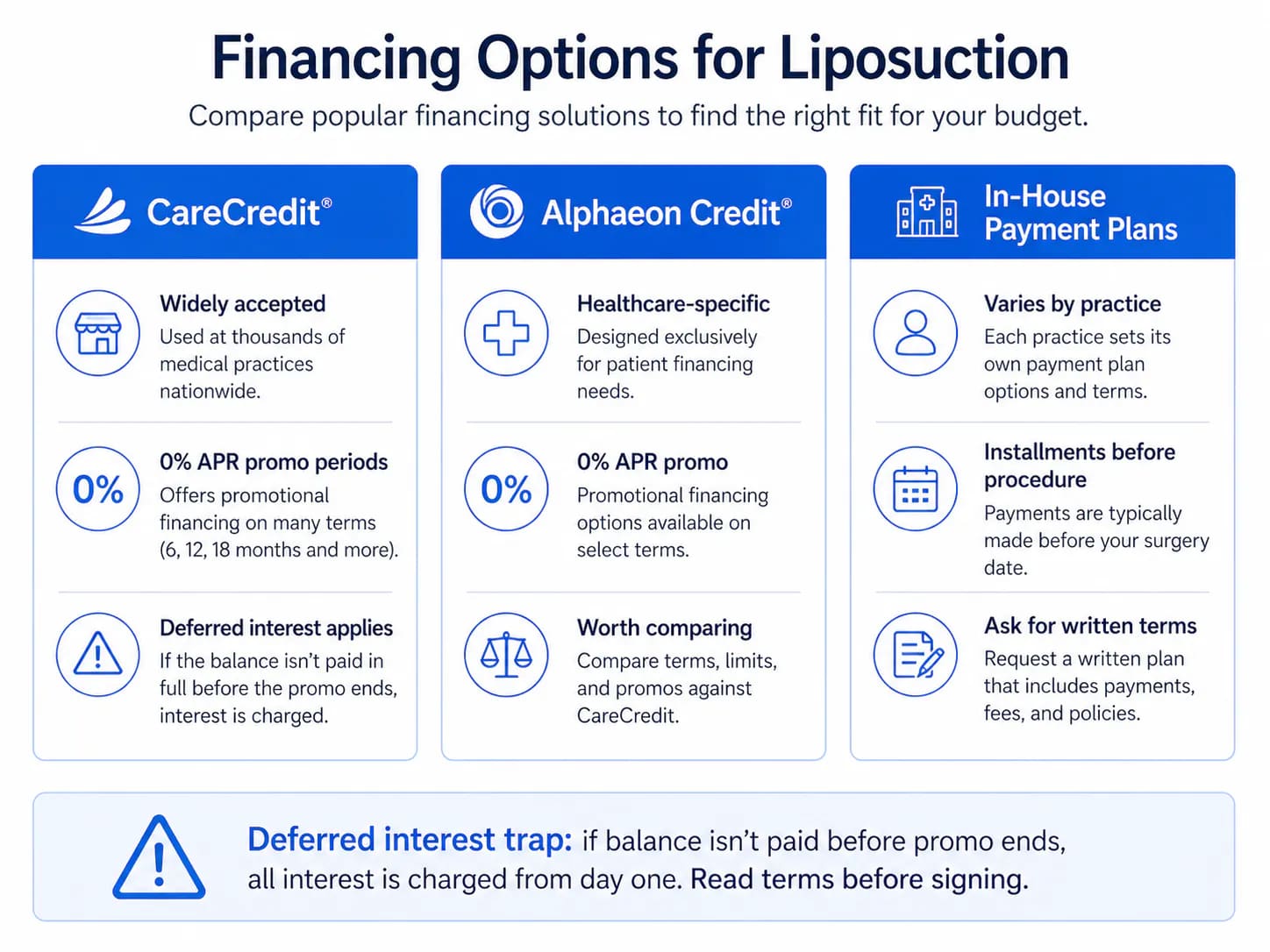
Surgeon's offices offer financing to make liposuction accessible. The most common options:
CareCredit is the most widely accepted healthcare financing program. They offer promotional 0% APR periods (typically 12–24 months for qualifying amounts). The catch: if the balance isn't paid in full before the promotional period ends, deferred interest kicks in — meaning all the interest from day one becomes due immediately. Read the fine print carefully.
Alphaeon Credit is a competitor to CareCredit with similar promotional offers. Worth checking both if you're financing.
In-house payment plans vary by practice. Some surgeons split the total into 3–4 installments before the procedure date. Rarely is post-procedure payment offered.
HSA/FSA accounts generally cannot be used for elective cosmetic procedures. The rare exception applies if the procedure addresses a documented medical condition (e.g., lipedema).
A word of caution: Be skeptical of any practice that makes it easier to sign financing paperwork than to discuss your surgical qualifications and credentials. Financing is a tool — not a reason to rush into surgery with an unvetted surgeon.
Is Liposuction Worth the Cost?
Patient satisfaction data says yes — for the right candidate with realistic expectations.
The American Society of Plastic Surgeons consistently reports liposuction satisfaction rates above 90% in outcome surveys. Results from fat cells removed are permanent. The body does not regenerate liposuction-removed fat cells in treated areas, provided body weight remains stable.
The factors that determine whether liposuction delivers on its cost:
Surgeon selection. This is not the place to optimize on price. A board-certified plastic surgeon with ABPS certification, fellowship training, and demonstrated before-and-after results in the specific procedure you want is worth paying more for. Revision liposuction — correcting botched results — routinely costs more than the original procedure and is more technically demanding. For help vetting surgeons, see our guide to choosing a safe liposuction surgeon.
Realistic expectations. Liposuction is body contouring, not weight loss. The best candidates are within 25–30 pounds of their target weight with localized fat deposits that don't respond to diet and exercise. Patients who view it as a weight-loss shortcut — or who expect tummy-tuck-level skin tightening — are often disappointed.
Post-op commitment. Wearing a compression garment consistently, attending follow-up appointments, and allowing full recovery time (not rushing back to the gym at week three) significantly affects final results.
When those three conditions are met, most patients describe their liposuction investment as worthwhile.
How to Get an Accurate Liposuction Quote
Request an itemized quote, in writing, that includes:
1. Surgeon's fee — for each area treated
2. Anesthesia fee — separate from the surgeon's fee
3. Facility fee — the OR or surgical suite charge
4. What's included post-op — follow-up visits, compression garment, revision policy
Ask specifically: "Is this all-in, or are there additional fees I should expect?"
Compare quotes from at least two board-certified surgeons. A quote significantly below the market average for your city isn't a bargain — it's a question. What's been cut to reach that price? Surgeon credential level? OR quality? Anesthesia provider qualifications?
Find board-certified liposuction surgeons in your area on lipo.com →
What is the average cost of liposuction in the US?
The average cost per treatment area is $4,711, according to the American Society of Plastic Surgeons. Most patients treat more than one area, and the all-in total — including anesthesia and facility fees — typically runs $6,000–$12,000 for a standard procedure.
Does insurance cover liposuction?
In almost all cases, no. Liposuction is elective cosmetic surgery and is excluded from standard health insurance coverage. The narrow exceptions — lipedema, documented gynecomastia, some post-bariatric cases — require extensive pre-authorization and are not guaranteed.
What is the cheapest form of liposuction?
Traditional tumescent liposuction is the most affordable technique, starting around $2,500–$3,500 per area for the surgeon's fee alone. That said, the cheapest option isn't always the right one — surgeon experience and safety record matter more than technique premium.
Why is liposuction so expensive?
You're paying for a board-certified surgeon, a trained anesthesiologist, an accredited surgical facility, and the equipment and support staff required for a safe procedure. A quoted surgeon's fee rarely reflects total cost. Anesthesia ($800–$1,500) and facility fees ($600–$1,200) are always additional.
What financing options are available for liposuction?
CareCredit and Alphaeon Credit are the most widely available. Both offer promotional 0% APR periods — read terms carefully, as deferred interest applies if the balance isn't cleared before the promotional period ends. In-house payment plans are available at many practices.
Is liposuction worth the cost?
For the right candidate — within range of goal weight, with localized fat deposits, and with realistic expectations — satisfaction rates are consistently above 90%. Results are permanent for treated fat cells. The answer depends on candidate fit, surgeon quality, and post-op commitment more than the price itself.
How do I get an accurate liposuction quote?
Request an itemized written quote covering surgeon's fee, anesthesia, facility, and post-op care separately. Get at least two quotes from board-certified surgeons. A quote significantly below the market average for your city is a red flag worth investigating.
What is the most expensive city for liposuction?
New York City and San Francisco are consistently the most expensive US markets, with single-area all-in costs running $7,000–$13,000. Miami is notably more affordable at $4,500–$8,000, driven by high competition among a large pool of providers.
Medically reviewed by the lipo.com Editorial Board. Pricing data reflects lipo.com surgeon network surveys and ASPS statistics as of April 2026. Individual costs vary based on surgeon, facility, geographic market, and procedure scope. This article is for informational purposes and does not constitute medical advice.
Find board-certified liposuction surgeons in your city →
