Watching the cost of liposuction is rational. It is usually paid out of pocket, and the difference between one quote and another can be thousands of dollars. The goal is not to find the cheapest liposuction. The goal is to get the best value while staying inside the safety lines that actually protect you. For detailed pricing by area, see how much liposuction costs.
Why you're right to watch the cost
Liposuction is the most commonly performed cosmetic surgical procedure in the U.S., and cost is one of the first questions patients ask for a reason. ASPS lists the average liposuction surgeon's fee at $4,711, and its 2024 projected surgeon-fee ranges put liposuction at $4,300–$7,500 and submental/chin liposuction at $3,000–$5,500. Those numbers do not include anesthesia, facility fees, garments, or other recovery costs, which is why the real out-of-pocket price is higher than the headline number.
That is why "affordable liposuction" should mean smart scope and transparent pricing, not bargain hunting. A surgeon may quote less because the treatment area is smaller, because you are having tumescent local anesthesia rather than general anesthesia, or because the procedure is being done in a lower-cost city. Those can be legitimate reasons. The danger starts when the low price comes from weaker credentials, non-accredited settings, rushed follow-up, or a stripped-down quote that leaves out half the bill.
| What usually drives the price | Why it matters |
|---|---|
| Number of treatment areas | More operative time, more facility cost, more recovery |
| Technique used | VASER and other energy-assisted options may add cost |
| Anesthesia plan | Local tumescent can cost less than general in smaller cases |
| City and overhead | NYC and San Francisco typically price higher than mid-market cities |
| Surgeon and facility | Training, accreditation, staff, and aftercare are not "extras" |
Where not to cut costs
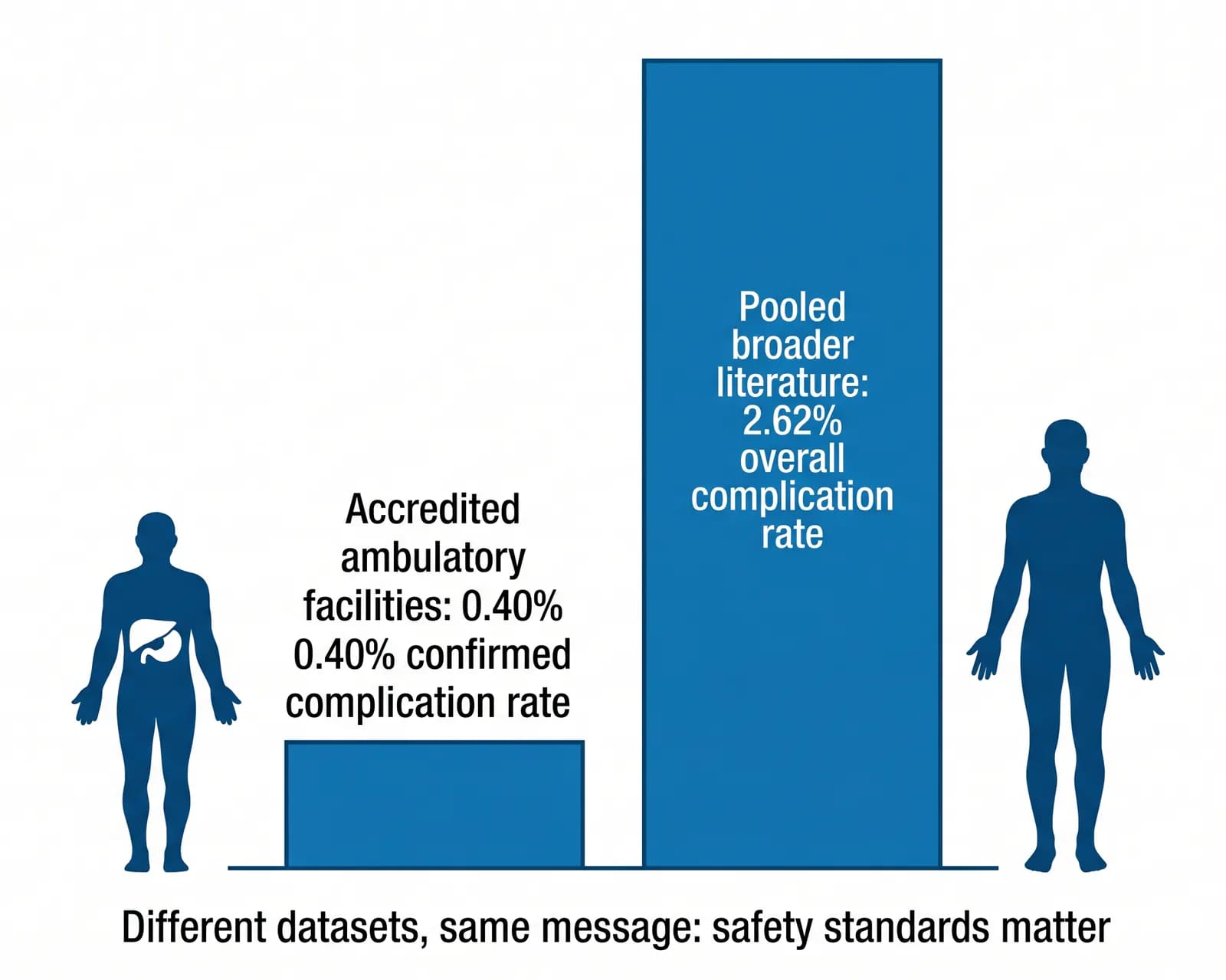
This is the line most competitors blur. The biggest safety savings do not come from shopping harder. They come from refusing to save money in the wrong place.
A 2024 meta-analysis of 39 studies and 29,368 patients found an overall liposuction complication rate of 2.62%. By contrast, a national analysis of 246,119 cases in accredited ambulatory surgery facilities found a confirmed complication rate of 0.40%. These are different datasets, so they are not a perfect apples-to-apples comparison, but they point in the same direction: the environment, standards, and people around the procedure matter.
So where should you never cut? Not on surgeon qualification. Not on facility accreditation. Not on follow-up care. The American Board of Plastic Surgery public search lets patients verify ABPS certification, and ASPS notes that its member surgeons are ABPS board-certified and operate in accredited facilities that follow strict safety standards. For the full framework, see our guide to choosing a safe surgeon. Accreditation bodies such as AAAHC and QUAD A exist for a reason: they are part of the safety infrastructure, not window dressing.
When low prices are a warning sign
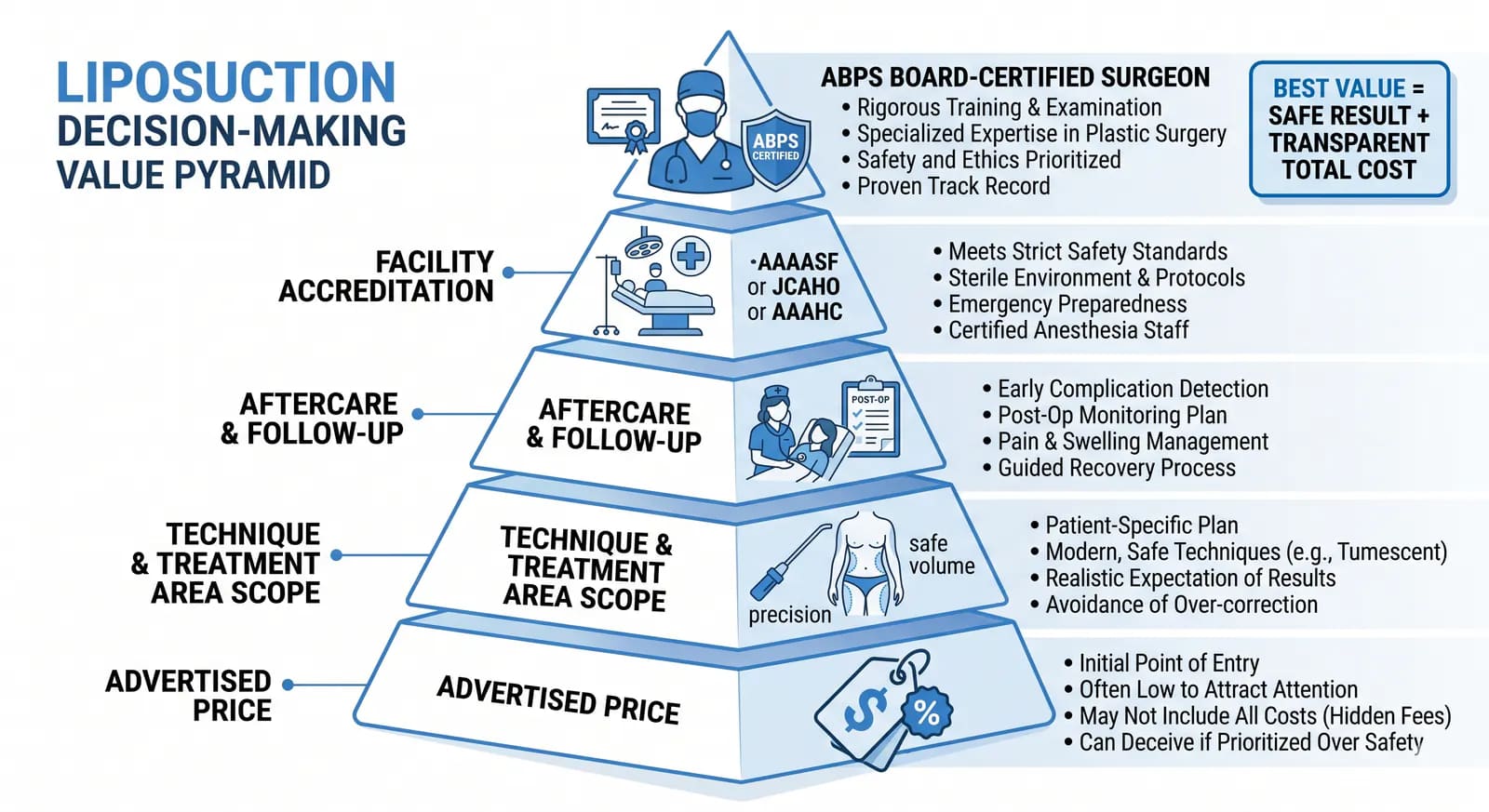
Sometimes a lower quote is simply a smaller case in a lower-cost market. But when "cheap liposuction" is created by cutting the surgeon, the setting, or the recovery support, that is not value. That is cost transfer. You save upfront and take on the risk later.
Revision surgery proves the point. ASPS warns that revision pricing is always higher than primary pricing because it is more difficult and takes longer. In real-world budgeting, a common rule of thumb is to expect revisions to cost roughly 20% to 30% more because the surgeon is working through scarred tissue, altered planes, and less predictable anatomy.
Legitimate ways to reduce cost without increasing risk
There are real ways to make liposuction more affordable. They just look different from a flashy ad.
First, reduce the scope before you reduce the standard. Treating one smaller area now is safer than chasing a suspicious "full body" price. A limited submental, arm, or flank case may fit your budget better and still give a meaningful improvement in contour. For some small cases, tumescent liposuction under local anesthesia can also reduce anesthesia-related costs without lowering standards.
Second, compare itemized quotes from more than one ABPS board-certified surgeon. One quote may be $4,200, another $6,800, and another $9,500, but they may not be measuring the same thing. The lowest number often excludes anesthesia, facility fees, garments, or follow-up.
Third, use academic options when appropriate. Resident and chief-resident aesthetic clinics at centers such as Stanford, the University of Utah, Michigan Medicine, Kansas, and MCW offer reduced-fee cosmetic procedures performed by senior trainees under attending supervision. That is one of the few honest ways to lower surgeon fees without walking away from structure and oversight.
Fourth, ask about timing, but keep expectations realistic. Some practices have quieter periods and occasional promotions. Treat that as a bonus, not a strategy that should ever override credentials or accreditation.
| Safe cost-reduction strategy | Why it works | Safety tradeoff |
|---|---|---|
| Treat fewer areas now | Smaller scope, lower facility/anesthesia cost | Low when properly planned |
| Compare itemized quotes | Finds real value, not fake discounts | Improves decision quality |
| Choose a lower-cost U.S. city | Reduces overhead, not standards | Low if credentials stay strong |
| Academic resident clinic | Discounted fees with attending oversight | Case selection matters |
| Financing instead of bargain shopping | Spreads cost without downgrading care | Depends on loan terms |
The most affordable body areas
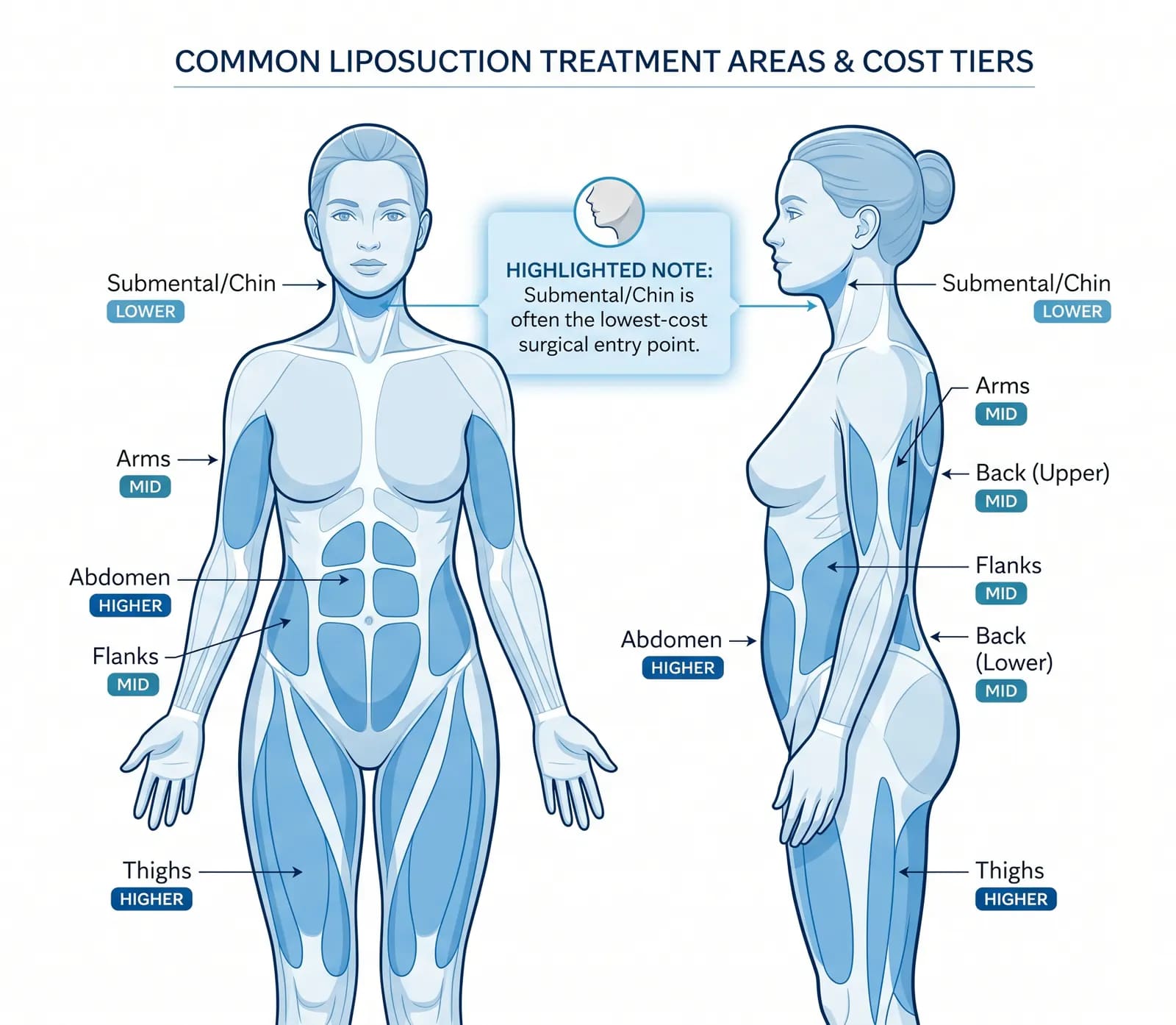
In most U.S. markets, submental liposuction is usually the lowest-cost surgical entry point. ASPS places surgeon fees for chin liposuction at $3,000–$5,500, versus $4,300–$7,500 for liposuction more broadly. Smaller treatment area. Less time. Less equipment. Shorter recovery timeline. That is why chin lipo often shows up first when patients ask about low cost liposuction.
That does not mean it is bargain surgery. Those ASPS numbers are surgeon fees only. Once you add facility, anesthesia, and aftercare, a legitimate U.S. quote below $2,500 total for surgical liposuction is uncommon. A quote under $3,000 can happen in a narrow set of cases, but it should usually be a very small treatment area in a lower-cost market, not a multi-area body-contouring promise.
For a broader breakdown, see liposuction cost by body area.
| Treatment area | Typical cost position |
|---|---|
| Submental/chin | Lowest |
| Arms or small flanks | Lower-mid |
| Abdomen | Mid |
| Thighs | Mid-high |
| Multi-area liposculpture / Lipo 360 | Highest |
Getting surgery for under $3,000
Yes, but only sometimes. Think small, limited, and simple. If someone is promising VASER, multiple treatment areas, or dramatic body liposculpture for that number, the first question should be: What is being left out?
What a suspiciously low price actually signals
Usually, suspiciously low pricing means one of four things.
It may be an unbundled quote. One practice includes surgeon, facility, garments, and follow-up. Another advertises only the surgeon's fee. It may be a high-volume "lipo mill" model where patients are moved through quickly and aftercare is thin. It may involve a non-ABPS operator marketing body contouring under cosmetic-sounding credentials. Or it may rely on a non-accredited setting that lowers overhead by lowering safeguards.
Aesthetic risks of bargain surgery
Patients usually think first about medical complications. Those matter. But aesthetic complications matter too: over-resection, under-correction, asymmetry, contour irregularity, burns with energy devices, and weak skin redraping. Liposuction is not just suction. It is surgical precision with a cannula, judgment about how much to remove, and experience reading the anatomy of each treatment area. When that goes wrong, the "savings" disappear fast.
For a deeper safety breakdown, see liposuction risks and complications.
How city affects price
Very much. The same procedure can cost 40% to 60% more in New York or San Francisco than in Nashville or Indianapolis. City-level estimates show single-area abdominal lipo at roughly $7,000–$12,000 in New York City, $6,500–$11,000 in Los Angeles, $4,500–$8,000 in Miami, $5,000–$9,000 in Dallas–Fort Worth, and $4,500–$8,000 in Houston.
This is where the value conversation gets practical. Houston and Dallas often come in below NYC and LA. Miami can also price lower than the top coastal markets, but it is not automatically a budget market; its averages are partly pulled down by high-volume clinics, which means you need to verify credentials even more carefully.
| City | Typical single-area abdomen range | Value note |
|---|---|---|
| New York City | $7,000–$12,000 | High overhead, premium market |
| Los Angeles | $6,500–$11,000 | Wide range, avoid choosing on branding alone |
| Miami | $4,500–$8,000 | Competitive pricing, but screen carefully |
| Dallas–Fort Worth | $5,000–$9,000 | Often better value than coastal markets |
| Houston | $4,500–$8,000 | Strong value market with deep surgeon pool |
| Nashville | $4,000–$7,000 | Often one of the best U.S. value markets |
Financing as a path to quality care at a lower upfront cost
Financing is often the most honest bridge between budget and safety. CareCredit offers promotional financing for 6, 12, 18, or 24 months on qualifying purchases, with no interest if the balance is paid in full in time. But the catch matters: if the promotional balance is not paid off by the deadline, interest is charged from the purchase date.
Used carefully, financing lets you choose the better surgeon and accredited setting now rather than settling for a lower-standard quote. Used poorly, it becomes another expensive surprise. The rule is simple: finance quality, not impulse. Start by reading liposuction financing options, and ask each office whether the monthly payment shown would actually retire the balance before deferred interest kicks in.
Medical tourism: realistic risk/benefit analysis
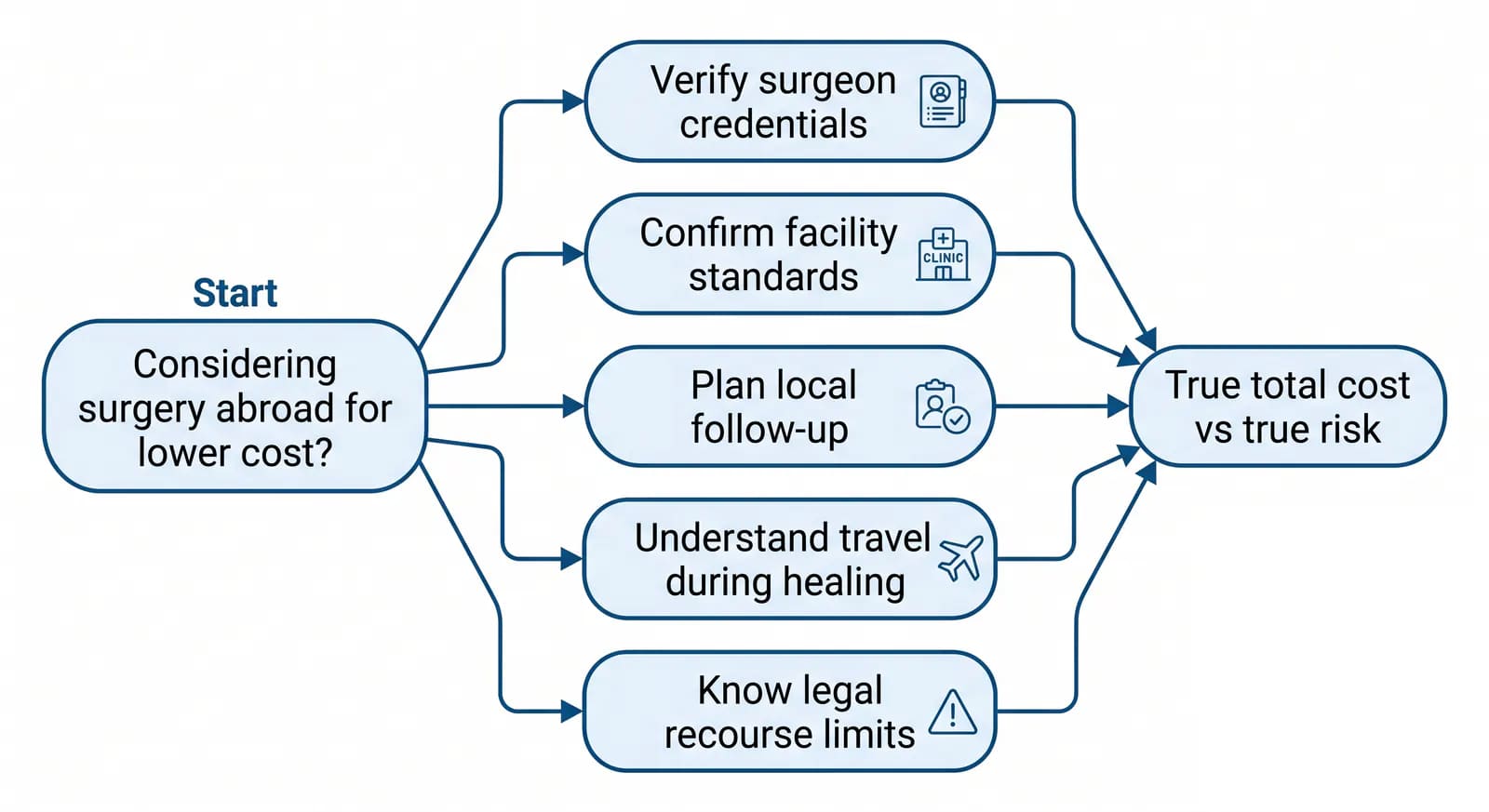
Medical tourism can lower the sticker price. That part is real. So are the tradeoffs.
CDC guidance warns that standards of care and infection control can vary, local follow-up should be coordinated before travel, complications may require treatment back in the U.S., and patients may not have the same legal recourse they would at home. CDC also notes that cosmetic-surgery medical tourism has been linked to outbreaks and deaths in some destinations.
So the right question is not "Can I save money abroad?" It is "What is my true total cost once I include flights, hotel, time off work, garments, possible travel during healing, and the reality that my original surgeon may be thousands of miles away if something looks wrong?" For some patients, the math still works. For many, it does not.
Reduce the scope before you reduce the safety standard. The best options are treating fewer areas, comparing itemized quotes from ABPS board-certified surgeons, considering financing, and looking at supervised academic resident clinics.
Submental or chin liposuction is usually the least expensive surgical lipo area because it is smaller and faster than abdomen or multi-area body contouring. ASPS lists surgeon fees for submental lipo at $3,000–$5,500.
A low price by itself is not unsafe. A low price created by weaker credentials, non-accredited facilities, or thin follow-up is where the risk rises.
Yes. Many practices use medical financing, including promotional CareCredit plans. Make sure you understand whether interest is deferred and what happens if you miss the payoff window.
Yes, significantly. Comparable procedures can cost 40% to 60% more in very high-overhead markets than in lower-cost cities with strong surgeon supply.
Sometimes, but usually only for a very small area in a lower-cost market. In the U.S., a fully legitimate all-in surgical liposuction quote below $2,500 is unusual and deserves close review.
The risks include both medical complications and poor contour results that require revision. Revision pricing is usually higher than primary pricing because the case is more complex.
Start with ABPS verification, accredited facilities, and transparent itemized quotes. Then compare experience, consistency of results, revision policy, and what is included in the total price. Our guide to choosing a safe liposuction surgeon is the right next read.
