The short answer: almost never for cosmetic purposes. But if your liposuction is medically necessary — not just aesthetically motivated — you may have a real path to coverage.
Here is what US insurers actually cover, which conditions qualify, and what documentation you need to give yourself the best chance of approval.
The Default: Cosmetic Liposuction Is Not Covered
Every major US health insurer — Aetna, Blue Cross Blue Shield, Cigna, UnitedHealthcare, Humana, and all others — explicitly excludes elective cosmetic procedures from coverage. Liposuction performed to remove unwanted fat for aesthetic reasons falls squarely in that category. That means the realistic planning baseline is what liposuction actually costs.
This applies regardless of how much fat is removed, how many body areas are treated, or how much distress the fat causes you emotionally. Insurers define "medically necessary" based on functional impairment and diagnosed conditions, not self-image or quality of life in the cosmetic sense.
If you are considering liposuction to improve your appearance, you will be paying out-of-pocket. The national average ranges from $3,500 to $9,000 depending on the body area, with multiple-area procedures running higher.
When Coverage May Apply: Medical Exceptions
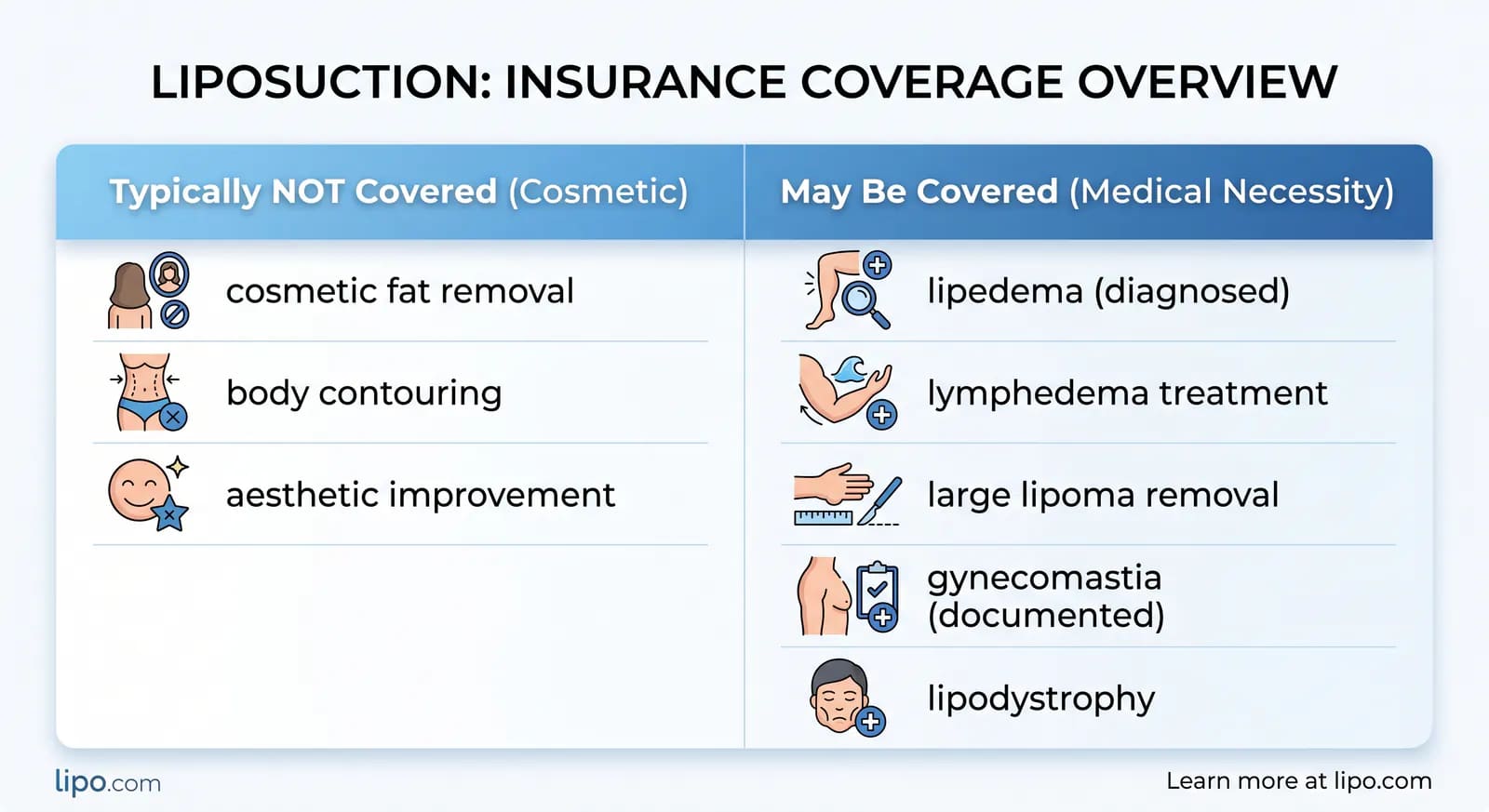
Liposuction crosses from cosmetic to potentially covered territory when it treats a diagnosed medical condition. These are the conditions where US insurers have approved claims:
Lipedema
Lipedema is a chronic fat disorder — almost exclusively affecting women — characterized by symmetrical, painful fat accumulation in the legs, thighs, and sometimes arms that does not respond to diet or exercise. It is frequently misdiagnosed as obesity.
Since lipedema received ICD-10 diagnostic codes, insurance coverage has expanded significantly. Germany and the Netherlands now cover lipedema liposuction as standard care. In the US, coverage remains inconsistent but achievable with:
- Formal diagnosis from a vascular medicine specialist or certified lipedema specialist
- Documentation of failed conservative treatment (compression garments, manual lymphatic drainage, 3–6 months minimum)
- Prior authorization from your insurer before surgery
- A letter of medical necessity from your treating physician
Coverage rates vary by insurer and state. Some Blue Cross Blue Shield plans and UnitedHealthcare plans have approved lipedema claims. Medicaid coverage varies by state, with some states covering it and others not.
Lymphedema
When liposuction is used as part of lymphedema treatment — reducing the volume of fat deposits that have accumulated due to lymphatic damage — some insurers will cover it. This typically follows failed conventional lymphedema therapy and requires specialist documentation.
Large or Multiple Lipomas
Lipomas (benign fatty tumors) can be removed with liposuction. If they are large, multiple, growing, painful, or causing functional limitation, insurers often cover removal as a medically necessary procedure. Smaller single lipomas are typically not covered.
Gynecomastia
Male breast tissue enlargement caused by hormonal imbalance or medication side effects can sometimes be covered when there is documented medical cause, functional impact, or psychological harm meeting clinical thresholds. Coverage is inconsistent — some plans cover it, most don't.
HIV-Associated Lipodystrophy
Fat redistribution caused by long-term antiretroviral medication is recognized as a medical condition by some insurers, with liposuction coverage for fat deposits in the upper back (buffalo hump) and other areas documented to cause functional or metabolic problems.
How to Build a Coverage Case
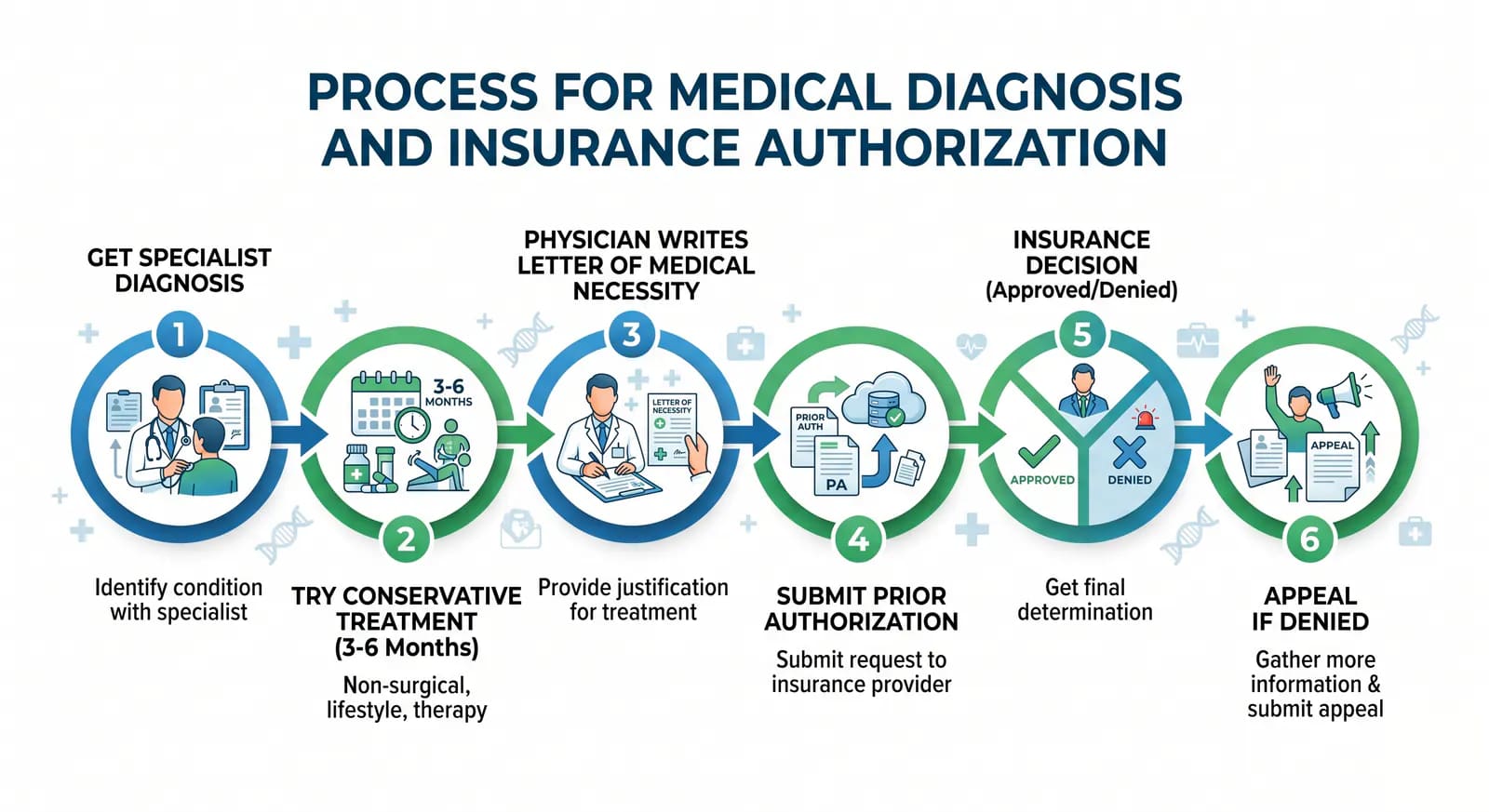
If you believe your condition qualifies, this is the documentation path:
Step 1: Get a specialist diagnosis. A primary care physician saying "she has lipedema" is not enough. You need formal diagnosis from a recognized specialist — vascular medicine, a certified lymphedema therapist's evaluation, or a board-certified plastic surgeon documenting the condition.
Step 2: Try conservative treatment first. Insurers require evidence that less-invasive treatment has failed. For lipedema, this means 3 to 6 months of compression garment use, manual lymphatic drainage, and dietary management — documented by a provider, not self-reported.
Step 3: Obtain a letter of medical necessity. Your physician writes a letter explaining the diagnosis, the functional impairment it causes, what conservative treatments were tried and why they were insufficient, and why liposuction is medically necessary. This letter is the cornerstone of your claim.
Step 4: Submit prior authorization before surgery. Your surgeon's office submits a prior authorization request to your insurer, including the medical necessity letter, diagnosis codes, procedure codes, and supporting documentation. Do not schedule surgery before receiving written approval.
Step 5: Appeal if denied. Insurers deny many first-time claims even for valid conditions. You have the right to an internal appeal and then an external independent review. For lipedema in particular, denials are frequently overturned when additional specialist letters and peer-reviewed literature are submitted.
HSA and FSA: What You Can and Cannot Use
HSA (Health Savings Account) and FSA (Flexible Spending Account) funds cannot be used for cosmetic liposuction. The IRS defines eligible expenses as those primarily for the diagnosis, cure, mitigation, treatment, or prevention of disease — cosmetic procedures do not qualify.
If your liposuction qualifies as medically necessary and is approved by your insurer, you may be able to use HSA/FSA funds for cost-sharing (deductibles, copays). Confirm with your plan administrator before assuming eligibility.
If You're Paying Out-of-Pocket: Your Options
Most liposuction patients self-pay. Common financing approaches:
- Medical credit cards: CareCredit and Alphaeon Credit offer 6–24 month promotional no-interest periods. Interest rates after the promotional period can be high (26–29% APR), so pay off the balance within the promotional window.
- Personal loans: Credit unions and online lenders often offer lower rates than medical credit cards — 8–16% APR for qualified borrowers — with fixed monthly payments.
- In-house practice financing: Many surgery practices offer payment plans, sometimes with 0% interest for shorter terms.
- Medical financing platforms: PatientFi, United Medical Credit, and similar platforms specialize in elective procedure financing and may offer options for patients with less-than-perfect credit.
See our complete guide to liposuction financing options for rate comparisons and a breakdown of what each option costs over time. Before committing, compare liposuction quotes like-for-like — and if you are weighing treatment abroad, read liposuction abroad and its real costs.
Does health insurance cover liposuction? Almost never for cosmetic purposes. All major US insurers classify cosmetic liposuction as elective and exclude it from coverage. Liposuction performed to treat a diagnosed medical condition — lipedema, lymphedema, large lipomas, gynecomastia — may qualify with proper documentation and prior authorization.
Does Medicare or Medicaid cover liposuction? Medicare does not cover cosmetic liposuction. Medicaid varies by state but also excludes elective cosmetic procedures. Both programs may cover liposuction in narrow medical circumstances — such as lipedema or large lipoma removal — but approval requires diagnosis, documentation, and prior authorization.
Is liposuction for lipedema covered by insurance? Increasingly yes, but coverage is inconsistent across plans and states. With formal diagnosis, documented conservative treatment failure, and prior authorization, some major insurers — including select BCBS and UnitedHealthcare plans — have approved lipedema liposuction claims. European coverage is more consistent; US coverage is evolving.
What medical conditions make liposuction insurance-eligible? Lipedema (Stage 2+), lymphedema, large or multiple painful lipomas, documented gynecomastia, and HIV-associated lipodystrophy are the most commonly approved conditions. Each requires specialist diagnosis, conservative treatment failure documentation, and prior authorization.
What documentation do I need? Specialist diagnosis, 3–6 months of documented conservative treatment, a letter of medical necessity from your physician, and a prior authorization request submitted by your surgeon before the procedure.
What happens if insurance denies my claim? You can appeal. Request the denial in writing, file an internal appeal with additional specialist letters and peer-reviewed literature, then pursue an external independent review if needed. Lipedema denials in particular are frequently overturned on appeal.
Can I use an HSA or FSA to pay for liposuction? Not for cosmetic liposuction. If your procedure qualifies as medically necessary and is insurer-approved, pre-tax account funds may cover cost-sharing. Confirm with your plan administrator.
How can I afford liposuction without insurance? CareCredit, Alphaeon Credit, personal loans, in-house payment plans, and medical financing platforms like PatientFi are the most common options. Compare total cost — including interest — before choosing. See our full financing guide for a breakdown.
Ready to find a surgeon? Browse lipo.com's directory of board-certified liposuction specialists — verified credentials, real patient reviews, and specialty filters by procedure type and city.
