Male chest concerns — often called "man boobs" — are among the most emotionally distressing aesthetic issues men face. They are also among the most commonly misunderstood medically, which leads to patients getting the wrong procedure.
The fundamental distinction: true gynecomastia is a glandular condition that requires surgical excision. Pseudogynecomastia is fat accumulation that responds well to liposuction. Many men have both. Liposuction on true gynecomastia produces a flat chest without nipple projection — but leaves the firm disc behind the areola intact. The result looks worse, not better.
Here's how to identify which condition you have, what each treatment involves, and what male liposuction results look like for all the body areas men most commonly address.
Understanding the Chest: Gynecomastia vs. Pseudogynecomastia
True Gynecomastia
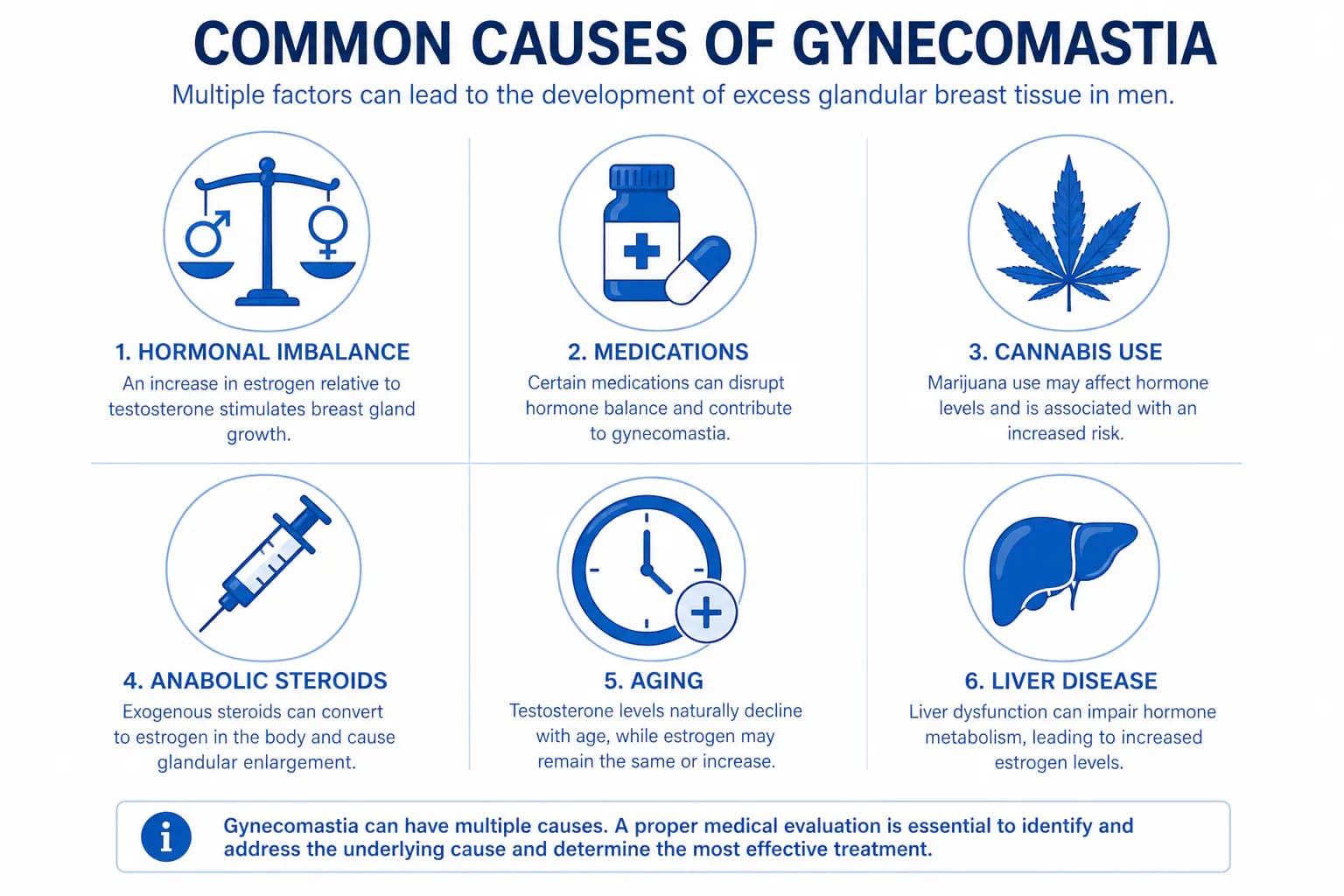
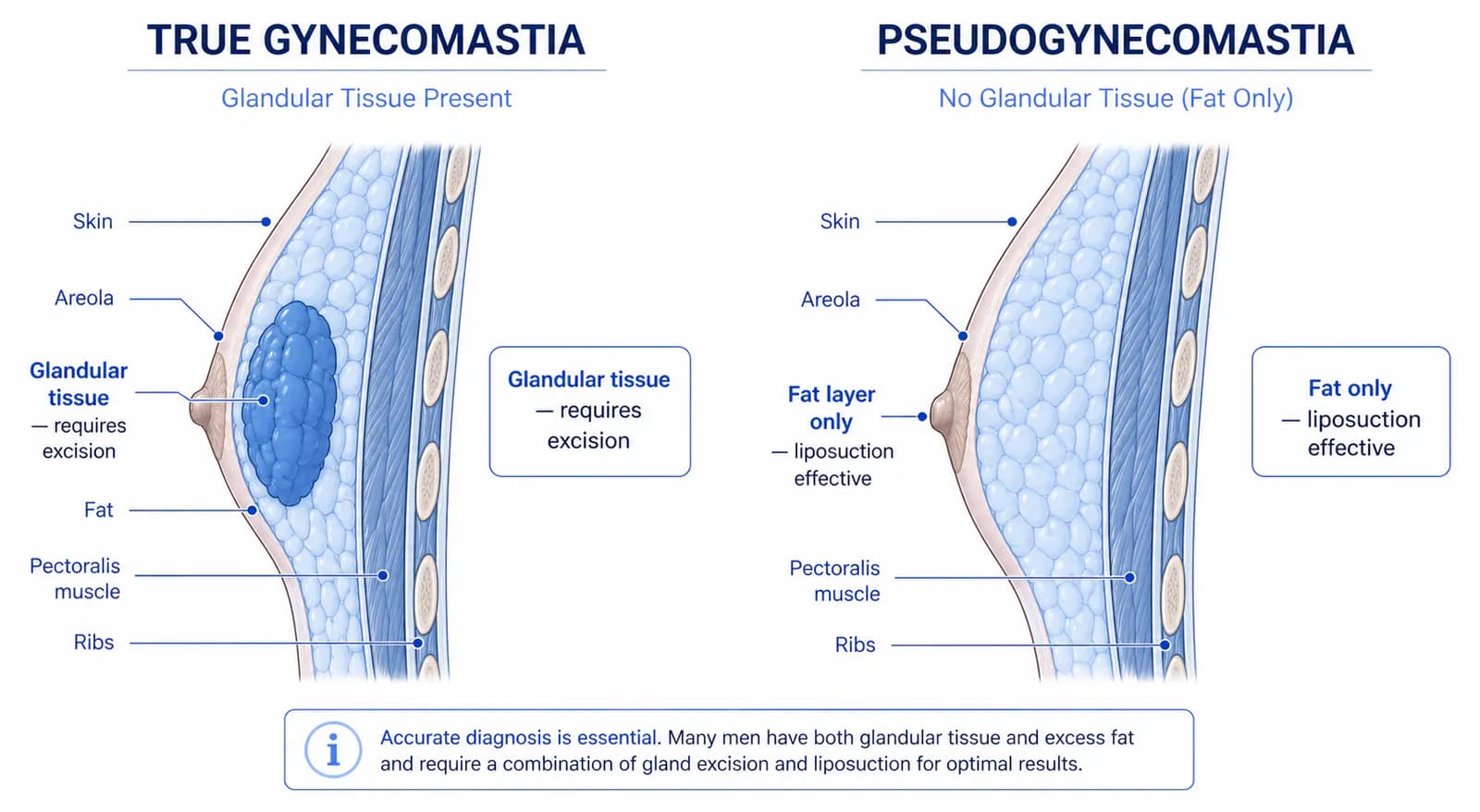
Gynecomastia is the development of actual breast glandular tissue in men. The tissue is firm, disc-like, and located directly behind the nipple and areola. It is caused by an imbalance between testosterone and estrogen — too little testosterone relative to estrogen — which triggers breast gland development.
How common is it? Very. Gynecomastia affects 60% to 90% of adolescent males during puberty (most cases resolve spontaneously), and an estimated 30% to 50% of adult men have some degree of gynecomastia.
Common causes in adult men:
- Anabolic steroids: Converting testosterone to estrogen, steroids are the most common iatrogenic cause of gynecomastia
- Cannabis: Regular cannabis use is associated with elevated estrogen and gynecomastia
- Medications: SSRIs, spironolactone, some blood pressure medications, finasteride (Propecia), and others
- Declining testosterone: Natural testosterone decline in men over 50 changes the T:E ratio
- Liver disease: The liver metabolizes estrogens; liver dysfunction allows estrogen to accumulate
- Obesity: Adipose tissue converts testosterone to estrogen; heavier men have higher estrogen levels
Critical point: Liposuction cannot remove glandular tissue. The cannula disrupts and aspirates fat; it cannot excise the rubbery, fibrous gland. True gynecomastia requires direct surgical excision through a small periareolar incision.
Pseudogynecomastia
Pseudogynecomastia is chest fat without glandular involvement. The chest is enlarged, soft, and distributed broadly — not concentrated in a firm mass behind the nipple. It is purely a fat accumulation issue, identical in composition to fat anywhere else on the body.
Pseudogynecomastia responds extremely well to liposuction — VASER or laser-assisted techniques are particularly effective on chest tissue, which tends to be dense and fibrous in men.
The Self-Assessment
Press your thumb and index finger together toward the center of your chest, directly behind the nipple. Apply firm pressure.
- Firm, rubbery, disc-like mass: Glandular tissue — true gynecomastia. Gland excision required.
- Uniformly soft, no distinct firm mass: Fat only — pseudogynecomastia. Liposuction may be sufficient.
- Some firmness plus surrounding softness: Mixed — combination of gland + fat. Both excision and liposuction typically needed.
Also assess nipple appearance: puffy or protruding nipples that remain visible even at low body fat are a strong indicator of glandular involvement.
A physical examination by a board-certified plastic surgeon confirms which you have and what treatment is appropriate.
The Procedure: Liposuction, Excision, or Both
Liposuction Only (For Pseudogynecomastia)
VASER liposuction is the preferred technique for male chest fat reduction. The ultrasound energy effectively breaks up the dense, fibrous chest fat for smoother, more even removal. Results: a flatter, more defined chest with reduced overall volume.
Incisions are placed in inconspicuous locations — typically at the edge of the areola or in the fold below the chest. The marks are minimal.
Not appropriate for true gynecomastia — leaving gland in place after liposuction results in continued nipple protrusion and an unnatural-looking flat chest with a remaining central mound.
Gland Excision Only (For Pure Glandular Cases)
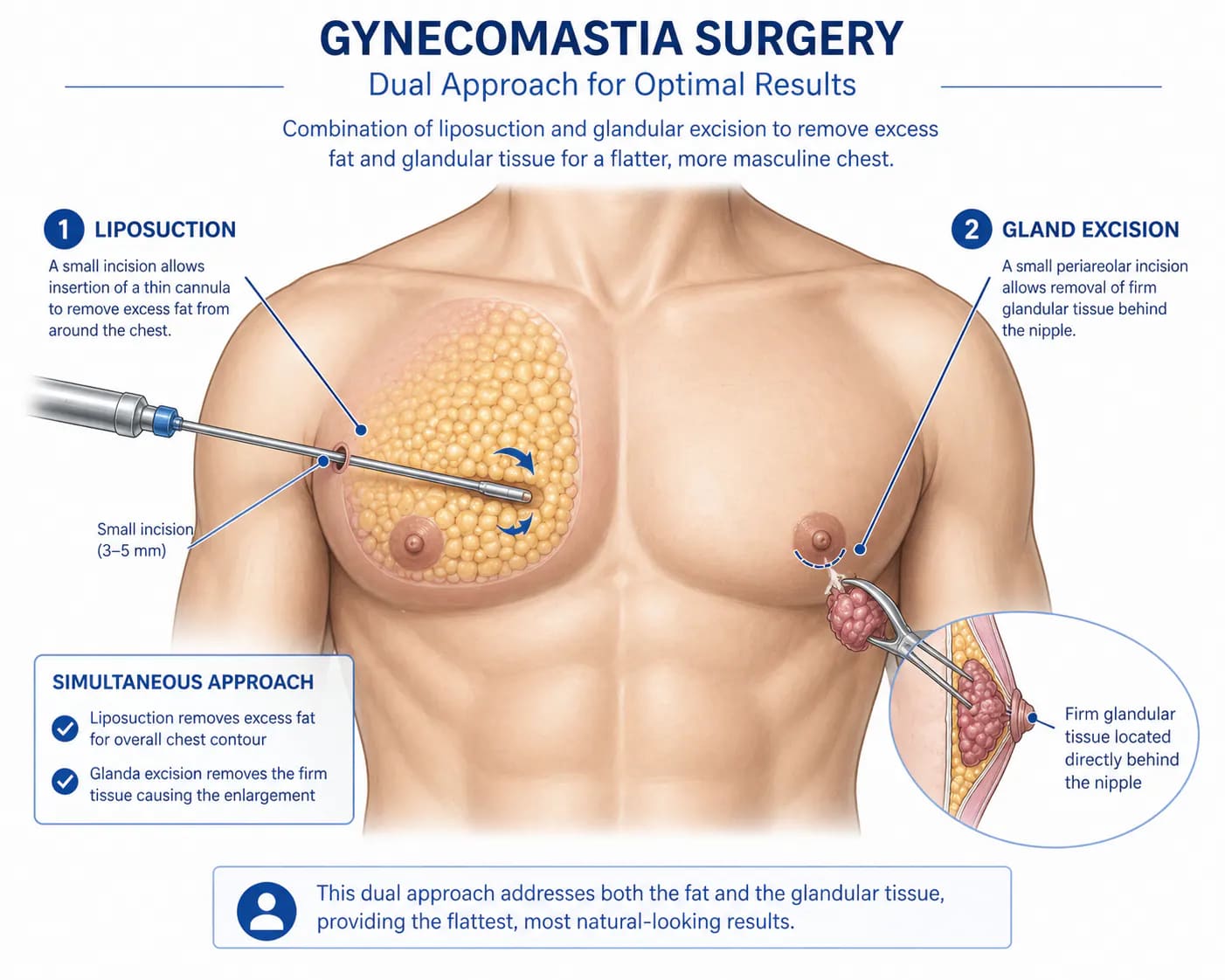
Through a small periareolar incision (along the lower border of the areola), the glandular disc is directly excised under direct visualization. Appropriate when the primary problem is gland with minimal fat.
Combined Liposuction + Gland Excision (Most Common)
Most gynecomastia patients benefit from both:
1. VASER liposuction removes the surrounding chest fat and sculpts the overall chest contour
2. Periareolar excision removes the glandular disc directly behind the nipple
Performing both in the same session produces the most complete result: a flat chest, reduced nipple protrusion, and defined chest contour. This combination is the current standard for most gynecomastia patients.
Skin Tightening (For Severe or Grade 3 Gynecomastia)
Severe gynecomastia — particularly in patients who have lost significant weight — may involve excess skin in addition to gland and fat. These cases may require skin removal (similar in principle to a breast reduction in women), which leaves a more visible scar. Some surgeons use radiofrequency devices (BodyTite, Renuvion) to tighten skin without excision in moderate skin laxity cases.
Cost: What Gynecomastia Surgery Actually Costs
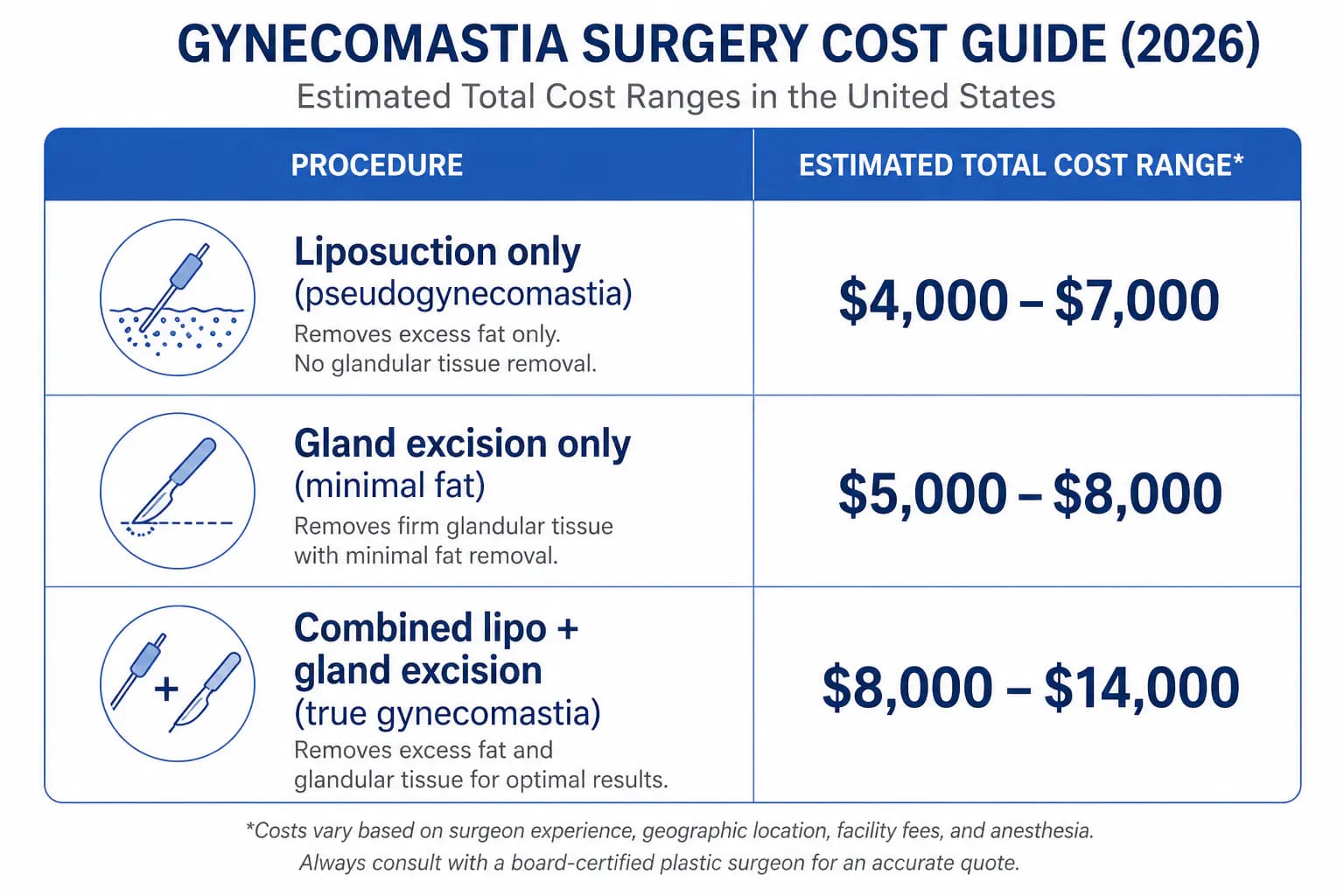
| Procedure | Total Cost Range |
|---|---|
| Liposuction only (pseudogynecomastia) | $4,000 – $7,000 |
| Gland excision only | $5,000 – $8,000 |
| Combined lipo + gland excision | $8,000 – $14,000 |
| With skin tightening (BodyTite/Renuvion) | $10,000 – $18,000 |
Total costs — surgeon, facility, anesthesia. Excludes compression vest and post-op supplies.
Gynecomastia surgery costs more than standard body liposuction because it involves gland excision — a more technically demanding component — and often requires general anesthesia. Geographic variation is significant: urban markets (NYC, Miami, LA) typically run toward the top of these ranges.
Does Insurance Cover Gynecomastia Surgery?
Insurance sometimes covers gynecomastia surgery — more often than most patients expect.
Coverage is possible when:
- There is a documented medical cause (hormonal imbalance confirmed by labs, medication-induced gynecomastia)
- There is functional impairment (skin irritation, infection, documented pain)
- The condition has been present for more than 12 months and has not resolved spontaneously
- Conservative treatment (addressing the underlying cause) has been tried and failed
Steps toward insurance coverage:
1. Request lab work: testosterone, estrogen (estradiol), LH, FSH, prolactin, and liver function
2. Document the duration and severity of the condition
3. Rule out or address correctable causes (stopping anabolic steroids, cannabis cessation, medication review)
4. Have your surgeon submit a prior authorization request with supporting documentation
Pure cosmetic cases — gynecomastia with no documented medical cause and no functional impairment — are almost never covered.
Recovery: What to Expect
Days 1–5: Soreness and tightness in the chest area. Compression vest worn continuously. Light walking encouraged. Most patients describe the pain as manageable — similar to a hard chest workout.
Week 1–2: Swelling and bruising visible, particularly around the areola. Most patients return to desk work at 5 to 7 days. Chest may appear flat but swollen — the definition develops as swelling resolves.
Weeks 3–6: Progressive swelling reduction. Chest contour becomes increasingly apparent. Light activity at week 3; compression vest worn during the day.
Week 6+: Full exercise, including chest training, cleared by surgeon. The chest should feel substantially different by now — without the glandular firmness.
Months 3–12: Final results emerge. Swelling in the chest area takes longer to resolve than most body areas — expect 6 to 12 months for final results, particularly around the areola where the excision was performed.
Male Liposuction Beyond the Chest
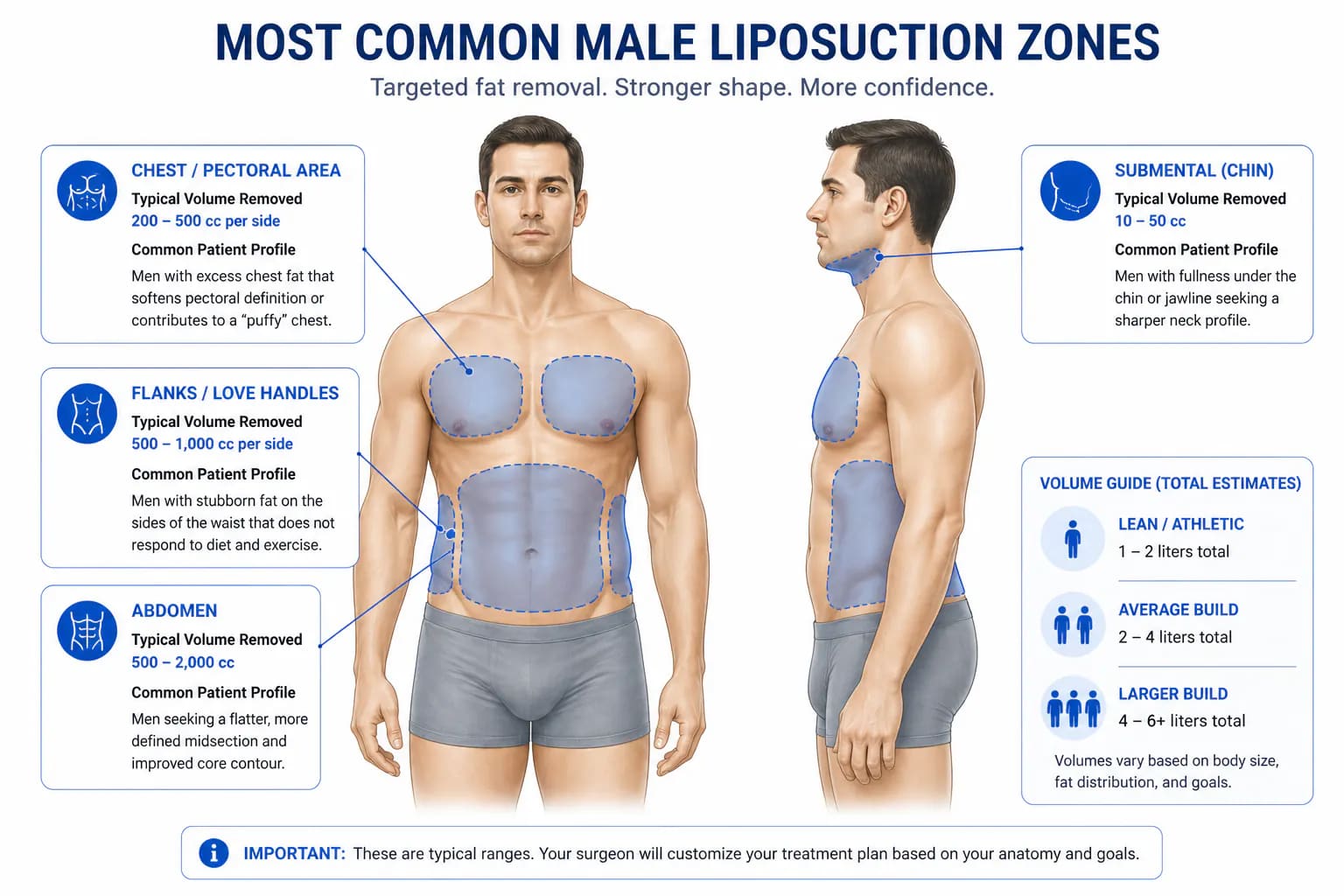
Gynecomastia is the most procedure-specific male body contouring concern. Beyond the chest, men most commonly seek liposuction for:
Flanks / Love Handles: The most common male liposuction area. Men tend to accumulate fat in the lateral trunk even when otherwise fit. The result — a tapered waist — significantly changes the appearance of clothing and silhouette. VASER is frequently used for its effectiveness on denser male tissue.
Abdomen: Male abdominal fat is often more visceral (deep, around the organs) than subcutaneous — liposuction can only address the subcutaneous layer. Men with primarily visceral belly fat are poor liposuction candidates.
Chin / Submental: One of the highest-satisfaction areas for male liposuction. A defined jawline with reduced chin fat dramatically changes facial appearance. Quick recovery, predictable results.
Back: Bra-area rolls and upper back fat are increasingly common concerns for men, particularly in those who have gained weight. Back liposuction requires positioning changes during surgery but is effective with good results.
HD Liposculpture: Men pursuing an athletic, defined appearance often combine flank + abdominal liposuction with HD techniques to reveal ab definition, oblique grooves, and chest definition. See our complete HD liposuction guide for candidacy and technique details.
Why Men Should Address the Cause Before Surgery
The most important warning for gynecomastia patients: if the hormonal cause is not addressed, surgery is not the end of the problem.
Men who continue anabolic steroid use after gynecomastia surgery frequently develop recurrence — new glandular tissue growing where the old was removed. The revision procedure is typically more complex and expensive than the original.
The same applies to medication-induced gynecomastia: if the causative medication cannot be stopped, the surgical result may be temporary.
Before scheduling surgery, work with your primary care physician or an endocrinologist to:
- Identify and if possible eliminate the cause
- Document lab values confirming the hormonal imbalance
- Allow adequate time for spontaneous resolution (particularly in younger men where puberty-related gynecomastia may still be resolving)
Men who address the underlying cause first and then have surgery tend to have better, more durable outcomes than those who proceed directly to surgery without investigation.
What is gynecomastia? Development of glandular breast tissue in men, caused by elevated estrogen relative to testosterone. True gynecomastia requires surgical excision — it does not respond to diet, exercise, or liposuction.
What's the difference between gynecomastia and pseudogynecomastia? Gynecomastia = actual glandular tissue (firm, behind the nipple). Pseudogynecomastia = chest fat only (soft, no firm disc). Many men have both. Treatment depends on which type — or combination — is present.
How do I tell if I have gynecomastia? Press your fingers together behind the nipple with firm pressure. A firm, rubbery disc = likely glandular (gynecomastia). Uniform softness = likely fat (pseudogynecomastia). Puffy nipples at low body fat = strong glandular indicator. Physical examination confirms.
How much does gynecomastia surgery cost? Lipo only: $4,000–$7,000. Gland excision only: $5,000–$8,000. Combined lipo + excision: $8,000–$14,000. Total costs including surgeon, facility, anesthesia.
Does insurance cover gynecomastia surgery? Sometimes — when a documented medical cause exists. Lab work confirming hormonal imbalance, documented duration, and conservative treatment failure support an insurance claim.
What is recovery time? Desk work at 5–7 days, full exercise at 6 weeks. Final chest results visible at 6 to 12 months as swelling resolves.
What other areas do men get liposuction? Flanks (most common), abdomen, chin, and back. HD liposculpture for abs and chest definition is increasingly popular for fit men.
Does gynecomastia come back? If the underlying cause is not addressed (anabolic steroids, cannabis, medications), new glandular tissue can develop after surgery. Address the cause before surgery for the most durable result.
