HD liposuction is the most technically demanding — and most frequently oversold — procedure in body contouring. When it works, the results are extraordinary: visible abdominal definition, sculpted flanks, and an athletic body that looks earned in the gym. When it's performed on the wrong patient, the results are disappointing at best and require costly revision surgery at worst.
Here is what HD liposuction actually involves, who it works for, what it costs, and the candidacy threshold most marketing doesn't tell you.
What Makes HD Liposuction Different
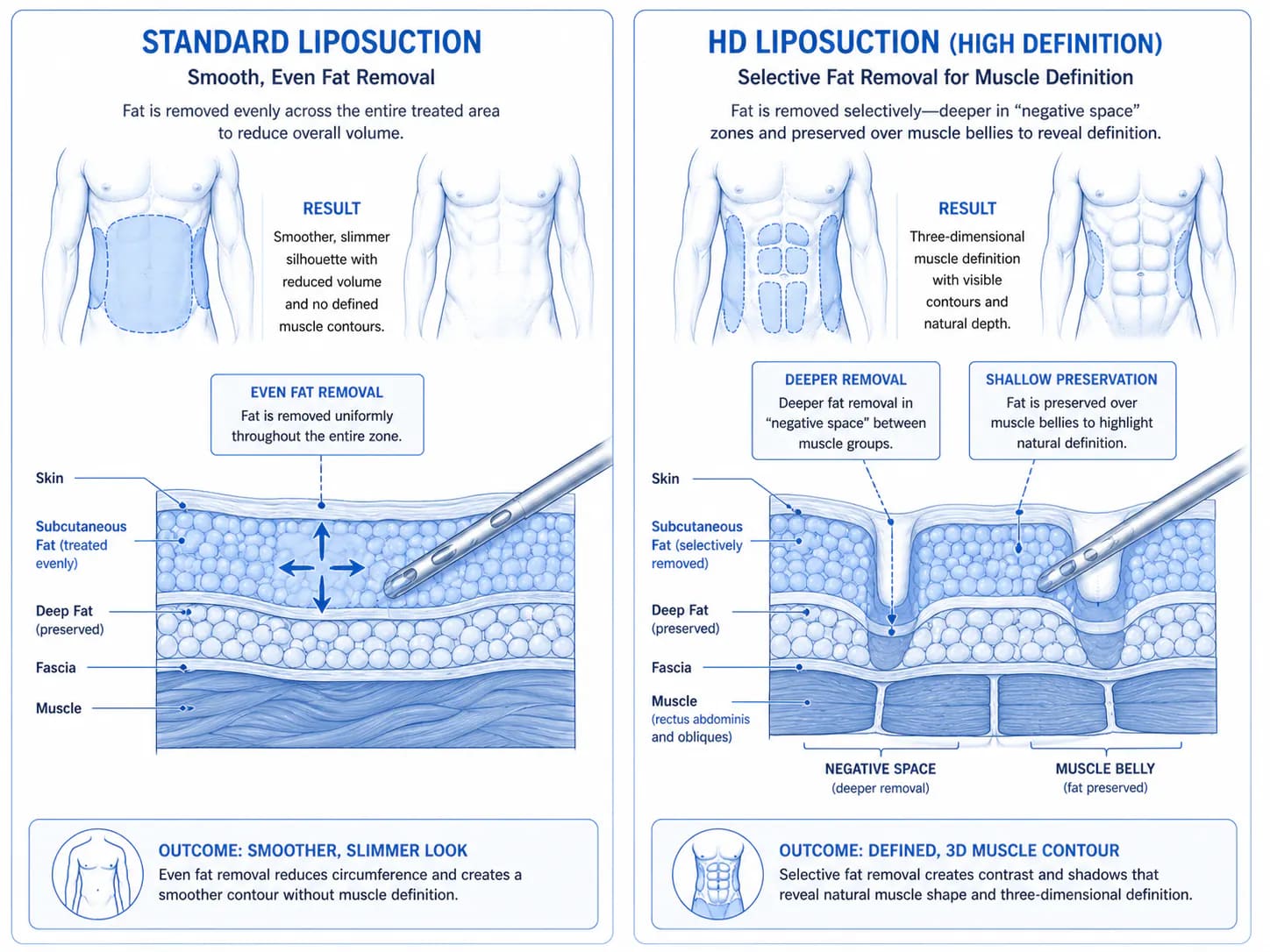
Standard liposuction removes fat evenly across a treatment zone. The result is a smaller, smoother contour — less bulk, same shape.
HD liposuction removes fat selectively, in varying amounts at different depths and positions, to create three-dimensional definition that mimics the look of developed musculature. The surgeon uses the natural anatomy of muscle groups as a template, then removes more fat from the "negative spaces" between muscles and less from directly over the muscle bellies.
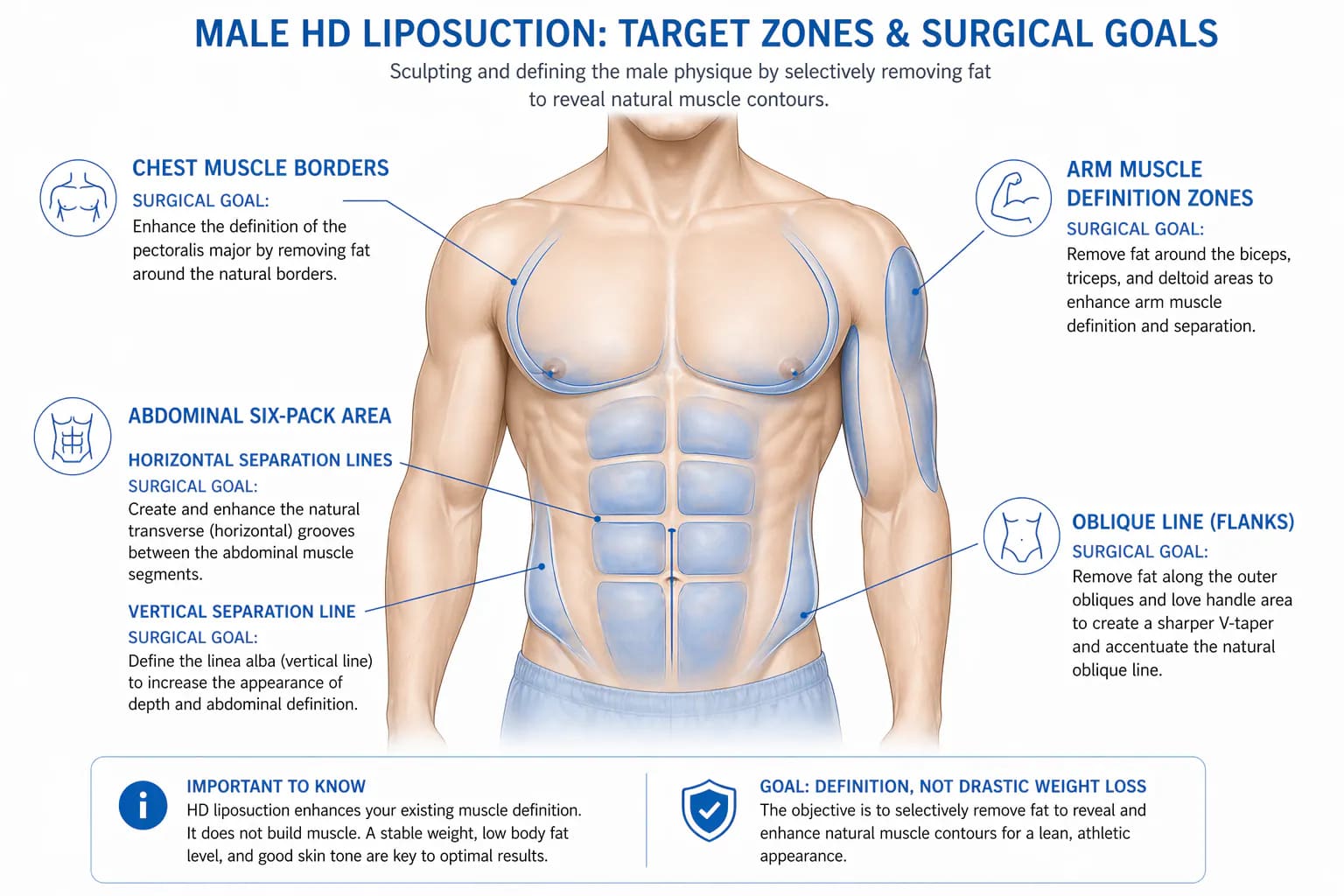
The result: a sculpted, defined look where muscles appear to be clearly visible — abs lines, oblique grooves, pectoral borders, arm muscle definition.
The catch: HD liposuction reveals muscles. It cannot create them. Patients who don't have underlying muscle tone from regular exercise don't have muscles to reveal — and no amount of selective fat removal produces definition from nothing. This is the single most important thing to understand about HD lipo candidacy.
The Technology: Why VASER Is Used for HD Lipo
Standard tumescent liposuction uses mechanical motion — a cannula moving in a pulling motion — to dislodge and remove fat. It's effective for bulk fat reduction but lacks the precision to sculpt between specific fat layers without disturbing adjacent tissue.
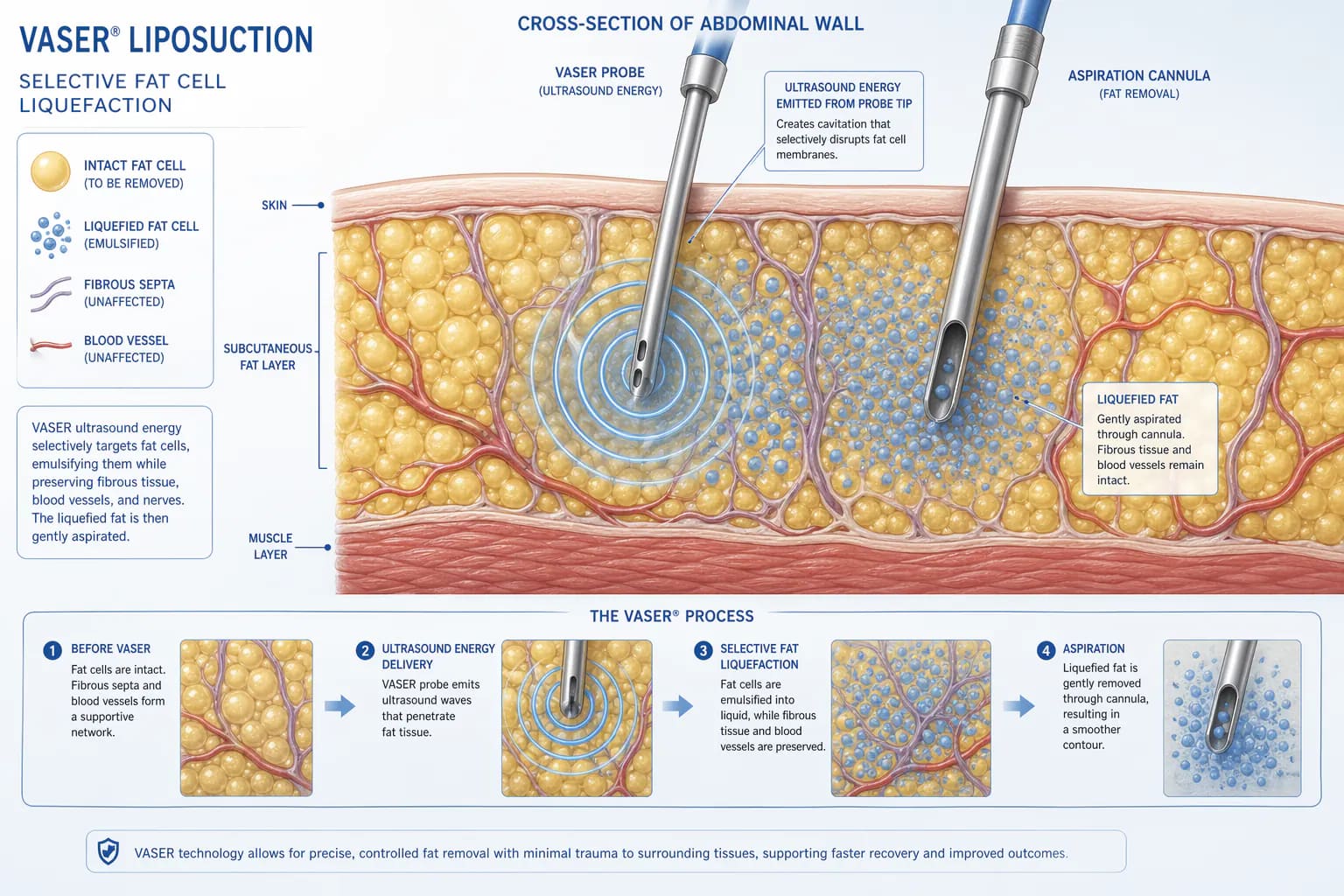
HD liposuction almost always uses VASER (Vibration Amplification of Sound Energy at Resonance) ultrasound technology:
1. A VASER probe emits ultrasound energy that selectively liquefies fat cells while largely preserving blood vessels, nerves, and the fibrous connective tissue (fibro-septal network) within the fat layer.
2. The liquefied fat is then aspirated through a smaller cannula with more control.
3. The VASER's ability to work at specific depths — removing fat from the deep layer while leaving the superficial layer intact, or vice versa — is what enables the selective pattern removal that creates definition.
Without this level of precision, attempting to sculpt anatomically detailed definition would result in high rates of contour irregularity. VASER is not the only technology used for HD lipo — laser-assisted devices are also used by some surgeons — but VASER Hi-Def is the most studied and widely adopted platform.
Who Is a Good HD Liposuction Candidate?
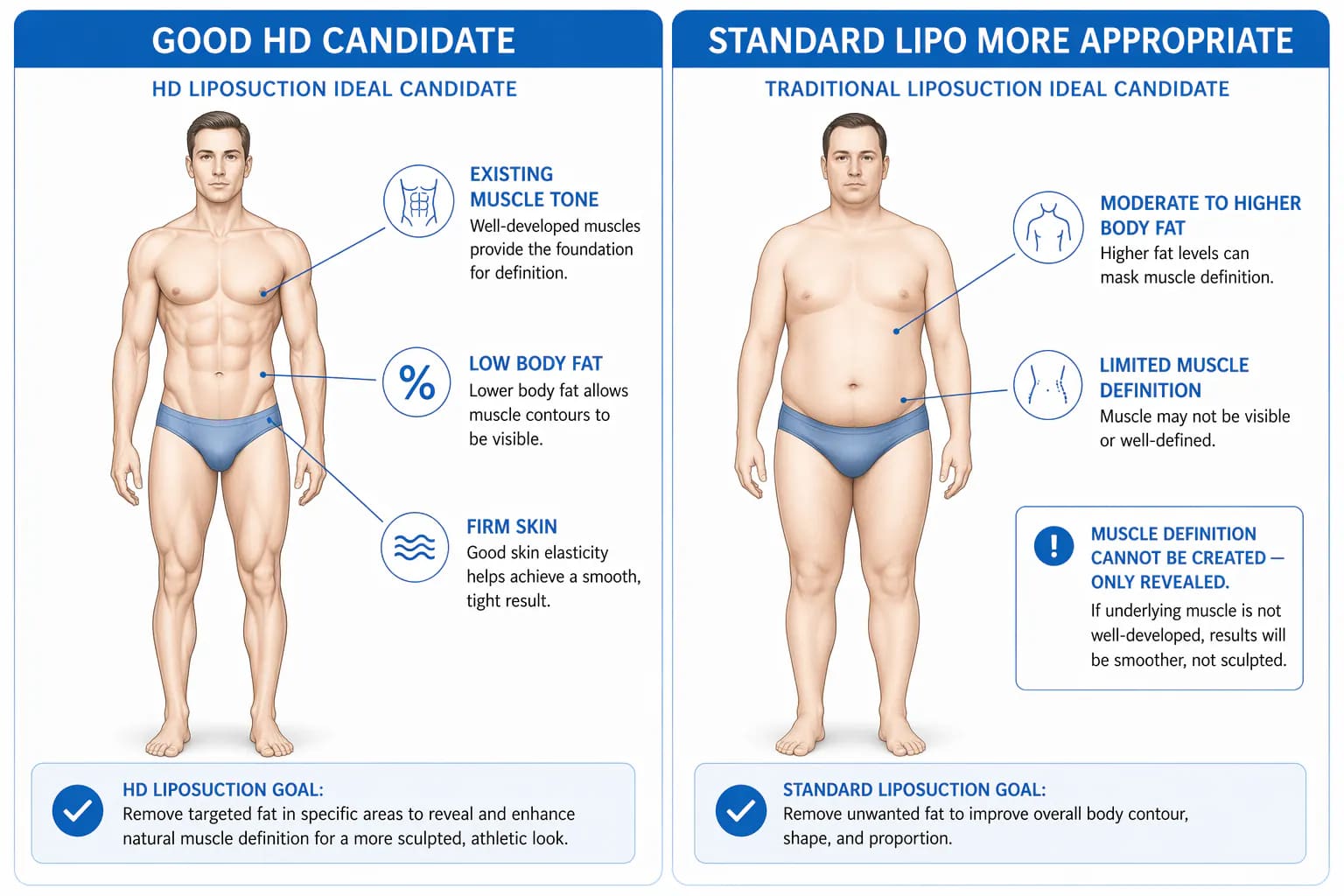
The candidacy bar for HD lipo is meaningfully higher than for standard liposuction. Most patients who inquire about HD lipo are not good candidates — not because they aren't motivated, but because they haven't been given honest information about what the procedure can and can't do.
Good HD liposuction candidates:
- Are at or within 10 to 15 lbs of their stable goal weight
- Exercise regularly and have existing, developed muscle tone
- Have a thin layer of stubborn fat over muscles that are already defined when flexed
- Have good skin elasticity — the skin needs to contract tightly over the sculpted contour
- Have realistic expectations: HD lipo enhances existing definition, it doesn't create it
Standard liposuction is more appropriate if:
- You have a significant amount of fat to remove
- You don't currently exercise regularly or have visible muscle tone
- Your primary goal is volume reduction, not definition
- You have loose or poor-quality skin in the treatment area
HD lipo is not appropriate if:
- You are significantly overweight and hoping surgery will create an athletic body
- You are not committed to maintaining an active lifestyle post-surgery
- You have unrealistic expectations about the degree of definition achievable
Male vs. Female HD Liposculpture: Different Goals, Different Zones
Male HD liposuction is most commonly focused on:
- Abdominal six-pack definition: Removing fat along the horizontal and vertical lines between the rectus abdominis muscle segments. Fat is removed more aggressively in the "negative spaces" (grooves) and preserved over the muscle bellies.
- Oblique line: The lateral abdominal groove visible in athletic males. Fat removal along the external oblique creates the V-taper silhouette.
- Chest/pectoral definition: Removing fat around the lower border and medial edge of the pectorals to define the muscle outline.
- Arm definition: Selective removal around the bicep and tricep to reveal muscle contour.
Female HD liposculpture typically targets:
- Abdominal toning: Less about six-pack visibility and more about a flat, slightly defined midsection with visible linea alba.
- Flank taper: Aggressive flank removal to create an hourglass waist curve.
- Arm definition: Reducing arm circumference while maintaining a feminine silhouette.
- Thigh contouring: Some HD protocols include selective thigh fat removal to define the quadriceps outline.
The aesthetic goals differ significantly between male and female patients, and surgeons with extensive HD experience approach each case differently.
Cost: HD Liposuction Pricing by Scope
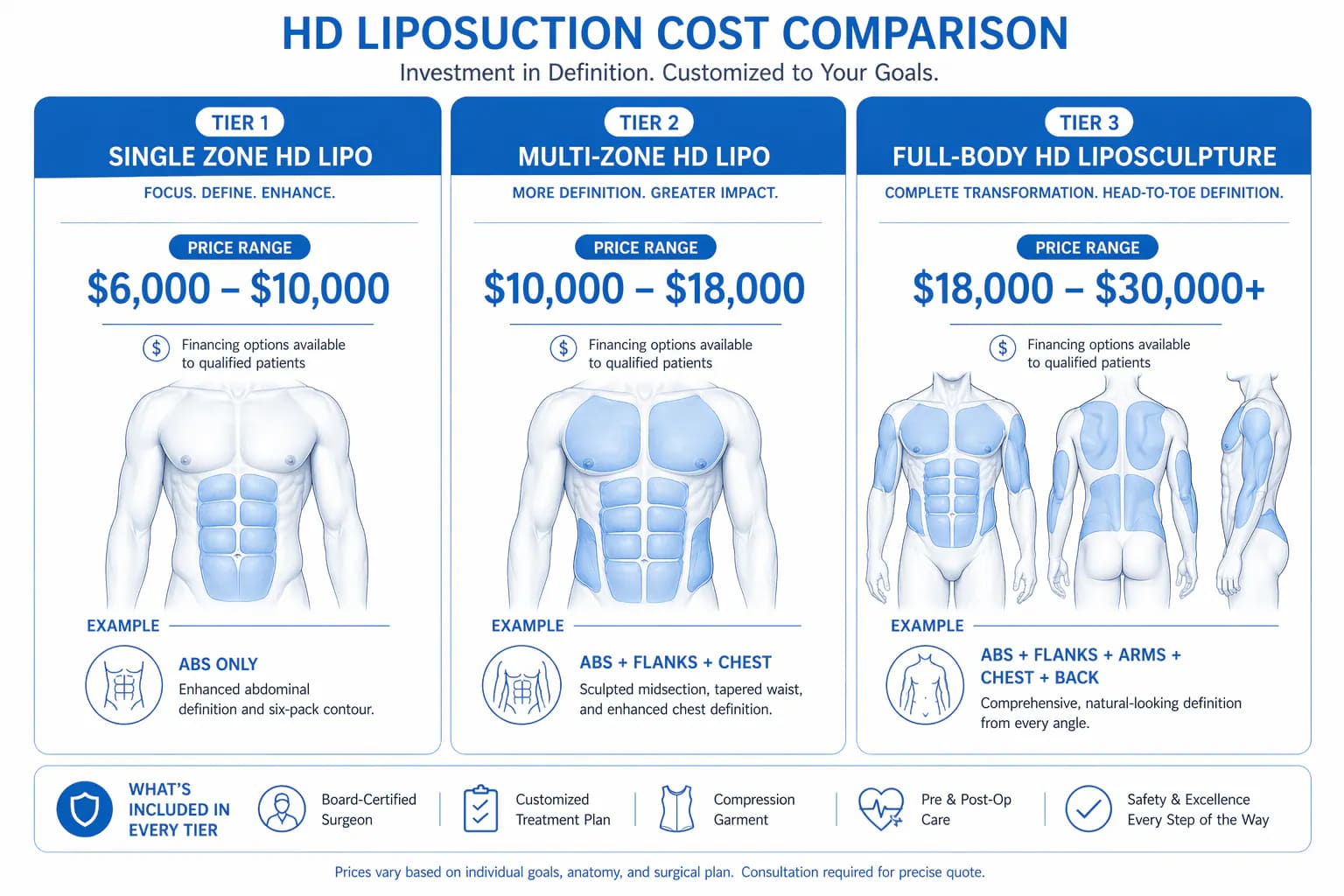
HD liposuction costs significantly more than standard liposuction because it requires more surgical time, specialized technique, VASER equipment, and a higher level of surgical artistry.
| Scope | Typical Total Cost |
|---|---|
| Single zone (abdomen only) | $6,000 – $10,000 |
| Two to three zones (abs + flanks + chest) | $10,000 – $18,000 |
| Full-body HD liposculpture | $18,000 – $30,000+ |
| HD + fat transfer (pecs, glutes) | $20,000 – $35,000+ |
These are total costs — surgeon, facility, anesthesia. Additional costs include compression garments, post-op supplies, and follow-up appointments.
High-volume HD liposuction specialists — surgeons known specifically for athletic body sculpting — typically charge toward the top of these ranges. This is generally appropriate: HD lipo outcomes are heavily dependent on surgical skill, and saving $3,000 on a procedure that requires this level of artistry often costs far more in revision surgery.
What HD Lipo Results Actually Look Like
The benchmark for HD lipo is what a patient's body would look like if they had achieved their ideal athletic physique — then enhanced by strategic fat removal.
Realistic results for good candidates:
- Visible abdominal definition (4-pack or 6-pack appearance, depending on anatomy)
- Defined oblique groove and V-taper silhouette in males
- Visible separation of muscle groups at the arm, chest, or back
- An athletic, toned appearance that is consistent with the patient's musculature
The muscle precondition matters for every result: A patient with a developed rectus abdominis will look like they have defined abs. A patient without developed ab muscles will look like they have less belly fat — a good result, but a standard liposuction result, not HD.
When HD lipo fails:
- Fat removal in a "muscle pattern" on underdeveloped muscles looks artificial, unnatural, and sometimes bizarre
- Over-removal in negative spaces with insufficient underlying muscle creates deep depressions that look like dents rather than muscle grooves
- Incorrect depth of treatment causes contour irregularity that requires revision
These outcomes are the most common source of HD lipo dissatisfaction — and they are almost always candidacy and technique errors, not inherent procedure limitations.
Fat Transfer in HD Liposculpture
Some HD liposculpture procedures incorporate strategic fat grafting alongside removal:
Pectoral augmentation: Fat removed from the abdomen or flanks is injected behind the existing pectoral muscle to enhance chest projection and definition without implants.
Deltoid/shoulder enhancement: Fat grafting to the deltoid adds projection and further defines the shoulder-arm contour — popular in male HD patients seeking a broader-shouldered athletic look.
Gluteal contouring: Fat removed from the flanks and lower back is transferred to the upper outer buttocks to create projection and a lifted appearance — a less invasive alternative to traditional BBL for patients who are already lean.
Fat grafting adds complexity, recovery time, and cost. The fat survival rate (how much of the transferred fat permanently incorporates) is typically 60% to 80%, with results becoming stable at 3 to 6 months.
Recovery: What HD Lipo Patients Should Expect
HD liposuction recovery is more intensive than standard liposuction given the larger treatment area and more extensive tissue work:
Days 1–5: Soreness, swelling, and bruising across all treated areas. Compression garment worn 24 hours per day. Walking immediately; limited activity.
Weeks 1–3: Desk work typically comfortable by days 3 to 5. Significant swelling makes treated areas look larger than expected — the definition you paid for is completely hidden under inflammation at this stage. This is one of the most psychologically challenging aspects of HD lipo recovery.
Weeks 4–8: Swelling gradually resolves. The first hints of definition begin to appear. Compression garment transitioned to daytime wear. Light exercise permitted around week 4; full training at weeks 6 to 8 with surgeon clearance.
Months 3–6: The majority of swelling resolves. Definition becomes progressively more visible. Final results typically clear at month 4 to 6. Patients who resume weight training see better definition as muscle mass develops within the newly sculpted fat layer.
A key insight: the best HD lipo results at 6 months come from patients who resumed consistent exercise during the healing period. The combination of surgical fat removal and continued muscle development produces better definition than surgery alone.
Choosing a Surgeon for HD Liposuction
HD liposuction is technically demanding and requires surgeons with extensive specific experience. The selection stakes are higher than for standard body contouring.
What to look for:
- ABPS board certification (verify at abplasticsurgery.org)
- A portfolio specifically of HD liposculpture results — not just general liposuction before-and-afters
- High volume of HD cases per year — surgeons who do this regularly are meaningfully better at it than those who do it occasionally
- Experience with VASER technology specifically
- Honest candidacy assessment at consultation — a surgeon who turns away poor HD candidates is more trustworthy than one who accepts everyone
Ask at consultation: "What would make me a poor candidate for HD lipo, and do any of those factors apply to me?" A surgeon who answers this question honestly and thoroughly is someone you can trust.
What is HD liposuction? A specialized technique that removes fat selectively to reveal underlying muscle definition — not just reduce volume. Almost always performed with VASER ultrasound technology. Results depend on existing muscle tone.
Who is a good candidate? Patients near their goal weight who exercise regularly and have existing muscle tone hidden by stubborn fat. HD lipo reveals muscles; it cannot create them.
How much does it cost? $6,000 to $10,000 for single-zone; $10,000 to $18,000 for multi-zone; $18,000 to $30,000+ for full-body HD liposculpture. More than standard liposuction due to surgical complexity and longer operative time.
Can it give you a six-pack? It can create the visual appearance of defined abs — but only if the rectus abdominis muscles are already developed. Fat is removed in a pattern following muscle anatomy. Without underlying muscle, there's no definition to reveal.
What's the difference between HD and regular liposuction? Standard lipo removes fat evenly for volume reduction. HD lipo removes fat selectively in varying amounts at different depths to create three-dimensional muscle definition. HD requires VASER precision and higher surgical skill.
How long is recovery? Desk work at 3 to 5 days, full exercise at 6 to 8 weeks, final results at 4 to 6 months. More extensive than standard lipo recovery given larger treatment area. Definition remains hidden under swelling for the first several weeks.
Is it permanent? The removed fat cells are gone permanently. Maintaining results requires continued exercise and stable weight — HD results fade with significant deconditioning or weight gain more than standard lipo results do.
Does HD lipo include fat transfer? It can — for pectoral, deltoid, or gluteal enhancement. Not all HD lipo includes fat transfer; discuss whether it's clinically indicated for your specific goals.
