Searching for full body liposuction usually means one question: can a surgeon contour several areas at once and still do it safely? Sometimes, yes. But the honest answer is that "full body" is not a standardized operation. In practice, it is marketing shorthand for liposuction across multiple areas — often 6 to 8 zones — and the safest plan may be one longer session or a staged upper-body/lower-body approach rather than everything in one OR day.
Most pages in this SERP stop at "5 to 8 areas in one session." What they leave out is what actually protects patients: the 5,000cc outpatient total-aspirate threshold, the added clot and anesthesia burden of longer operating times, and the fact that not every wish-list combination belongs in a single OR day. Good surgeons prioritize surgical precision and recovery safety over area count.
What Full Body Liposuction Actually Is
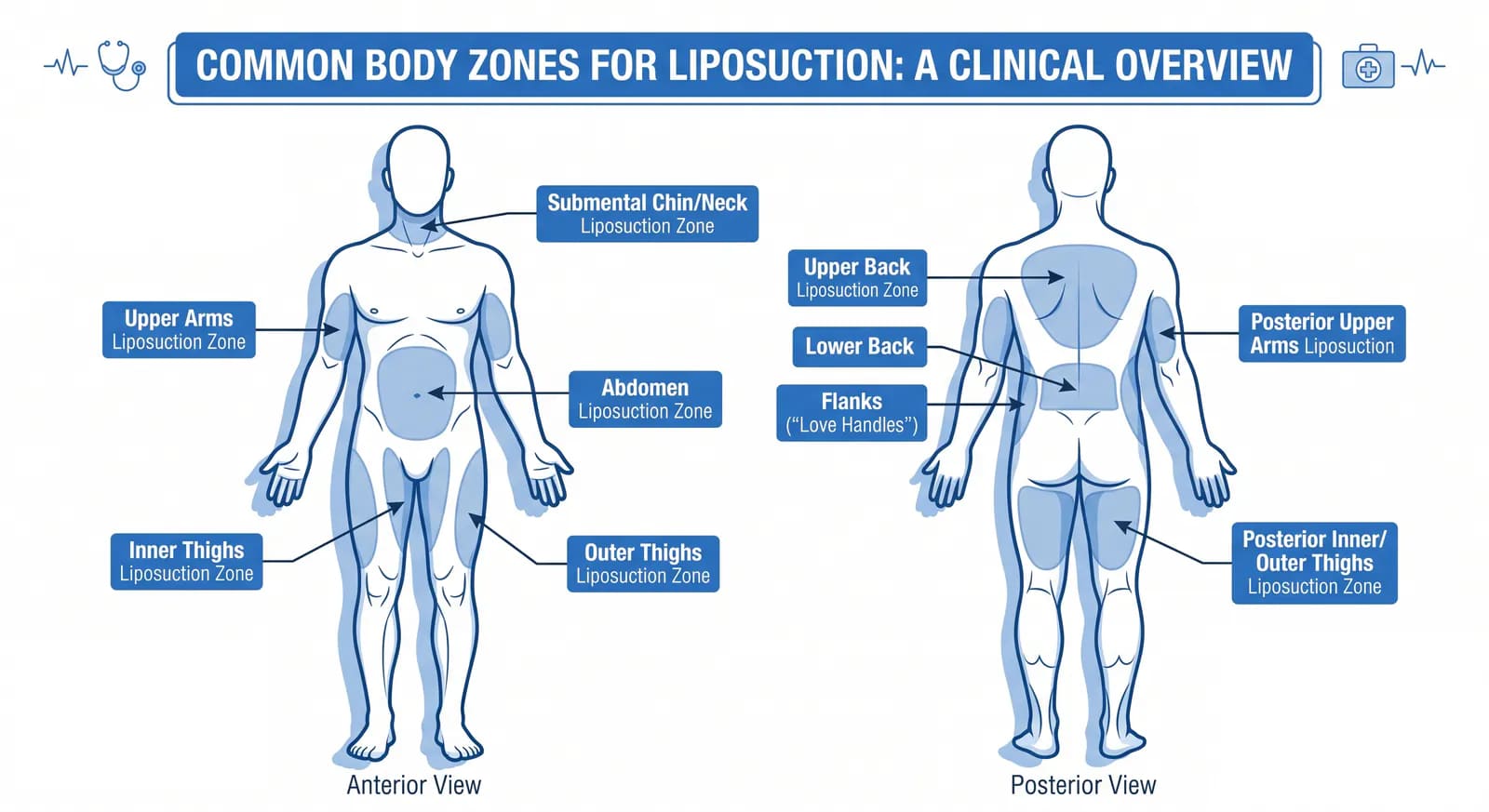
Full body liposuction is liposculpture across several selected treatment areas — not every inch of the body. A surgeon places a small cannula through tiny incisions and contours zones that have stayed resistant to diet and exercise. In real-world consults, that usually means the torso plus one or more limb or neck areas, most often under general anesthesia.
It is also different from Lipo360. Cleveland Clinic describes 360 liposuction as a midsection procedure targeting the upper and lower abdomen, love handles, and sometimes the back. A true whole-body liposuction plan usually goes beyond that to include thighs, arms, and submental chin or neck contouring.
It is not a weight-loss shortcut. ASPS and Mayo Clinic both frame liposuction as body contouring for specific areas in people with otherwise stable weight, and both note that poor skin elasticity can limit how smooth the final redrape looks. If loose skin is the primary problem, more suction is not always the right answer.
What Areas Are Typically Included
The classic full-body plan usually starts with the torso: abdomen, flanks, and back. From there, surgeons commonly add inner thighs, outer thighs, upper arms, and submental chin/neck depending on where the patient carries fullness and what the silhouette needs.
| Common treatment area | Why it gets included | How offices may count it |
|---|---|---|
| Abdomen | Central front contour | 1 zone |
| Flanks | Waistline and love handle contour | 1 zone |
| Upper and lower back | Bra-roll, posterior waist, torso transition | 1–2 zones |
| Inner thighs | Medial thigh contour | 2 zones if sides counted separately |
| Outer thighs | Lateral thigh or saddlebag contour | 2 zones if sides counted separately |
| Upper arms | Sleeve fit and arm taper | 2 zones if sides counted separately |
| Submental chin/neck | Jawline and neck definition | 1 zone |
One important catch: there is no universal area-counting system. One office's "8 areas" may be another office's "5 zones." The better question is not "How many areas?" but "What total aspirate, what operative time, and what contour plan?"
A common balanced combination is torso 360 plus thighs, or torso 360 plus arms and submental liposuction. The goal is harmony — the best result rarely comes from treating every pocket with the same aggression. It comes from choosing the right treatment areas in the right order, with enough restraint to preserve smooth transitions.
Safety: The 5,000cc Outpatient Threshold
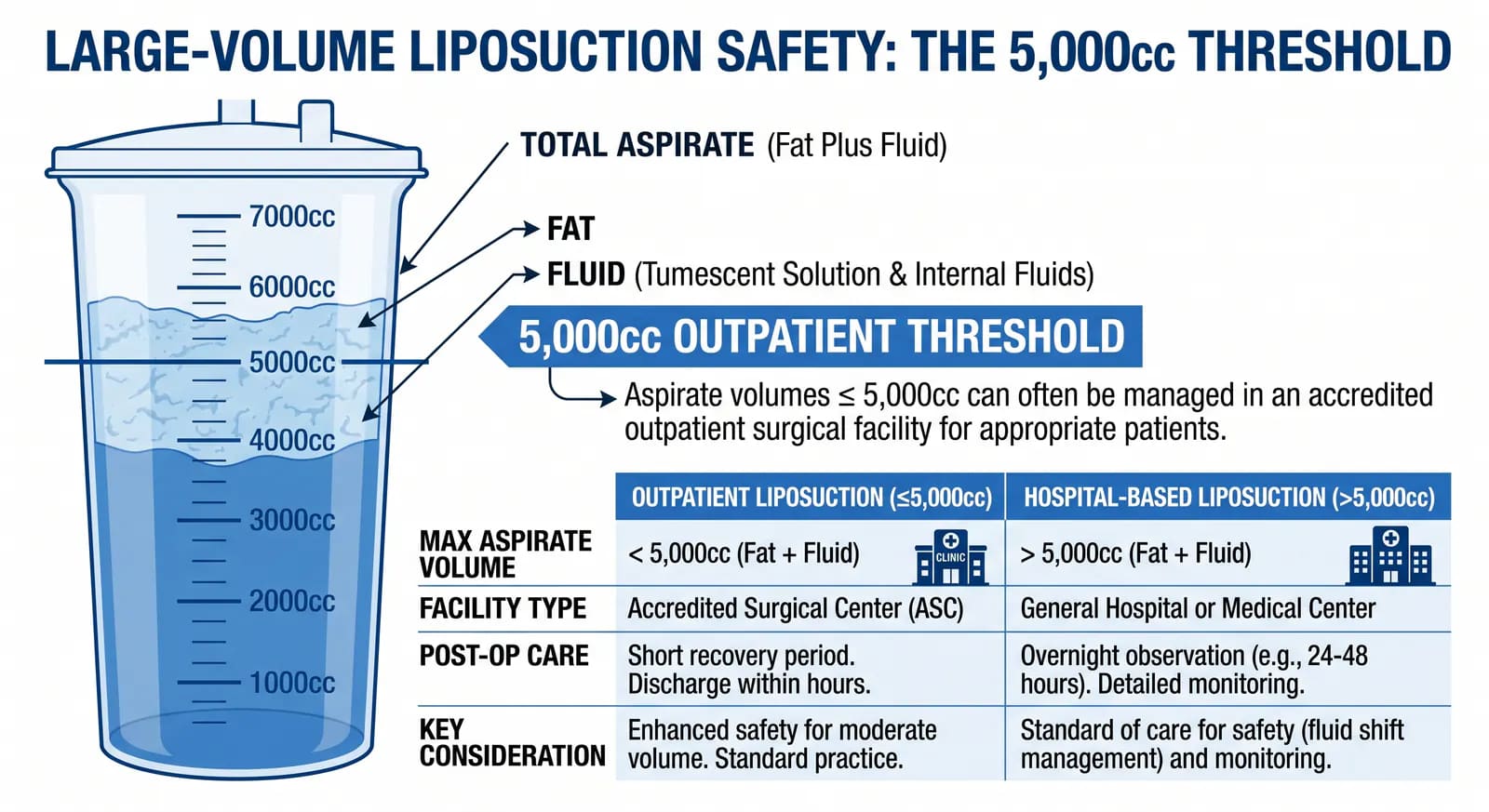
Liposuction across multiple areas in one session is common. But area count is only part of the safety story. The variables that matter most are total aspirate volume, operative time, patient health, position changes during surgery, and whether other procedures are being added.
ASPS defines large-volume liposuction as 5,000cc or more of total aspirate, and advises that cases above that threshold be performed in a hospital or accredited facility with overnight monitoring.
An important detail many patients never hear: total aspirate means fat plus fluid, not just fat. A case can sound moderate by area count but still become a large-volume operation. Most surgeons use a tumescent or superwet approach, and some add power-assisted liposuction or VASER for dense or fibrous areas like the back. Those tools can improve efficiency, but they do not erase volume and time limits. For a deeper breakdown, see our liposuction risks and safety guide.
How Long Does It Take?
A true multi-area plan takes several hours in the operating room — often 4 to 6+ hours once pre-op marking, infiltration, liposculpture, repositioning, dressings, and garment placement are included. Exact timing depends on body size, zone count, tissue density, and whether this is a primary case or a revision.
That duration matters. ASPS VTE guidance recommends limiting operative time as a risk-reduction strategy, and plastic surgery data show that longer anesthesia duration independently increases VTE risk. Good surgical teams counter that risk with sequential compression devices, warming measures, early ambulation, and case-by-case blood-thinner decisions for higher-risk patients.
Is It Safe to Treat Many Areas at Once?
It can be safe in a healthy, well-selected patient. But "safe" does not mean "maximal." A 2024 systematic review estimated the overall complication risk of isolated liposuction at 2.62%, and ASPS notes that risk rises as aspirate volume and the number of anatomic sites treated increase.
Not every wish list belongs in one session. Once a plan also includes a tummy tuck, skin excision, or fat transfer, surgeons have to think about tissue perfusion, patient repositioning, and blood supply preservation. If you are also considering fat transfer to the buttocks, read our 360 lipo and BBL guide first — that is a different safety conversation than liposuction alone.
One Session or Two: Staged vs Single Approach
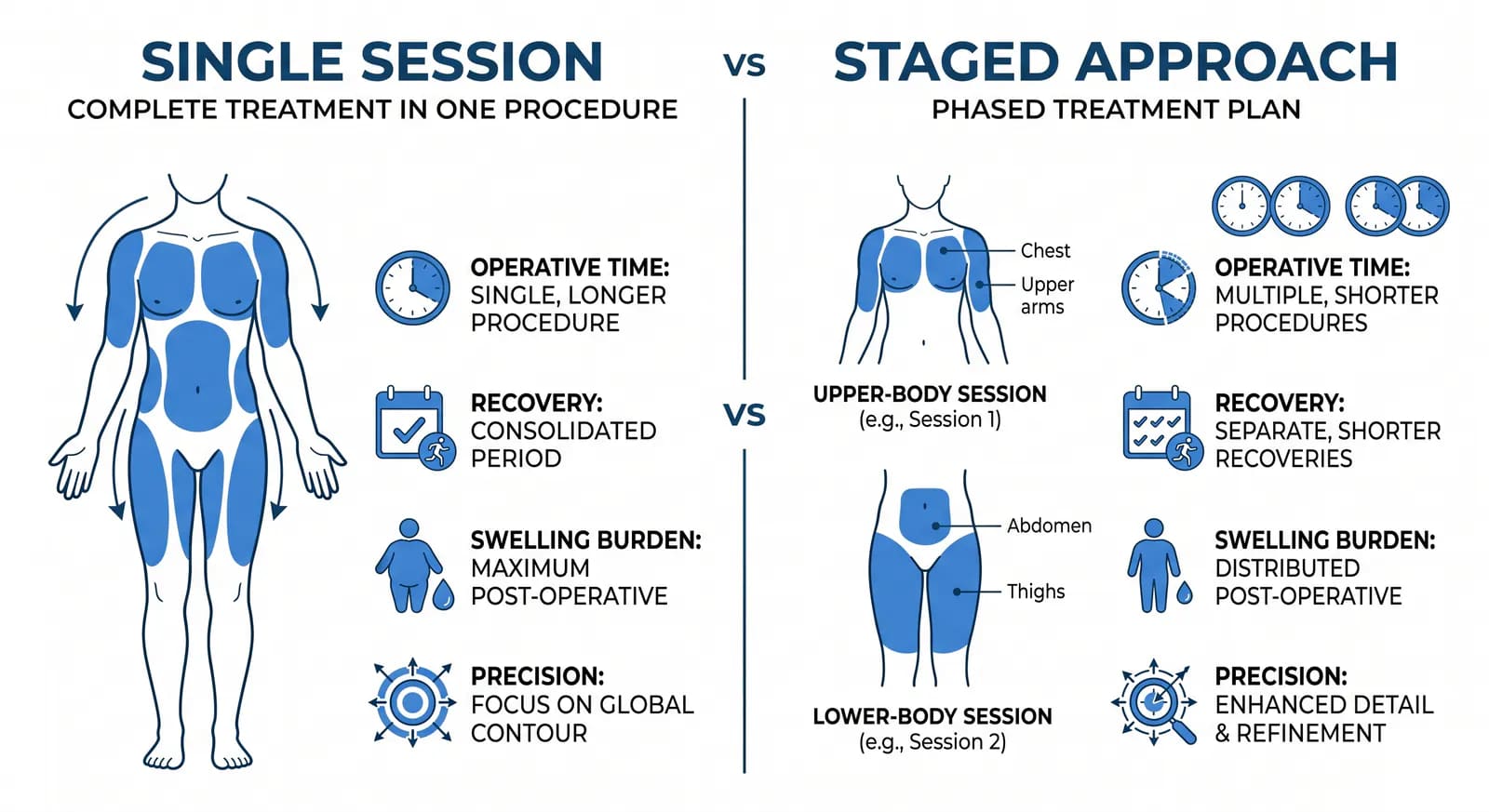
Some patients can be treated in one session. Two sessions are common when the plan would otherwise approach the outpatient threshold, run too long under anesthesia, or create too much swelling burden at once. Full body liposuction is often better understood as a treatment plan than a single date on the calendar.
Many surgeons prefer a staged approach: upper body first, then lower body later. That lets them stay well inside safety limits and often improves contour accuracy because the second session is planned after early swelling from the first session has settled. ASPS explicitly notes that, under some circumstances, larger-volume liposuction is best performed as separate serial procedures.
| Approach | Best for | Main upside | Main downside |
|---|---|---|---|
| Single session | Moderate-volume plans across fewer zones | One anesthesia event, one main recovery timeline | Longer OR time, heavier swelling burden |
| Staged approach | Larger aspirate, more zones, revisions, higher-risk patients | Safer pacing, better contour precision, easier regional recovery | Two OR dates, more total downtime planning |
A staged plan can be the more conservative choice — but it is often the more professional one too.
Cost Breakdown
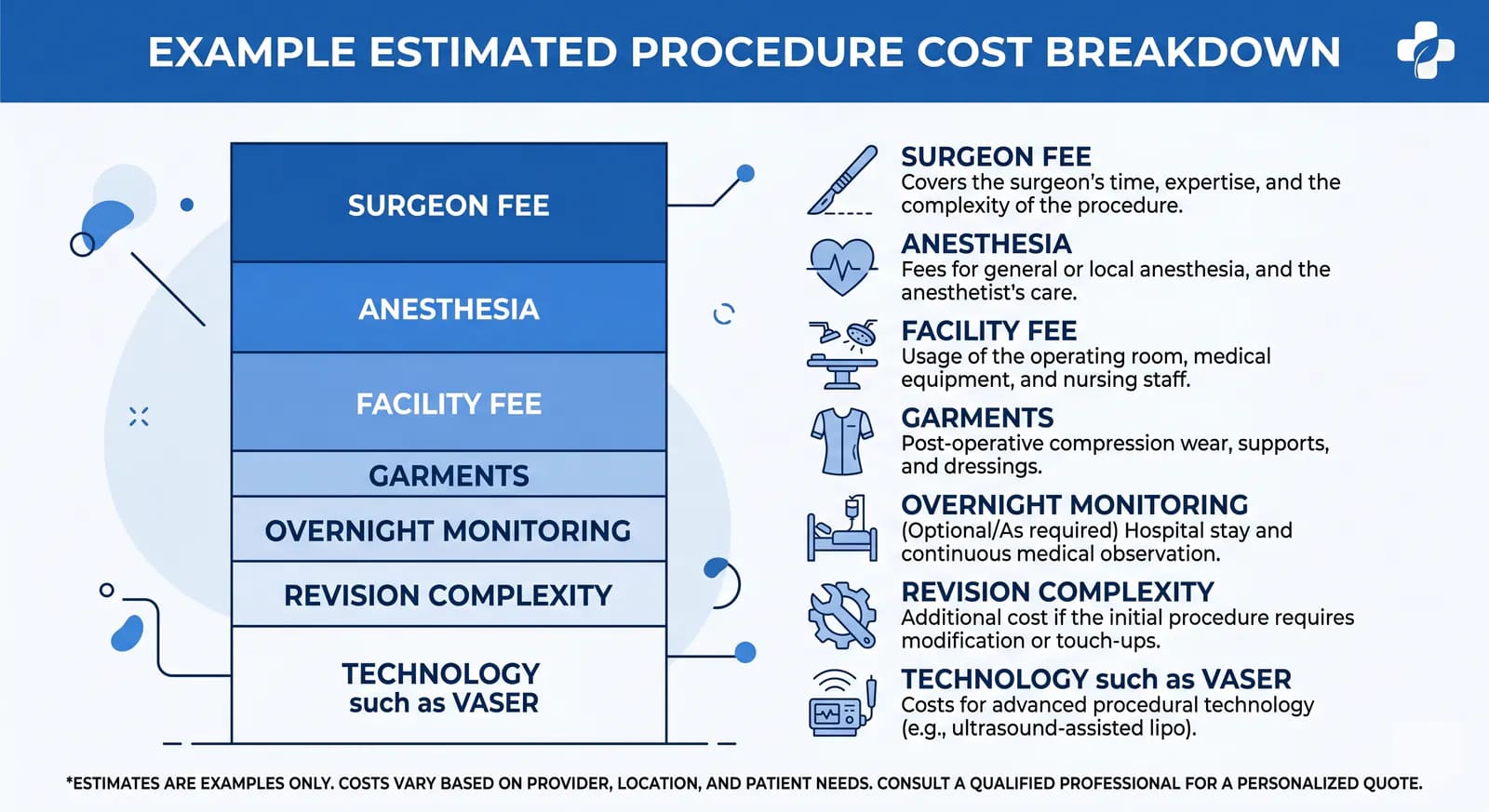
A realistic full body lipo cost usually lands around $12,000 to $30,000+. Staged plans can cost more. That range depends on how many zones are treated, whether the case is primary or revision, which city you are in, whether the surgeon uses VASER or other adjunctive technology, and whether surgery is outpatient or includes overnight monitoring.
There is no official ASPS "full body" package price because ASPS reports area-based surgeon-fee ranges, not a standardized multi-area bundle. Current ASPS fee data list liposuction at $4,300–$7,500 and submental/chin liposuction at $3,000–$5,500, with anesthesia and facility charges billed separately. That is why true multi-area quotes move quickly into the low- to upper-five-figure range.
| Typical plan | What it may include | Planning range |
|---|---|---|
| Torso-focused multi-area lipo | Abdomen, flanks, upper/lower back | $12,000–$18,000 |
| Torso plus one limb region | Torso plus arms or thighs | $16,000–$24,000 |
| True multi-area full-body plan | Abdomen, flanks, back, thighs, arms, submental | $20,000–$30,000+ |
| Staged two-session plan | Upper body in one session, lower body in another | $22,000–$35,000+ |
These are planning estimates derived from current ASPS surgeon-fee ranges plus the reality that anesthesia, facility, garments, and monitoring are separate line items. The cheapest quote is not the best signal in a big multi-area case — experience and facility standards matter more.
Recovery Timeline
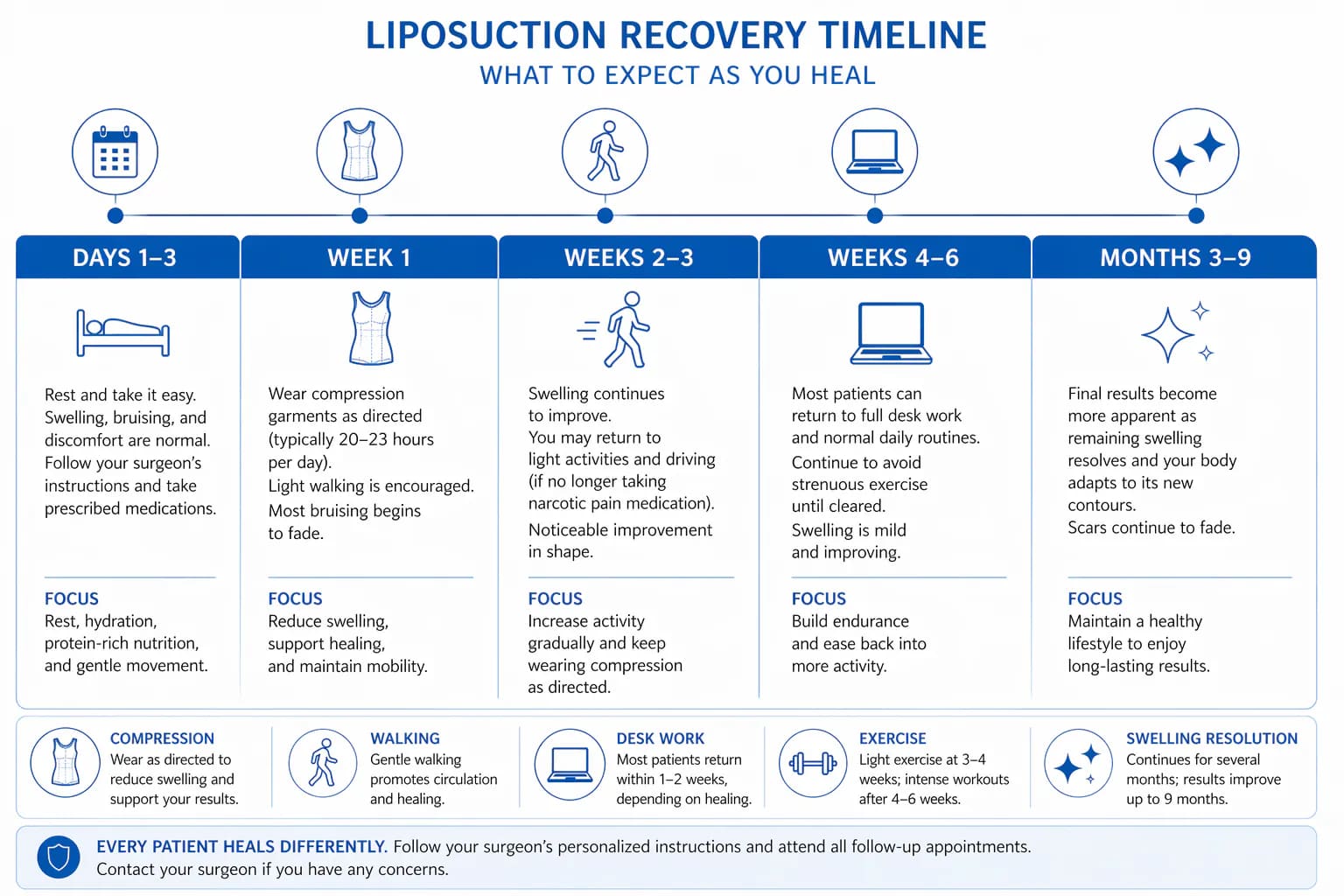
Recovery after multi-area liposuction is more involved than a single small zone. More of your body is swollen, bruised, stiff, and compressed at the same time. Expect a larger garment footprint, more drainage in the first day or two, more fatigue, and slower lower-body recovery if thighs are included.
Most patients need 1 to 2 weeks before desk work feels realistic, though physically demanding jobs and childcare-heavy routines take longer. Gentle exercise usually restarts after week 6. In extensive cases, full exercise commonly takes 6 to 8 weeks, while results can keep refining for 3 to 9 months as swelling resolves — lower-body swelling often lingers longer than torso swelling. See our liposuction recovery timeline for a week-by-week guide.
| Recovery point | What is typical after multi-area lipo |
|---|---|
| Days 1–3 | Soreness, drainage, compression, frequent short walks, help at home useful |
| Week 1 | Swelling and bruising peak, standing straight feels tight |
| Weeks 2–3 | Desk work often becomes realistic; swelling still significant, workouts stay limited |
| Weeks 4–6 | Bruising fades, shape starts to sharpen, activity returns gradually |
| Months 3–9 | Residual swelling resolves and final contour becomes clearer, especially in the lower body |
Call your surgical team immediately for chest pain, shortness of breath, one-sided calf swelling, fever, or worsening drainage.
Who Is a Good Candidate
The best candidate is not the person who wants the most removed. It is the person with the best setup for a clean, safe result: stable weight, good skin elasticity, realistic goals, and no major uncontrolled medical issues. ASPS describes ideal liposuction patients as adults within 30% of ideal weight with firm, elastic skin, good muscle tone, overall good health, and no smoking or vaping.
You may not be a strong full-body candidate if your main goal is weight loss, if you have very lax skin that needs excision rather than suction, or if medical issues complicate anesthesia, wound healing, or clot prevention. Liposuction is not an obesity treatment — it works best as targeted body contouring in people with relatively stable weight.
This is also where honesty matters. Some patients will get a better result from staged liposuction. Others need skin tightening or excisional body contouring instead of more suction. A good consult should tell you that clearly, even if it means a smaller first surgery.
Questions to Ask Your Surgeon Before a Full-Body Session
Bring these to your consult, then compare the answers with our guide on how to choose a liposuction surgeon.
1. Are you ABPS board-certified, and how often do you perform multi-area liposuction?
2. Which treatment areas would you do in one session, and which would you stage?
3. What total aspirate do you expect, and how close is that to the 5,000cc outpatient threshold?
4. How long do you expect me to be under anesthesia?
5. Will this be outpatient or inpatient, and why is that the safest setting for me?
6. What DVT-prevention plan do you use: compression boots, early ambulation, blood thinners if indicated?
7. Which technique are you recommending: tumescent, PAL, or VASER?
8. Do I need skin tightening or excision in any area instead of more liposuction?
9. What is my realistic recovery timeline for driving, work, childcare, and exercise?
10. Do you have before-and-after photos of patients with my body type and a similar multi-area plan?
What is full body liposuction? A non-standard term for liposuction of several body areas, not a single official operation. Most plans include 5 to 8 zones — often the abdomen, flanks, back, thighs, arms, and submental neck/chin — done in one session or staged across two.
How much does full body liposuction cost? Most patients should budget $12,000 to $30,000+, and staged plans can run higher. Current ASPS fee data place standard liposuction at $4,300–$7,500 and submental/chin liposuction at $3,000–$5,500 before anesthesia and facility fees are added.
Can liposuction be done on multiple areas at once? Yes — multi-area liposuction is common. The real safety variables are total aspirate, operative time, health status, and whether other procedures are added.
How long does full body liposuction take? Plan on several hours in the OR. True multi-area body contouring often runs 4 to 6+ hours in practice, which is why experienced surgeons watch anesthesia time closely and use clot-prevention protocols.
What is the recovery like after full body liposuction? More demanding than single-area lipo. Many patients need 1 to 2 weeks before desk work feels reasonable, stay in compression for several weeks, and return to meaningful exercise gradually after about 6 weeks, while final contour keeps refining over months.
Is it safe to do liposuction on many areas at once? It can be safe in the right patient, with the right surgeon, in the right setting. It becomes less safe when volume, operative time, and combined procedures expand beyond what your body and facility can support.
How many sessions do you need for full body liposuction? One session may be enough for moderate-volume plans. Two sessions are common when the surgeon wants to stay well inside outpatient limits or keep the procedure shorter and more precise.
What areas are typically included in full body liposuction? Usually the abdomen, flanks, back, thighs, upper arms, and submental chin/neck. Some surgeons also treat bra-roll, knees, or chest transition zones, but the exact mix depends on proportions, skin quality, and how the office counts treatment areas.
