Thigh fat is among the most stubborn and anatomically variable on the body. The inner thighs rub and chafe. The outer thighs create a saddlebag shape that changes how clothing fits. And the banana roll — the fold of fat under the buttock crease — is an area many patients want treated but few surgeons will touch.
This guide covers each thigh zone honestly: what can be safely treated, what results actually look like, the critical skin elasticity threshold that determines whether you need lipo or a thigh lift, and why the banana roll is a warning rather than a target.
Thigh Fat Zones: What's Treatable and What Isn't
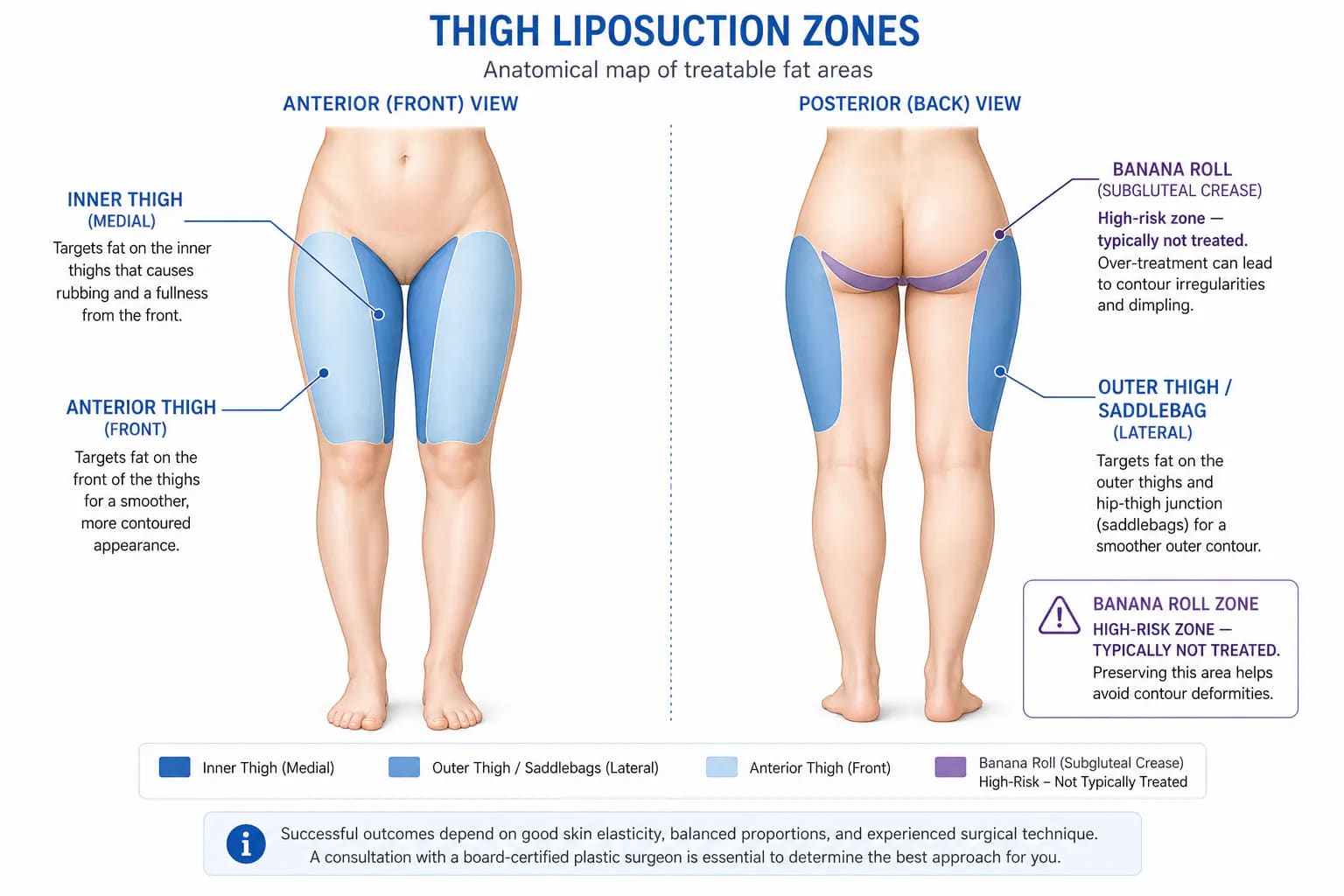
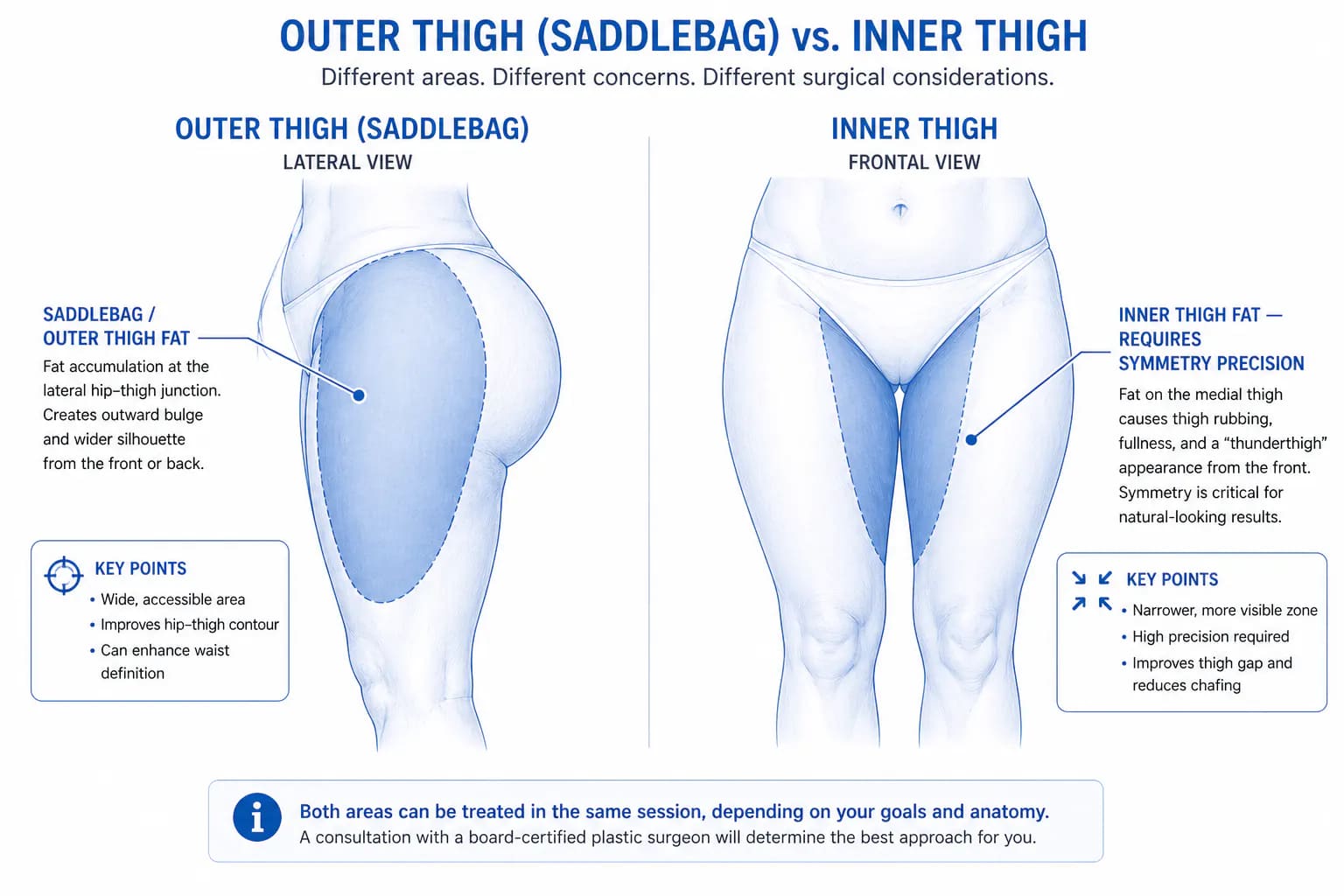
The thigh has four distinct zones, and liposuction results differ significantly across them.
Inner Thigh (Medial Thigh)
The inner thigh fat zone runs from the upper inner thigh near the groin down to just above the knee. This fat causes thigh rubbing and chafing, creates a visual appearance of thighs that press together in the front view, and is highly resistant to diet and exercise.
Inner thigh liposuction is technically demanding. Because both inner thighs are visible simultaneously, any asymmetry is immediately apparent. Surgeons must work carefully and symmetrically across both sides. The skin of the inner thigh is thinner than most body areas, which increases the risk of contour irregularity if fat is removed unevenly.
Result: When done well, a reduction in inner thigh bulk and chafing, and sometimes the creation of a thigh gap (depending on skeletal structure — see FAQs).
Outer Thigh (Saddlebags)
Saddlebag fat sits at the lateral hip-thigh junction — the bulge at the side of the hip that creates a shelf-like appearance visible in profile and from behind. This is anatomically well-defined subcutaneous fat that responds predictably to liposuction.
Outer thigh liposuction is generally more forgiving than inner thigh work. The area is less technically demanding, and the results — a reduced hip-to-thigh shelf — are consistently achievable in good candidates.
Anterior Thigh (Front)
The front of the thigh is less commonly treated but can accumulate fat that creates a boxy leg appearance. Anterior thigh liposuction requires caution to avoid over-treatment, which can create depressions or dimpling on the prominent front surface of the leg.
Banana Roll (Subgluteal Crease) — A Special Warning
The banana roll is the horizontal fold of fat that sits directly under the buttock crease. Many patients ask about treating this area because it affects how the buttocks look from behind.
Most experienced surgeons do not liposuction the banana roll. Here's why: the subgluteal crease is a structural landmark that holds the buttock in position. Removing fat from the banana roll area disrupts this support and can cause the buttocks to drop and sag — the opposite of the lifted look patients want. RealSelf Q&A and multiple surgeon blogs confirm this: the banana roll should not be aggressively liposuctioned without combining it with a buttock lift or fat grafting to compensate.
If a surgeon enthusiastically offers banana roll liposuction without explaining this risk, treat it as a red flag.
Who Is a Good Candidate?
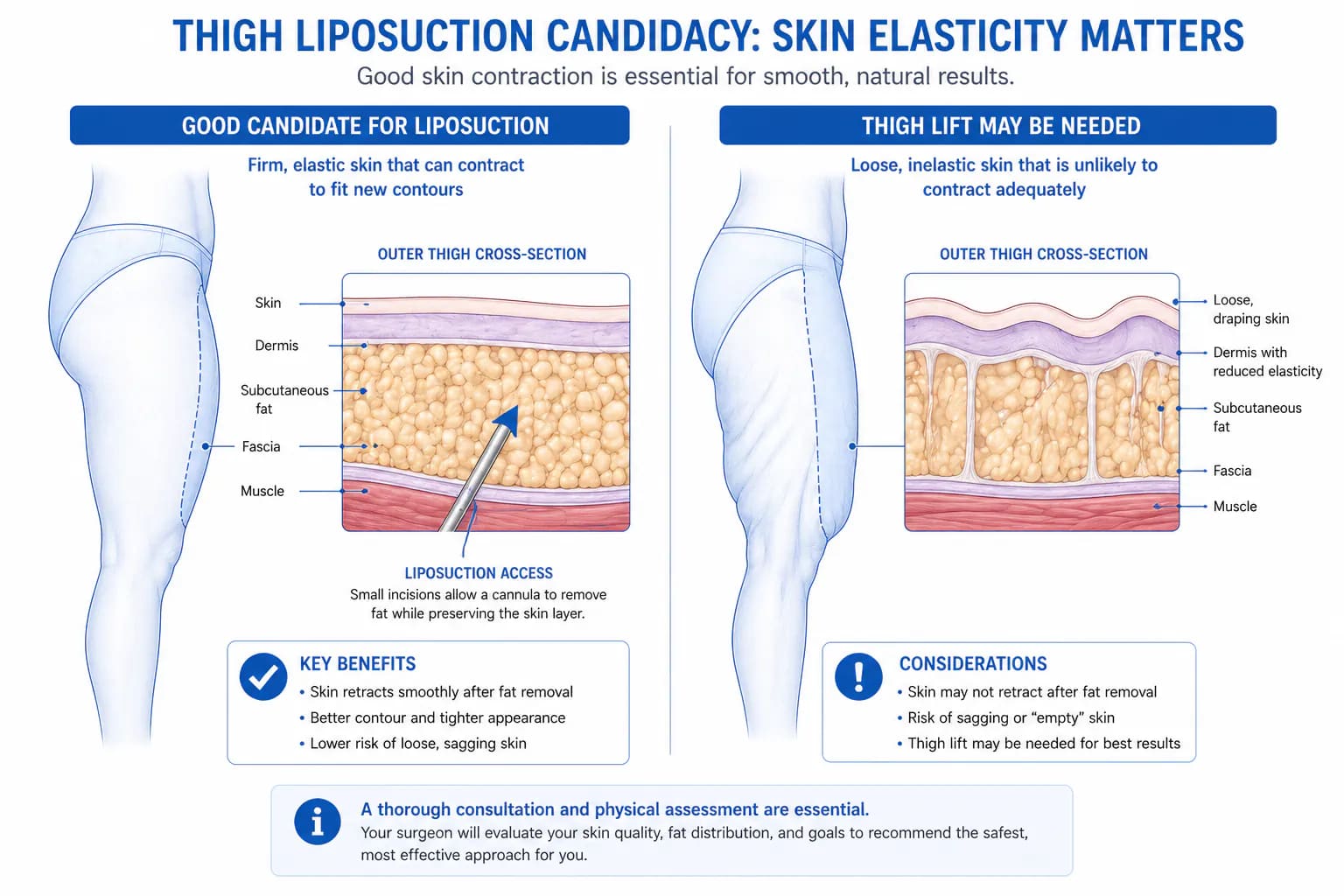
The single most important variable in thigh liposuction candidacy is skin elasticity. Because the thighs are a gravity-dependent area, skin must be firm enough to contract around the new contour after fat is removed.
Good candidates:
- Are at or near stable goal weight (within 15–20 lbs)
- Have firm, elastic skin on the inner and outer thighs — skin that bounces back when pinched
- Have localized thigh fat deposits that are clearly subcutaneous (soft and pinchable)
- Have not lost significant amounts of weight recently — rapid weight loss leaves skin without the elasticity to contract
- Are in good general health with no uncontrolled conditions
Thigh lift is the better option if you:
- Have visible loose or hanging skin on the inner thigh
- Have stretch marks extending across the treatment zone (indicating skin damage)
- Have lost 50+ lbs and have skin redundancy at the thigh
- Are older with significant skin laxity
The inner thigh is particularly unforgiving of poor skin quality. Removing fat under thin, inelastic inner thigh skin can result in sagging folds rather than a smooth contour. A board-certified plastic surgeon will assess your skin thickness and elasticity during a consultation and advise whether lipo or a thigh lift — or a combination — is appropriate.
Technique: How Thigh Liposuction Is Performed
Thigh liposuction is most commonly performed under general anesthesia or IV sedation, given the scope of the area treated. Local anesthesia alone is possible for very limited single-zone treatments.
Typical approach:
1. Tumescent infiltration. The thigh zone is infiltrated with tumescent solution — saline with lidocaine and epinephrine — to firm the fat, reduce bleeding, and provide local anesthesia.
2. Fat disruption (if VASER or laser). VASER ultrasound energy is commonly used for thighs because it handles the fibrous connective tissue within thigh fat more effectively than mechanical suction alone, producing a smoother result. Laser (SmartLipo) provides some skin tightening that can benefit borderline skin elasticity.
3. Aspiration. The surgeon works through 3mm to 5mm incisions placed in natural creases — inner groin fold for inner thigh, outer hip crease for saddlebags. Multiple passes at different angles ensure even fat removal.
4. Patient positioning. Inner thigh treatment typically requires the patient to be repositioned during surgery (supine and lateral positions) to access the full medial zone. Outer thigh treatment is often done from a lateral position.
Cost: Thigh Liposuction by Zone
| Treatment Zone | Typical Cost Range |
|---|---|
| Inner thighs (both) | $3,000 – $5,500 |
| Outer thighs/saddlebags (both) | $3,500 – $6,000 |
| Inner + outer thighs | $5,500 – $8,500 |
| Full thigh (all zones) + knee | $6,000 – $9,500 |
These are total costs — surgeon, facility, anesthesia. They exclude compression garments, post-op supplies, and any combination procedures. For the national picture, see thigh liposuction cost in the full body-area price breakdown.
City significantly affects price: New York, Miami, and Beverly Hills run toward the top of these ranges. Midwestern markets typically run lower. High-volume body contouring specialists often charge more than general plastic surgeons, but their outcomes for technically demanding areas like inner thighs tend to justify the premium.
Adding thigh liposuction to an existing procedure (flanks, BBL) typically adds less cost than booking it as a standalone session, since facility and anesthesia fees are already covered.
Inner vs. Outer Thigh: Which Area Gets Better Results?
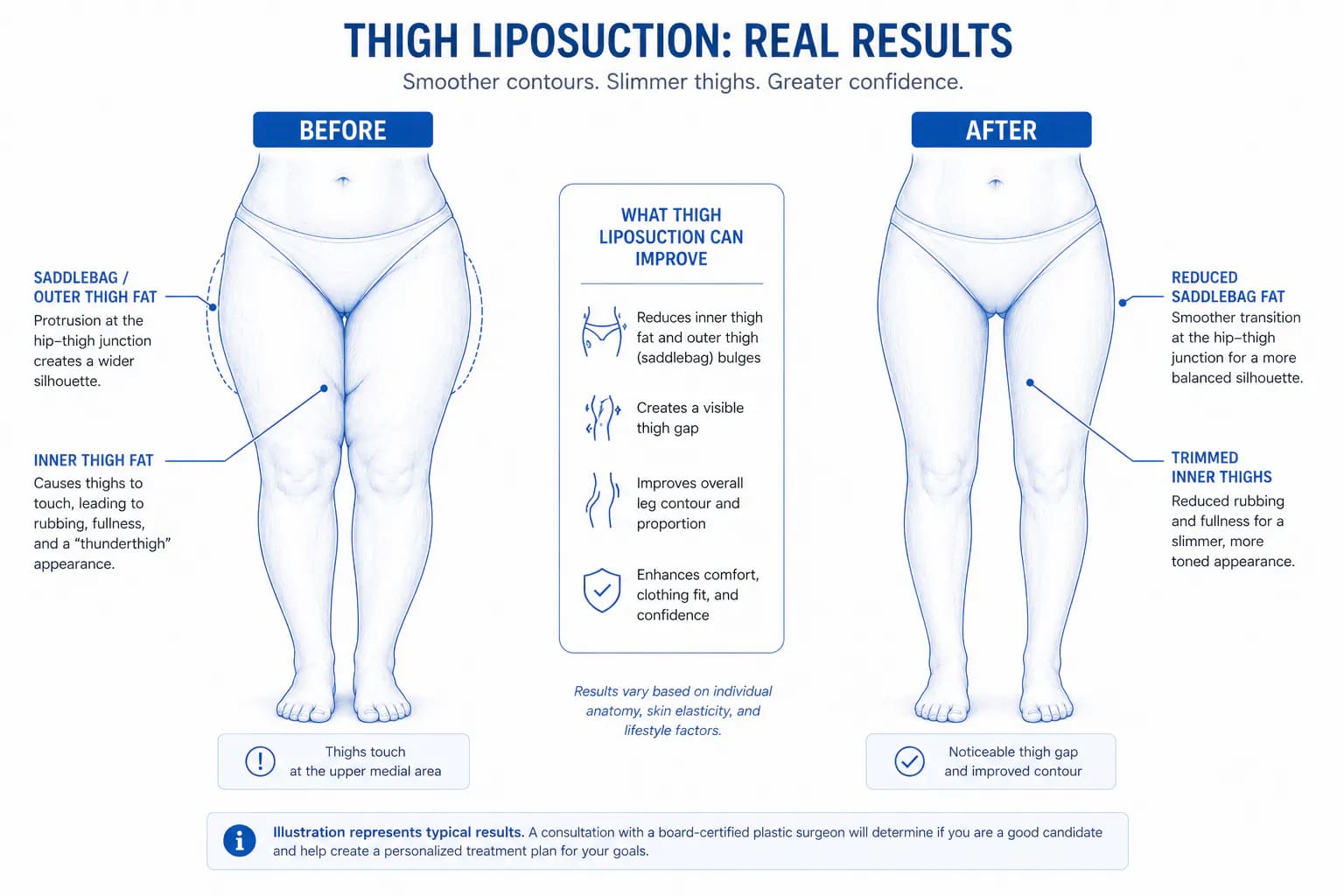
Outer thigh/saddlebags tend to produce more consistently satisfying results. The anatomy is well-defined, the skin over the outer thigh tends to be thicker, and the visual improvement — a reduced hip shelf — is clear and durable.
Inner thigh results are excellent when the patient is properly selected but require a more skilled surgeon. The thin inner thigh skin is less forgiving of technique error, the symmetry requirement is demanding, and swelling resolves more slowly in this gravity-dependent zone. Patients should expect 4 to 6 months to see the true final result.
Both areas require excellent skin elasticity. The inner thigh requirement is stricter.
Recovery: Thigh Liposuction Week by Week
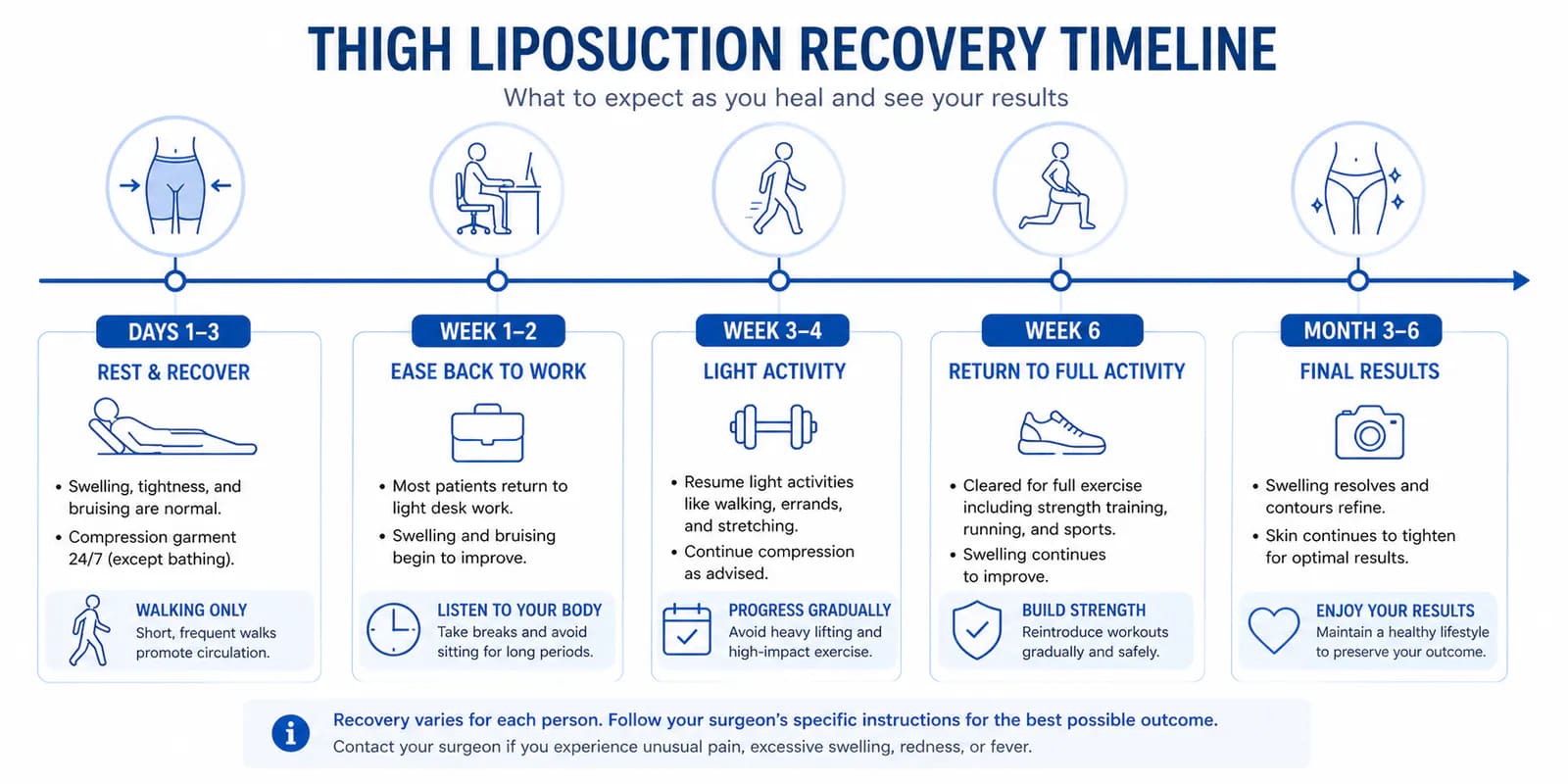
Thigh liposuction has a longer swelling trajectory than upper-body liposuction because gravity pulls fluid downward into the legs. Compression is central to that recovery — see wearing a faja after thigh liposuction.
Days 1–3: Significant swelling and bruising, especially in the inner thigh where gravity pools fluid. Walking is encouraged to prevent blood clots, but activity is kept light. Compression garment worn 24 hours per day. Most patients manage discomfort with prescribed or over-the-counter pain medication.
Week 1–2: Swelling peaks around days 3 to 5. Most patients return to desk work within 48 to 72 hours. Inner thigh swelling in particular can feel pronounced — this is expected and does not indicate a problem. The legs may feel numb or firm in treated zones.
Weeks 3–6: Swelling continues reducing. Light activity — walking, gentle swimming — is usually permitted by week 3. Lower-body exercise (running, squatting, cycling) is typically cleared at the 6-week mark after surgeon approval.
Months 3–6: Final results emerge as residual swelling clears and skin contracts to the new contour. Patients who maintain stable weight see permanent results.
Compression garment: Worn continuously for 4 to 6 weeks, then during the day as needed. Essential for thigh liposuction — it reduces swelling, supports skin contraction, and reduces the risk of fluid buildup (seroma).
Can Thigh Liposuction Create a Thigh Gap?
Inner thigh liposuction reduces the bulk of the medial thigh fat, which can create a gap between the legs where one didn't exist. However, a thigh gap is not just about fat — it is also about hip width and femoral angle.
Patients with narrow hips and a more vertical femur angle may not develop a gap even with complete inner thigh fat removal, because the geometry of the skeleton keeps the thighs close together at the midline. Patients with wider hips are more likely to see a gap develop.
No surgeon can guarantee a specific thigh gap result. What inner thigh liposuction reliably delivers: less bulk, less chafing, and a slimmer medial thigh profile. Whether a gap develops depends on your anatomy.
Thigh Liposuction and the Thigh Lift Decision
Some patients need both: liposuction to remove fat and a thigh lift to remove excess skin. This is most common in patients who:
- Have lost significant weight (bariatric surgery patients or natural weight loss of 50+ lbs)
- Are older with significant skin laxity at the inner thigh
- Have skin overhanging the groin crease
A medial thigh lift removes a wedge of skin from the inner thigh, tightening the skin of the entire medial thigh. Combined with inner thigh liposuction, it produces the most complete result — but it also leaves a scar at the groin crease and requires longer recovery. Unsure which you need? Our liposuction vs. tummy tuck comparison walks through the same skin-laxity decision.
The right choice depends on your anatomy. If you're unsure, consult with a board-certified plastic surgeon who regularly performs both procedures — the assessment is straightforward.
Scars: What to Expect
Access incisions for thigh liposuction are 3mm to 5mm. Placement:
- Inner thigh: in the groin fold where the thigh meets the body
- Outer thigh: at the outer hip crease
- Knee area: in the natural crease behind the knee or at the knee's inner crease
These positions hide the marks in natural body creases. Most patients find the marks barely visible at 12 months, often as a small pale dot. Silicone scar gel applied starting at 3 to 4 weeks post-op helps minimize mark visibility. Ready to explore options? Browse board-certified thigh liposuction surgeons on lipo.com.
How much does thigh liposuction cost? $3,000 to $5,500 for inner thighs alone; $3,500 to $6,000 for outer thighs; $5,500 to $8,500 for inner + outer; $6,000 to $9,500 for all zones including knee. Total costs including surgeon, facility, and anesthesia. Costs vary significantly by city and surgeon experience.
What is the difference between inner and outer thigh liposuction? Inner thigh targets medial fat causing chafing and thigh bulk — technically demanding due to symmetry requirements. Outer thigh targets saddlebag fat at the lateral hip-thigh junction — more anatomically defined and generally more forgiving. Both require good skin elasticity.
How long does it take to see results? Initial improvement visible at 2 to 4 weeks. Final results take 3 to 6 months because thigh swelling resolves slowly due to gravity. Inner thighs take longer than outer thighs.
Am I a candidate? Good candidates are near stable weight with firm, elastic thigh skin and localized fat deposits. Poor skin elasticity, hanging skin, or post-bariatric anatomy typically means a thigh lift is needed, not liposuction alone.
Does thigh liposuction help with thigh gap? Inner thigh lipo reduces bulk and may create a gap — but whether a gap develops depends partly on hip width and femoral angle, not just fat volume. Surgeons cannot guarantee a specific gap width.
What is the recovery time? Desk work in 48 to 72 hours. Light activity by week 3. Full exercise at week 6. Final results at 3 to 6 months. Compression garment worn 4 to 6 weeks.
Can liposuction help with saddlebags? Yes — outer thigh saddlebag fat is a reliable liposuction target. The results are consistently good in patients with adequate skin elasticity.
Does thigh liposuction leave scars? 3mm to 5mm incisions placed in natural creases (groin fold, outer hip crease). Marks are typically invisible or barely visible at 12 months.
