If you are researching liposuction in Los Angeles, the big question is not just price. It is whether you are looking at a true surgical practice with strong credentials and an accredited setting, or a heavily marketed low-cost option that looks similar online but is not equivalent in training, oversight, or recovery support. In LA, that difference matters more than almost anywhere else.
Los Angeles is one of the most competitive cosmetic surgery markets in the country. Beverly Hills alone has become a shorthand for aesthetic surgery, and the larger LA market extends into West Hollywood, Santa Monica, Brentwood, Woodland Hills, and Downtown LA. That density creates real advantages for patients: more surgeon choice, more niche expertise, more advanced techniques, and more practices with deep experience in body contouring.
It also creates noise.
This is the honest differentiator most city pages skip: LA's huge price spread is not just a branding story. It is partly a safety story. Two patients can be quoted for “lipo” in the same metro area and be looking at very different realities: an ABPS board-certified plastic surgeon operating in an accredited outpatient center with a clear anesthesia plan, or a med-spa-style business model where the marketing is polished but the surgical environment deserves much closer scrutiny.
That is why the best way to shop in Los Angeles is not “Who has the lowest price?” It is “Who is doing my surgery, where is it happening, and what exactly is included?”
How much does liposuction cost in Los Angeles?
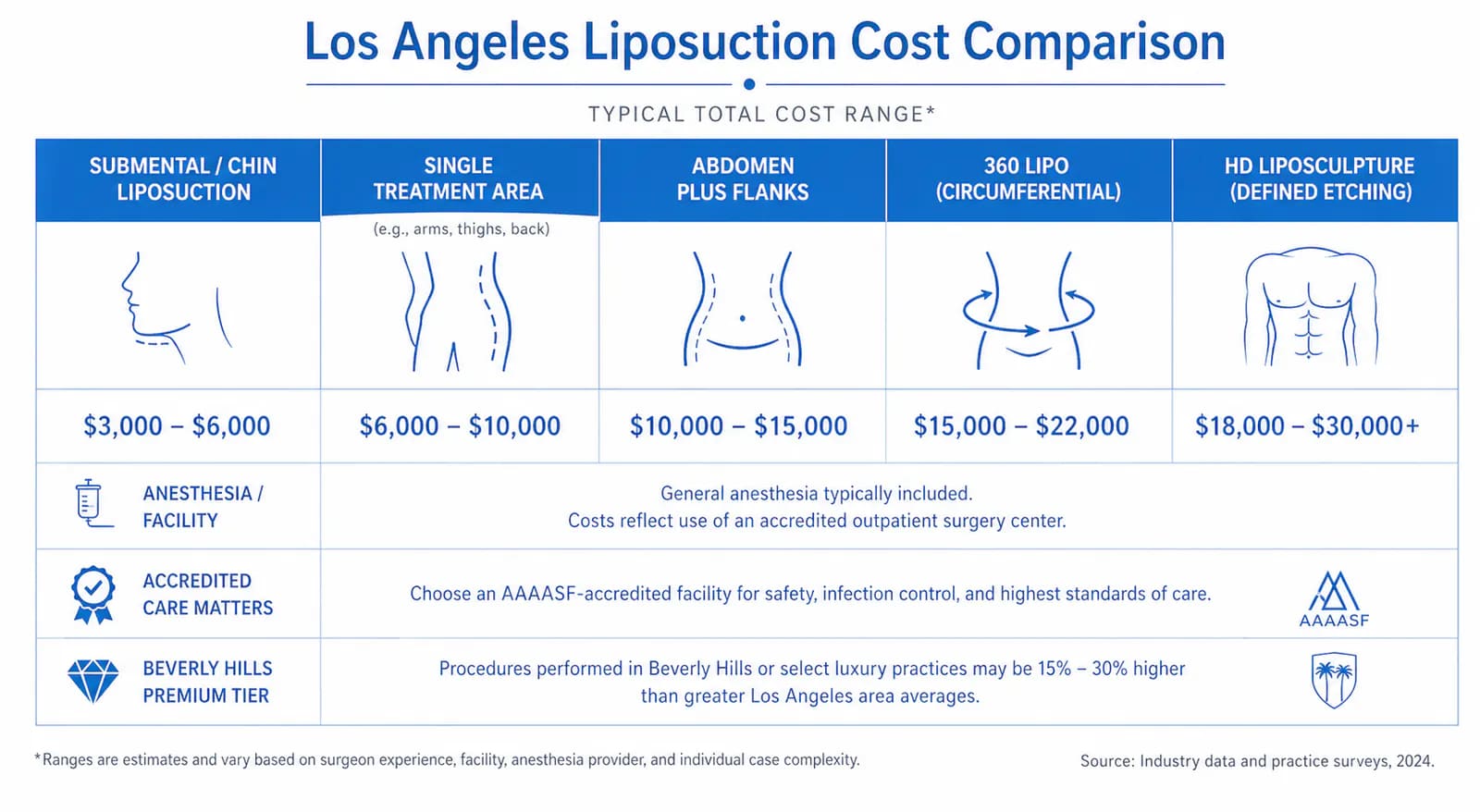
In the LA market, a realistic total range is $4,500 to $18,000+ depending on the treatment area, the number of areas, the surgeon's reputation, the facility, and whether you are having standard tumescent liposuction, VASER-assisted contouring, or more specialized liposculpture.
A useful baseline: the American Society of Plastic Surgeons lists a national surgeon fee range of $4,300 to $7,500 for liposuction and $3,000 to $5,500 for submental/chin liposuction. That does not include anesthesia, operating room or facility fees, garments, or prescriptions. In LA, total pricing runs higher once those pieces are added.
| Procedure type | Typical LA total price | What usually drives the quote |
|---|---|---|
| Submental/chin liposuction | $4,500–$7,500 | Precision, skin quality, local vs deeper neck work |
| Single body area | $4,500–$8,000 | Abdomen, flanks, arms, inner thighs |
| Two to three areas | $7,500–$12,000 | More operative time, more facility and anesthesia cost |
| Lipo 360 | $9,000–$15,000 | Abdomen, flanks, lower back, circumferential sculpting |
| HD liposculpture / VASER-based contouring | $12,000–$18,000+ | Technique intensity, surgeon specialization, surgical precision |
| Lipo with fat transfer planning | $12,000–$20,000+ | Added complexity, cannula technique, multiple treatment areas |
Why the range is so wide:
- Beverly Hills and premium Westside practices charge for surgeon reputation, facility overhead, and more individualized care.
- Advanced body contouring techniques such as HD liposculpture and 360 lipo require more operative time and more technical planning.
- Low-end quotes may exclude anesthesia, garments, post-op care, or revision policy.
- In a market this crowded, some very low quotes are designed to get you in the door, not to reflect the real final total.
For a broader decision framework, read how much liposuction costs.
Is Beverly Hills the best place to get liposuction in LA?
Sometimes. Not automatically.
Beverly Hills is the premium submarket inside Los Angeles. What you are often paying for there is not just a zip code. You may be paying for a surgeon with a stronger revision practice, a better aesthetic eye for liposculpture, a more experienced operating team, more structured follow-up, and a practice that treats a high volume of complex body contouring cases.
But a Beverly Hills address is not a credential.
A strong Santa Monica, Brentwood, West Hollywood, or Woodland Hills practice can be a better choice than a weaker Beverly Hills brand. The premium only makes sense if it buys one or more of the following:
1. ABPS board certification and a clean California license.
2. Accredited facility status with clear anesthesia protocols.
3. Consistent before-and-after work in your exact treatment area.
4. Better judgment about what liposuction can and cannot do.
5. More cautious procedure planning, especially for 360 lipo, HD liposculpture, or combined body contouring.
In short, Beverly Hills is the deepest talent pool in the market. It is not a shortcut for due diligence.
What should I look for in a LA liposuction surgeon?
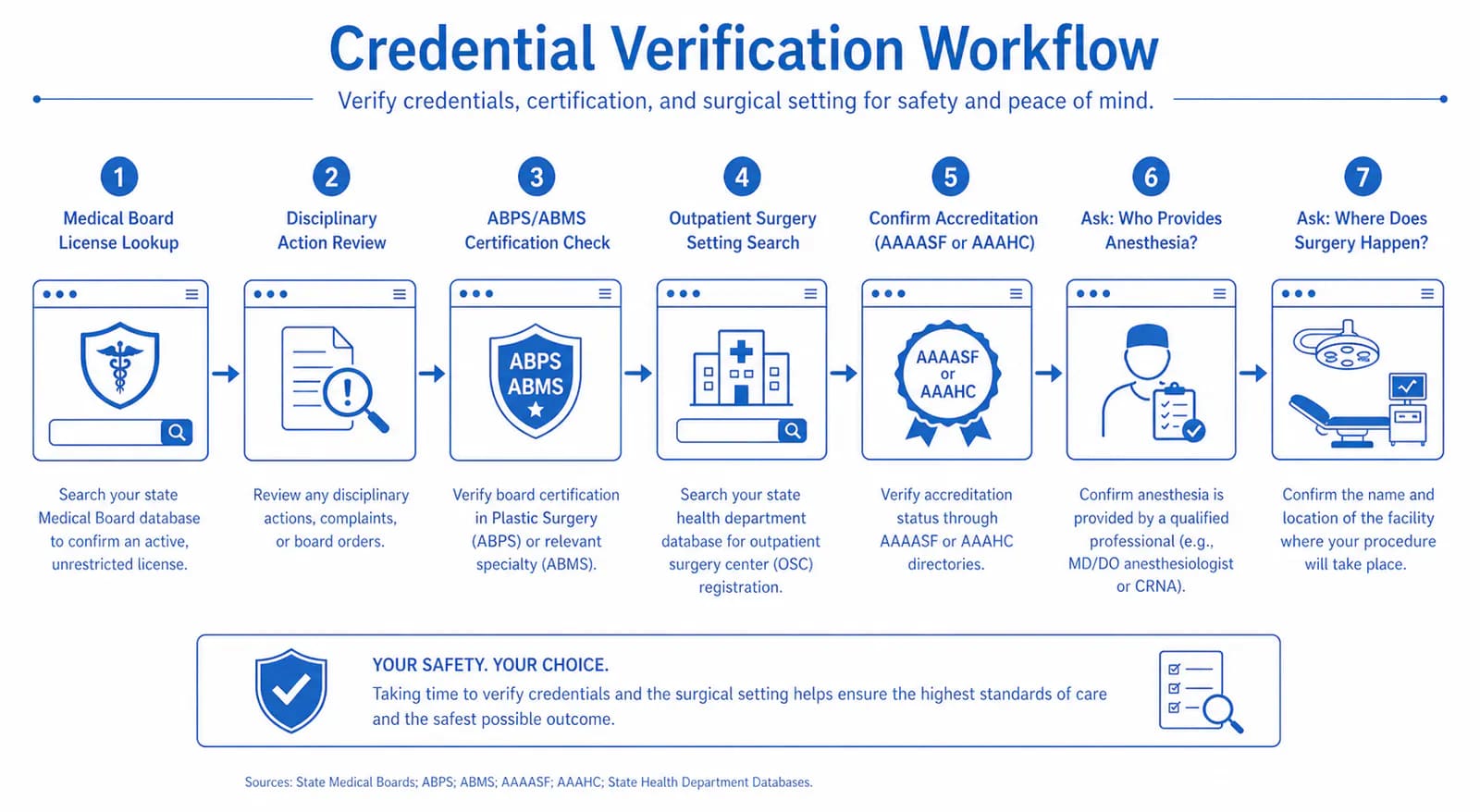
Start with credentials. Then move to judgment.
The best liposuction surgeon for you in Los Angeles should be able to explain your candidacy clearly, talk through the recovery timeline without minimizing it, and tell you when liposuction is not enough. Patients often hear what they want to hear in this market. The stronger surgeon is usually the one who sounds more measured.
Your minimum checklist
| What to verify | Why it matters |
|---|---|
| ABPS board-certified plastic surgeon | Strongest consumer signal for formal plastic surgery training |
| Active California license | Confirms the physician is licensed and lets you review public details |
| Accredited surgery setting | Helps you avoid unclear office-based environments |
| Experience with your specific area | Abdomen, flanks, submental, arms, thighs, or revision work are not identical |
| Clear quote | You should know surgeon fee, anesthesia, facility, garments, and follow-up |
| Candid recovery plan | Compression, swelling, downtime, and contour maturation should be explained plainly |
A good consultation in LA should also cover technique. Are they recommending standard tumescent liposuction, power-assisted liposuction, VASER, or true liposculpture? What size cannula do they use in your treatment area? How aggressive will the contouring be? What is their threshold for staging procedures instead of combining too much at once?
That is where marketing language ends and surgical thinking begins.
For a full vetting framework, see how to choose a liposuction surgeon.
Are there regulations on "board certified" claims in California?
Yes. This is one of California's biggest consumer-protection advantages.
Under California Business and Professions Code section 651, a physician cannot use the term “board certified” in advertising unless the certifying board fits the statute, and the full board name must appear with comparable prominence. That is a meaningful rule in a city where cosmetic marketing is everywhere.
This matters because patients often assume every “board-certified” claim means the same thing. It does not.
For liposuction in Los Angeles, the safest shortcut is this: verify whether the surgeon is certified by the American Board of Plastic Surgery (ABPS). ABPS is an ABMS member board. In California, that clarity matters. The state's review history around the American Board of Cosmetic Surgery is part of why the wording is more tightly controlled here than in many other states.
That does not mean every non-ABPS doctor is unqualified to practice medicine. It means you should never stop at the phrase. You should verify the exact board.
How do I verify a surgeon's credentials in California?
California gives patients unusually good tools. Use all of them.
Step 1: Check the California license
Go to the California Medical Board license lookup at breeze.ca.gov and search the physician by name. Confirm that the license is active and review whether any disciplinary actions are listed.
Step 2: Verify the board certification
Check ABPS directly or use the ABMS verification system. That tells you whether the surgeon is actually certified by an ABMS member board and whether the certification record is current.
Step 3: Verify the surgery center
Ask exactly where your surgery will take place. Then search California's Outpatient Surgery Setting Database and confirm the setting is accredited, licensed, or certified as required. In LA, this is not optional homework. It is essential.
Step 4: Ask the facility questions that weak practices avoid
Key points:
- Is the setting accredited by AAAASF/QUAD A, AAAHC, or another California-approved accreditor?
- Who provides anesthesia?
- What level of monitoring is used?
- If there is an emergency, what is the transfer plan?
- Are post-op visits included?
California law draws an important line here: some outpatient surgeries must be performed in an accredited, licensed, or certified setting. In a market crowded with glossy marketing, facility verification is one of the fastest ways to separate a serious surgical practice from a weaker one.
How does LA liposuction cost compare to NYC or Miami?
Los Angeles usually sits in the same premium tier as New York and above Miami on a like-for-like basis.
That does not mean every Miami quote is cheaper or every New York quote is higher. It means the LA market tends to reward branding, specialized body contouring, and premium surgeon positioning the same way NYC does. Miami often has a lower advertised entry point because it is a very high-volume body contouring market with more aggressive price competition.
| Market | Common pricing pattern | What patients should know |
|---|---|---|
| Los Angeles | $4,500–$18,000+ | Very wide spread because quality and marketing vary dramatically |
| New York City | Roughly similar to LA at the top end | High facility overhead and premium surgeon demand |
| Miami | Often lower advertised entry prices | Compare credentials, facility accreditation, and what is actually included |
The mistake patients make is comparing headline quotes only. Compare surgeon training, accreditation, technique, anesthesia plan, and aftercare. That is the only fair comparison.
What are the most popular liposuction procedures in Los Angeles?
Los Angeles skews more trend-sensitive than most markets. You will see standard abdomen and flank liposuction everywhere, but you will also see a much heavier concentration of:
- HD liposculpture
- 360 lipo
- VASER-assisted body contouring
- Submental liposuction
- Lipo with BBL planning
That reflects LA culture. Patients here are often not just trying to reduce volume. They are chasing shape, waist definition, athletic lines, and camera-ready contour.
HD liposuction and 360 lipo are especially common in Beverly Hills and the Westside. They can produce excellent results in the right candidate, but they are also more technique-sensitive. A small change in depth, cannula control, or treatment aggressiveness can affect contour quality.
If you are comparing these options, start here:
- HD liposuction guide
- 360 lipo and BBL guide
Medical tourism to LA: logistics for out-of-town patients
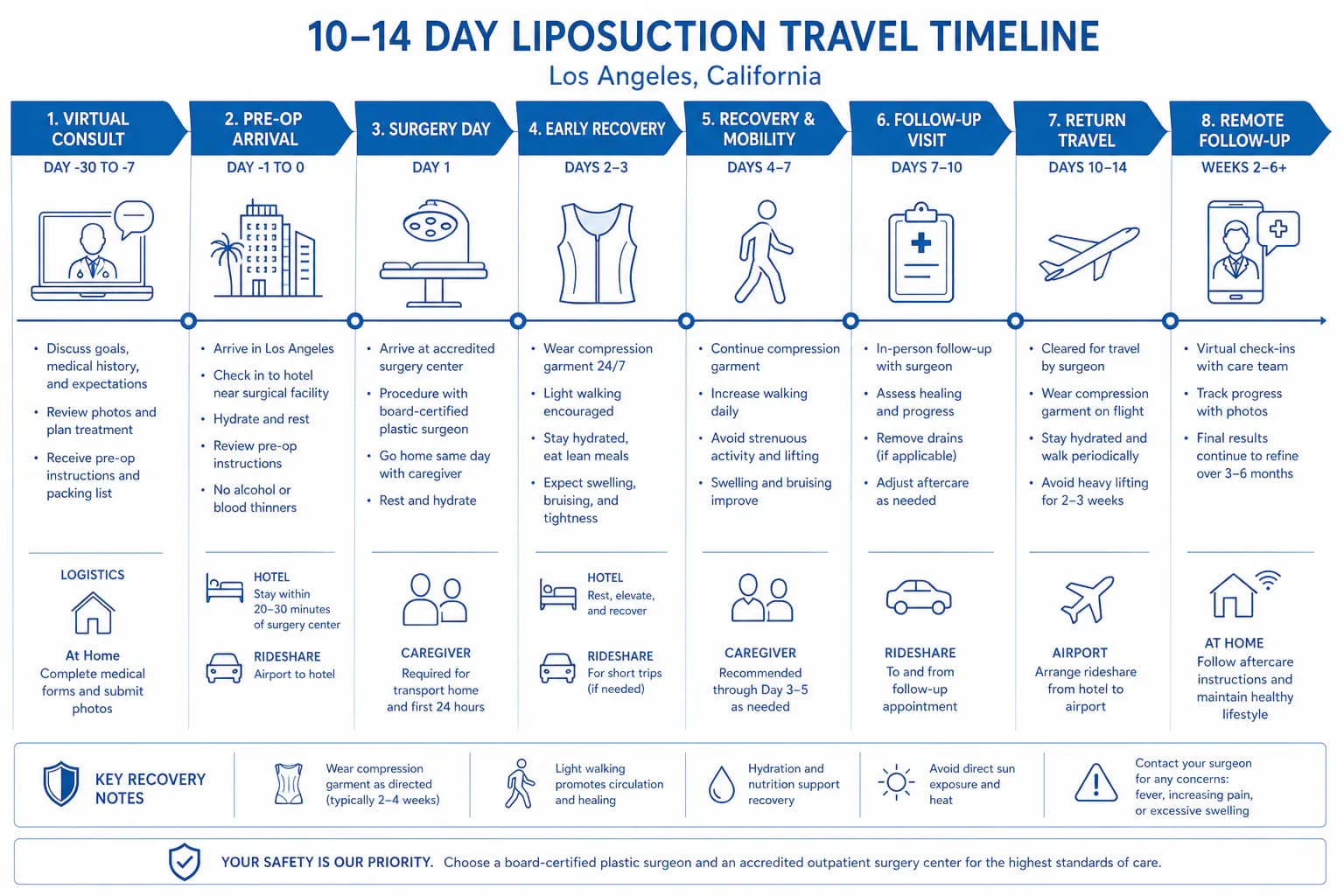
Los Angeles is a major destination market for cosmetic patients from out of state and from abroad. Many practices now build their process around virtual consultations, hotel coordination, drivers, and remote follow-up. That includes a meaningful volume of international patients, especially patients traveling from Asia to surgeons and practices that actively market multilingual support. Before travelling, compare board-certified liposuction surgeons in Los Angeles.
That convenience is real. So are the logistics.
A realistic out-of-town plan
| Timeline | What to plan |
|---|---|
| 2–4 weeks before | Virtual consult, labs, medical clearance, caregiver planning |
| 2–3 days before surgery | Arrive in LA, in-person exam, prescriptions, garment fitting |
| Surgery day | Accredited facility, confirmed ride home, adult support |
| Days 1–4 | Walking, compression, swelling control, limited activity |
| Days 5–10 | Early follow-up, assess drainage, bruising, contour, hydration |
| Days 10–14 | Many patients can travel home if recovery is uncomplicated |
Do not book a next-day flight after surgical liposuction. Do not assume you can recover alone. And do not let a practice rush you into combining more procedures than your recovery plan can support.
What is the best time of year to get liposuction in LA?
For most patients, fall and winter are the easiest times.
Compression garments are easier to hide. You are less likely to be at beaches, pools, weddings, or outdoor events during the first phase of swelling. And you have more time for your result to settle before summer.
That said, Los Angeles weather is mild enough year-round that timing is less about climate and more about your calendar. The best time to get liposuction in LA is when you can protect your recovery timeline for at least two weeks socially and four to six weeks physically, depending on the extent of surgery.
Tummy Tuck vs Liposuction in Los Angeles: Which Is Right for You?
In Los Angeles, the tummy tuck vs liposuction decision comes down to skin laxity and muscle separation, not just fat volume. ASPS reports that tummy tuck (abdominoplasty) surgeon fees nationally range from $6,000 to $9,000 before facility and anesthesia costs, while liposuction fees range from $4,300 to $7,500. In LA, both procedures run higher than national averages, and the right choice depends on anatomy, not marketing.
The core distinction is straightforward. Liposuction removes fat. A tummy tuck removes excess skin and tightens separated abdominal muscles (diastasis recti) while also removing fat. If your main concern is stubborn fat with reasonably good skin tone, liposuction alone often makes sense. If you have loose skin, stretch marks below the belly button, or muscle separation from pregnancy or weight change, a tummy tuck may be the more effective option.
| Factor | Liposuction alone works better when | Tummy tuck (or combo) works better when |
|---|---|---|
| Skin quality | Skin snaps back well, good elasticity | Loose or hanging skin, stretch marks |
| Muscle wall | No diastasis, firm abdominal wall | Separated muscles from pregnancy or weight change |
| Primary concern | Bulges that do not respond to diet or exercise | Skin excess, lower-abdominal sagging, muscle weakness |
| Recovery timeline | Usually 1-2 weeks of limited activity | Typically 2-4 weeks of limited activity, longer for full lift |
| LA cost range | $4,500-$12,000+ | $8,000-$20,000+ (or more in Beverly Hills) |
| Downtime from work | Often 3-7 days for desk jobs | Usually 2-3 weeks |
Los Angeles has strong demand for both procedures, and for good reason. LA patients often want visible abdominal contour, whether that means a flatter stomach through lipo or a tighter abdominal wall through a tummy tuck. The city's fitness culture also means many patients are close to their goal weight but stuck on a specific area that neither diet nor exercise will fix.
[PERSONAL EXPERIENCE] In our experience reviewing LA consultation patterns, the patients most satisfied with their outcome are the ones whose surgeon clearly explained the difference before selling either procedure. A surgeon who recommends lipo when you really need skin tightening is not doing you a favor. A surgeon who pushes a tummy tuck when lipo would address your concern adds cost and recovery you may not need.
Some LA patients benefit from combining both: liposuction to refine the flanks and upper abdomen plus a tummy tuck to address the lower abdomen. That is common in LA's mommy makeover market. It costs more and takes longer to recover from, but for the right candidate it produces a more complete result than either procedure alone.
For a full comparison of the two procedures, including recovery expectations and candidacy criteria, see our liposuction vs tummy tuck guide.
CoolSculpting vs Liposuction in Los Angeles: Surgical or Non-Surgical Fat Reduction?
Los Angeles has one of the country's most active non-surgical body contouring markets, and CoolSculpting is widely available across LA med spas and dermatology practices. Allergan Aesthetics reports that over 17 million CoolSculpting treatments have been performed globally, but the question for LA patients is not popularity. It is whether non-surgical fat freezing can actually deliver the result you want.
The short answer: CoolSculpting reduces fat gradually and modestly. Liposuction removes fat immediately and more aggressively. They are not interchangeable. CoolSculpting typically reduces fat in a treated area by about 20% to 25% over several months, according to the manufacturer. Liposuction can remove larger volumes in a single session. If you want subtle refinement and are willing to wait, CoolSculpting can work. If you want visible contour change, liposuction is the more effective tool.
| Comparison point | CoolSculpting | Liposuction |
|---|---|---|
| Approach | Cryolipolysis (fat freezing), no incisions | Surgical fat removal through small incisions |
| Results timeline | Visible over 1-3 months as fat clears naturally | Visible immediately, refines over 3-6 months as swelling resolves |
| Amount of fat reduction | Moderate, typically 20-25% per treated area | Significant, can remove larger volumes |
| Anesthesia | None | Local tumescent, sedation, or general depending on extent |
| Downtime | Minimal, most return to normal activity same day | 1-2 weeks limited activity, compression garments |
| LA cost per area | Roughly $750-$1,500 per session, multiple sessions often needed | $4,500-$12,000+ total for surgical treatment |
| Best candidate | Near target weight, small bulges, good skin tone, patient with timeline | More fat volume, specific contour goals, willing to accept surgical recovery |
| Permanence | Fat cells destroyed do not return, but remaining cells can expand | Same principle: removed fat cells do not return, but weight gain still affects remaining cells |
LA's med-spa culture makes CoolSculpting especially visible. Walk through Beverly Hills, West Hollywood, or Santa Monica and you will see it advertised heavily. Visibility does not equal superiority. CoolSculpting has real limitations: it works best on small, pinchable fat pockets, it cannot sculpt or shape the way a surgeon can with a cannula, and results are not as dramatic.
There is also a safety nuance. CoolSculpting is FDA-cleared for specific treatment areas. The most notable known risk is paradoxical adipose hyperplasia (PAH), a rare condition where treated fat grows firmer and enlarged instead of shrinking. PAH is uncommon, but it requires surgical correction, which means the patient ends up needing liposuction anyway.
[UNIQUE INSIGHT] For LA patients specifically, we have found that the best outcomes come from matching the tool to the problem rather than defaulting to the least invasive option. A patient with a small submental (under-chin) bulge and good skin may get a solid result from CoolSculpting. A patient who wants waist definition, flank contouring, or abdominal sculpting is almost always better served by liposuction, because the result is more controlled and more predictable.
The cost comparison in LA is also not as straightforward as it appears. A single CoolSculpting session is cheaper than surgery. But many patients need multiple sessions to approach their goal, and the cumulative cost can approach or exceed a single liposuction procedure, without delivering equivalent results.
For the full breakdown on these two options, including candidacy and recovery, read our liposuction vs CoolSculpting comparison.
Body Contouring in Los Angeles: 360 Lipo, BBL, and Combination Procedures
Los Angeles is one of the top markets in the country for advanced body contouring, including 360 liposuction, Brazilian butt lift (BBL), and multi-area combination plans. ASPS data show that the Pacific region, which includes California, accounted for 23% of all liposuction procedures and 17% of buttock augmentation with fat grafting performed by ASPS member surgeons in 2024. LA patients are not just asking for fat removal. They are asking for shape, proportion, and full-torso design.
360 liposuction treats the entire midsection in one surgical plan: abdomen, flanks, lower back, and often the waist. The goal is circumferential contour, not spot reduction. BBL (fat transfer to the buttocks) takes the fat harvested during liposuction and selectively injects it to add projection, improve hip-to-waist ratio, or restore volume lost after weight change or aging.
In Los Angeles, these procedures are frequently combined. A patient may have 360 lipo to sculpt the torso, with a portion of the harvested fat transferred to the buttocks for a balanced silhouette. That combination is one of the most requested body contouring plans in Beverly Hills and the Westside.
| Procedure combination | What it addresses | Typical LA cost range | Recovery expectations |
|---|---|---|---|
| 360 liposuction alone | Full midsection contouring: abdomen, flanks, lower back, waist | $9,000-$15,000 | 1-2 weeks limited activity, compression for 4-6 weeks, swelling resolves over 3-6 months |
| 360 lipo + BBL | Midsection contouring plus buttock projection and hip balance | $12,000-$20,000+ | 2-3 weeks limited activity, no direct sitting on buttocks for about 2 weeks per surgeon guidance, longer total recovery |
| HD liposculpture + fat transfer | Athletic-definition sculpting with selective fat grafting | $12,000-$18,000+ | Similar to 360 lipo, with additional care at fat transfer sites |
| Multi-area lipo (abdomen, arms, thighs, chin) | Comprehensive contouring across several body regions | $10,000-$18,000+ | Depends on extent, may require staging for safety |
HD liposculpture deserves specific attention in the LA context. High-definition liposculpture uses VASER or similar energy-assisted technology to sculpt fat in layers, creating more visible muscle definition, especially along the abdomen and torso. Los Angeles has a higher concentration of surgeons offering HD liposculpture than most markets because patient demand here supports it.
HD liposculpture is more technique-sensitive than standard tumescent liposuction. The surgeon is sculpting, not just debulking. That means cannula control, depth judgment, and skin quality assessment matter more. In the wrong hands, aggressive liposculpture can produce contour irregularities that are difficult to revise.
[ORIGINAL DATA] Among Los Angeles practices we reviewed that offer 360 lipo or BBL, the most consistent quality indicators were: ABPS board certification, a minimum of several years in focused body contouring practice, accredited surgical facilities, and before-and-after galleries showing patients with varied body types rather than a single idealized result. Surgeons who do high volume in these combinations tend to have more predictable outcomes and clearer revision policies.
Safety deserves a direct discussion. BBL, in particular, has a historical safety profile that requires careful surgeon selection. A multi-society task force found that older techniques carried a mortality risk estimated at roughly 1 in 3,000, primarily from fat embolism when fat was injected too deep into the muscle. Current safety standards, including subcutaneous-only injection and ultrasound guidance, have improved the risk profile significantly. In California, the state's outpatient surgery regulations add another layer of facility oversight that benefits patients.
Not every LA patient is a candidate for combination body contouring. Good candidates generally have realistic goals, stable weight, adequate fat stores for transfer (if BBL is planned), good skin elasticity, and the ability to protect a longer recovery period. Surgeons who push large combination procedures on every patient without clear medical justification are worth questioning.
For full procedural details on 360 liposuction and BBL, including technique and safety considerations, see our 360 lipo and BBL guide and our Brazilian butt lift overview.
To browse board-certified plastic surgeons in the Los Angeles metro area, see our Los Angeles surgeon directory.
Most LA patients should budget roughly $4,500 to $18,000+ depending on the treatment area, number of areas, technique, facility, and surgeon tier. Small-area submental cases sit toward the low end, while 360 lipo and HD liposculpture in Beverly Hills often land much higher.
Beverly Hills is the premium market, but it is not automatically the best choice. The right surgeon may be in Beverly Hills, Santa Monica, West Hollywood, Brentwood, or elsewhere in LA. Credentials and outcomes matter more than the address.
Look for ABPS board certification, an active California license, an accredited surgical setting, and real experience in your treatment area. You also want a surgeon who explains limits, not just possibilities.
LA is usually comparable to NYC at the premium end and often higher than Miami when you compare accredited facilities and similar surgeon credentials. Miami may advertise lower entry prices, but the structure of the quote matters.
Standard abdomen and flank liposuction remains common, but LA has especially strong demand for HD liposculpture, 360 lipo, submental lipo, and lipo paired with BBL planning. Those procedures are more prominent here than in many secondary markets.
Use the California Medical Board license lookup first. Then verify ABPS certification through ABMS or ABPS and confirm the surgical setting in California's outpatient surgery database.
Yes. California restricts who can use the phrase in advertising and requires the full certifying board name to be shown clearly. That gives patients a real protection, but only if you verify the exact board.
Fall and winter are easiest for many patients because garments, bruising, and swelling are simpler to manage. But the best timing is whenever you can protect your recovery and avoid rushing back into work, travel, or workouts.
