Facial fat removal has two completely different procedures — and they target two completely different types of fat. Choosing the wrong one for your anatomy produces the wrong result. Choosing the right one but at the wrong age can cause premature aging you won't see for a decade.
Here's the anatomy, the honest assessment of each procedure, what the buccal fat removal controversy is actually about, and how to determine which approach is appropriate for your face.
The Two Types of Facial Fat — and Why They Require Different Procedures
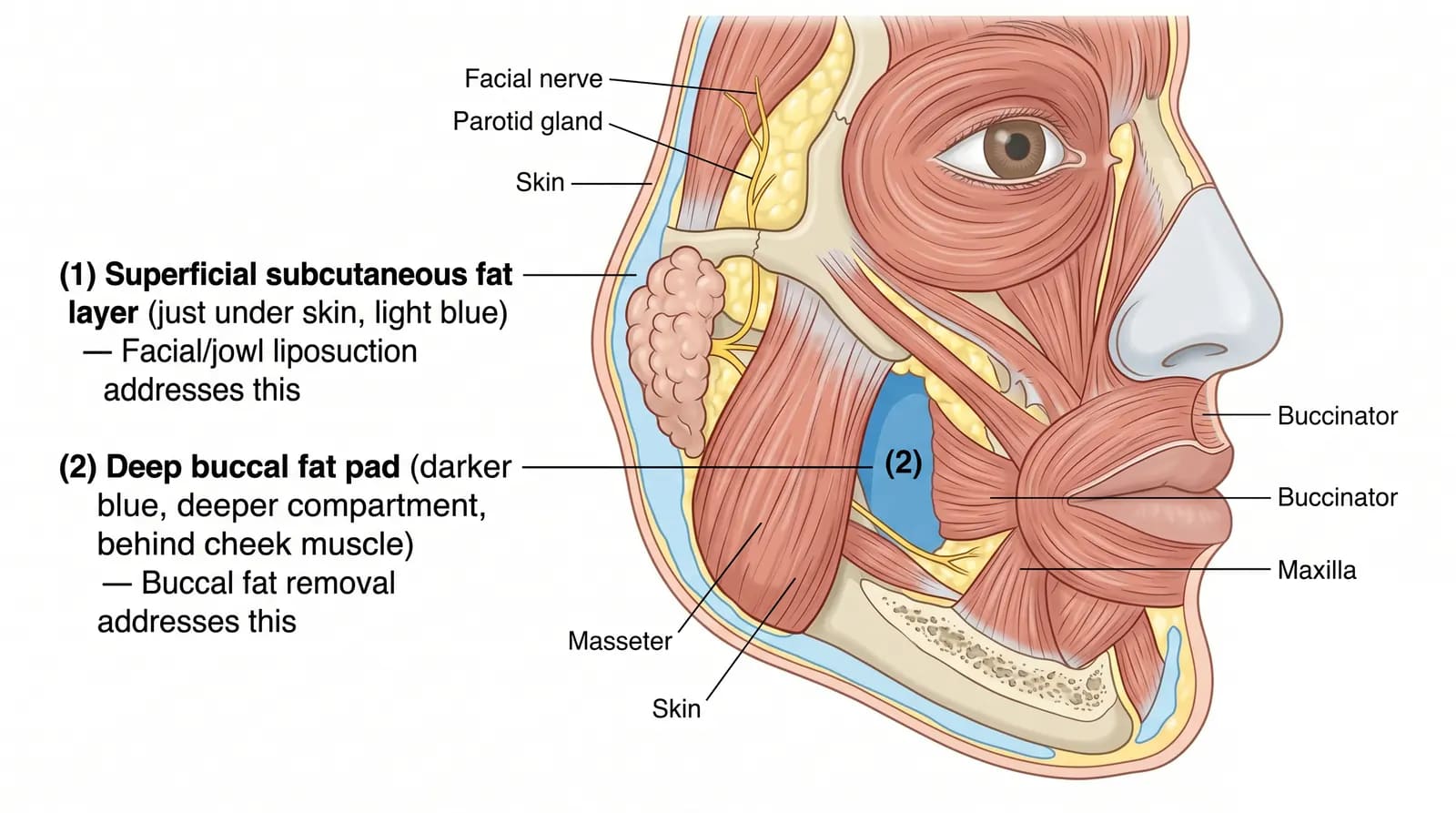
The face has two distinct fat compartments, and they require different treatments:
Subcutaneous facial fat: The soft, pinchable layer directly under the skin. This is the fat responsible for jowling along the jawline, fullness in the lower cheeks that drapes over the mandible, and the layer that creates a double chin appearance. This fat responds to liposuction — the same cannula-and-suction technique used on the body.
Buccal fat pad: A deeper, enclosed package of fat that sits inside the cheek cavity, between the cheek muscles (buccinator and masseter), below the cheekbone. This is what creates a "chipmunk cheek" or round lower face appearance. It is not subcutaneous — you can't pinch it — and liposuction cannot reach it effectively. The buccal fat pad requires direct surgical excision through a small incision inside the mouth.
Many patients asking about "face liposuction" actually need one of these, the other, or both — depending on their anatomy. Understanding the distinction determines whether you get the right procedure.
Facial Liposuction: What It Treats and How It Works
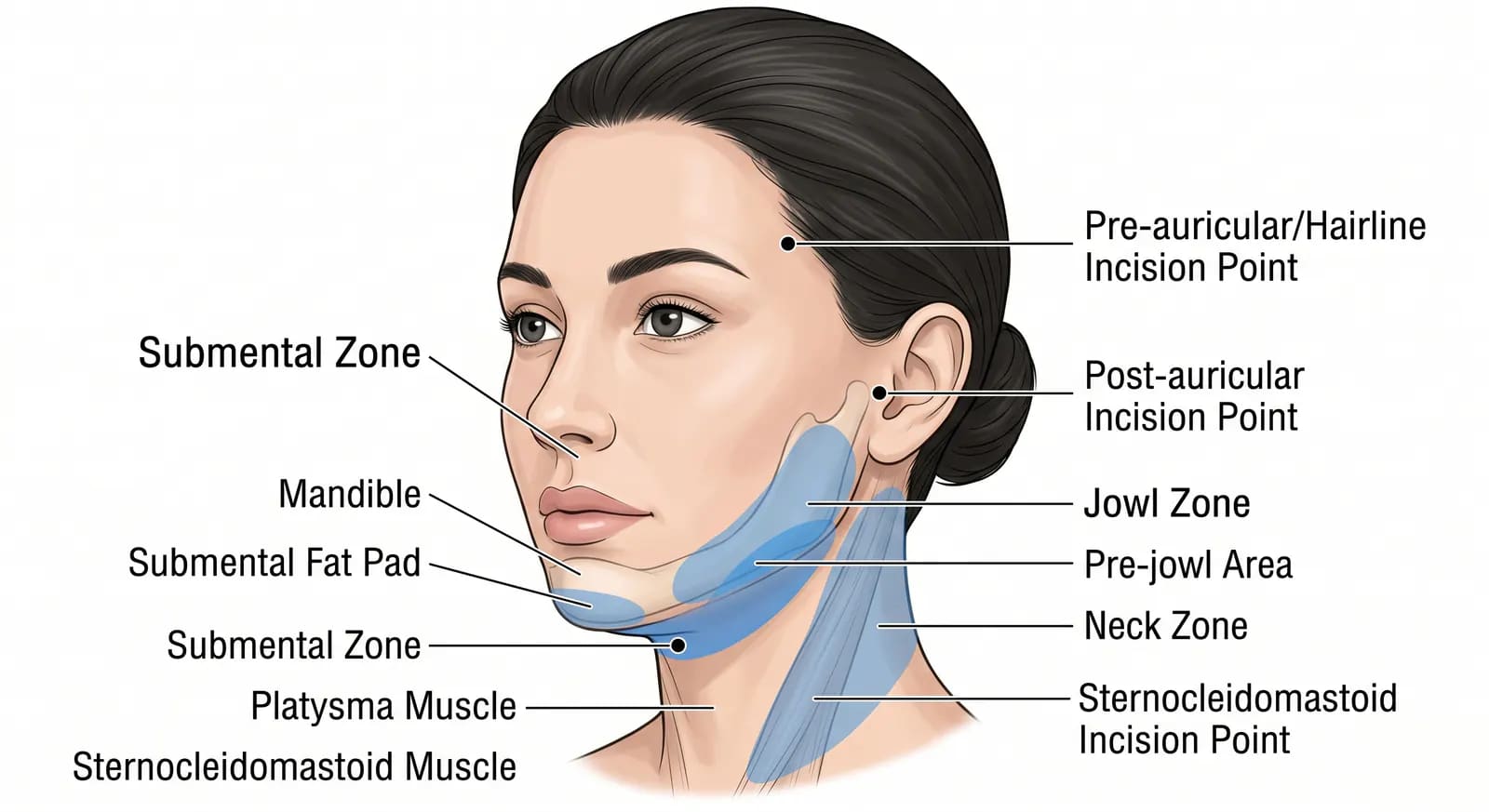
Facial liposuction — more accurately described as lower facial and neck liposuction — addresses the subcutaneous fat layer at the jowls, lower face, and upper neck. It is the same tumescent liposuction technique used on the body, performed through incisions that are just 2 to 3mm.
Typical treatment areas:
- Jowls: The fat that drapes over the jawline as it descends, creating the "jowl" appearance on either side of the lower face
- Pre-jowl area: The fat along the mandibular border that softens jawline definition
- Submental: The fat under the chin — often combined with chin liposuction, which is covered in our chin liposuction guide
- Upper neck: The fat that creates neck thickness and makes the jaw-to-neck angle undefined
The procedure: Tiny incisions are made under the chin, behind the earlobes, or within natural facial creases. Tumescent fluid is infiltrated, then a very small cannula (2–3mm — far smaller than body liposuction) is used to suction the subcutaneous fat. Incision sites are placed where they will be hidden.
Results: A more defined jaw-to-neck angle, reduced jowl bulk, sharper mandibular border, and a more youthful face-neck relationship. Before-and-after photos consistently show dramatic improvement in patients with good skin elasticity who have localized subcutaneous facial fat.
Who it works for: Patients with pinchable subcutaneous fat at the jowls and lower face, good skin elasticity, and realistic expectations. It is most effective in patients under 55 whose skin retains enough elasticity to contract over the newly contoured area.
When it doesn't work: Patients whose primary facial aging concern is skin laxity rather than fat — loose skin that has descended from the upper face — typically need a facelift, not liposuction. Removing fat from under loose, descended skin can make the skin look more deflated. Experienced surgeons make this distinction during consultation.
Buccal Fat Removal: The Deeper Procedure — With a Long-Term Warning
Buccal fat removal became extremely popular in 2022 and 2023, driven in part by social media before-and-after content and celebrity speculation. It then sparked significant backlash — and for legitimate clinical reasons.
What buccal fat removal does:
A small incision (approximately 1cm) is made inside the mouth, in the cheek lining. The buccal fat pad is located, freed from surrounding tissue, and excised. The incision is sutured. No external incisions. No external scars. The procedure takes 30 to 60 minutes under local anesthesia or light sedation.
What it achieves:
- Reduction in lower cheek fullness
- More prominent cheekbones (the underlying structure becomes more visible)
- A sculpted, slightly hollowed midface appearance
- Narrower lower face
Results are permanent — the buccal fat pad, once removed, does not regenerate.
The age warning — and why experienced surgeons take it seriously:
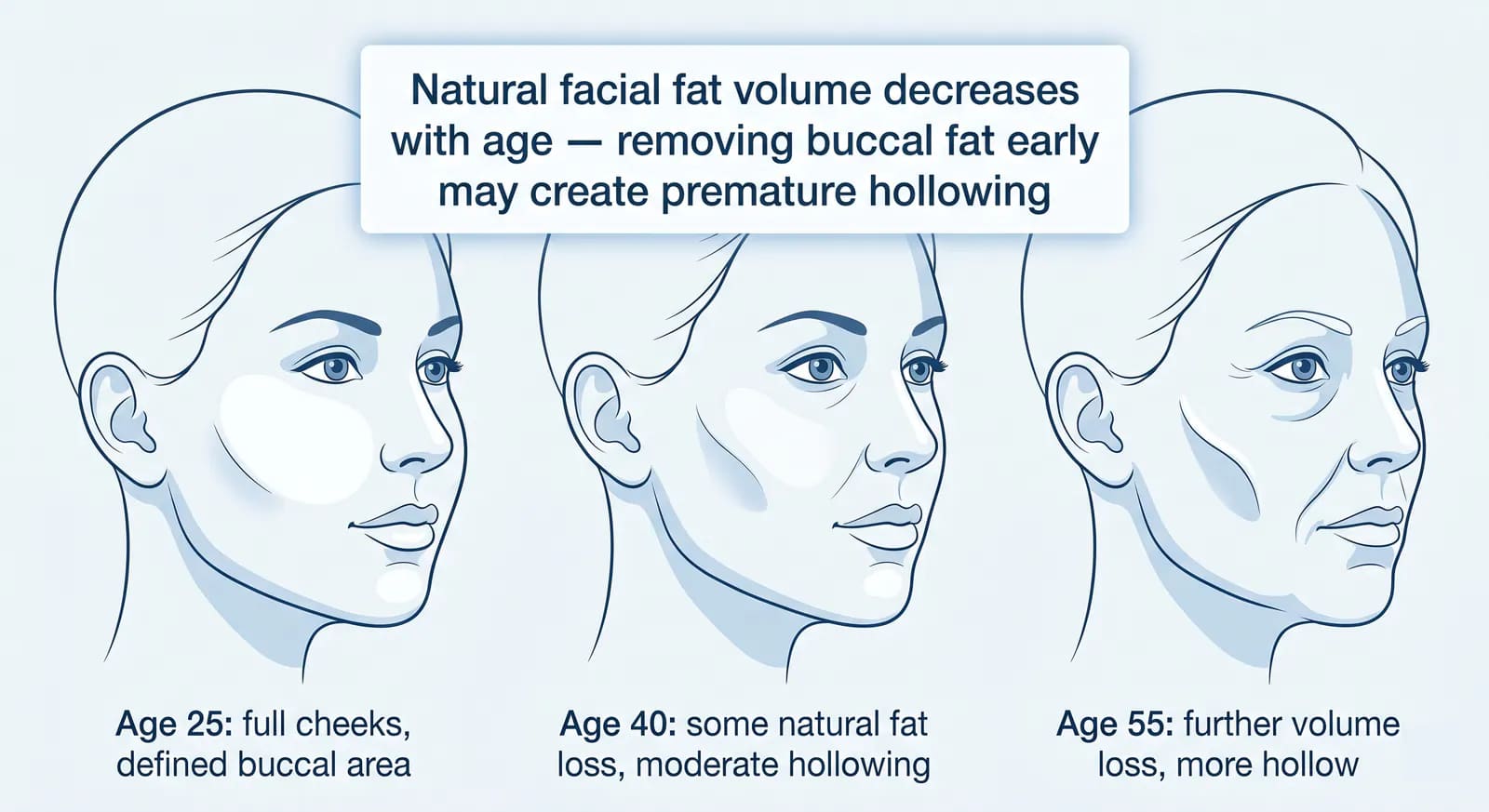
The buccal fat pad serves a structural purpose. It provides volume to the midface that helps maintain a youthful, lifted appearance. The face naturally loses volume with age — in the 40s and 50s, the buccal fat pad shrinks and descends, contributing to the hollowed, gaunt appearance of facial aging.
Patients who remove their buccal fat in their mid-20s may look contoured and defined initially. But as natural facial aging progresses and the surrounding fat compartments also lose volume, the already-removed buccal fat is conspicuously absent. The result: premature hollowing of the midface — an appearance associated with aging and illness — in patients who are only in their late 30s or 40s.
This is not a theoretical risk. Plastic surgeons began reporting it in clinical discussions after the 2022–2023 surge in buccal fat removal requests. Many experienced facial plastic surgeons now decline to perform buccal fat removal on patients under 30 to 35, or counsel extensively about long-term aging implications before proceeding.
The honest assessment: Buccal fat removal is a legitimate procedure with appropriate candidates. Those candidates are typically patients over 35 with genuinely large buccal fat pads causing persistent fullness that is clearly buccal rather than structural, who understand and accept the long-term aging trade-off. It is not appropriate for young patients who simply want a more angular face based on social media trends.
Cost: Facial Liposuction and Buccal Fat Removal
| Procedure | Typical Total Cost |
|---|---|
| Chin/neck liposuction | $3,000 – $6,000 |
| Facial liposuction (jowls + lower face) | $3,500 – $7,000 |
| Buccal fat removal | $2,800 – $4,500 |
| Chin lipo + buccal fat removal (combo) | $5,000 – $9,000 |
Total costs — surgeon, facility, anesthesia. Buccal fat removal can sometimes be performed under local anesthesia only, reducing facility fees.
Facial liposuction costs more than buccal fat removal because it requires more surgical time and a formal operating room setting. Buccal fat removal is simpler to perform technically and can sometimes be done in a procedure room rather than a full OR.
The combination of chin/neck lipo plus buccal fat removal is the most cost-efficient approach for patients who need both, as it consolidates facility and anesthesia fees.
How to Determine Which You Need
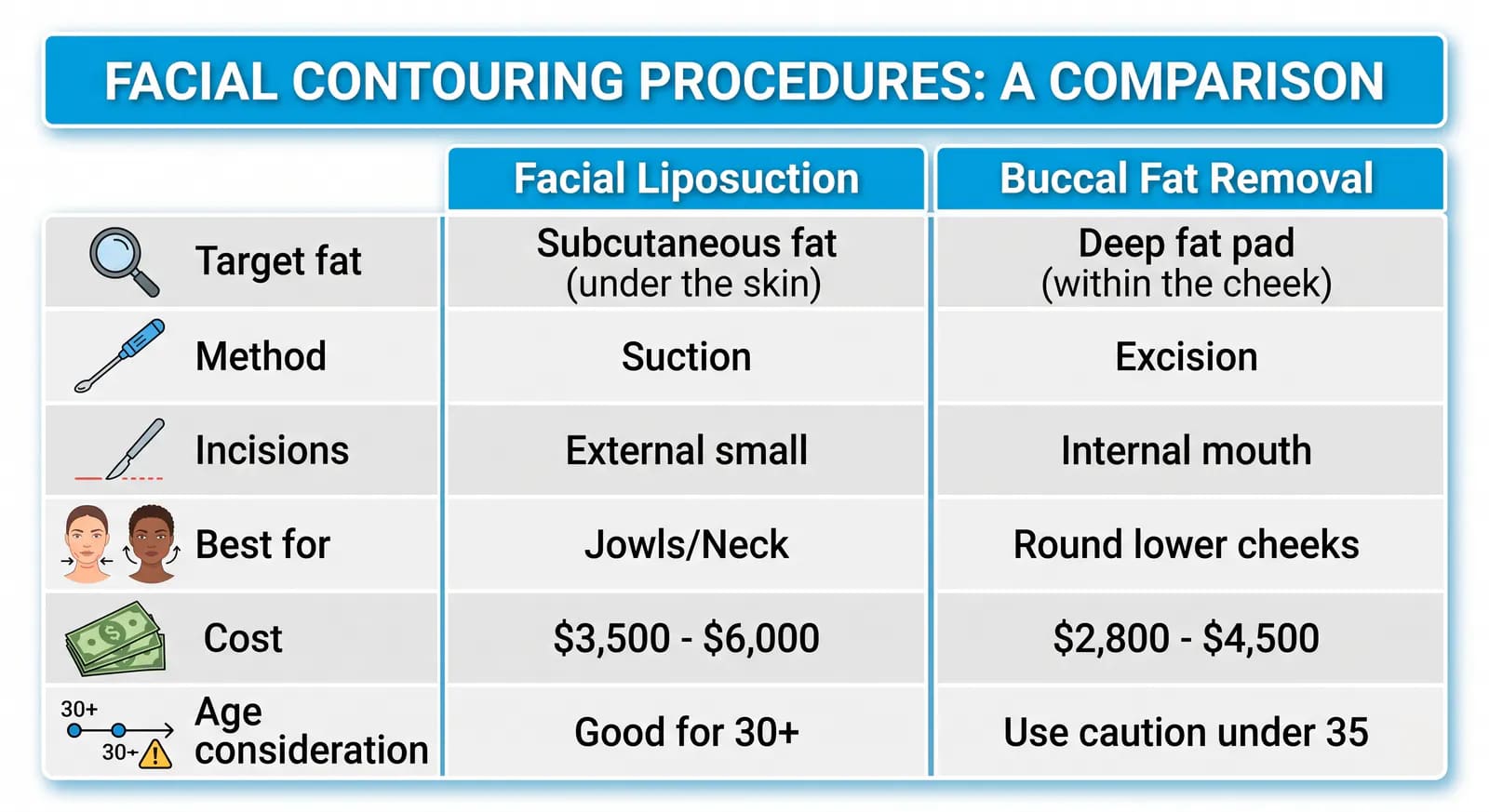
You likely need facial/neck liposuction if:
- You can pinch soft fat along your jawline, lower cheeks, or under your chin
- Your face looks undefined or heavy due to subcutaneous fat rather than bone structure
- You have good skin elasticity and are looking to sharpen the jawline and neck area
You likely need buccal fat removal if:
- Your lower cheeks are persistently round despite being at a healthy weight
- The fullness is deeper — not pinchable at the surface
- A surgeon has confirmed on examination that your buccal pads are genuinely large
- You are over 35 and have considered the long-term aging implications with your surgeon
You may benefit from both if:
- You have fullness at both the surface (jowls) and deep (cheeks) levels
- Your surgeon identifies subcutaneous jowl fat plus large buccal pads as separate contributing factors
A facelift may be more appropriate than either if:
- The primary concern is loose, descended skin rather than fat
- You have significant skin laxity at the lower face and neck
- Fat removal alone would produce a deflated rather than defined result
Recovery: Facial Liposuction and Buccal Fat Removal
Facial liposuction recovery:
- Days 1–3: Swelling, bruising, mild discomfort. Compression chin strap worn 24 hours per day.
- Days 4–7: Most patients comfortable for desk work. Bruising visible.
- Weeks 2–4: Bruising resolves. Swelling gradually reduces. Chin strap worn during the day.
- Months 2–3: Final results visible as swelling completely resolves.
Buccal fat removal recovery:
- Days 1–3: Cheek swelling (noticeable), mild discomfort. Soft diet required — incisions are inside the mouth.
- Days 4–7: Desk work comfortable for most patients. Swelling peaks around day 3 to 5.
- Weeks 2–4: Swelling progressively resolves. The final sculpted result begins to appear.
- Months 2–4: Final result visible. The hollowing effect becomes apparent as swelling clears completely.
Note: for buccal fat removal, results look most dramatic at 3 to 6 months — before that, residual swelling partially obscures the change. Some patients worry at 4 weeks that nothing has changed; the true result is still developing.
Combining Facial Liposuction with Other Procedures
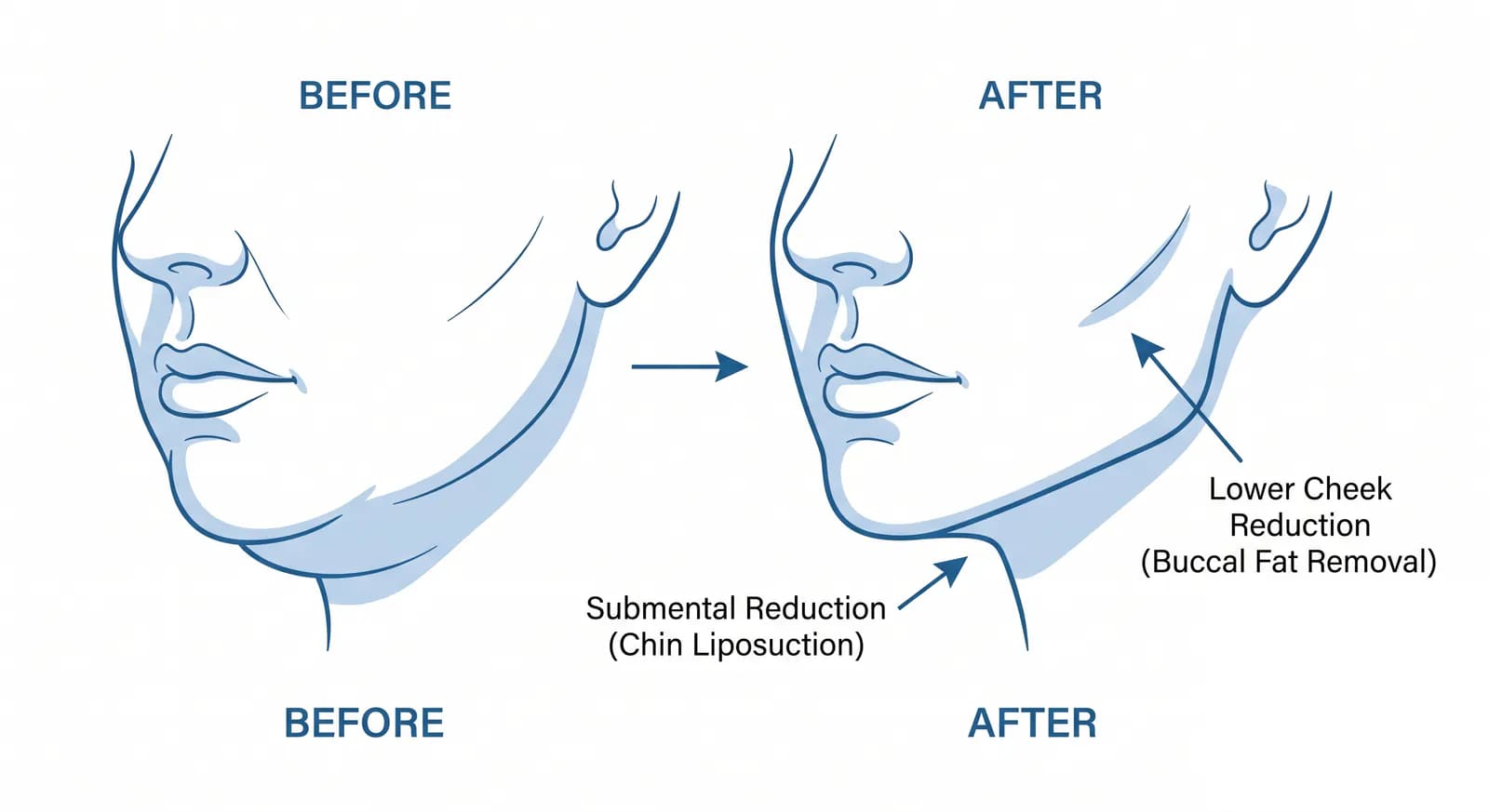
Chin/facial lipo + buccal fat removal: The most common combination. Addresses both surface and deep facial fat for comprehensive lower face definition.
Chin/facial lipo + Renuvion or Morpheus8: Combining liposuction with radiofrequency skin tightening addresses fat and skin laxity simultaneously. Good option for patients with borderline skin quality who aren't ready for a facelift.
Chin/facial lipo + rhinoplasty (nose job): The "lower face and nose" combination dramatically changes facial balance and is one of the highest-satisfaction combinations in facial plastic surgery.
Buccal fat removal + cheek filler: Counterintuitively, some patients benefit from removing deep buccal fat while adding filler to the upper cheekbones — creating the cheekbone projection while reducing lower cheek fullness. This combination should be discussed with a surgeon who understands three-dimensional facial anatomy.
What's the difference between facial liposuction and buccal fat removal? Facial liposuction removes subcutaneous fat (just under the skin) from the jowls, lower face, and neck via suction. Buccal fat removal excises a deep fat pad inside the cheek through a mouth incision. Different fat types, different depths, different techniques.
How much does face liposuction cost? Facial/jowl liposuction: $3,500–$7,000. Buccal fat removal: $2,800–$4,500. Both combined: $5,000–$9,000.
What is buccal fat removal? Surgical excision of the buccal fat pad — a deep cheek fat pocket — through a small internal mouth incision. Creates a more sculpted, contoured midface appearance. Results are permanent.
Is buccal fat removal safe for young patients? This is the key concern. Facial fat naturally decreases with age — patients who remove buccal fat in their 20s may appear prematurely gaunt in their 40s as surrounding fat also depletes. Most experienced surgeons counsel caution for patients under 35.
Am I a candidate for facial liposuction? Good candidates have soft, pinchable subcutaneous fat at the jowls or lower face with good skin elasticity. Patients whose primary concern is loose or sagging skin may need a facelift rather than liposuction.
What is the recovery time? Desk work in 5 to 7 days for both procedures. Swelling at 1 to 3 weeks. Final results at 2 to 4 months.
Can facial liposuction be combined with other procedures? Yes — frequently with buccal fat removal, Renuvion skin tightening, rhinoplasty, or facelift depending on the patient's needs.
Does facial liposuction leave scars? Tiny 2–3mm marks, placed in hidden locations (under chin, behind earlobes). Essentially invisible at 12 months. Buccal fat removal leaves no external scars.
