
Chin liposuction costs $2,000–$7,200 in the US, takes 30–60 minutes, and has most patients back at a desk within a week. It's one of the shortest and most predictable liposuction procedures — a small incision under the chin, a thin cannula, and a sharper jawline that appears as the swelling settles over the next few months.
But "predictable" doesn't mean "right for everyone." The single biggest reason patients are disappointed with chin lipo is not the surgery itself — it's that they had a skin problem or a muscle problem, and the surgeon treated it like a fat problem. This guide is written to help you figure out which problem you actually have, and what to do about it.
We'll cover what chin liposuction is, how it compares to Kybella and CoolSculpting, who is and isn't a candidate, how much it realistically costs across the US in 2026, and what the first eight weeks of recovery look like — week by week.
What Is Chin Liposuction?
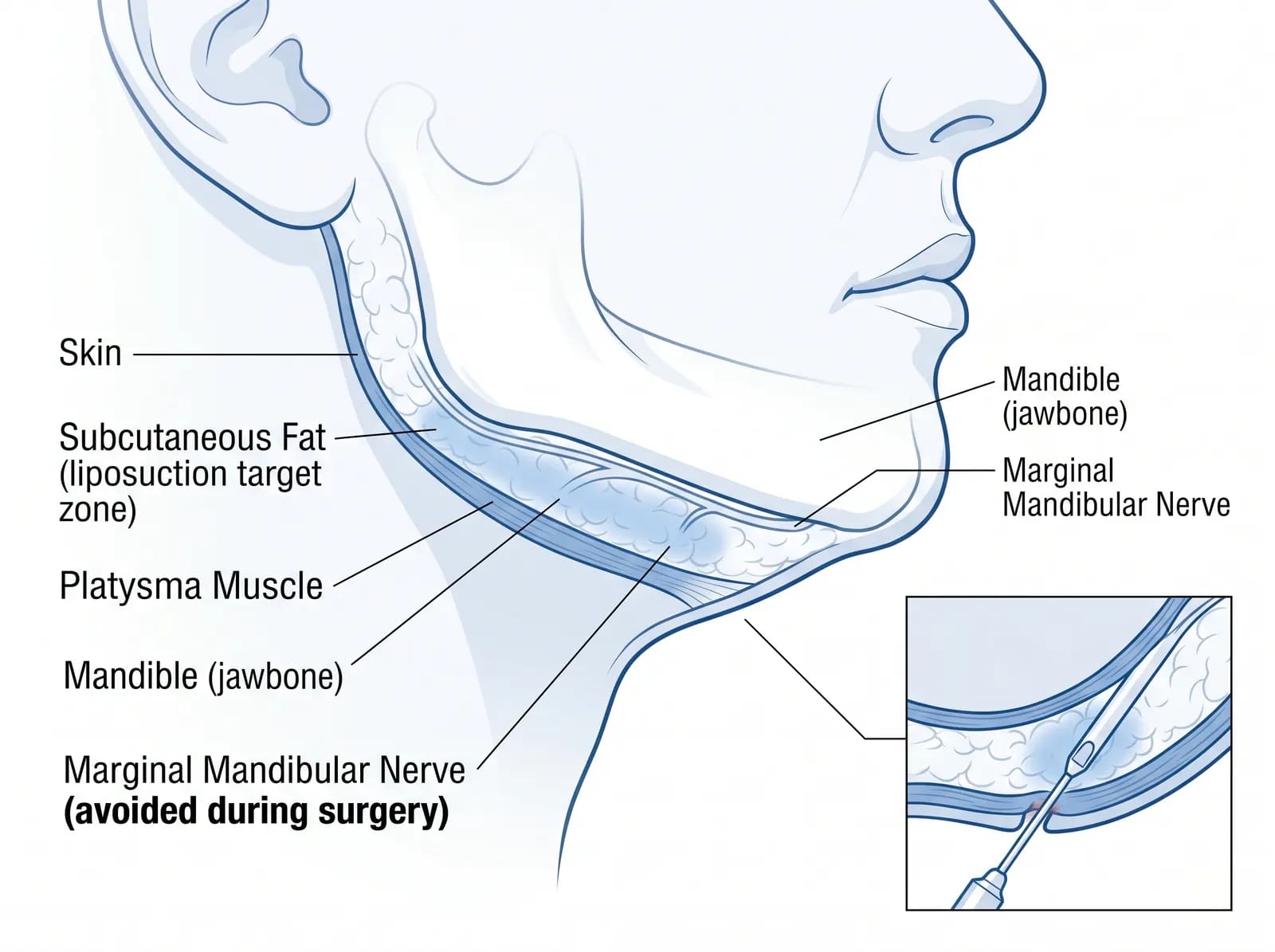
Chin liposuction — also called double chin liposuction or submental liposuction — is a cosmetic procedure that removes excess fat from the submental region, the area beneath the jawline and chin. The goal is a more defined jaw-neck transition and a reduction of the so-called "double chin."
It's the same procedure under all three names. "Submental" is the anatomical term surgeons use. "Double chin" is the patient-facing term most searches use. Some surgeon websites split them into marketing categories; they're describing one operation.
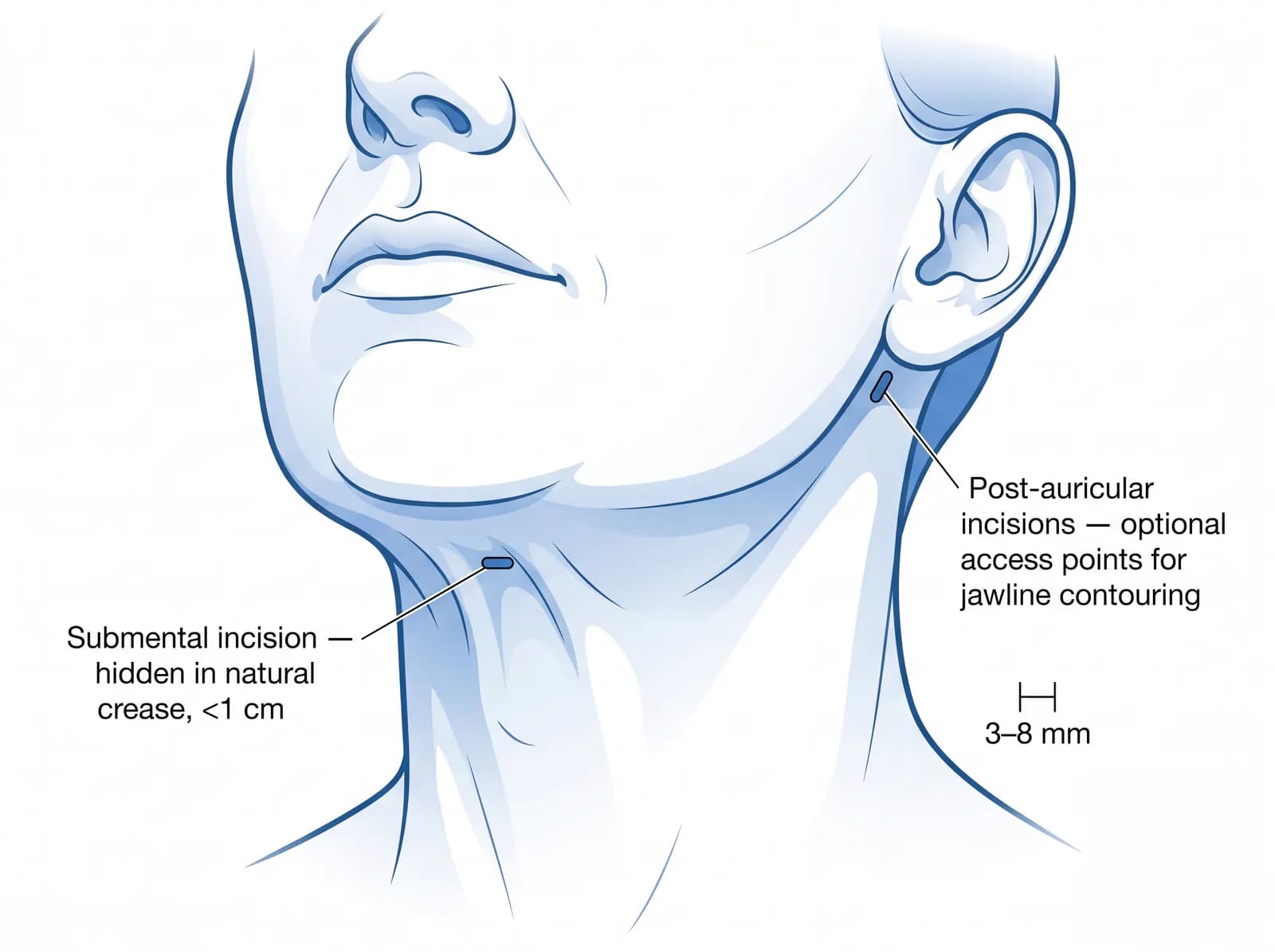
The mechanism is straightforward. A surgeon makes a small incision — usually less than a centimeter, hidden in the natural crease under the chin — and inserts a thin cannula. The cannula breaks up and suctions out the fat that sits between the skin and the platysma muscle. Occasionally, small accessory incisions behind the ears are used to contour the jawline more broadly.
What chin lipo does: it removes fat. That's the entire promise.
What chin lipo does not do:
- It does not tighten significant loose skin on its own.
- It does not correct the vertical bands at the front of the neck (platysmal banding).
- It does not fix a small or recessed chin — that's the job of a chin implant or genioplasty.
- It does not treat excess fat deeper to the platysma muscle, which is a different surgical problem.
Figuring out which of these is actually driving the contour issue you see in the mirror is the single most important conversation to have with a surgeon at consultation. Which brings us to candidacy.
Am I a Good Candidate?
The ideal candidate for chin liposuction:
- Is at or near a stable weight. Lipo is a contouring procedure, not a weight-loss procedure. Significant weight fluctuation after surgery can compromise the result.
- Has good skin elasticity. Younger skin retracts better after fat is removed. Most surgeons point to the 20–50 age window as the sweet spot, but this is less about the calendar and more about how your skin actually snaps back when pinched.
- Has a localized fat pocket as the main issue. If a surgeon pinches the area and finds a clear fat layer above the muscle, that's the tissue lipo can address.
- Has realistic expectations. Chin lipo refines. It does not transform a face shape.
Weaker candidates include:
- Patients with significant loose skin. A neck lift (or a mini neck lift) addresses skin; lipo alone will leave it looking emptied out and slack.
- Patients with prominent platysmal bands. Those vertical cords visible when you tense your neck are muscle, not fat. Platysmaplasty is the procedure that tightens them.
- Patients with a weak or recessed chin. A chin implant, on its own or combined with lipo, gives a better result than lipo alone in these cases.
- Patients with chronic neck swelling, thyroid disorders, or lymphatic issues affecting the submental region. These need medical workup before any cosmetic surgery.
Here's the honest version most surgeon websites soften: skin elasticity is the one candidacy factor patients most often get wrong about themselves. If in doubt, ask the surgeon to show you before-and-after photos of patients with your specific skin quality — not just your fat pattern.
Chin Liposuction vs Kybella vs CoolSculpting
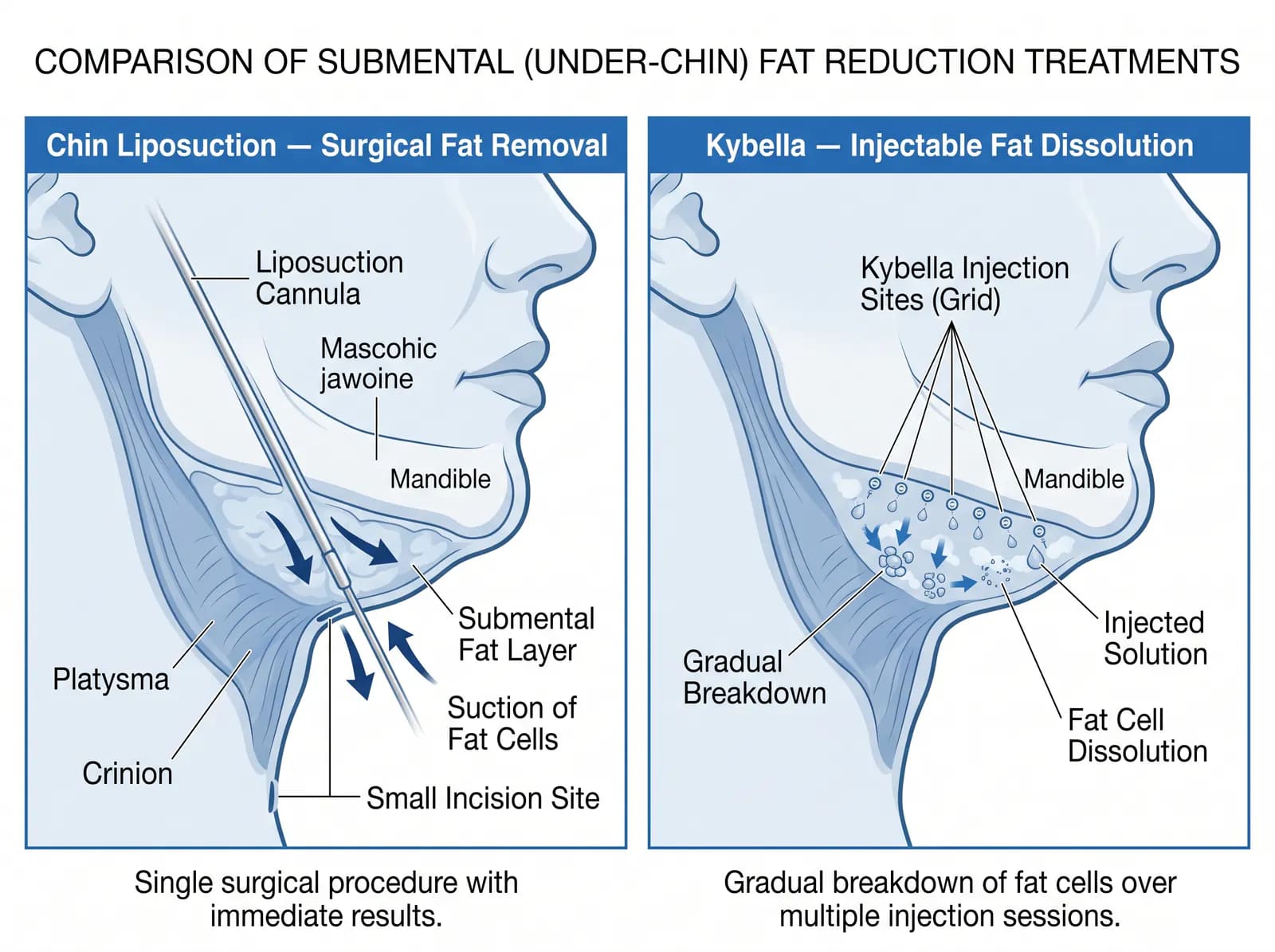
This is the first decision most patients should make, and it's the one most surgeon blogs skew toward whatever they sell. Here's the neutral version.
Chin Liposuction
Key points:
- Mechanism: Surgical. Fat is physically removed through a cannula.
- Sessions: One.
- Downtime: 5–7 days off work; compression garment for the first week.
- Best for: Moderate to larger submental fat pockets; patients who want immediate contouring with the most precise jawline sculpting; patients with good skin elasticity.
- Result timeline: Initial contour visible at 2–4 weeks; final result at 3–6 months.
- Typical cost: $2,000–$7,200.
Kybella (Deoxycholic Acid)
Key points:
- Mechanism: Injectable. A synthetic version of deoxycholic acid (a bile salt) chemically dissolves fat cells over several weeks.
- Sessions: 2–6 sessions, typically spaced about a month apart.
- Downtime: No surgical downtime, but each session causes 1–2 weeks of significant swelling. Some patients report more cumulative swelling time than a single lipo would have caused.
- Best for: Mild to moderate submental fullness; patients who want to avoid surgery; patients comfortable with a gradual, multi-month treatment course.
- Result timeline: Gradual, visible across the treatment course. Final result usually 6 months after starting.
- Typical cost: $1,200–$1,800 per session; $3,000–$6,000 total across the full course.
CoolSculpting Mini (Cryolipolysis)
Key points:
- Mechanism: Non-invasive. Controlled cooling freezes fat cells, which are then cleared by the body over weeks.
- Sessions: Usually 2 sessions, spaced 6–8 weeks apart.
- Downtime: None to speak of. Some numbness and redness after each session.
- Best for: Small, pinchable pockets of submental fat in patients who will not consider injectables or surgery.
- Result timeline: Visible results at 8–12 weeks per session.
- Typical cost: $700–$1,500 per session.
How to Decide
The decision matrix is essentially three variables:
1. How much fat is there? Larger volumes → lipo. Small, pinchable pocket → CoolSculpting is an option. Anything in between → Kybella or lipo, depending on the other two factors.
2. What is your skin like? Good elasticity → any of the three can work. Borderline elasticity → lipo with skin-tightening adjunct (laser-assisted) is often the most contoured outcome.
3. What is your downtime tolerance? A week of clear downtime → lipo is the most efficient path. A slower multi-session course with no single "down week" → Kybella or CoolSculpting.
The most common mistake we see is patients with a genuinely moderate fat pocket doing three or four Kybella sessions, being underwhelmed, and eventually paying for lipo anyway. If a surgeon tells you the fat volume is beyond what Kybella does well, it's worth listening before committing to a long injectable course.
Chin Liposuction vs Neck Lift
Chin lipo and a neck lift are sometimes compared, but they're usually complementary rather than competitive.
A neck lift addresses loose skin and platysmal banding. It's a larger surgery, with incisions behind the ears (and sometimes under the chin), a longer recovery, and a bigger effect on the overall neck appearance.
A chin lipo addresses fat. If your neck appearance is driven by a submental fat pad and your skin is elastic, lipo alone can be enough. If it's driven by lax skin or muscle banding, a neck lift is the right procedure.
Many patients — especially in their 40s and 50s — end up with a combination: lipo of the submental region plus platysmaplasty (tightening the platysma muscle) plus a mini neck lift for skin. That's a conversation to have with a facial plastic surgeon at consultation, not one to pre-decide.
How the Procedure Works
Anesthesia
Most chin liposuction is done under local anesthesia with oral or IV sedation. General anesthesia is rare and usually reserved for combined procedures.
Incision Placement
The primary incision is made directly beneath the chin, hidden in the natural submental crease. It's typically 3–8 mm — smaller than the head of a matchstick. Occasional cases use small accessory incisions just behind each earlobe to access the lateral jawline for broader contouring.
Scar visibility after healing, in most patients, is minimal. The submental location makes the scar anatomically difficult to see in normal conversation or photography.
The Procedure Itself
After local anesthesia and any sedation is in effect, the surgeon injects a tumescent fluid (a saline solution with dilute lidocaine and epinephrine) into the fat layer. This expands the target tissue, reduces bleeding, and provides extra anesthesia.
A thin cannula — typically 2–3 mm in diameter — is then inserted through the submental incision. The surgeon moves it in a controlled fanning pattern through the fat layer, disrupting fat cells and suctioning them out. The marginal mandibular nerve, which controls lower-lip movement, sits near the work area; an experienced surgeon keeps the cannula in the correct plane to avoid it.
Start to finish, the procedure takes 30 to 60 minutes. With prep and recovery-room monitoring, plan on being at the facility for two to three hours.
Techniques Used on the Chin
Key points:
- Traditional (suction-assisted) lipo. The standard. Effective, predictable.
- Laser-assisted lipo (SmartLipo). A laser fiber is introduced alongside the cannula to liquefy fat and induce mild collagen tightening. Often favored for the chin specifically, where some skin retraction is valuable.
- VASER (ultrasound-assisted) lipo. Ultrasonic energy emulsifies fat before suction. Good precision for small areas like the jawline.
- Power-assisted (PAL) lipo. A mechanically oscillating cannula. Can reduce surgeon fatigue on longer combined cases; less common as a standalone choice for the chin.
For patients specifically interested in the skin-tightening claims of laser lipo, our laser liposuction guide covers the realistic limits of that technology in detail.
Chin Liposuction Results: What to Expect
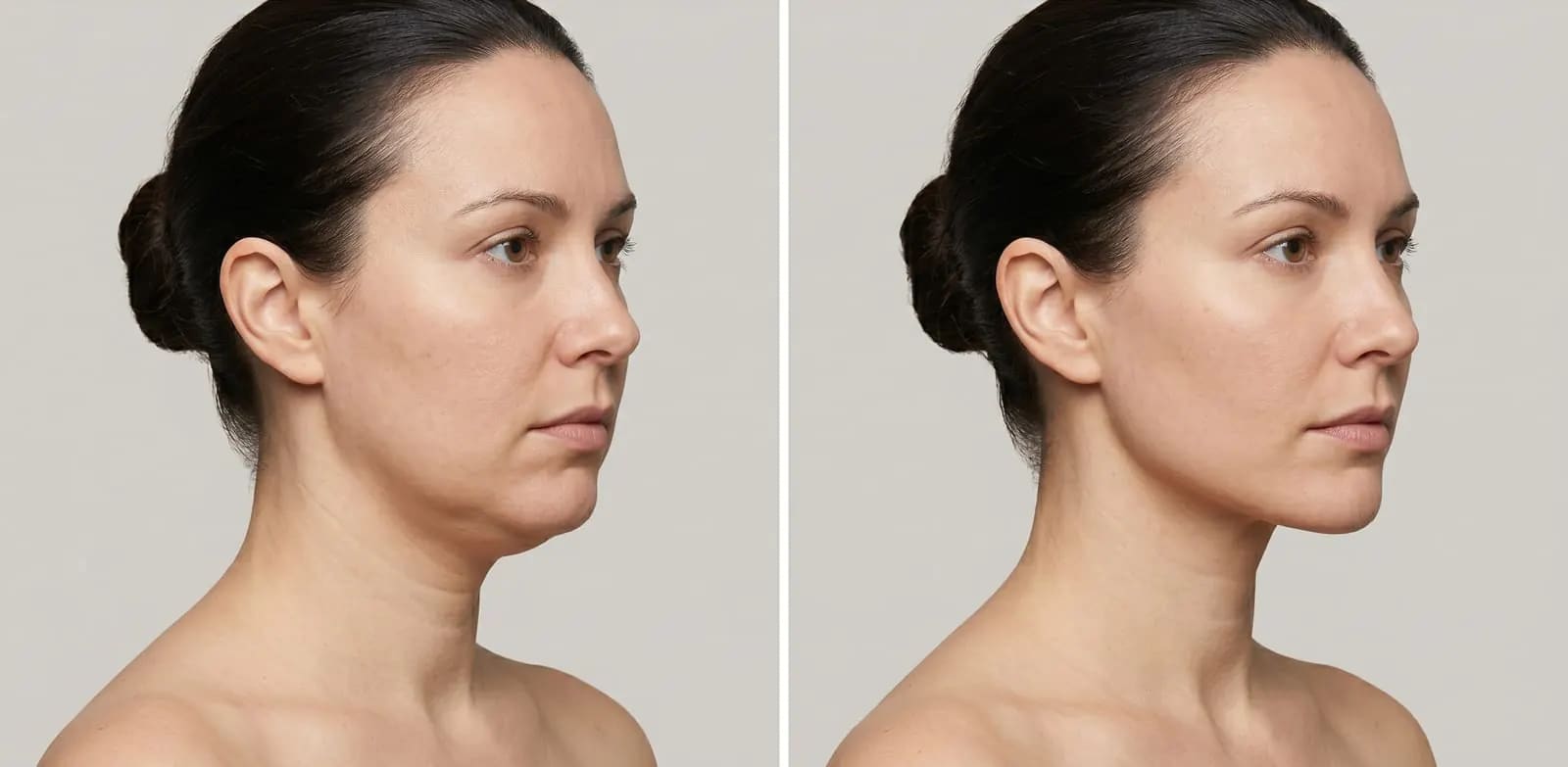
The results timeline looks like this:
- Day 1–7: The area is swollen, bruised, and wrapped. You cannot yet see the result. This is normal and expected.
- Week 2–3: Most bruising resolves. Major swelling begins to settle.
- Week 4–6: You see the shape of the result. It's still not final — residual swelling is typical.
- Month 3: Most patients see close to their final contour.
- Month 6: Final result. Collagen remodeling and any last skin retraction have completed.
Is it permanent? The fat cells removed are gone and do not regenerate. As long as you maintain a stable weight, the contour change is long-lasting. Significant weight gain can still cause the remaining fat cells in the region to enlarge, so the result is durable but not weight-proof.
How big a change should you expect? Chin lipo is a contouring procedure. Realistic expectation: a more defined jawline and a visibly improved chin-neck transition, not a new face. Patients with a large submental fat pad see more dramatic change; patients with a small pad see subtler refinement. Before-and-after photos from the specific surgeon you're consulting with are the best reference point.
Recovery Week by Week

Days 1–3
Compression garment worn 23/7 (only off for meals and bathing). Bruising, tightness, and numbness are normal. Soft foods are easier than anything requiring significant jaw movement. Ice packs (wrapped) over the garment help with swelling. Pain is usually well controlled with prescribed medication and typically de-escalates to over-the-counter analgesics within 2–3 days.
Days 4–7
Most patients feel presentable enough to return to desk work. Bruising is still visible but concealable. Compression garment still worn most of the day.
Week 2
Bruising fades substantially. Swelling improves but is still present. Most patients begin wearing the compression garment only at night (surgeon-specific protocols vary).
Weeks 3–4
The submental area feels tight and sometimes numb. Some firmness beneath the skin is common and resolves over the next few months. Light cardio typically cleared. Heavy lifting and high-impact exercise usually cleared at 4–6 weeks.
Weeks 6–12
Residual swelling continues to settle. Sensation normalizes over several months. Collagen remodeling produces additional skin retraction.
Month 3–6
Final contour visible. Scar continues to fade.
The compression garment deserves its own note: for chin lipo, the "garment" is a chin strap that wraps under the jaw and over the top of the head. Most patients find it more tolerable than body-area compression, but it's still tight for a reason — it shapes the healing tissue to the newly reduced contour. Our guide to compression and faja wear after lipo explains why surgeon-specific protocols matter and why shortcutting compression wear can compromise the result.
Chin Liposuction Scars and Risks
Scars
The primary scar is a single submental incision under 1 cm, hidden in a natural crease. In most patients, it's difficult to find after healing. Any optional behind-the-ear incisions heal similarly well due to location.
Risks
Chin lipo is one of the lower-risk liposuction procedures, but no surgery is risk-free. Known risks, drawn from both the surgical literature and the 2022 scoping review of submental liposuction complications in PubMed Central, include:
- Temporary numbness. Nearly universal. Sensation typically returns over weeks to months.
- Asymmetry or contour irregularity. The most common aesthetic complication. Minor cases improve with time; larger cases may require revision.
- Prolonged swelling. Some patients swell for longer than expected. Usually resolves without intervention.
- Seroma (fluid collection). Uncommon. May require needle drainage.
- Infection. Rare with sterile technique and postoperative care.
- Marginal mandibular nerve injury. Rare but important. The nerve controls lower-lip movement; temporary weakness or (very rarely) persistent weakness can occur. Experienced surgeons keep the cannula in the correct plane to avoid it.
- Over-resection. Taking too much fat leaves a hollowed look that's harder to fix than to prevent.
The most effective way to reduce risk is surgeon selection. We cover this next.
How Much Does Chin Liposuction Cost?
National range in the US, as of 2026: $2,000–$7,200, with most patients paying $3,000–$5,000.
That range depends on:
- Surgeon credentials and experience. Board-certified facial plastic surgeons and plastic surgeons with significant chin-specific experience charge more. They should.
- Type of anesthesia. Local anesthesia with oral sedation costs less than IV sedation, which costs less than general anesthesia.
- Facility. Accredited ambulatory surgical centers cost more than in-office procedure rooms. The accreditation matters.
- City and region. Major metros — New York, Los Angeles, Miami, San Francisco — are typically 20–40% above the national median. Secondary metros and rural areas are below.
- Technique. Laser-assisted (SmartLipo) and VASER add $500–$1,500 over standard liposuction.
- Combined procedures. Adding neck lipo, platysmaplasty, or a mini neck lift increases total cost but usually reduces the per-procedure cost compared to staging them separately.
Chin liposuction sits on the lower end of the overall lipo cost spectrum because the area is small and operative time is short. For broader context, see our full liposuction cost guide. One note on 2026 specifically: anesthesia and facility fees rose roughly 6–8% over 2025 industry-wide, and chin lipo prices moved with them.
A note on quotes that look unusually low. If a quote comes in meaningfully below the typical range for your city, it's worth asking a few questions before booking: Is the surgeon board-certified? Is the facility accredited? What anesthesia is included? Low quotes aren't automatically a red flag — market variation is real — but they are worth understanding before you sign. If you have a specific quote you're evaluating, our forthcoming quote-checker tool will let you contextualize it against our network data.
How to Find a Surgeon for Chin Liposuction
The chin is a higher-stakes area than it looks. The face is small, symmetry is scrutinized in every photograph and conversation, and the marginal mandibular nerve is nearby. Surgeon selection matters more here than on larger body areas.
Minimum bar:
- Board-certified in plastic surgery (ABPS) or facial plastic surgery (ABFPRS). The ABFPRS specifically trains on the face and neck; for chin work specifically, this matters.
- Meaningful experience with chin/submental cases — not a handful of cases a year.
- Accredited surgical facility.
Questions worth asking at consultation:
- How many chin liposuction procedures have you done in the last year?
- Can I see before-and-after photos of patients with skin and fat patterns similar to mine?
- Is my skin elastic enough that lipo alone will give me a result I'll be happy with — or will I need lipo plus something else?
- What is your revision rate, and what does it cost me if a revision is needed?
- What is included in the quoted price — facility, anesthesia, garment, follow-up visits?
The honest consultation is the one where a surgeon is willing to tell you lipo alone isn't the right operation for you. That's the surgeon worth working with.
How much does chin liposuction cost?
Chin liposuction costs $2,000–$7,200 in the US, with most patients paying $3,000–$5,000. The price typically includes the surgeon's fee, anesthesia, and facility fee. Lower prices are more common in small-volume cases done under local anesthesia; higher prices reflect board-certified facial plastic surgeons, accredited surgical facilities, and combined procedures like neck lipo or platysmaplasty.
How long is recovery from chin liposuction?
Most patients return to desk work in 5–7 days. Bruising and swelling peak at days 3–5 and largely resolve by weeks 2–3. A chin compression garment is worn nearly full-time for the first week and at night for several weeks after. Final contour — after collagen remodeling and residual swelling resolves — appears at 3–6 months.
Is chin liposuction permanent?
Yes. The fat cells removed during chin liposuction do not grow back. As long as you maintain a stable weight, the contour result is long-lasting. Significant weight gain can still cause remaining fat cells in the area to enlarge, so lifestyle stability matters.
Chin liposuction vs Kybella — which is better?
Neither is universally better — they fit different situations. Liposuction is typically better for moderate to larger fat pockets, patients who want a single session with immediate contouring, and those who want the most precise jawline sculpting. Kybella is better for mild to moderate submental fullness, patients who want to avoid surgery, and those willing to undergo 2–6 injection sessions spaced a month apart. Both are permanent if weight stays stable.
Does chin liposuction leave a scar?
Chin liposuction uses one small incision — typically under 1 cm — hidden in the natural crease beneath the chin. In most patients, the resulting scar is barely visible after healing. Occasional optional incisions behind the ears leave equally well-concealed marks. Scar quality depends on healing biology and surgical technique.
Can chin liposuction tighten loose neck skin?
Partially, but with limits. Removing fat often allows mildly lax skin to retract over several months, especially in younger patients with good elasticity. Laser-assisted lipo (SmartLipo) adds some thermal skin tightening. However, significant loose skin or prominent platysmal bands typically require a neck lift or platysmaplasty, not lipo alone.
Am I a good candidate for chin liposuction?
Strong candidates are at or near a stable weight, have good skin elasticity, and have a localized submental fat pocket as the main contour issue. Age 20–50 is a typical window, though older patients with good skin tone can still do well. Patients with significant skin laxity, heavy platysmal banding, or chronic swelling from medical conditions are often better served by alternative procedures.
How long does chin liposuction take?
The procedure itself takes 30 to 60 minutes in most cases. With prep, anesthesia, and recovery-room monitoring, plan for 2–3 hours at the surgical facility. Cases combined with neck lipo, platysmaplasty, or a mini neck lift take longer.
Ready to find a surgeon? Search lipo.com for board-certified chin liposuction specialists near you. Every surgeon in our national directory is board-certified and operates in an accredited facility.
Medically reviewed by Dr. Rebecca Marsh, MD. Last updated April 2026. This article is for informational purposes only and is not medical advice. Individual results vary. Always consult a board-certified plastic surgeon or facial plastic surgeon about your specific case.
Internal links included:
- Laser Liposuction Guide
- How Long to Wear a Faja/Compression Garment After Lipo
- How Much Does Liposuction Cost? (Full Guide)
- Find a Surgeon Directory — Chin Specialists
External citations:
- PMC: Complications associated with submental liposuction — scoping review
- Cleveland Clinic: Double Chin Surgery
- ASPS: Double Chin Liposuction
