Here is the direct answer: liposuction removes 50–70% of the fat in the treated area in a single surgical procedure. CoolSculpting reduces fat by 20–25% per session without surgery, gradually, over two to three months. They are not interchangeable. The right choice depends entirely on what you are trying to achieve, how much downtime you can accept, and how honest you want to be with yourself about the degree of change you are actually after. For the broader non-surgical vs. surgical comparison, see our surgical vs. non-surgical fat removal guide.
This guide gives you the comparison most clinics will not — including the CoolSculpting risk that almost no comparison article covers honestly, and the true cost accounting that makes the "CoolSculpting is cheaper" claim more complicated than it sounds.
The Core Difference: Surgery vs. Controlled Cold
Liposuction is surgery. A surgeon makes small incisions, inserts a cannula, and physically removes fat cells from the body. The fat is gone immediately. Results are visible within weeks as swelling resolves.
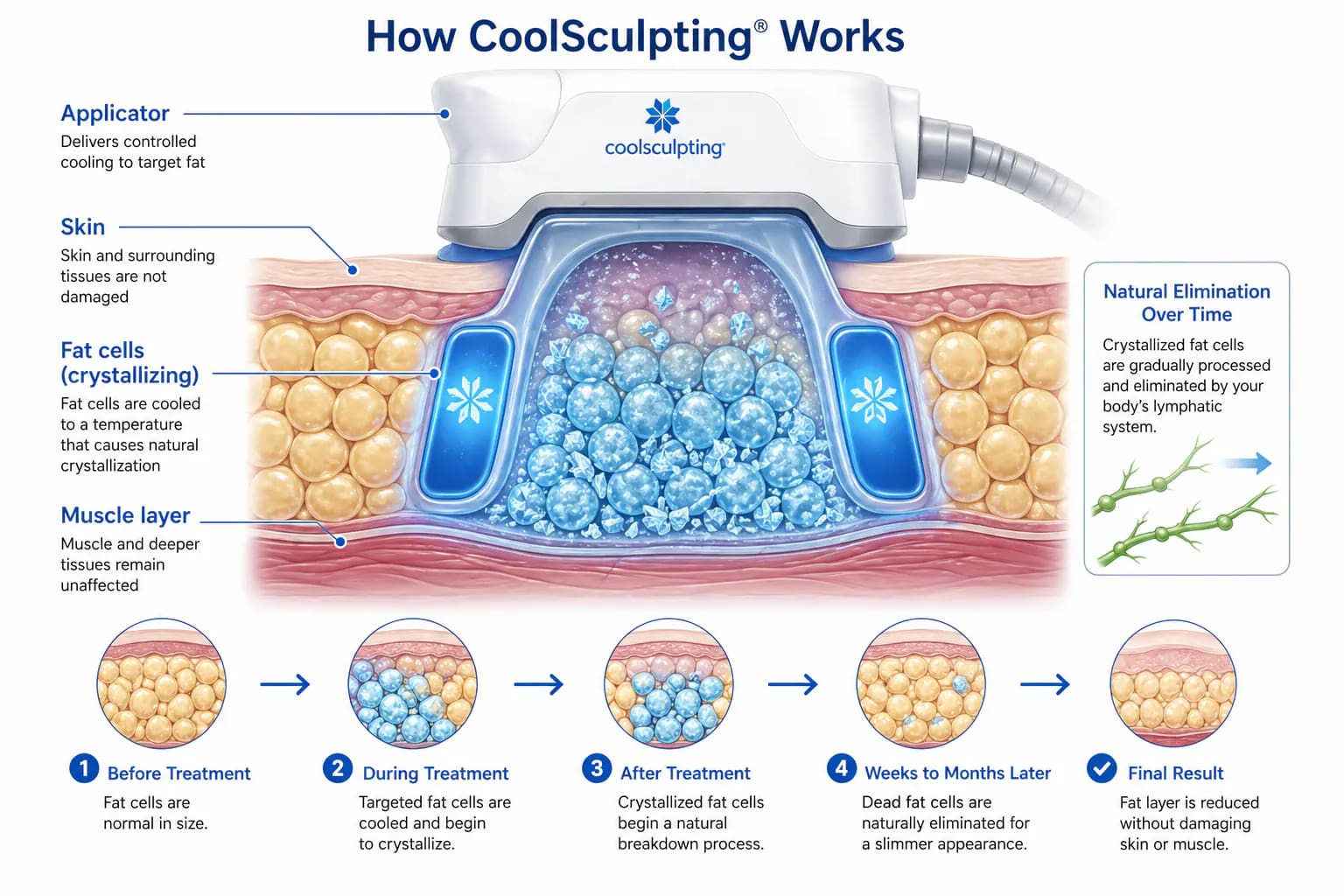
CoolSculpting is a non-surgical body contouring device. An applicator placed against the skin uses controlled cooling (cryolipolysis) to crystallize and destroy fat cells in the treatment area. The dead cells are gradually processed and eliminated by the body's lymphatic system over the following two to three months. There is no incision, no anesthesia, no recovery period. There is also less fat removed.
Both destroy fat cells permanently. The difference is how many cells are affected, how quickly, and with what degree of precision.
Side-by-Side Comparison
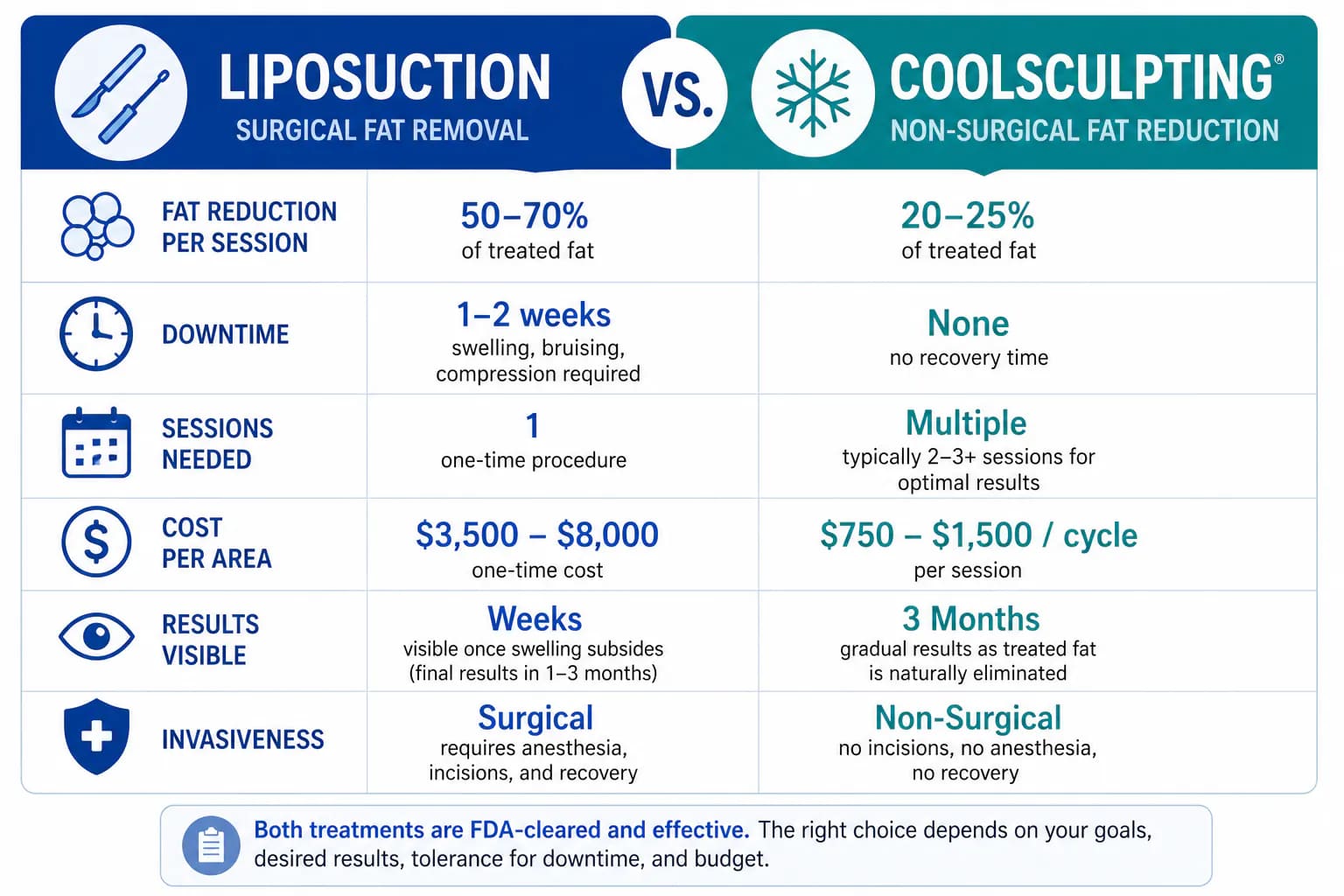
| Factor | Liposuction | CoolSculpting |
|---|---|---|
| Type | Surgical | Non-surgical |
| Fat reduction per treatment | 50–70% of treated area | 20–25% per session |
| Sessions needed | 1 | Multiple (typically 2–3 per area) |
| Downtime | 1–2 weeks | None |
| Results visible | Weeks (post-swelling) | 2–3 months |
| Precision | High (surgeon-guided) | Moderate (applicator-shaped) |
| Skin tightening | Some (varies by technique) | Minimal |
| Multiple area treatment | Common, cost-efficient | Per-applicator cost compounds |
| Anesthesia | Local or general | None |
| Cost per area | $3,500–$8,000 (one time) | $750–$1,500/cycle (multiple cycles) |
| Permanent? | Yes (cells removed) | Yes (cells destroyed) |
| Serious risk | Surgical complications (rare) | Paradoxical adipose hyperplasia (PAH) |
CoolSculpting: What It Does Well — and Where It Falls Short
CoolSculpting works. For the right patient with the right expectations, it genuinely reduces fat in the treated area without surgery, without anesthesia, and without any meaningful recovery period. You can have a session over lunch and go back to work the same afternoon.
The mechanism is straightforward: the applicator cools the skin and fat tissue to a temperature that causes fat cell death without harming the surrounding skin, muscle, or nerves. Over the following weeks, the body's lymphatic system processes the dead cells and eliminates them. The result: a modest but real reduction in the treated area.
The clinical number to hold onto is 20–25% fat reduction per session. In a small, isolated pocket of fat — say, mild love handles or a small submental pocket under the chin — a 20–25% reduction is visible and satisfying. In a larger or more significant area, it produces results that are subtle rather than transformative.
The multiple-session reality. Most providers do not achieve their advertised results in a single session. For meaningful reduction in an area like the abdomen or flanks, two to three sessions — each separated by several weeks — is common. Each session adds cost. By the time a patient completes three sessions on their abdomen, they may be looking at $4,000–$6,000 in treatment costs for that single area alone.
The gradual timeline. CoolSculpting results unfold slowly. Most patients see their full result at three months post-treatment. For patients who need a result by a specific date, or who want to see significant change quickly, this timeline is a real constraint.
The CoolSculpting Risk Most Guides Skip: Paradoxical Adipose Hyperplasia
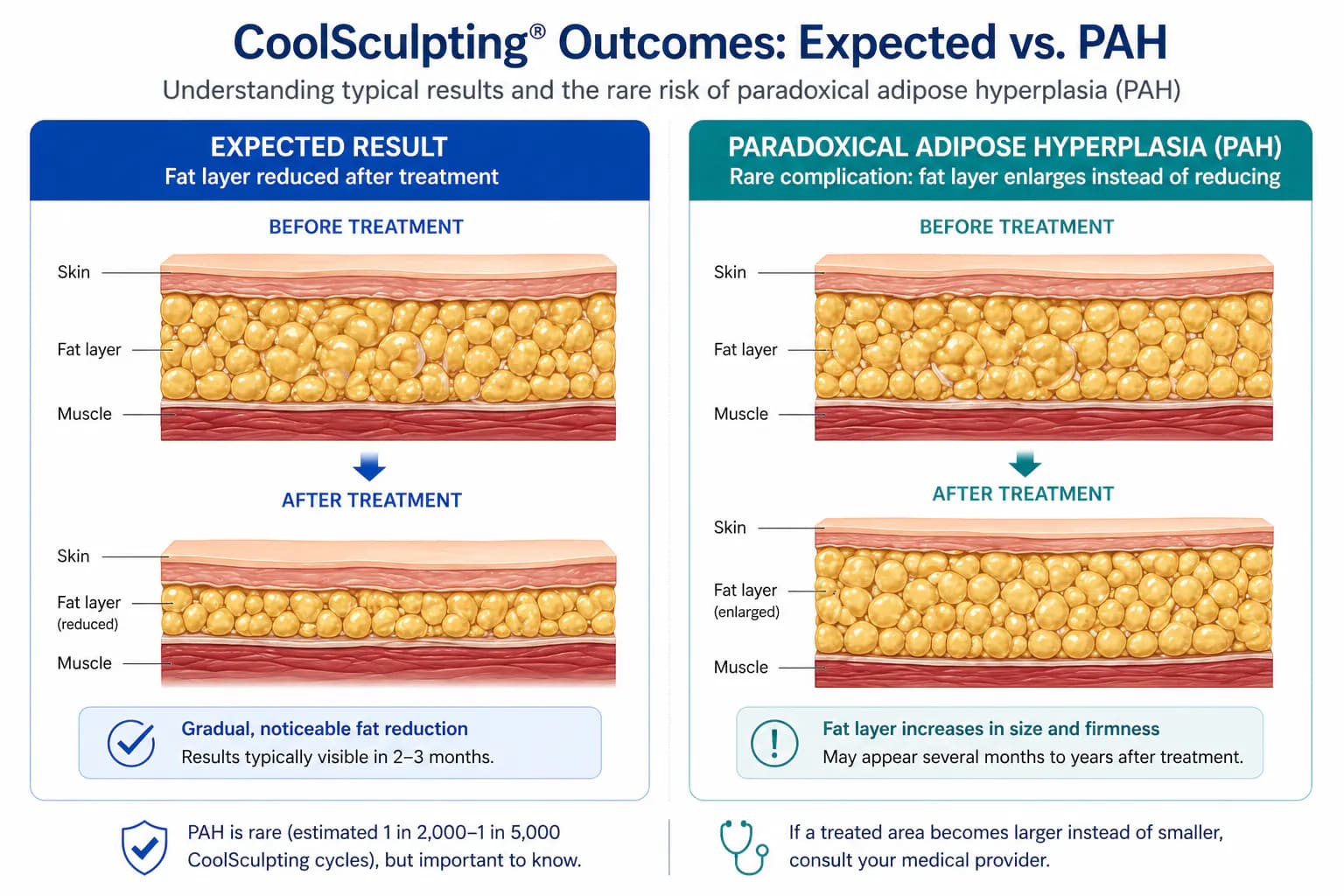
Every CoolSculpting comparison article mentions temporary redness, numbness, and bruising. Almost none of them cover paradoxical adipose hyperplasia (PAH) with the depth patients deserve before making a decision.
PAH is a rare but serious CoolSculpting complication in which the treated fat does the opposite of what it is supposed to do: it grows larger. The expanded fat often takes the shape of the CoolSculpting applicator — patients and physicians have described the result as resembling a "stick of butter" under the skin. It does not resolve on its own. CoolSculpting more of the same area makes it worse, not better. Correction typically requires surgical liposuction.
The disputed rate. Allergan Aesthetics — the manufacturer of CoolSculpting — reports a PAH occurrence rate of 0.033%. Independent researchers and patient advocates have questioned this figure, with some estimates suggesting PAH may occur in as many as 1–2% of treatment cycles. The U.S. FDA received more than 1,900 adverse event reports related to CoolSculpting in 2022, the majority involving PAH.
The litigation context. As of 2025, active lawsuits against Allergan over PAH are ongoing. The cases generally allege that Allergan knew about the PAH risk earlier than it disclosed and did not adequately warn patients or providers. The most publicly known case involved supermodel Linda Evangelista, who attributed a significant period of personal withdrawal from public life to PAH following CoolSculpting treatments. She filed a $50 million lawsuit and settled with Allergan for an undisclosed amount in 2022.
What this means practically. PAH does not affect most CoolSculpting patients. But unlike the typical side effects — numbness, swelling, temporary discomfort — PAH is not self-resolving. If it happens, you are likely looking at surgical liposuction to correct it. That is a meaningful risk to understand before choosing a non-surgical procedure partly to avoid surgery.
Patients who choose CoolSculpting knowing about PAH are making an informed decision. Patients who were not told are not.
Liposuction: When Surgical Fat Removal Is the Right Call
Liposuction removes fat cells through a cannula, guided precisely by a surgeon. The degree of reduction — 50–70% of the treated area — is not achievable through any non-surgical device. The results are visible in weeks, not months. A single procedure treats the area completely rather than requiring repeated sessions.
For patients who want to see a real difference — not a subtle improvement — liposuction is more reliably effective. This is especially true for:
- Larger treatment areas (full abdomen, full flanks, thighs)
- Multiple treatment areas in a single procedure
- Patients wanting body contouring precision (defined waist, arm reduction, gynecomastia)
- Patients for whom CoolSculpting results would be insufficient even if they worked perfectly
The tradeoff is real: liposuction is surgery. There is a recovery period — typically one to two weeks before returning to desk work, four to six weeks before strenuous exercise. For what to expect each week, see our recovery timeline. There is anesthesia. There are surgical risks, which, in the hands of a board-certified plastic surgeon at an accredited facility, are uncommon but not zero.
For patients who genuinely cannot accept surgery or recovery time, that tradeoff may be decisive. For patients who want results rather than just a treatment, it usually is not.
The True Cost Comparison
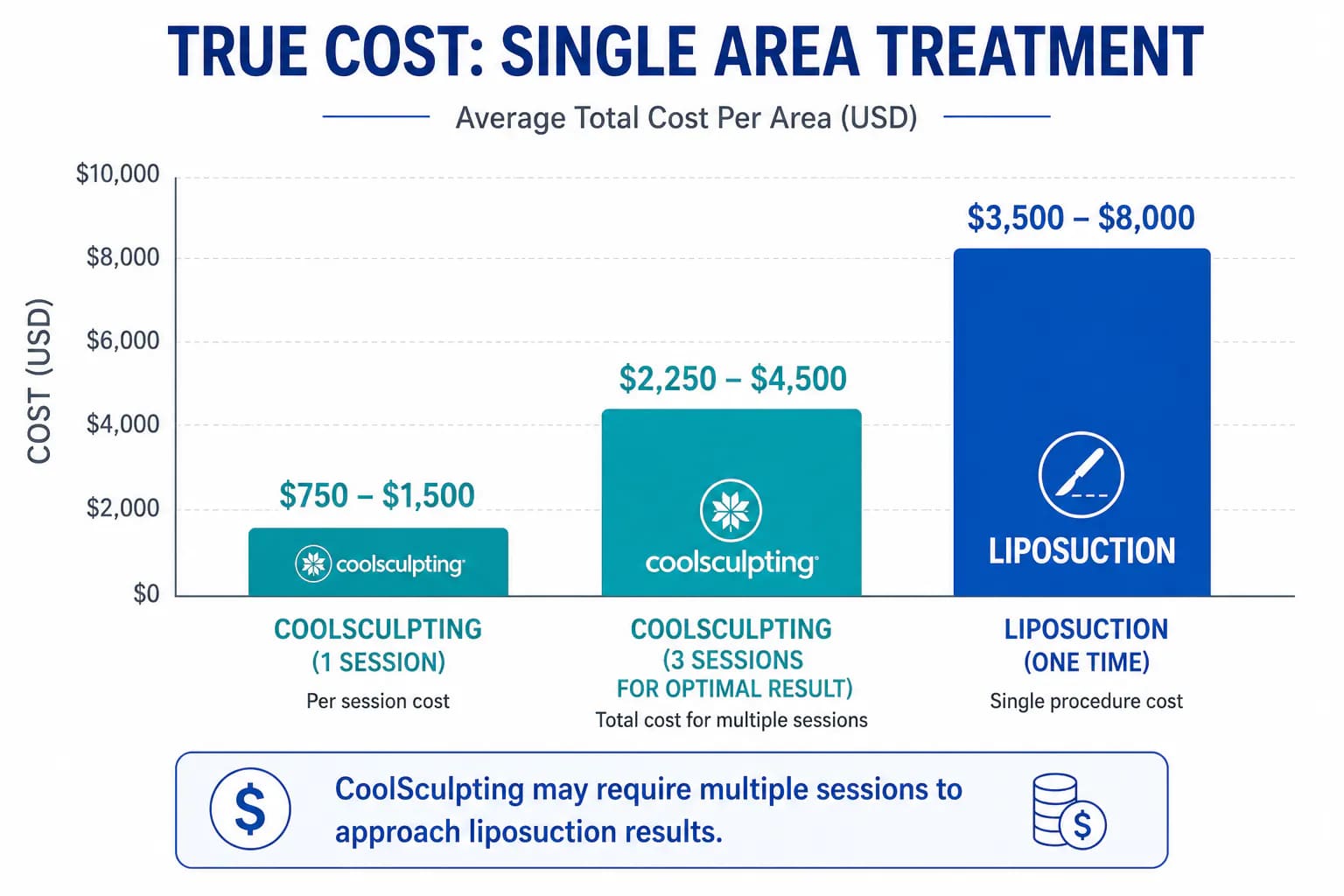
The "CoolSculpting is cheaper" narrative deserves scrutiny.
A single CoolSculpting applicator cycle costs $750–$1,500. That figure is accurate. It is also incomplete, for two reasons.
First: most areas require multiple cycles per session. The abdomen, for instance, is typically treated with several overlapping applicator placements in a single session. A realistic single-session cost for treating the abdomen is $2,000–$4,000, not $750.
Second: most patients need more than one session. For meaningful results, two to three sessions per area is common. Treating the abdomen across three sessions — at $2,000–$4,000 per session — produces a total cost of $6,000–$12,000. For a result that is 20–25% fat reduction per session.
Liposuction for the same area: $3,500–$8,000 as a single, one-time procedure. With 50–70% fat reduction.
When CoolSculpting is genuinely cheaper: For patients who need only mild improvement in a single small area — love handles, a chin pocket, inner knees — and who only require one or two cycles to achieve their goal, CoolSculpting can be meaningfully less expensive than surgery. The per-session advantage is real in that specific scenario.
When liposuction is more cost-effective: For patients treating multiple areas, wanting significant results, or who would otherwise need three or more CoolSculpting sessions, liposuction frequently costs less in total and delivers more.
Who Should Choose CoolSculpting
CoolSculpting is the right call when:
- You want to avoid surgery and anesthesia, full stop. No result justifies surgery to you, and that is a legitimate position.
- You have a small, isolated fat deposit — mild love handles, a modest chin pocket — that you want modestly reduced, not dramatically changed.
- You understand and accept that results will be gradual (2–3 months) and incremental (20–25% reduction per session).
- Your timeline and budget align with multiple sessions if needed.
- You have discussed PAH with your provider and understand the risk profile.
CoolSculpting is not the right call if you are expecting liposuction-level results, are treating a large area, or would be significantly dissatisfied with a modest outcome. Managing expectations honestly before treatment — on both sides of the provider relationship — is how patients avoid feeling like the procedure failed them.
Who Should Choose Liposuction
Liposuction is the right call when:
- You want significant, reliable fat reduction — 50–70% of the treated area — in a single procedure.
- You are treating multiple areas and want consistent results across all of them.
- You want precise body contouring: waist definition, arm reduction, chest sculpting, or any application requiring surgeon-guided precision.
- You are willing to take one to two weeks for recovery in exchange for a result that a non-surgical device cannot deliver.
- You have tried CoolSculpting and found the results insufficient.
- You want to use removed fat for a BBL or fat transfer procedure — liposuction is the only source.
The recovery period is the most common reason patients initially lean toward CoolSculpting. It is worth asking honestly: if the liposuction result would be significantly better and more permanent, is avoiding two weeks of recovery the right tradeoff over a decade of wearing your body?
How to Make the Decision
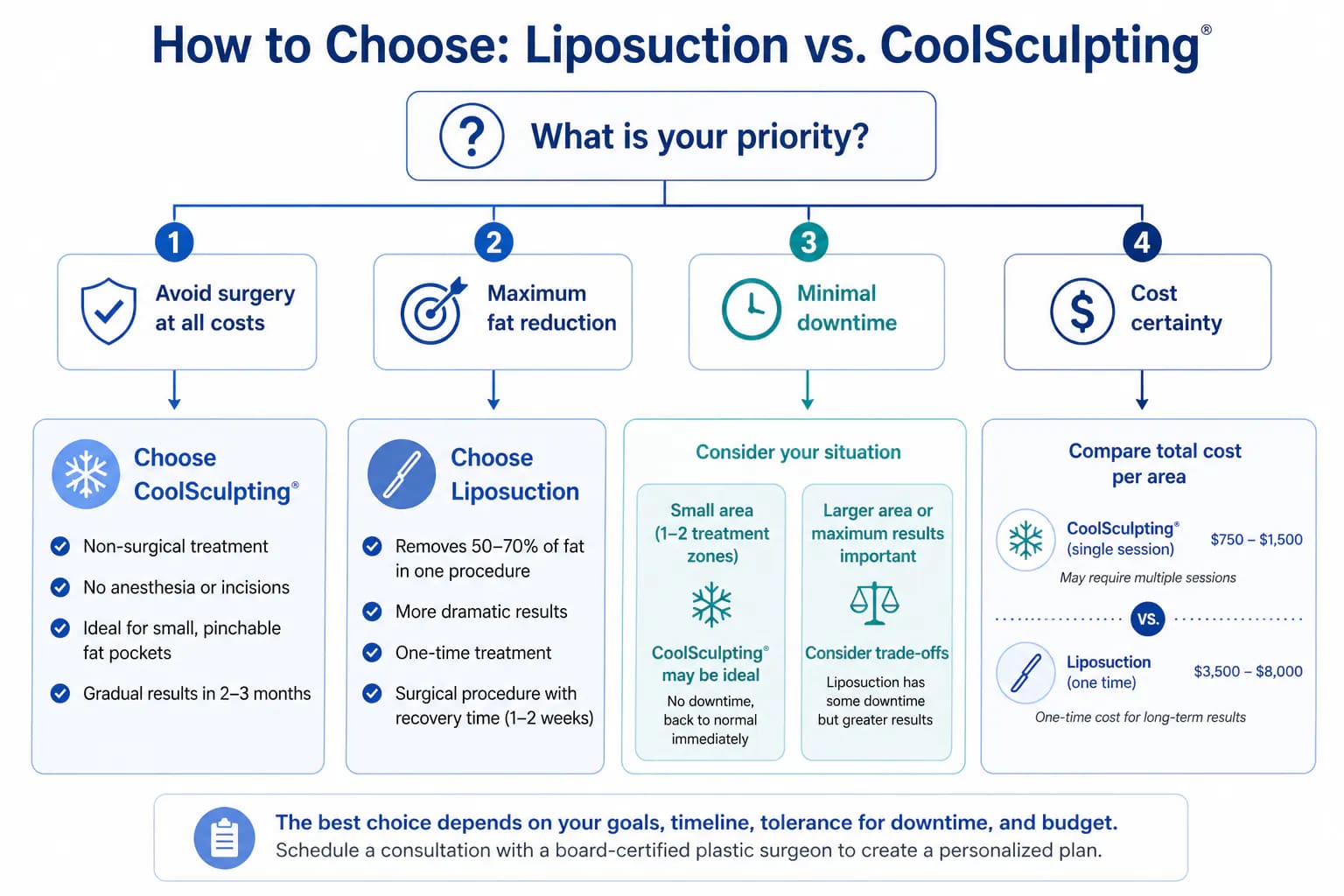
Four questions worth sitting with before you book:
1. What result am I actually after? If 20–25% reduction per session would satisfy you, CoolSculpting can work. If you need real contouring — visible, meaningful change — liposuction is more likely to deliver it.
2. How many areas do I want treated? One small area: CoolSculpting may be appropriate. Multiple areas or the full torso: liposuction is more efficient and often less expensive in total.
3. Can I accommodate recovery? One to two weeks of reduced activity is the liposuction reality. If that is genuinely impossible for your life right now, CoolSculpting becomes more relevant by default.
4. Have I done true cost accounting? Price the full course of CoolSculpting sessions you would need, not just the first session. Then compare it to a liposuction quote for the same areas. The numbers often look different than you expect.
A consultation with a board-certified plastic surgeon who offers both procedures — not a med spa that only sells CoolSculpting, and not a surgery practice that dismisses non-surgical options — is the most useful next step. For help vetting your surgeon, see our guide to choosing a safe liposuction surgeon.
Is CoolSculpting better than liposuction?
Neither is universally better — they serve different goals. CoolSculpting is better for patients who want to avoid surgery, have a small isolated fat deposit to modestly reduce, and are willing to wait 2–3 months for gradual results. Liposuction is better for significant, reliable fat reduction (50–70% vs. CoolSculpting's 20–25% per session), multiple areas, and precise body contouring. For most patients who want meaningful results, liposuction delivers a more complete outcome in a single procedure.
How much does CoolSculpting cost compared to liposuction?
A single CoolSculpting applicator cycle costs $750–$1,500. Most areas require multiple cycles per session and two to three sessions total — pushing the true per-area cost to $2,000–$5,000 or more. Liposuction for the same area typically costs $3,500–$8,000 as a one-time procedure. For patients treating multiple areas or wanting significant reduction, liposuction is often more cost-effective overall.
Which lasts longer — liposuction or CoolSculpting?
Both destroy fat cells permanently. The cells surgically removed by liposuction and the cells killed by cryolipolysis do not regenerate. In that sense, both produce lasting results. The difference is degree: liposuction removes 50–70% of fat in the treated area; CoolSculpting reduces 20–25% per session. Significant weight gain after either procedure causes remaining fat cells throughout the body to enlarge, affecting results.
Is CoolSculpting safe?
CoolSculpting is FDA-cleared and generally safe for most patients. Common side effects include temporary redness, swelling, bruising, and numbness at the treatment site. The most serious risk is paradoxical adipose hyperplasia (PAH) — a rare condition where treated fat grows larger instead of shrinking. Allergan reports a PAH rate of 0.033%, though some independent estimates suggest it may be higher. PAH typically requires surgical liposuction to correct. Active litigation over PAH was ongoing as of 2025.
How many CoolSculpting sessions equal liposuction?
CoolSculpting cannot replicate liposuction results regardless of session count. The mechanisms are different — cryolipolysis destroys approximately 20–25% of fat cells per session through gradual cell death; liposuction removes 50–70% surgically with immediate precision. Multiple CoolSculpting sessions can compound results somewhat, but the degree of reduction and body contouring precision are not equivalent. For significant fat reduction, liposuction achieves in one procedure what CoolSculpting approaches only partially across multiple treatments.
What is paradoxical adipose hyperplasia?
Paradoxical adipose hyperplasia (PAH) is a rare CoolSculpting side effect in which the treated fat grows larger rather than shrinking — the opposite of the intended result. The enlarged fat often takes the shape of the CoolSculpting applicator. PAH does not resolve on its own and is not corrected by further CoolSculpting treatments. Correction typically requires surgical liposuction. Allergan reports a 0.033% PAH rate; some independent estimates are higher. Active lawsuits over PAH against Allergan were ongoing as of 2025.
Who is a good candidate for CoolSculpting vs. liposuction?
CoolSculpting candidates: Near their target weight, want modest reduction in a small isolated area, want to avoid surgery and anesthesia, can accept gradual results over 2–3 months, and understand multiple sessions may be needed. Liposuction candidates: Near their target weight, want significant fat reduction or body contouring in one procedure, are comfortable with a surgical recovery of 1–2 weeks, may be treating multiple areas, and want precise sculpting results.
Can CoolSculpting replace liposuction?
No. CoolSculpting reduces fat by 20–25% per session non-surgically. Liposuction removes 50–70% surgically in a single procedure with precise contouring. They are different tools for different goals. For patients wanting meaningful body contouring — especially across multiple areas — CoolSculpting cannot replicate what liposuction achieves. CoolSculpting is an appropriate alternative for patients wanting modest reduction in a small area without surgery; it is not a substitute for surgical fat removal.
Internal links:
- How Much Does Liposuction Cost?
- VASER Liposuction: The Complete Guide
- Laser Liposuction Guide
- How Long to Wear a Faja After Liposuction
