Most people searching for liposuction alternatives want one of three things: lower cost, less downtime, or no surgery. That is reasonable. But the honest answer is that these treatments do not all do the same job. Some target small amounts of subcutaneous fat. Some modestly tighten skin. Some build muscle tone. Diet and exercise reduce visceral fat, which liposuction cannot reach. None truly reproduce the one-session volume reduction and surgical precision of liposuction.
The honest way to compare alternatives to liposuction is by target tissue. Fat, skin, and muscle are different problems. Most "liposuction alternatives" pages blur them together, which is why so many patients end up with the wrong expectations for a given treatment area.
Why patients look for alternatives
Patients usually look for alternatives for rational reasons: cost, fear of anesthesia or surgery, concern about scars, and a desire for a shorter recovery timeline. The American Society of Plastic Surgeons reports average surgeon or physician fees for liposuction in the range of roughly $4,300 to $7,500 depending on the area, while the average physician fee for nonsurgical fat reduction is $1,157 per treatment. Non-surgical options also tend to involve little to no activity restriction, while liposuction usually means swelling, compression garments, and at least a few days of recovery even when patients return to desk work quickly.
The catch is that a lower entry price is not the same as lower total cost. Many alternatives require a series of sessions. Some require maintenance. And several work best only for small, localized bulges rather than the broader reshaping that liposculpture can achieve in one procedure.
The fat type distinction most articles miss
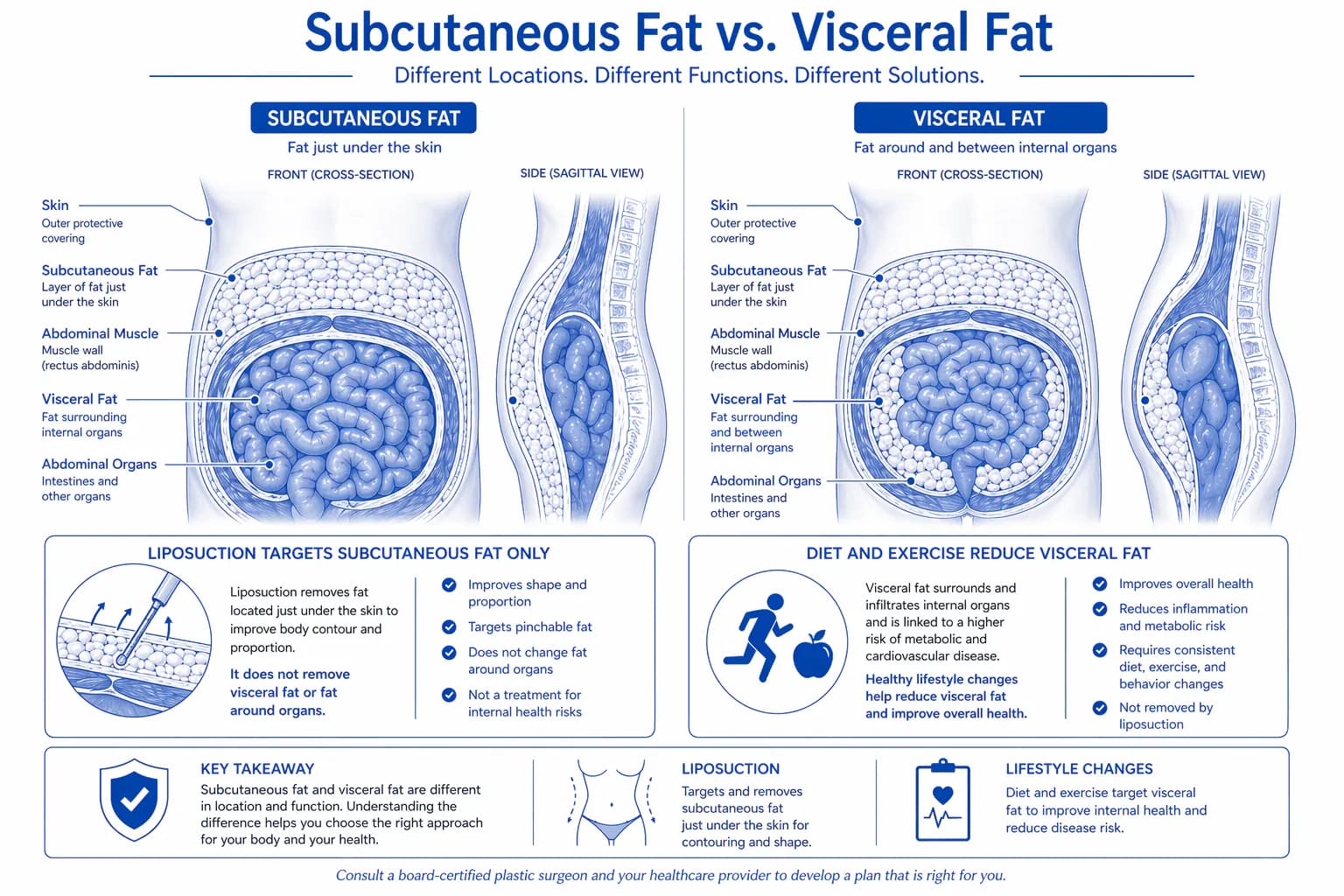
This is the key distinction. Before you compare treatments, separate subcutaneous fat from visceral fat.
Subcutaneous fat sits under the skin. It is the pinchable layer in the lower abdomen, flanks, thighs, upper arms, bra roll, or under the chin. Liposuction targets this layer with a cannula placed through small incisions after tumescent fluid is infused to reduce bleeding and improve surgical precision.
Visceral fat sits deeper inside the abdomen around the organs. Liposuction cannot treat it. Diet, exercise, and broader weight-loss strategies are the right alternative when visceral fat is the real issue, and exercise has evidence for reducing visceral fat even without a formal diet intervention.
| What is actually causing the contour issue? | Most rational first-line option |
|---|---|
| Small, localized subcutaneous fat pocket | Cryolipolysis, 1060-nm laser, or liposuction depending on how much change you want |
| Visceral abdominal fullness | Diet, exercise, and medical weight-loss planning; liposuction will not help this |
| Mild fat + mild skin laxity | Radiofrequency-based treatment may help modestly |
| Mostly weak muscle tone | HIFEM/RF treatment such as Emsculpt NEO may help tone, not debulk fat |
| Larger-volume subcutaneous fat or multi-area contouring | Liposuction is usually more rational |
This anatomy-first framework reflects ASPS guidance that liposuction treats subcutaneous fat rather than visceral fat, plus FDA and ASPS descriptions of what RF and electromagnetic devices can and cannot do.
The best candidates for non-surgical fat reduction
The best candidates are people with a small, well-defined, pinchable pocket of subcutaneous fat who are already close to a stable weight and willing to accept a modest, gradual result. Non-invasive body contouring is not a substitute for obesity treatment, and the FDA emphasizes that these procedures reduce only small amounts of fat and may require more than one treatment.
Non-surgical options compared
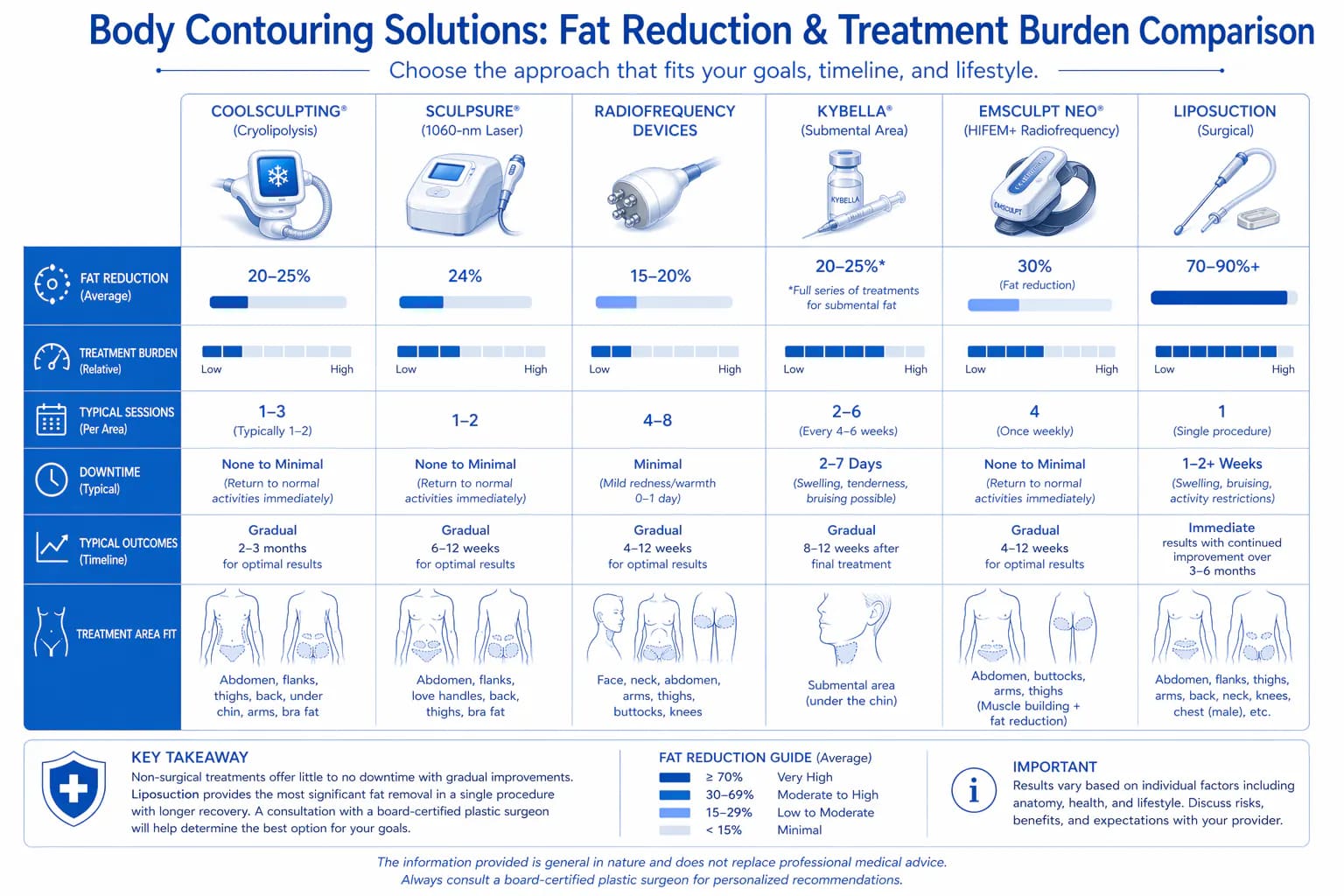
There is no true non-surgical liposuction. That phrase is marketing shorthand. Patients searching for fat removal without surgery are usually comparing cryolipolysis, laser, RF, injections, and muscle-toning devices, but those are not interchangeable categories. ASPS states plainly that nonsurgical fat reduction is not a replacement for liposuction, and the FDA notes that results may be temporary, incomplete, or require repeat procedures.
Non-surgical options by anatomy
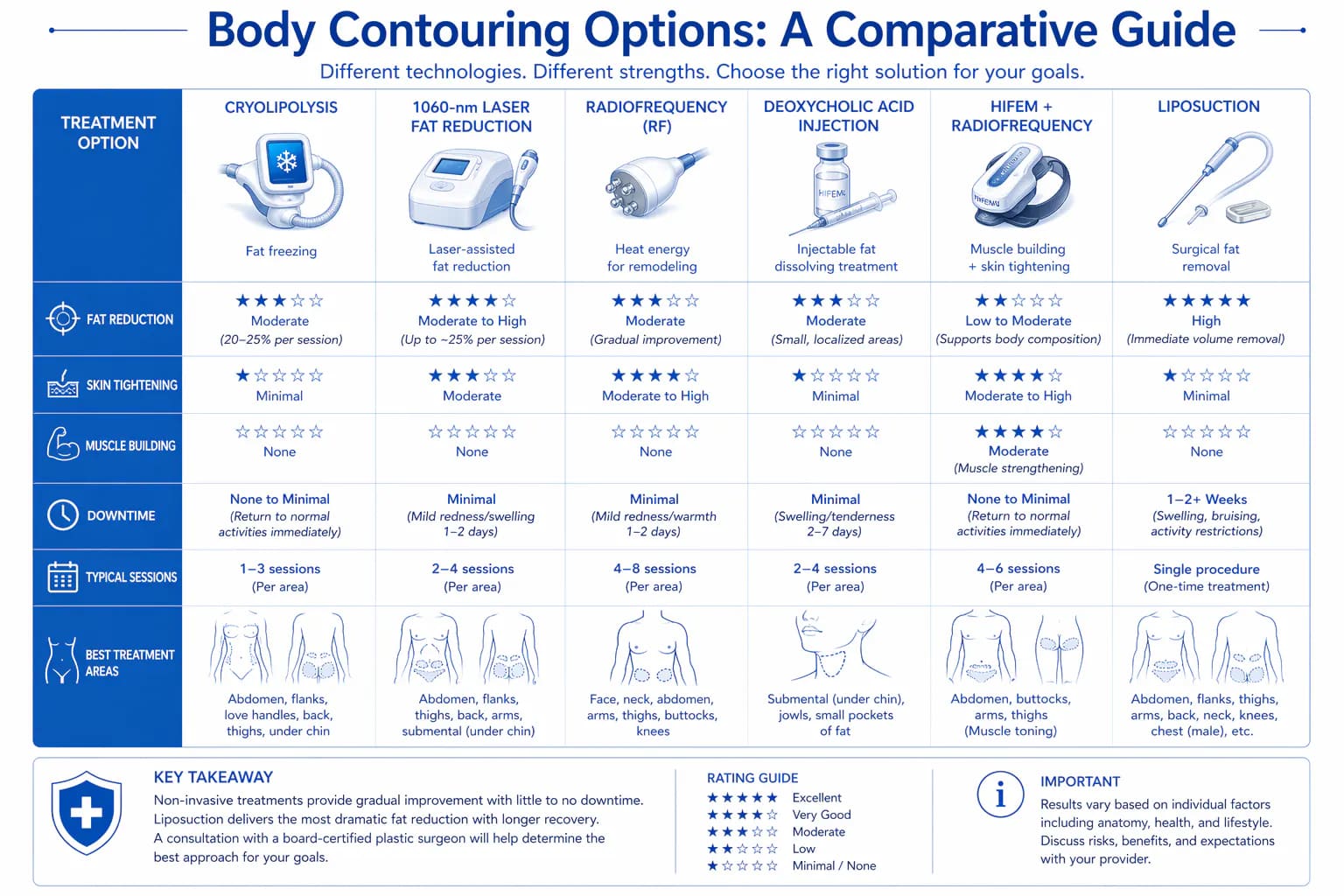
The best non-surgical alternatives depend on the anatomy:
- Cryolipolysis (CoolSculpting) and 1060-nm laser fat reduction (SculpSure) have the clearest published numbers for small reductions in localized subcutaneous fat.
- Radiofrequency devices such as Vanquish or truSculpt are better framed as mild contouring tools that may also offer some skin tightening.
- Kybella is FDA-approved only for submental fat under the chin.
- HIFEM/RF systems such as Emsculpt NEO are strongest as muscle-toning complements, not direct replacements for liposuction.
| Option | Best for | What it actually treats | Realistic result | Sessions | Typical U.S. package cost* | Downtime |
|---|---|---|---|---|---|---|
| Cryolipolysis (CoolSculpting) | Small pinchable bulges in abdomen, flanks, thighs, arms, submental area | Subcutaneous fat | About 20%–25% reduction in the treated area, gradual over months | 1–3; many patients need at least 2 | $1,500–$5,000 | Minimal |
| 1060-nm laser (SculpSure) | Small to moderate localized fat | Subcutaneous fat | About 24% reduction in fat-layer thickness after a 25-minute treatment | A series is often required | $1,500–$4,000+ | Minimal |
| Radiofrequency (Vanquish, truSculpt) | Mild bulges plus mild skin laxity | Fat plus some skin tightening | Usually milder circumferential reduction than cryo or laser | 4+ often used | $1,200–$3,500 | Minimal |
| Deoxycholic acid (Kybella) | Fullness under the chin | Submental fat only | Good for small to moderate under-chin fullness; swelling is common | 2–4 common, up to 6 on label | $1,200–$3,000 | No formal downtime; swelling and bruising are common |
| HIFEM/RF (Emsculpt NEO) | Patients who want better muscle tone with some fat reduction | Muscle plus some fat | Better definition and firmness; not a debulking treatment | Usually a series | $3,000–$5,000+ | Minimal |
*Package-cost estimates are editorial planning ranges based on ASPS-reported average physician fees for nonsurgical fat reduction and common treatment counts; real quotes vary by treatment area, applicator count, geography, and provider. Data on results and treatment burden are compiled from ASPS, FDA, manufacturer clinical summaries, and sham-controlled studies.
Which non-surgical option produces the strongest result
For fat reduction, cryolipolysis and 1060-nm laser have the most recognizable efficacy numbers in mainstream use: about 20% fat reduction for cryolipolysis and about 24% reduction in fat-layer thickness for SculpSure in published or manufacturer-reported data. That still means the ceiling is modest. If your mental picture is a major waistline change, the numbers themselves are telling you that you are probably describing a surgical goal.
Radiofrequency belongs in a different lane. It can produce mild contour change and may tighten skin through collagen remodeling, but it is usually subtler than cryo or laser for actual fat reduction. HIFEM/RF belongs in yet another lane: it improves muscle tone and firmness, with fat change as a secondary effect, and the higher-quality evidence still suggests smaller measured changes than many advertisements imply.
When CoolSculpting is a reasonable choice
CoolSculpting is a reasonable alternative when the job is small. It works best for a discrete bulge, a patient who accepts gradual results, and a treatment area that does not need a dramatic change. ASPS reports an average fat reduction of about 20%, no anesthesia, and no activity restrictions, while the official treatment journey notes that most patients need at least two sessions spaced 4 to 8 weeks apart.
CoolSculpting is not a strong alternative when you want larger-volume fat removal, sharper contour lines, or multiple areas treated with precision. It also carries a rare but real risk of paradoxical adipose hyperplasia, which ASPS cites as under 1%. For a fuller head-to-head breakdown, see liposuction vs. CoolSculpting.
Diet and exercise: what they do and do not address
Diet and exercise are the best answer for overall fat loss, metabolic health, and visceral fat. That matters because visceral fat is the fat linked to health risk, and it is also the fat liposuction cannot remove. This is where the best "alternative to liposuction" may actually be a nutrition plan, resistance training, aerobic exercise, or formal obesity treatment rather than any device.
What diet and exercise can and cannot do
Sometimes diet and exercise are the right answer. If your main concern is a firm, rounded abdomen driven by visceral fat or general weight gain, lifestyle change is the more rational answer and liposuction is the wrong tool. But if you are already near a stable weight and your frustration is a persistent lower-abdomen pouch, flank roll, or under-bra pad of subcutaneous fat, diet and exercise may improve overall leanness without fully changing that specific contour.
That is why "just work out more" advice can feel incomplete. It is good health advice. It is not always good body contouring without surgery advice. For the terminology and the real limits, see our guide to non-invasive liposuction.
The real cost of "cheaper" alternatives
The cheapest alternative is diet and exercise. It is also the highest-value option for overall health. Among office procedures, the cheapest sticker price is not always the cheapest pathway. A treatment quoted at a lower per-session price can become expensive once you add multiple sessions, repeat treatment areas, and maintenance. ASPS's own fee data make that clear.
How the results compare
This is where honesty matters most. The best-published non-surgical fat-reduction numbers in common use cluster around one-fifth to one-quarter fat reduction in a treatment area. RF devices are usually milder. Kybella is useful but limited to the submental area. HIFEM/RF helps tone and definition more than debulking. None of these options matches liposuction for one-session volume reduction across a larger treatment area.
The other difference is precision. Liposuction is not just about removing more fat. It lets a surgeon contour the treatment area deliberately. With tumescent technique, a cannula, and sometimes technology such as VASER-assisted liposuction in selected cases, a board-certified surgeon can reshape transitions between areas in a way devices cannot. That is why surgery tends to win when the goal is definition rather than a modest decrease in fullness.
How long results last
Some are durable. Cryolipolysis, 1060-nm laser, and Kybella are all intended to destroy fat cells rather than simply dehydrate tissue, and results can last if weight remains stable. But the practical limitation is scale: they usually remove a smaller fraction of fat cells from a treatment area, and some modalities rely on repeat sessions or ongoing maintenance for the best cosmetic effect. Liposuction physically removes fat cells from the area in one procedure, and ASPS notes that results are maintained when patients keep a healthy lifestyle and avoid substantial weight gain.
Cost follows the same logic. If you treat one small bulge once, a non-surgical option may cost less. If you treat several areas, repeat sessions, or come back for maintenance over 1 to 2 years, cumulative spend can get surprisingly close to, and sometimes exceed, the surgeon-fee range for liposuction.
When non-surgical alternatives are genuinely sufficient
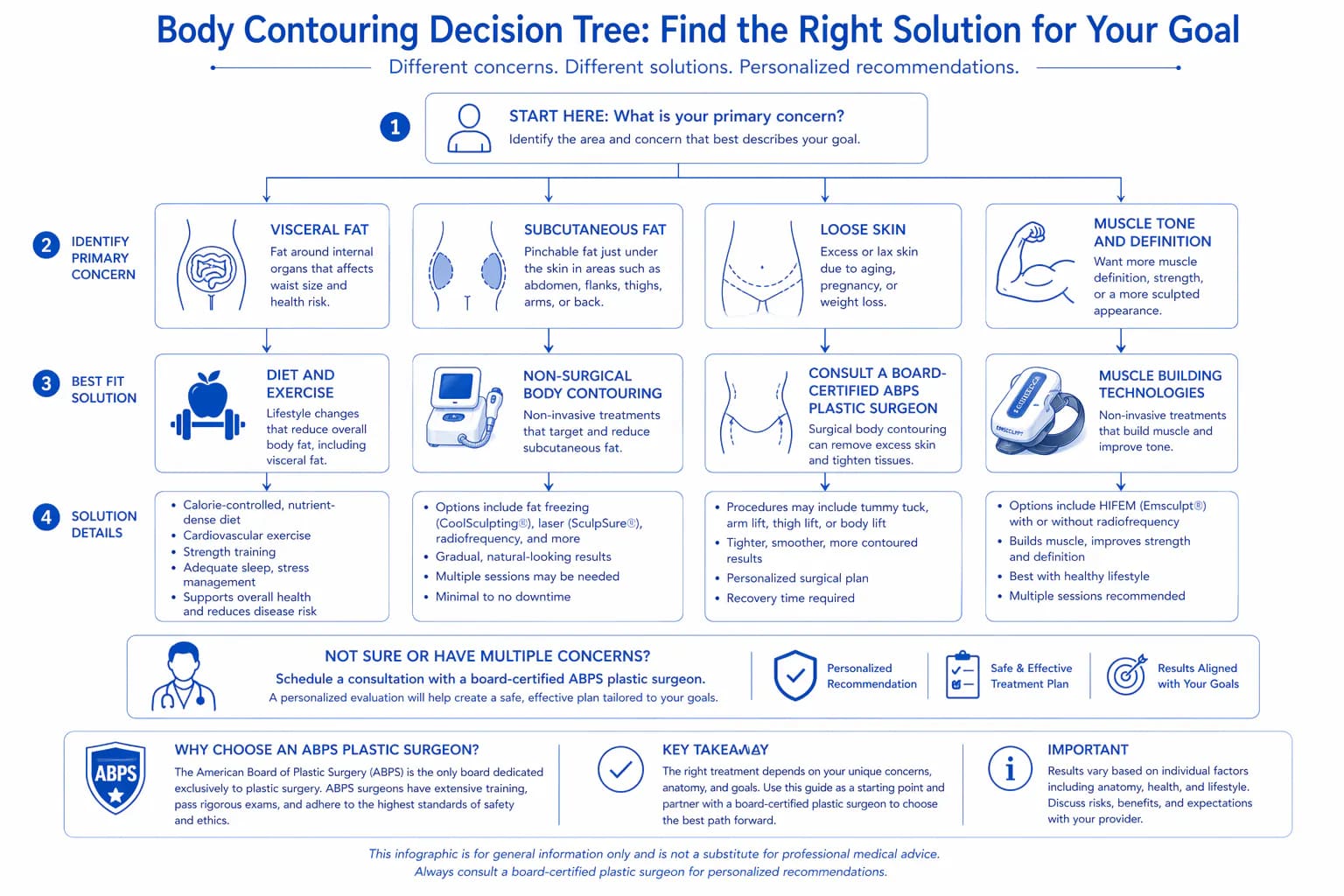
Non-surgical treatment is often a good decision when all of the following are true:
- The fat pocket is small and localized.
- You want minimal downtime.
- You are comfortable with gradual results.
- You do not need dramatic reshaping.
- The treatment goal is narrow, such as submental fullness or modest lower-abdomen thickness.
- You understand that "non-surgical" does not mean "as effective as surgery."
That is the non-surgical sweet spot: a small target, modest expectations, and a clear reason to avoid surgery.
This is also the right lane for patients who simply do not want surgery. That matters. A modest result you are comfortable pursuing is better than a theoretically better procedure you will never book.
When liposuction is the more rational choice
Liposuction becomes the more rational answer when you want a bigger change, when several treatment areas need work, or when precise contour matters more than avoiding surgery. It is also often the smarter financial decision when you have already spent on rounds of med spa treatment that did not deliver enough improvement.
A modern liposuction procedure is not the cartoon version many patients picture. Tumescent solution is infused first. A small cannula removes subcutaneous fat through tiny incisions. Patients commonly return to work within days, wear compression garments for a few weeks, and see the final contour develop over 1 to 3 months as swelling settles. In selected cases, VASER-assisted liposculpture can help with surgical precision.
| Non-surgical may be enough if... | Liposuction is usually more rational if... |
|---|---|
| You have one small bulge and want subtle change | You want a clear, visible change in one procedure |
| You care most about avoiding downtime | You care most about contour precision |
| Your concern is under the chin only | You have multiple body areas to treat |
| Your main issue is muscle tone, not fat volume | Your main issue is stubborn subcutaneous fat volume |
| You accept repeat sessions | You would rather do one procedure than a series |
That is the real dividing line: subtle reduction versus deliberate reshaping. Once the goal shifts to larger-volume change or sharper contouring, surgery usually wins.
The safest next step is evaluation by a board-certified plastic surgeon, ideally one certified by the ABPS in the United States. ASPS notes that its member surgeons are certified by the American Board of Plastic Surgery or the Royal College of Physicians and Surgeons of Canada, and that the ABPS is the only plastic surgery board recognized by the American Board of Medical Specialties. For the broader framework, see surgical vs. non-surgical fat removal.
For localized subcutaneous fat, cryolipolysis and 1060-nm laser have the clearest fat-reduction numbers in common use. Kybella is best reserved for submental fat, while HIFEM/RF is better for muscle tone and definition than for major fat reduction.
Yes, but usually only in small amounts and with gradual results. FDA-cleared body-contouring devices reduce small amounts of localized fat; they do not replicate liposuction for larger-volume contouring.
If the problem is localized subcutaneous fat, cryolipolysis and 1060-nm laser currently have the strongest recognizable efficacy numbers. If the problem is under-chin fullness, Kybella can work well. If the problem is muscle tone, HIFEM/RF makes more sense than a fat-reduction device.
It can be, but only for the right patient. CoolSculpting is reasonable for a small, defined bulge when you accept a modest result and possible repeat sessions. It is not the right substitute when you want large-volume fat reduction or sharper sculpting.
Yes when the real issue is visceral fat, overall body fat, or weight-related health goals. No when the real issue is a stubborn subcutaneous pocket that has not changed despite stable habits and stable weight.
Diet and exercise. Among procedures, a low per-session price can be misleading because several non-surgical options require multiple treatments and sometimes maintenance, which changes the total cost.
Most non-surgical options produce subtler changes than liposuction. The best-known fat-reduction data generally fall around 20% to 24% in a treatment area, while liposuction can remove more fat and shape the area more precisely in one procedure.
They can be long-lasting if your weight remains stable, and some treatments destroy fat cells. But they usually remove fewer fat cells from the treatment area and more often require repeat sessions than liposuction, which physically removes fat cells through a cannula.
