If you want the biggest visible change in one treatment area, surgical liposuction still wins. Non-surgical body contouring can work well for small, localized bulges with almost no downtime, but the result ceiling is lower, and the 2-year cost gap is often smaller than patients expect.
There is no single best fat removal method. The right choice depends on your anatomy, your skin quality, your recovery timeline, your risk tolerance, and whether you want modest refinement or true reshaping.
| Category | Non-surgical body contouring | Surgical liposuction |
|---|---|---|
| Best for | Small, stubborn pockets near goal weight | Larger contour change, multi-area reshaping, stronger liposculpture |
| Typical effect | About 20–25% fat reduction per cycle with cryolipolysis | Much larger one-session debulking; objective abdominal imaging has measured about 45% fat-layer reduction |
| Downtime | Usually same day or next day | Usually a few days off desk work; hard exercise often waits 4–6 weeks |
| Scars | None | Tiny cannula incisions |
| Cost pattern | Lower upfront for small areas, but repeat sessions add up | Higher upfront, usually fewer treatment episodes |
CoolSculpting's own materials cite up to 20–25% fat-layer reduction and say most patients need at least two sessions. By contrast, an ASPS abstract measuring abdominal liposuction with MRI reported about 45% fat-layer reduction, while current ASPS fee data place liposuction at roughly $4,300–$7,500 in surgeon fees alone.
What each category includes
Surgical body contouring means liposuction. That may be tumescent liposuction, power-assisted liposuction, VASER ultrasound-assisted liposuction, or another technique variation, but the core act is the same: a surgeon uses a small cannula to remove subcutaneous fat through tiny incisions with direct surgical precision. It is not a weight-loss treatment, and it does not remove visceral fat.
Non-surgical body contouring includes cryolipolysis, laser, radiofrequency, focused ultrasound, and electromagnetic muscle-focused platforms. These treatments work through intact skin, so they avoid incisions and anesthesia, but they are designed for modest reduction in a localized treatment area rather than large-volume debulking. And despite the marketing phrase, there is no true non-invasive version of what a liposuction cannula does mechanically; our non-invasive liposuction guide explains why that matters.
How the results compare
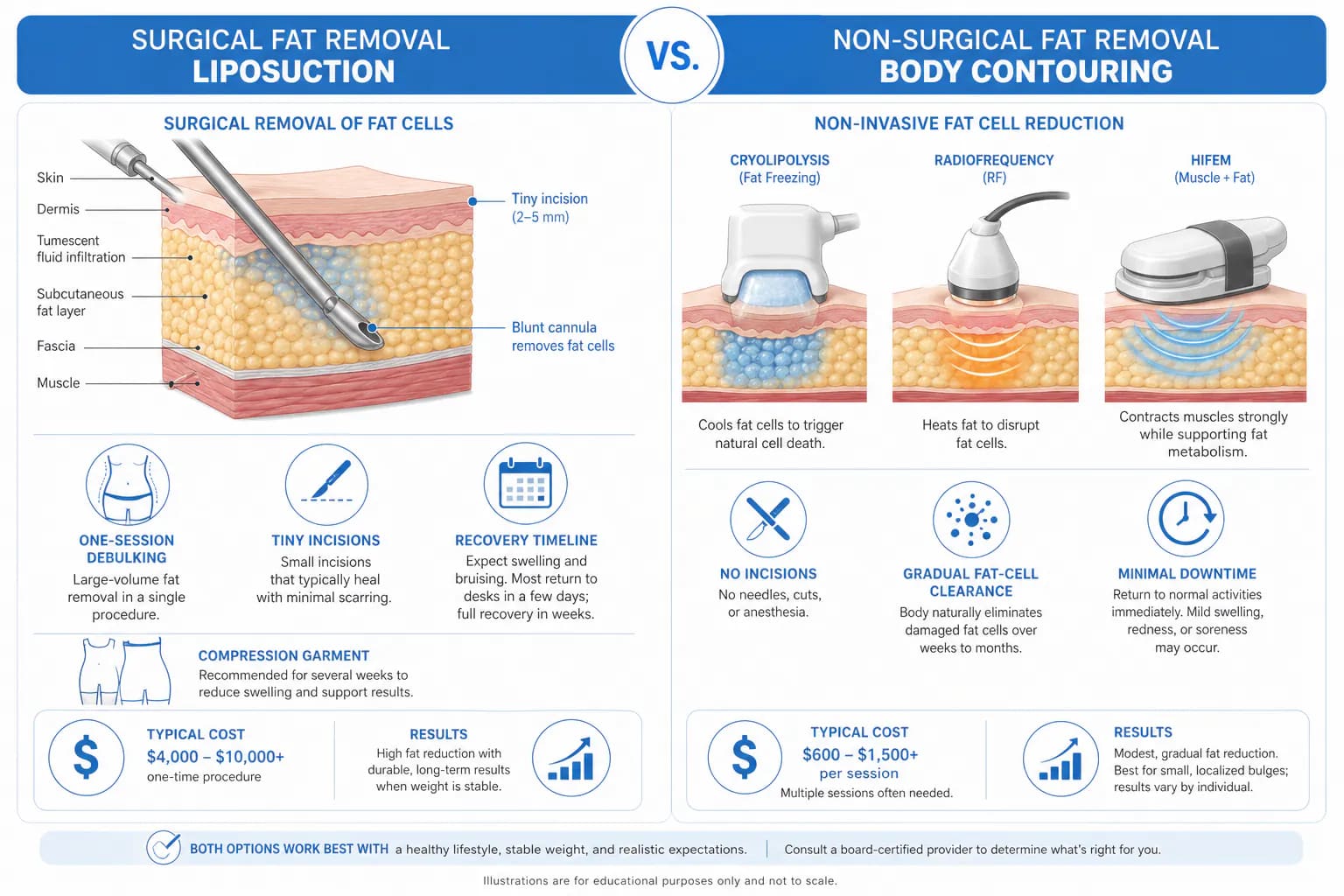
Usually no. FDA-cleared cryolipolysis is typically quoted at up to 20–25% fat-layer reduction per cycle, and older review data found ultrasound-measured reductions around 20.4% to 25.5% after a single flank treatment, with 23% to 27% reductions in some series. The manufacturer also states that most patients need at least two sessions, usually spaced 4 to 8 weeks apart.
Not all non-surgical devices chase the same endpoint. Emsculpt NEO is partly a muscle-definition treatment: current BTL materials cite up to 30% fat reduction and 25% muscle increase, but a 2024 systematic review found only two Emsculpt NEO studies and reported more modest mean abdominal changes overall. That makes it useful for selected patients who want more tone and definition, not a direct replacement for liposuction.
Liposuction works differently because it removes subcutaneous fat immediately instead of waiting for the body to clear injured fat cells over weeks or months. Objective imaging work has measured about 45% abdominal fat-layer reduction after liposuction, and surgical reviews consistently describe liposuction as the stronger option when the goal is removing larger volumes in one session. In plain English: non-surgical body contouring chips away; liposuction debulks.
Which non-surgical option reduces the most fat
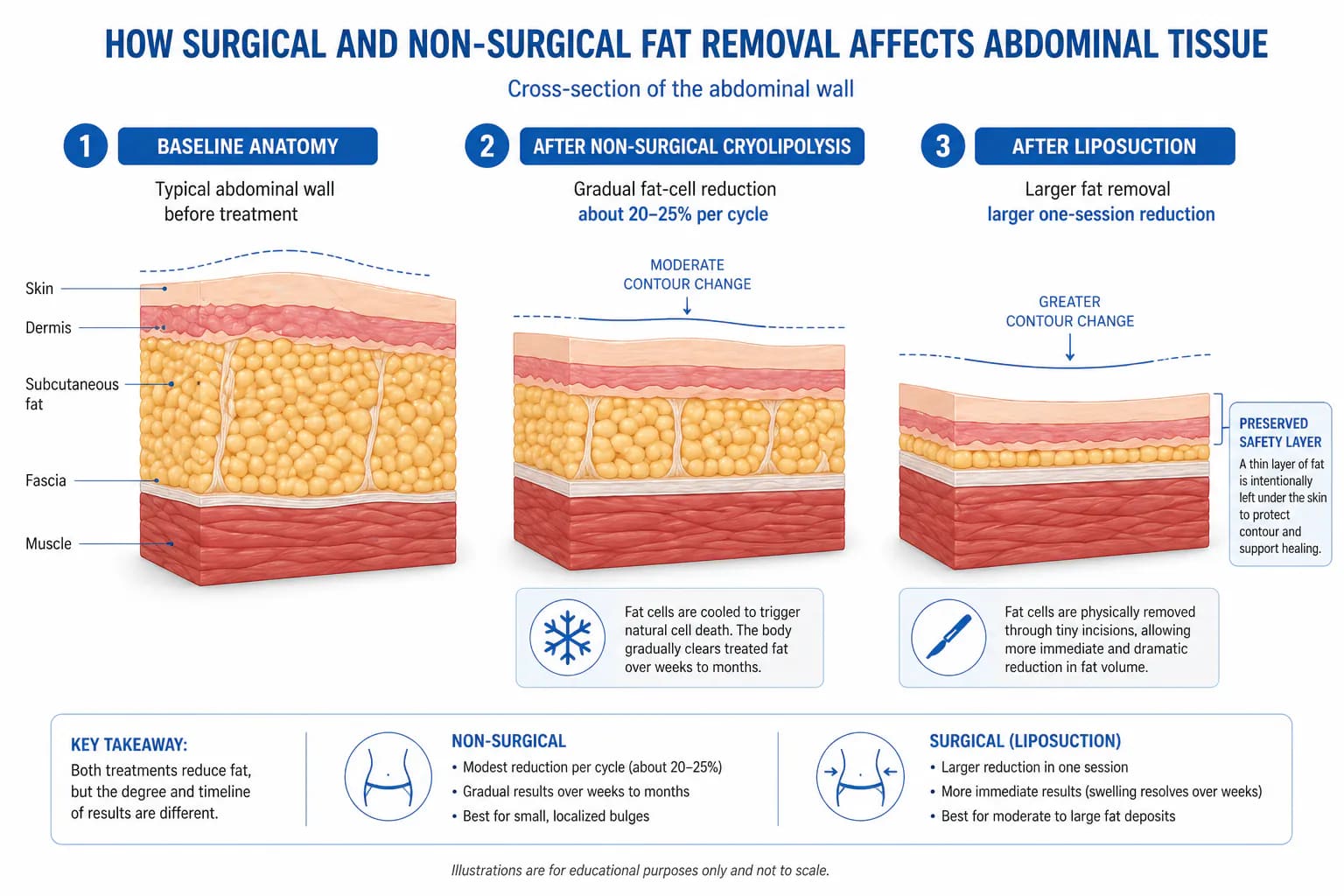
Among non-surgical options, cryolipolysis still has the clearest localized-fat data and the easiest number to quote: about 20–25% per cycle. Laser, RF, and HIFU can work, but older review data more often report modest centimeter-level circumference change rather than liposuction-like debulking.
Non-surgical limits for larger fat deposits
Non-invasive treatments work best for people who are already close to goal weight and want to shrink a small bulge—like a flank pinch, a modest lower-abdomen roll, or a submental pocket. They are much less effective when the problem is a larger deposit, multiple treatment areas, or the need for three-dimensional liposculpture. For a narrower head-to-head on cryolipolysis, see liposuction vs. CoolSculpting.
Downtime and recovery
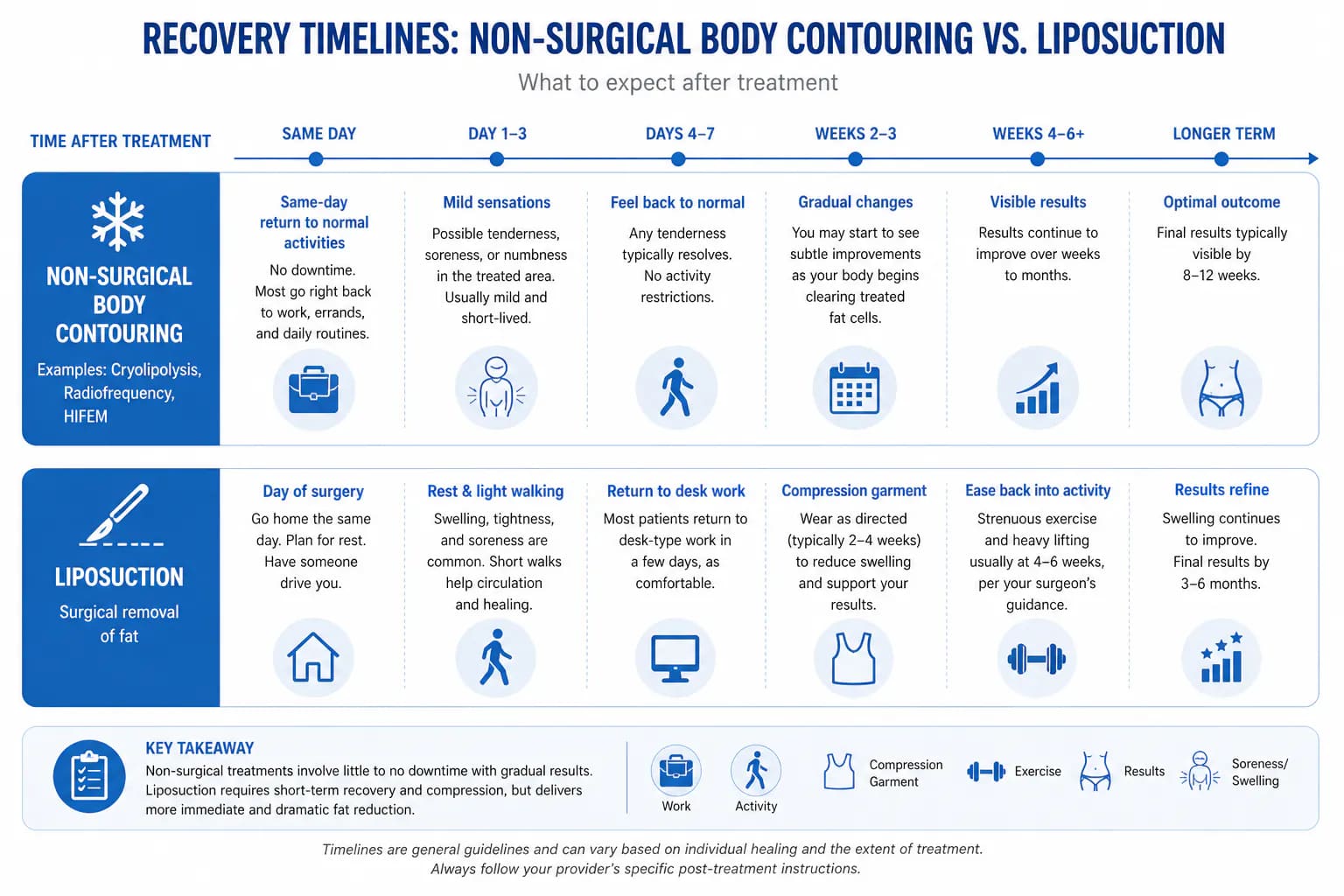
This is the category where non-surgical clearly wins. CoolSculpting and Cleveland Clinic both describe return to normal activity the same day or immediately after treatment, though soreness, swelling, tingling, numbness, or itch can linger for days to weeks. Liposuction recovery is still reasonable for most healthy patients, but it is real surgery: The Aesthetic Society says many patients return to work within a few days, resume most normal activities within 10 days or less, and avoid strenuous exercise for 4–6 weeks.
| Recovery question | Non-surgical body contouring | Liposuction |
|---|---|---|
| Back to desk work | Usually same day or next day | Usually a few days; some smaller cases feel ready sooner, larger cases take longer |
| Bruising and swelling | Usually mild to moderate and localized | More swelling and bruising are expected |
| Exercise | Light activity right away if comfortable | Walking early, but hard workouts usually wait 4–6 weeks |
| Scars | None | Tiny access-point scars from the cannula |
| Compression garment | Not usually needed | Common for several weeks |
That recovery timeline is why non-surgical treatments remain attractive even when the result is smaller. But if you can tolerate a few surgical days and a month-plus before full activity, liposuction buys more change per treatment episode. For a deeper safety discussion, read liposuction risks and safety.
The real cost picture
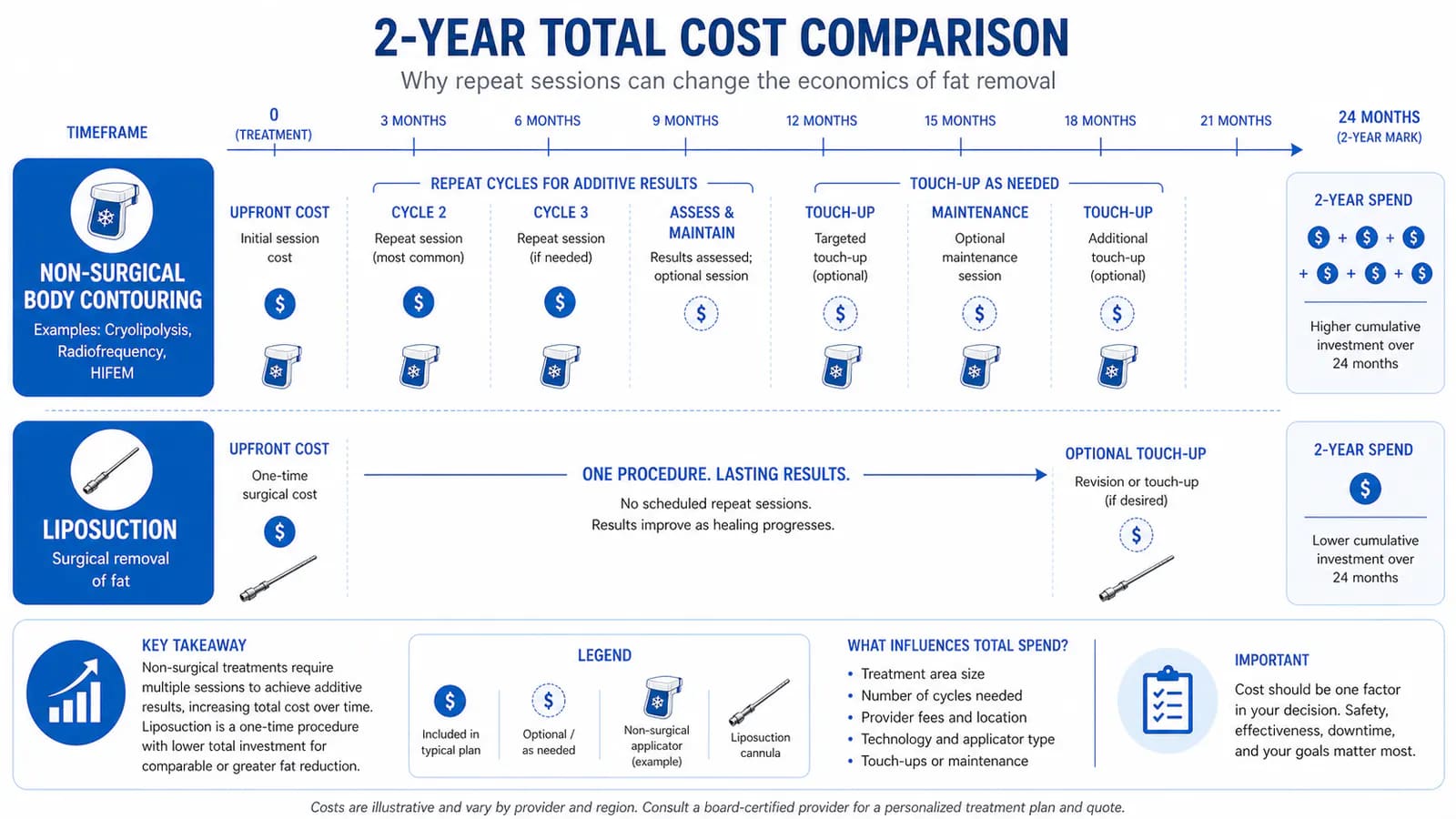
If you mean overall body fat, diet and exercise are obviously cheaper than any cosmetic procedure. If you mean aesthetic body contouring, a single small-area non-surgical session usually has the lowest sticker price. But lowest sticker price is not the same as lowest cost per visible result.
RealSelf lists an average CoolSculpting cost of $3,201, with pricing from about $650 for one targeted session to $6,835 for a full treatment series on multiple areas. GoodRx says individual sessions for one area often run $700 to $1,500. Liposuction's current ASPS data show an average surgeon fee of $4,711, and the 2024 ASPS range lists liposuction at about $4,300 to $7,500 before anesthesia, operating room, and related costs.
Here is the honest 2-year math most comparison pages skip:
| Scenario | Example non-surgical plan* | 2-year non-surgical spend | Surgical liposuction fee context | Honest takeaway |
|---|---|---|---|---|
| Small bilateral area | 4 cycles total (2 applicators × 2 visits) | $2,800–$6,000; with one touch-up cycle, $3,500–$7,500 | $4,300–$7,500 surgeon fee range before facility/anesthesia | The price gap can be much smaller than expected |
| Abdomen + flanks | 8 cycles total (4 applicators × 2 visits) | $5,600–$12,000; with 2 touch-up cycles, $7,000–$15,000 | Same surgeon fee range, though total all-in surgery cost is higher than surgeon fee alone | Non-surgical can approach or exceed surgery while still producing a milder result |
*Illustrative math using current per-session pricing and the manufacturer's statement that most patients need at least two sessions. Exact applicator count depends on anatomy, symmetry, and provider plan.
When CoolSculpting makes sense
It can be worth it when your goal is modest contouring, no incisions, and almost no downtime. It becomes less compelling when you want a bigger one-and-done change, have looser skin, or know you will be unhappy after paying for multiple cycles to get a partial result.
The other issue patients often underweight is PAH, or paradoxical adipose hyperplasia. That is the rare scenario where the treated area enlarges instead of shrinking. Published estimates vary: early postmarketing data suggested about 0.0051%, a recent large chart review found 0.018% to 0.048% per cycle, and manufacturer-linked sources have cited about 0.033% per cycle. When PAH happens, corrective treatment often means liposuction. Surgery is not risk-free either; reviews of liposuction list infection, hematoma, edema, and contour irregularity, with revision for contour issues reported in 2% to 10% of cases.
How long results last
Both categories can be permanent in the same limited, honest sense: the fat cells destroyed or removed are gone, but the remaining fat cells can still enlarge if your weight goes up. CoolSculpting says treated fat is permanently eliminated and cites case reports with results still visible at 6 and 9 years. ASPS patient education says liposuction permanently removes fat cells and that treated areas usually keep looking better if you maintain your post-lipo weight, though new fat cells can form with substantial weight gain.
So the real question is not whether the technology is "permanent." The real question is whether your weight will be stable enough for the new contour to hold.
Choosing the right approach
Choose non-surgical if your bulge is small, your skin is fairly tight, you are close to goal weight, and your top priority is avoiding incisions and downtime. Choose surgical if you want a clearly visible one-session change, multiple treatment areas, or more accurate liposculpture than a device can usually deliver through intact skin.
Who should choose non-surgical?
Non-surgical treatment is strongest for the patient who says, "I like my shape overall. I just want this one area smaller." That often means a modest flank, a small lower-abdomen pocket, or a submental area that bothers you in photos. It also fits the person who cannot step away from work, wants no scars, and is comfortable with gradual improvement rather than instant change.
Who should choose surgical?
Surgical treatment is better for the patient who wants a bigger result and wants it once. That includes larger abdomen-and-flank deposits, thicker arm or thigh fullness, asymmetry, or cases where you want contour refinement with true surgical precision. Technique choice matters—tumescent, power-assisted, VASER—but the bigger issue is surgeon judgment, skin quality, and whether your plan is realistic. For that decision, consult an ABPS board-certified plastic surgeon, not just a device salesperson.
The hybrid approach: combining both
A hybrid plan can make sense. Some patients do best with liposuction for the main debulking and a non-surgical treatment later for a tiny residual pocket or for muscle-focused finishing. That is an inference from how these treatments work, not a standard formula, and it should be timed only after swelling settles and your surgeon can see the true contour.
Usually no. Cryolipolysis is best understood as modest debulking—about 20–25% per cycle—while liposuction creates a much larger one-session contour change. Non-surgical works for refinement; liposuction works for more decisive reshaping.
For generalized fat loss, diet and exercise are cheapest. For cosmetic body contouring, a small non-surgical treatment is often the lowest upfront bill, but liposuction can deliver better cost-per-result once you compare a full treatment plan over 2 years.
Destroyed fat cells do not come back, so results can last for years. But surviving fat cells can still enlarge with weight gain, just like after liposuction, so weight stability matters more than the device name.
Cryolipolysis has the clearest localized-fat data and is usually quoted around 20–25% per cycle. Muscle-building platforms like Emsculpt NEO add a different benefit profile, but they are not direct liposuction substitutes.
Non-surgical treatments usually let you go back to routine activities the same day, even if soreness or numbness lingers. Liposuction usually means a few days before desk work feels normal and about 4–6 weeks before strenuous exercise.
Usually no. Non-surgical body contouring is better for smaller, localized bulges in patients near goal weight, while liposuction remains the stronger choice for larger deposits and multi-area sculpting.
It can be, if your goal is smaller, slower, incision-free change. It is less compelling when you want one-session reshaping or when repeated cycles move your total spend toward surgery while still delivering a milder outcome.
Choose non-surgical if you want modest improvement, minimal downtime, and treatment of a small area. Choose surgical if you want stronger one-session change, better liposculpture, or a more substantial reduction in a larger treatment area.
