Patients seeking body contouring face a confusing landscape of medical terms and marketing claims. The promise of fat removal without surgery is highly appealing, but the reality of what these devices can achieve often conflicts with patient expectations. This guide details how non-surgical fat reduction actually performs, the costs and risks involved, and how outcomes compare directly to surgical liposuction.
The Truth About "Non-Invasive Liposuction"
"Non-invasive liposuction" is a medical misnomer. Liposuction, by definition, is an invasive surgical procedure — it requires incisions, tumescent fluid infiltration, and the mechanical extraction of fat using a hollow tube called a cannula.
When clinics advertise "non-invasive lipo," they are referring to non-surgical body contouring technologies. These devices use external energy — cold, heat, radiofrequency, or electromagnetic waves — to damage fat cells beneath the skin without breaking the surface. The body's lymphatic system then gradually processes and eliminates those damaged cells over several months.
The honest differentiator most practices fail to clearly explain: non-surgical options work, but they typically produce a 20% to 25% fat layer reduction in the treated area per cycle. Surgical liposuction removes the majority of targeted subcutaneous fat in a single session. That capability gap is large, and patients who choose non-invasive treatments expecting surgical results frequently end up disappointed — often spending thousands of dollars on multiple sessions before pursuing the surgery they originally tried to avoid.
You can explore a deeper analysis of this dynamic in our surgical vs. non-surgical fat removal guide.
How the Main Non-Surgical Fat Reduction Technologies Work
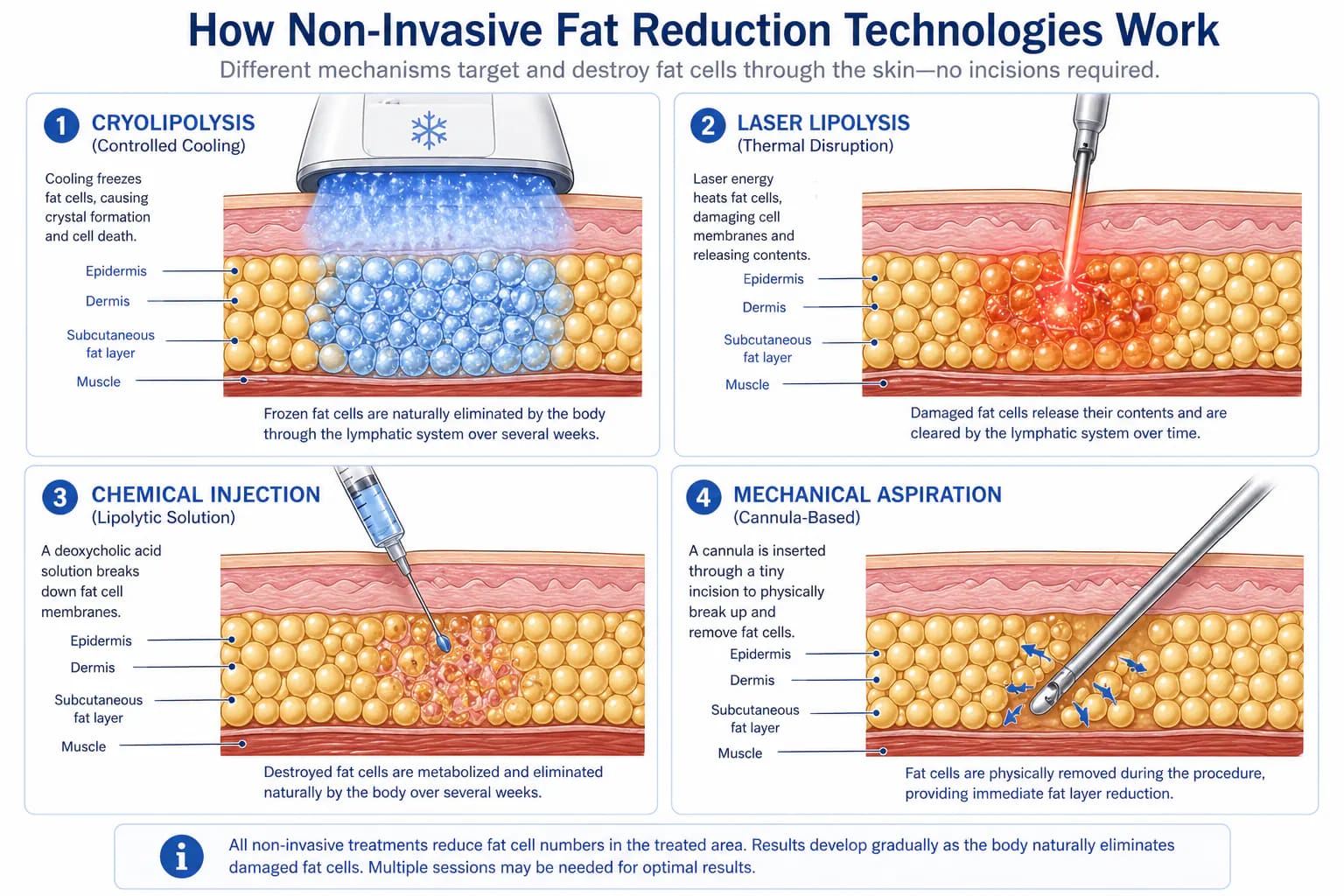
The aesthetics industry has developed several methods to destroy fat cells without a scalpel. While the delivery methods differ, the biological goal is the same: induce apoptosis (controlled cell death) in fat cells without harming surrounding skin, nerves, or muscle tissue.
Cryolipolysis (CoolSculpting)
Cryolipolysis applies controlled, localized cooling to target fat deposits. Because fat cells freeze at a higher temperature than water-rich surrounding tissue, the device crystallizes lipids inside the fat cells without causing frostbite to the skin. The crystallized cells die and are naturally metabolized by the body over 8 to 12 weeks. CoolSculpting is currently the most widely used non-invasive body contouring technology in the US.
Radiofrequency and Laser Energy (SculpSure, Vanquish, truSculpt)
Rather than freezing fat, these technologies use heat to destroy it. SculpSure uses hyperthermic laser energy to heat subcutaneous fat cells to 42°C to 47°C — a thermal threshold that compromises fat cell membrane integrity. The body slowly clears the damaged cells. These treatments typically require zero downtime.
Injectable Deoxycholic Acid (Kybella)
Kybella is distinct from external energy devices. It is an FDA-approved injectable composed of synthetic deoxycholic acid — a naturally occurring molecule that aids in the breakdown and absorption of dietary fat. When injected into a localized fat pocket, the acid physically ruptures fat cell membranes. Its FDA approval is limited to one specific area: submental (under-chin) fat.
Radiofrequency + HIFEM (Emsculpt NEO)
Emsculpt NEO is a hybrid approach that combines radiofrequency heating (to reduce fat) with High-Intensity Focused Electromagnetic energy (to stimulate supramaximal muscle contractions). It addresses body composition — fat and muscle together — rather than fat volume alone.
Efficacy Comparison: Non-Surgical vs. Surgical
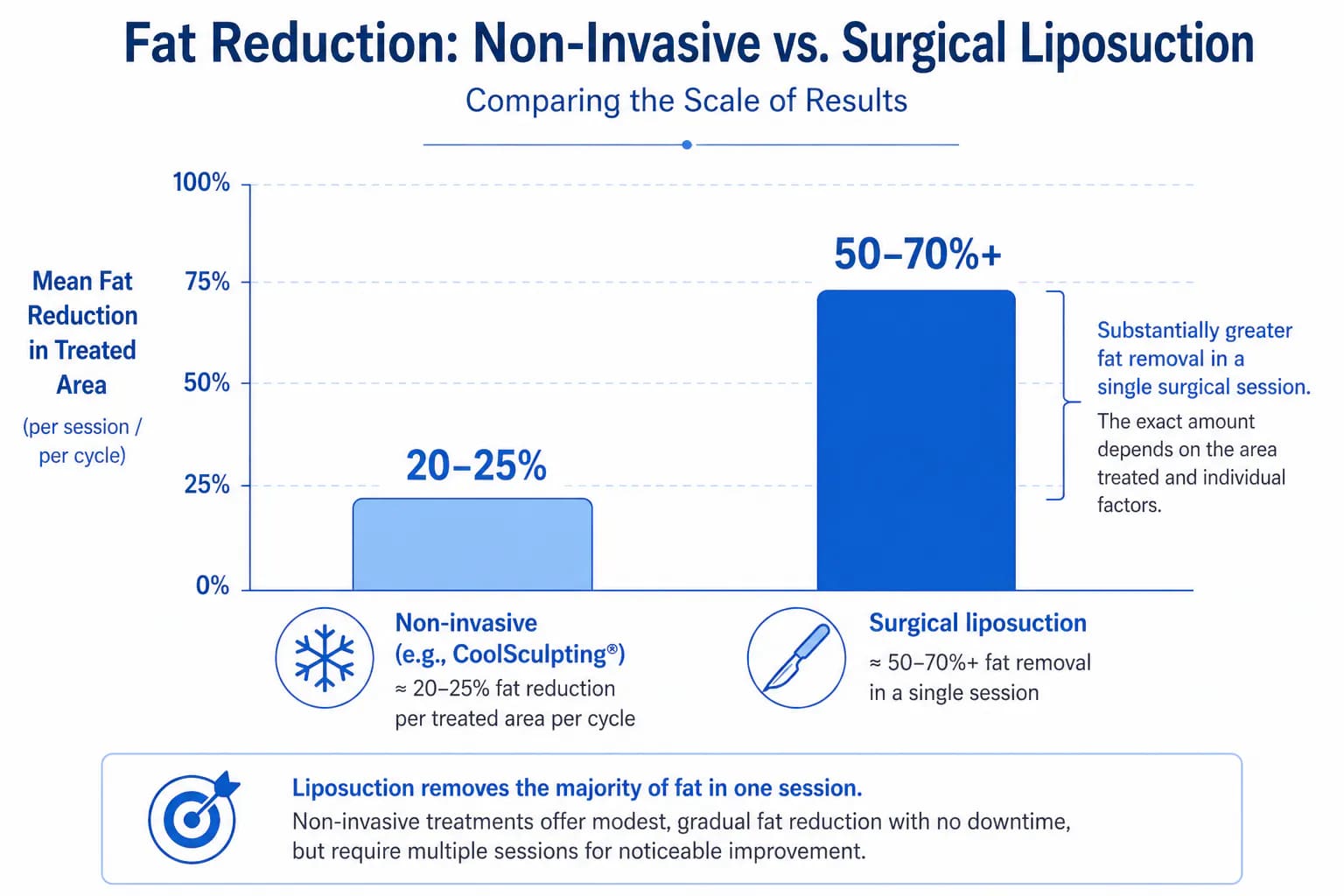
The defining factor in your decision should be the scale of contouring you require. Both surgical and non-surgical methods permanently destroy fat cells. The difference is in how much fat is removed and how quickly you see the result.
| Feature | Non-Surgical Contouring (e.g., CoolSculpting) | Surgical Liposuction |
|---|---|---|
| Fat Reduction Per Session | ~20% to 25% of fat layer in treated area | Majority of targeted subcutaneous fat |
| Time to Final Results | 8 to 12 weeks | Immediate contour change; final results at 3–6 months |
| Sessions Required | 1 to 4 per area | 1 procedure |
| Anesthesia | None | Local (tumescent) or general |
| Downtime | None | 1 to 2 weeks of restricted activity |
| Precision | Moderate — relies on applicator shape | High — surgeon controls contouring via cannula |
If you need precise sculpting or removal of heavy, fibrous fat across multiple areas, surgical precision is necessary. If you want to soften a small, stubborn bulge with zero downtime, non-surgical methods offer a viable pathway.
The Reality of CoolSculpting: Results and PAH Risk
CoolSculpting is effective for the right candidate. Clinical studies consistently confirm the 20% to 25% reduction rate per cycle. However, patients need to be fully informed about a specific complication known as Paradoxical Adipose Hyperplasia (PAH).
PAH is a rare condition where the treated fat tissue, instead of shrinking, hardens and expands into a dense, rectangular mass mirroring the shape of the applicator. This expanded tissue is resistant to diet and exercise. Reversing PAH requires surgical intervention — specifically liposuction, and sometimes excision.
The incidence rate is a point of clinical debate. The manufacturer officially reports the risk at 0.033% (roughly 1 in 3,000 treatments). Published peer-reviewed studies suggest the true incidence may be meaningfully higher than that figure — a gap that matters for informed consent. Public awareness of PAH surged after supermodel Linda Evangelista's high-profile lawsuit against the manufacturer following her development of severe PAH.
When evaluating liposuction vs. CoolSculpting, weigh the zero-downtime convenience against the rare but serious risk of PAH — a complication surgical liposuction does not carry.
Kybella: Targeted Treatment for Submental Fat
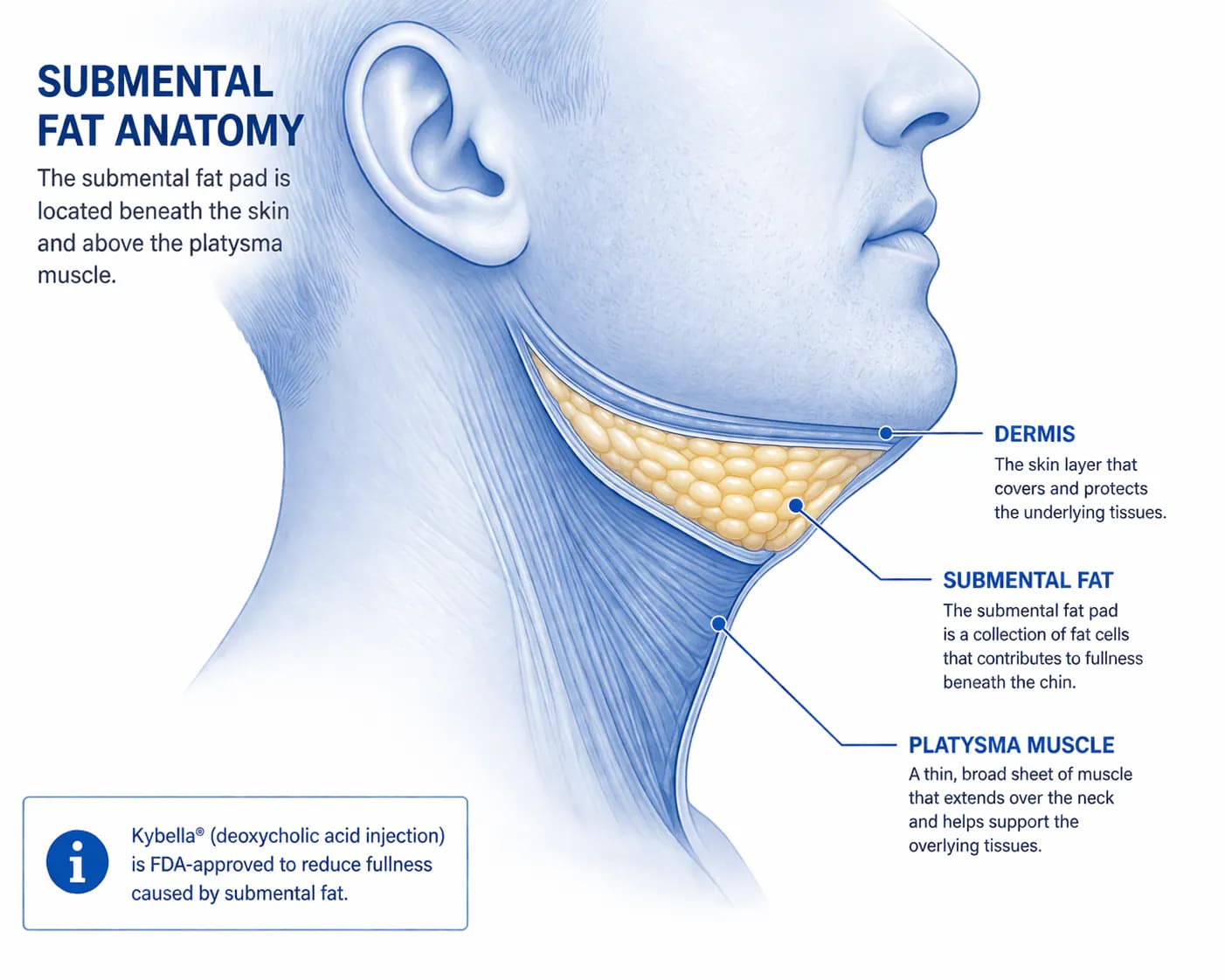
Kybella offers a chemical approach to fat removal, but its applications are strictly limited. It is FDA-approved exclusively for moderate to severe submental fat — the "double chin." Use outside that area is not recommended.
While Kybella permanently dissolves fat cells, patients need to prepare for the recovery. The injections trigger a significant inflammatory response. Most patients experience marked swelling — often described as a "bullfrog" appearance — lasting one to two weeks after each session.
Kybella typically requires two to four sessions spaced a month apart. When you factor in the total cost and repeated weeks of visible swelling, many patients find that a single submental liposuction procedure offers a faster, more predictable, and often more economical result. For the surgical comparison, read our chin liposuction guide.
Emsculpt NEO: Building Muscle While Reducing Fat
Emsculpt NEO occupies a different lane from the other devices here. Because it combines radiofrequency heating with electromagnetic muscle stimulation, it addresses body composition — fat and muscle together — rather than fat volume alone.
Manufacturer clinical data for a standard four-session protocol reports an average 19% fat reduction and 25% increase in muscle mass in the targeted area.
This device suits patients who are already near their ideal weight and want core strengthening or enhanced abdominal definition. It is not a fat debulking treatment. Emsculpt NEO refines and tones; liposuction removes and sculpts.
Who Should Choose Non-Surgical vs. Surgery?
You are a good candidate for non-surgical contouring if:
- You are within 10 to 15 pounds of your stable goal weight
- You have distinct, isolated, pinchable pockets of subcutaneous fat
- You have good skin elasticity — non-surgical options do not tighten loose skin
- You cannot accommodate surgical downtime
- You have realistic expectations about mild to moderate improvement
You should consider surgical liposuction if:
- You want a noticeable, dramatic transformation
- You need to address larger fat volumes or multiple areas simultaneously
- You prefer a single procedure with immediate structural change
- You require the precision needed for complex sculpting — HD liposculpture, VASER, or revision work
Cost Comparison Over Two Years: The True Price of Fat Reduction
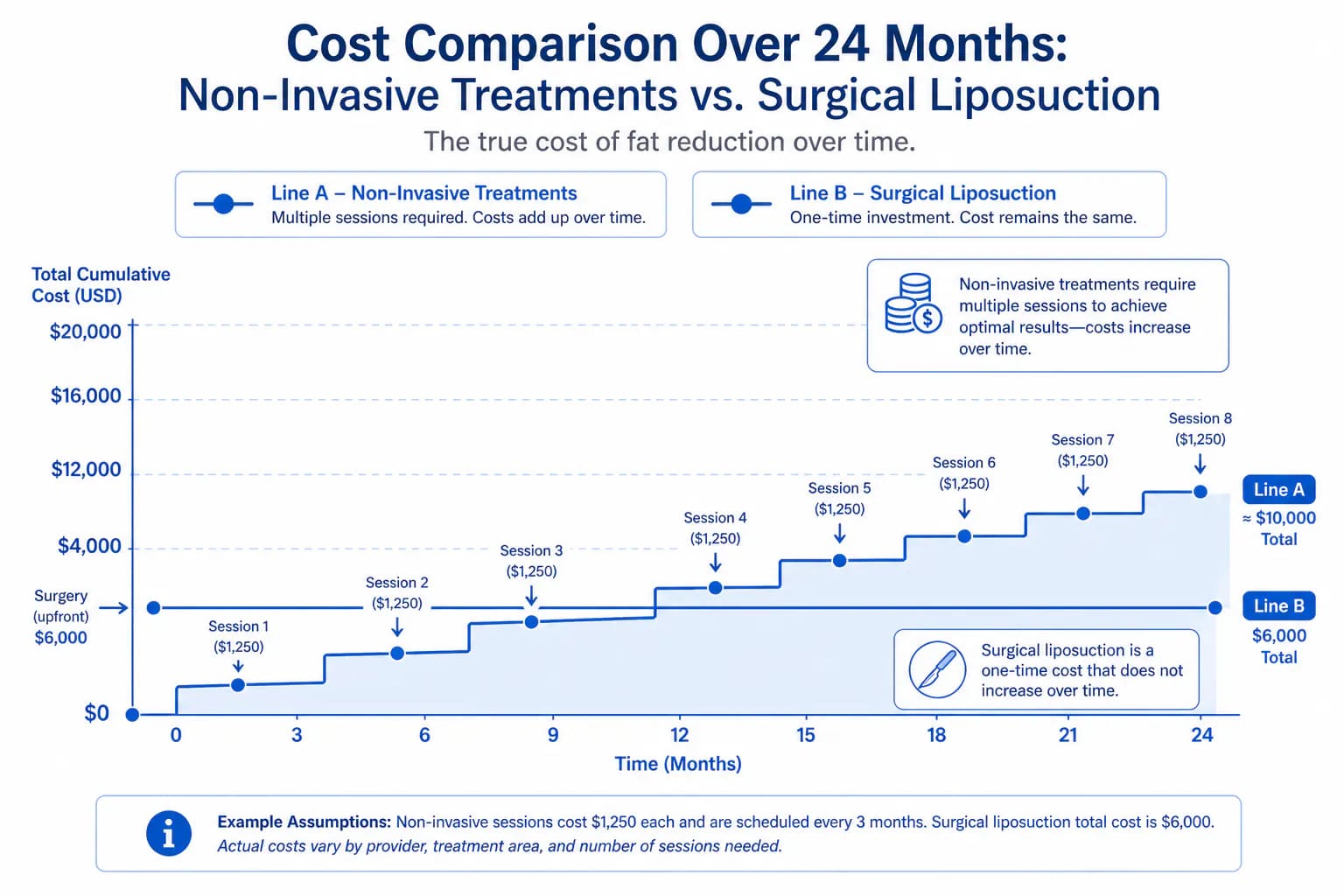
Many patients are drawn to non-invasive options because the per-session price looks lower than surgery. But the relevant comparison is total cost to achieve your goal — not entry price.
| Treatment | Average Cost | Sessions | Estimated 2-Year Total |
|---|---|---|---|
| Liposuction (surgical) | $4,500 – $7,000 | Single procedure | $4,500 – $7,000 |
| CoolSculpting | $750 – $1,500 per cycle | 2 to 4 cycles per area | $1,500 – $6,000 |
| Kybella | $600 – $800 per vial | 2 to 4 sessions (multiple vials) | $1,200 – $3,200 |
| Emsculpt NEO | $750 – $1,000 per session | 4-session protocol | $3,000 – $4,000 |
Treating a single area with multiple rounds of non-invasive technology can quickly approach the cost of a single surgical procedure — without the same magnitude of result. Evaluate your budget against your ultimate goal, not just the first appointment price.
What is non-invasive liposuction? A marketing term, not a medical one. It refers to non-surgical body contouring devices that use cold, heat, ultrasound, or injectables to destroy fat cells without incisions. True liposuction always requires surgical extraction via a cannula.
Does non-invasive fat removal actually work? Yes, for the right patient. FDA-cleared devices do reduce fat in the treated area — typically 20% to 25% per session. Results require multiple treatments and 8 to 12 weeks to fully appear.
What is the difference between CoolSculpting and liposuction? CoolSculpting freezes fat from the outside and clears it gradually over months, with no downtime and modest per-cycle reduction. Liposuction surgically removes the majority of targeted subcutaneous fat in one session, with immediate structural change and a 1 to 2 week recovery.
What is the best non-surgical alternative to liposuction? It depends on the area and goal. CoolSculpting and RF platforms are most established for small body bulges. Kybella is FDA-approved for submental fat only. Emsculpt NEO is the best fit for patients prioritising body composition — tone alongside modest fat reduction.
How long do non-invasive fat reduction results last? The destroyed fat cells are gone permanently. But remaining fat cells can still enlarge with weight gain. Maintaining stable weight is the best way to protect a result that was modest to begin with.
Can non-invasive treatments replace liposuction? For selected patients with small goals and low tolerance for downtime — sometimes. For patients wanting dramatic debulking, multiple areas, or surgical precision — no. The capability gap between devices and surgery is significant.
What is the cost of non-invasive fat removal vs liposuction? Non-surgical treatments run $750 to $4,000 total depending on session count. Surgical liposuction typically costs $3,500 to $9,000 for one area. When multiple non-surgical sessions are required, the cost gap narrows — without equivalent results.
Who is a good candidate for non-invasive body contouring? Someone within 10 to 15 pounds of their goal weight, with good skin elasticity and a small pinchable fat pocket, who has realistic expectations about mild to moderate improvement. Patients with large fat volumes, skin laxity, or high outcome expectations are usually better served by surgery.
