This is the most common abdominal contouring decision patients face — and the one most frequently answered incorrectly, by both patients and the surgeons they consult. For help deciding whether you are a good candidate for either procedure, see our liposuction candidacy guide.
The mistake: choosing based on how invasive a procedure sounds, or how much it costs, rather than what your anatomy actually requires. Liposuction on a patient who needs a tummy tuck doesn't just produce a suboptimal result — it can make the problem noticeably worse by removing the fat that was supporting loose skin.
Here's the honest decision framework: what each procedure does, which problems it solves, and the clinical indicators that tell you which one (or which combination) your situation calls for.
What Each Procedure Actually Treats
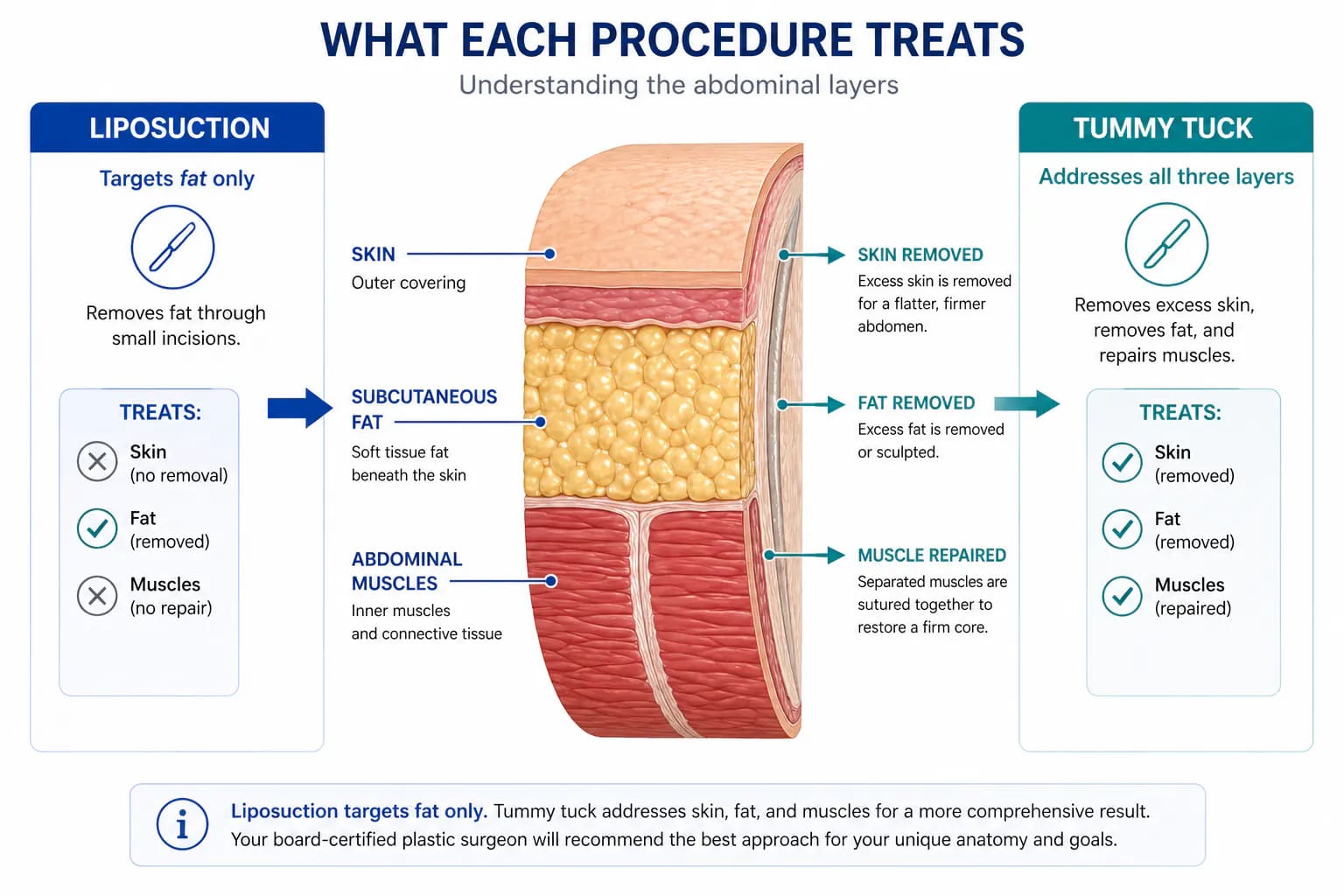
The abdomen is made up of three layers: skin, subcutaneous fat, and muscle. Most abdominal appearance concerns involve some combination of all three. The critical question is which layers are driving the problem.
Liposuction treats: fat only
Liposuction removes subcutaneous fat through small incisions using a thin cannula. It cannot:
- Remove excess skin
- Tighten loose or stretched skin (beyond what natural elasticity provides)
- Repair separated abdominal muscles
If fat is the primary issue and your skin has good elasticity, liposuction is highly effective. If skin quality or muscle anatomy is part of the problem, liposuction alone will not produce the result you want — and may worsen it.
A tummy tuck treats: skin + fat + muscle
A full abdominoplasty:
- Removes excess skin (the apron or overhang of skin that hangs below the belly button)
- Removes and repositions fat in the lower abdomen
- Repairs diastasis recti (separated abdominal muscles) via muscle plication — suturing the muscle columns back together at the midline
- Repositions the navel to a natural position after skin removal
A mini tummy tuck (mini abdominoplasty) addresses only the lower abdomen below the navel and does not reposition the belly button. It is appropriate for patients with excess skin confined to the lower abdomen with no muscle separation above the navel.
The Three Questions That Determine Which Procedure You Need
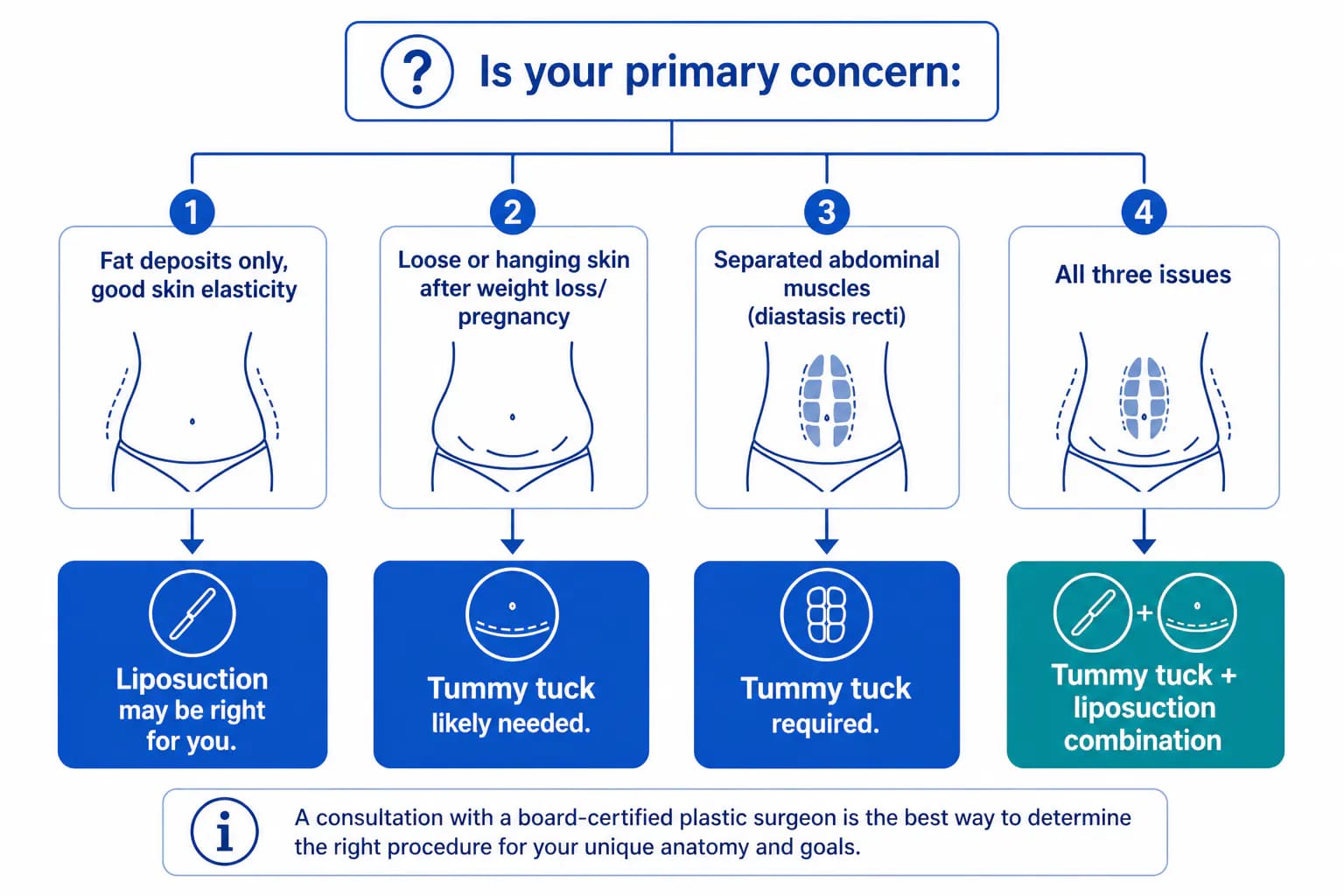
Before consulting a surgeon, assess your own anatomy honestly:
If you can grab a fold of excess skin on your lower abdomen — skin that remains loose even when you're at a healthy weight — liposuction will not fix this. Removing fat from under loose skin makes the looseness more pronounced. A tummy tuck is needed to remove that excess skin.
Loose skin is common after:
- Pregnancy (especially multiple pregnancies)
- Significant weight loss (bariatric surgery or natural)
- Aging with significant UV exposure or collagen loss
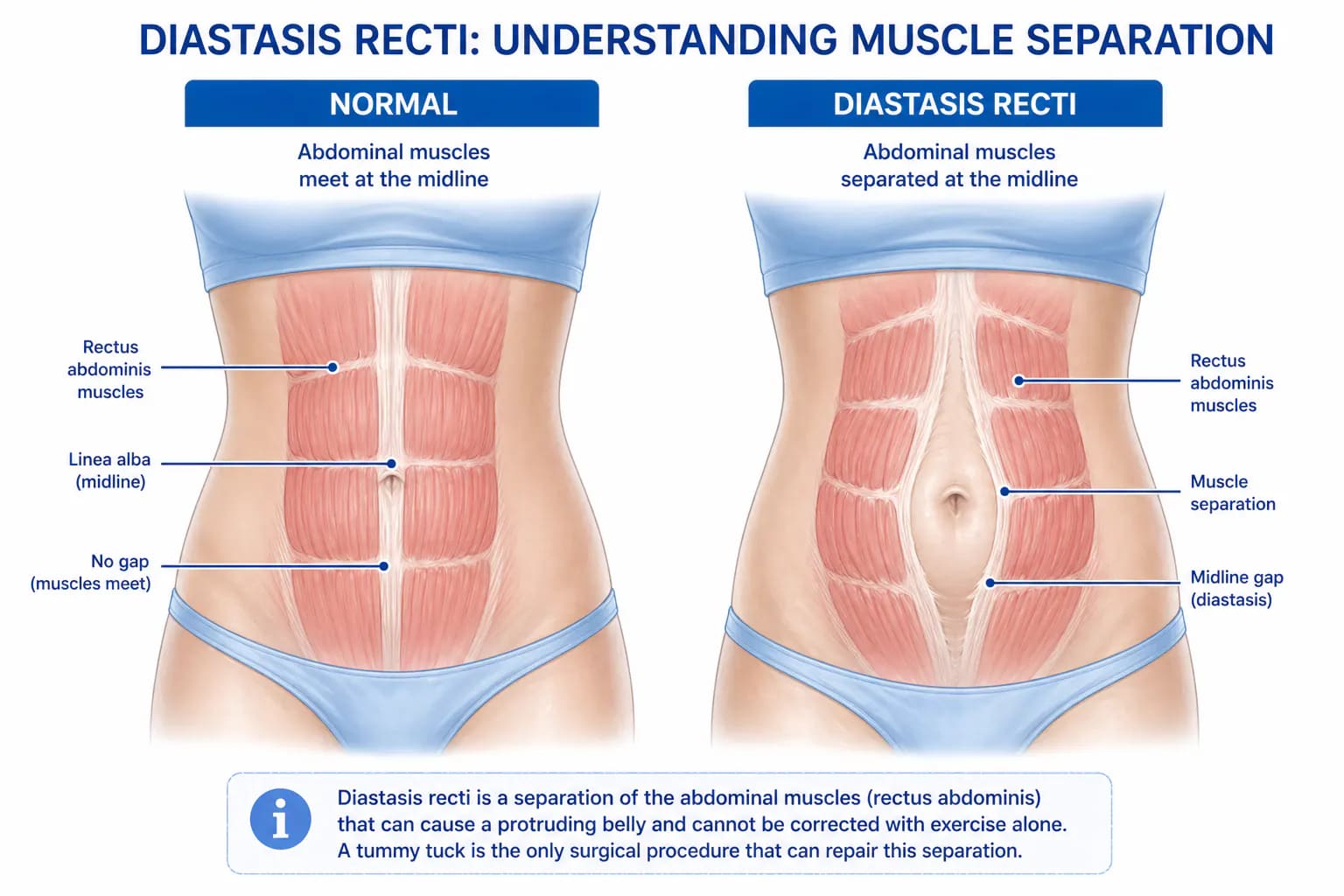
Diastasis recti is a separation of the rectus abdominis muscles at the midline — the two vertical muscle columns that run down the center of the abdomen. During pregnancy, the growing uterus can push these muscles apart. They often don't return to their original position after childbirth.
Signs of diastasis recti:
- A "pouch" or dome-shaped protrusion when you flex your abs or sit up
- A visible ridge running down the center of the abdomen when you tense your core
- Core weakness, back pain, or difficulty with functional movements
- Belly that looks pregnant despite being at goal weight
Diastasis recti cannot be corrected by liposuction, exercise, or any non-surgical treatment. Tummy tuck muscle plication is the definitive treatment.
If your abdominal concern is localized fat deposits, you have good skin tone (skin snaps back when pinched), and you don't have loose skin or diastasis recti, you may be an excellent liposuction candidate.
Good skin elasticity predictors:
- You've never been significantly overweight
- No significant stretch marks in the abdominal area
- You're under 45 (skin elasticity generally declines with age, though individuals vary widely)
- The skin feels firm and taut when not pinched
The Telltale Test: Pinch Test and Skin Assessment
A simple self-assessment: while standing, pinch the skin of your lower abdomen.
- If you can grab a meaningful fold of excess skin (not just fat) — that skin will likely need to be removed by a tummy tuck.
- If what you're grabbing is primarily soft fat with minimal skin excess — liposuction may be appropriate.
This test is directional, not definitive. A consultation with an experienced board-certified plastic surgeon includes proper skin thickness assessment, diastasis recti evaluation, and fat analysis that no self-test can replace.
When Liposuction Is the Right Choice
Liposuction is appropriate for abdominal contouring when:
- Fat is the primary or only concern
- Skin has good elasticity — it will contract over the new contour
- There is no significant loose skin to remove
- There is no diastasis recti
- The patient is at or near goal weight with no plans for further weight loss
- The patient has not had significant weight changes that have stretched the skin
These patients often achieve excellent flat-abdomen results from liposuction alone — sometimes better than they expected, because removing the fat allows the elastic skin to contract smoothly over a dramatically improved contour.
When a Tummy Tuck Is the Right Choice
A tummy tuck (abdominoplasty) is indicated when:
- Loose or excess skin is present — particularly in the lower abdomen
- There is a skin fold or overhang below the belly button
- Diastasis recti is present — confirmed by physical examination
- The patient has had multiple pregnancies
- There has been significant weight loss leaving skin redundancy
- Liposuction alone would leave visible loose skin after fat removal
For post-pregnancy patients, a full tummy tuck is the most common and most effective solution, because it addresses all three problems simultaneously: loose skin, excess lower abdominal fat, and muscle separation.
When Both Together Is the Right Choice
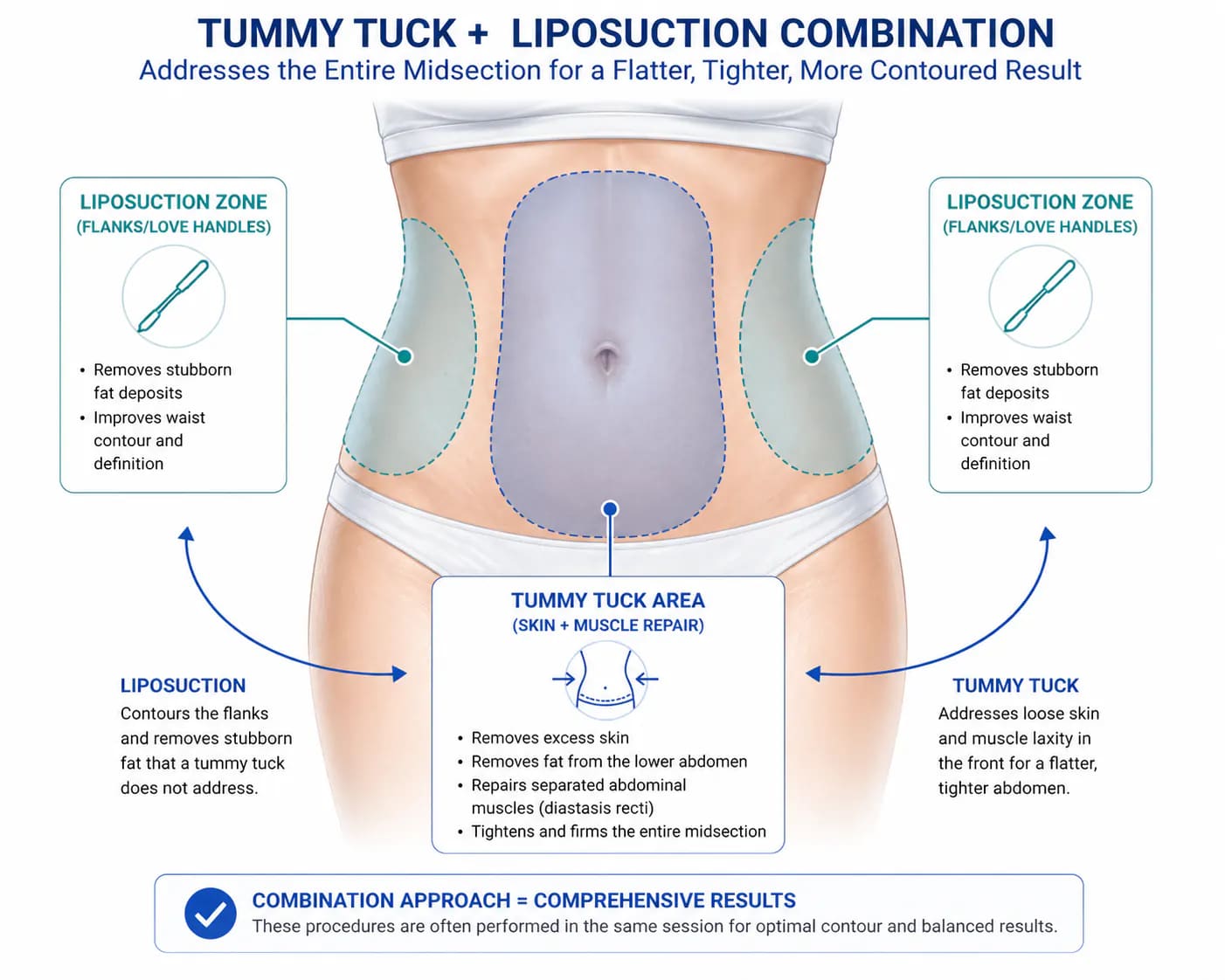
Many patients benefit from combining a tummy tuck with liposuction in the same session.
The typical combination: Full tummy tuck (central abdomen — skin removal + muscle repair) plus liposuction of the flanks, love handles, and lateral abdomen. This addresses the full midsection: the tummy tuck handles the front, liposuction sculpts the sides.
When this combination makes sense:
- Patient has loose skin and diastasis recti centrally, plus flank fat laterally
- Addressing both in one session is more efficient and cost-effective than separate surgeries
- Patient can tolerate a longer surgical session (typically 3 to 4 hours combined)
Note: there are limits to how much liposuction can be safely combined with a tummy tuck. Aggressive liposuction of the central abdomen during a tummy tuck can impair blood supply to the skin flap, increasing complication risk. Experienced surgeons plan the combination carefully.
Cost Comparison
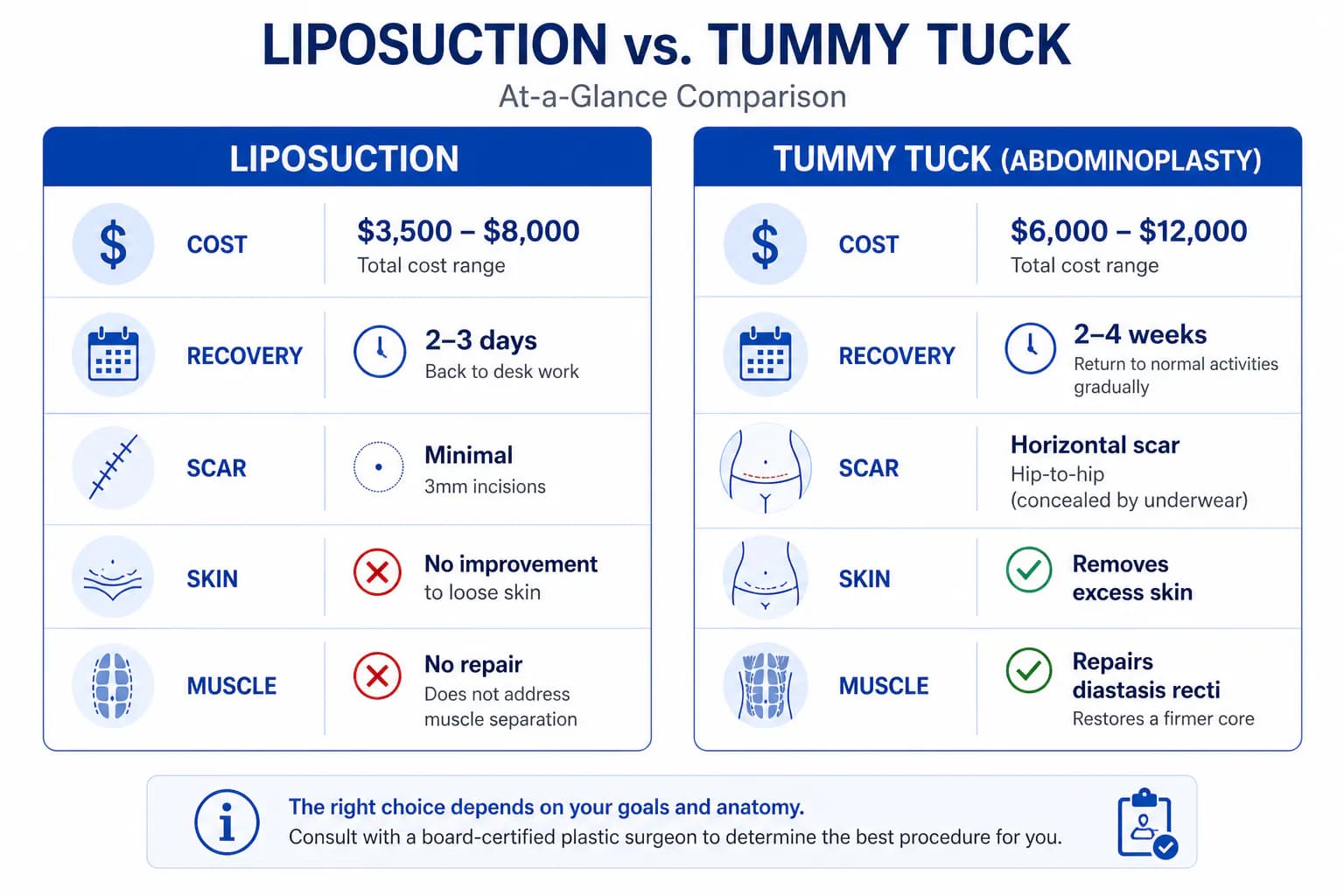
| Procedure | Typical Total Cost | Recovery to Desk Work | Scarring |
|---|---|---|---|
| Abdominal liposuction | $3,500 – $8,000 | 2–3 days | 3–5 small dots |
| Mini tummy tuck | $5,000 – $8,500 | 1–2 weeks | Short low horizontal scar |
| Full tummy tuck | $6,000 – $12,000 | 2–4 weeks | Hip-to-hip horizontal scar |
| Tummy tuck + lipo (combo) | $8,000 – $15,000 | 2–4 weeks | Tummy tuck scar + small lipo incisions |
Total costs — surgeon, facility, anesthesia. Excludes garments and supplies.
Liposuction is significantly less expensive than a tummy tuck — but this comparison is only meaningful if liposuction can actually achieve the result you want. Choosing liposuction to save money when you actually need a tummy tuck results in a poor outcome and likely a costly revision. For detailed pricing, see our liposuction cost guide.
Recovery: The Real Difference
Liposuction: Back to desk work in 48 to 72 hours. Compression garment for 4 to 6 weeks. Light exercise at 3 to 4 weeks, full activity at 6 weeks. Minimal activity restrictions during recovery. For a complete timeline, see our week-by-week recovery guide.
Tummy tuck: The first 2 weeks are the hardest. Patients must walk slightly hunched forward to protect the abdominal closure. A surgical drain is placed (typically removed at 1 to 2 weeks). Standing fully upright is often not comfortable until week 2 to 3. Desk work at 2 to 4 weeks. Full recovery takes 4 to 6 months.
The tummy tuck recovery is substantially more demanding — and this matters for planning around work and childcare responsibilities.
Mommy Makeover: The Full Post-Pregnancy Solution
A mommy makeover is a combination of procedures — typically a tummy tuck + breast lift or augmentation — done in a single surgical session to address the comprehensive physical changes from pregnancy.
Including liposuction of the flanks and thighs as part of the mommy makeover is extremely common. The result: total body recontouring in a single recovery period.
Mommy makeovers range from $10,000 to $20,000+ depending on the combination of procedures. Doing them together is typically 20 to 30% less expensive than the same procedures done separately — facility and anesthesia fees are paid once.
What is the difference between liposuction and a tummy tuck? Liposuction removes fat only. A tummy tuck removes excess skin, removes fat, and repairs separated abdominal muscles. The right choice depends on which of these problems applies to you.
Can liposuction replace a tummy tuck? No — for patients with loose skin or diastasis recti, liposuction can worsen the appearance of loose skin. It is not a substitute for tummy tuck when skin or muscle are part of the problem.
How much does a tummy tuck cost compared to liposuction? Abdominal lipo: $3,500–$8,000. Full tummy tuck: $6,000–$12,000. Tummy tuck costs 40–60% more due to greater surgical complexity.
What is diastasis recti and how does it affect the decision? Diastasis recti is separation of the abdominal muscles — common after pregnancy. It causes a belly pouch that liposuction cannot fix. Tummy tuck muscle plication is the appropriate treatment.
What is the recovery difference? Lipo: desk work in 2–3 days, full activity at 6 weeks. Tummy tuck: desk work in 2–4 weeks, full recovery over 4–6 months. Tummy tuck recovery is substantially more demanding.
Will liposuction give me a flat stomach? If fat is the primary issue and skin is elastic, yes. If loose skin, separated muscles, or visceral fat are contributing, liposuction will not achieve a flat result.
Can liposuction and a tummy tuck be done at the same time? Yes — this is common. Tummy tuck addresses the central abdomen; liposuction addresses the flanks and lateral abdomen. Combination is typically more cost-efficient than separate surgeries.
Which leaves less scarring? Liposuction: tiny 3–5mm marks hidden in creases. Tummy tuck: hip-to-hip horizontal scar, permanent but fades significantly over 12–24 months. For patients who need a tummy tuck, the scar is worthwhile.
