If you are considering liposuction fat transfer, the real question is not whether surgeons can move fat — they can. The real questions are how much survives, where it can go, and whether the result is worth the price and recovery timeline for your goals.
The honest differentiator most SERP pages skip: fat transfer is not just BBL marketing. It can be used in the buttocks, breasts, face, temples, hands, and even the pectoral region; only part of the graft usually persists long term; and modern Brazilian butt lift fat transfer is materially safer than the pre-2017 era because the standard moved toward subcutaneous-only injection and real-time ultrasound guidance.
How Liposuction Fat Transfer Works
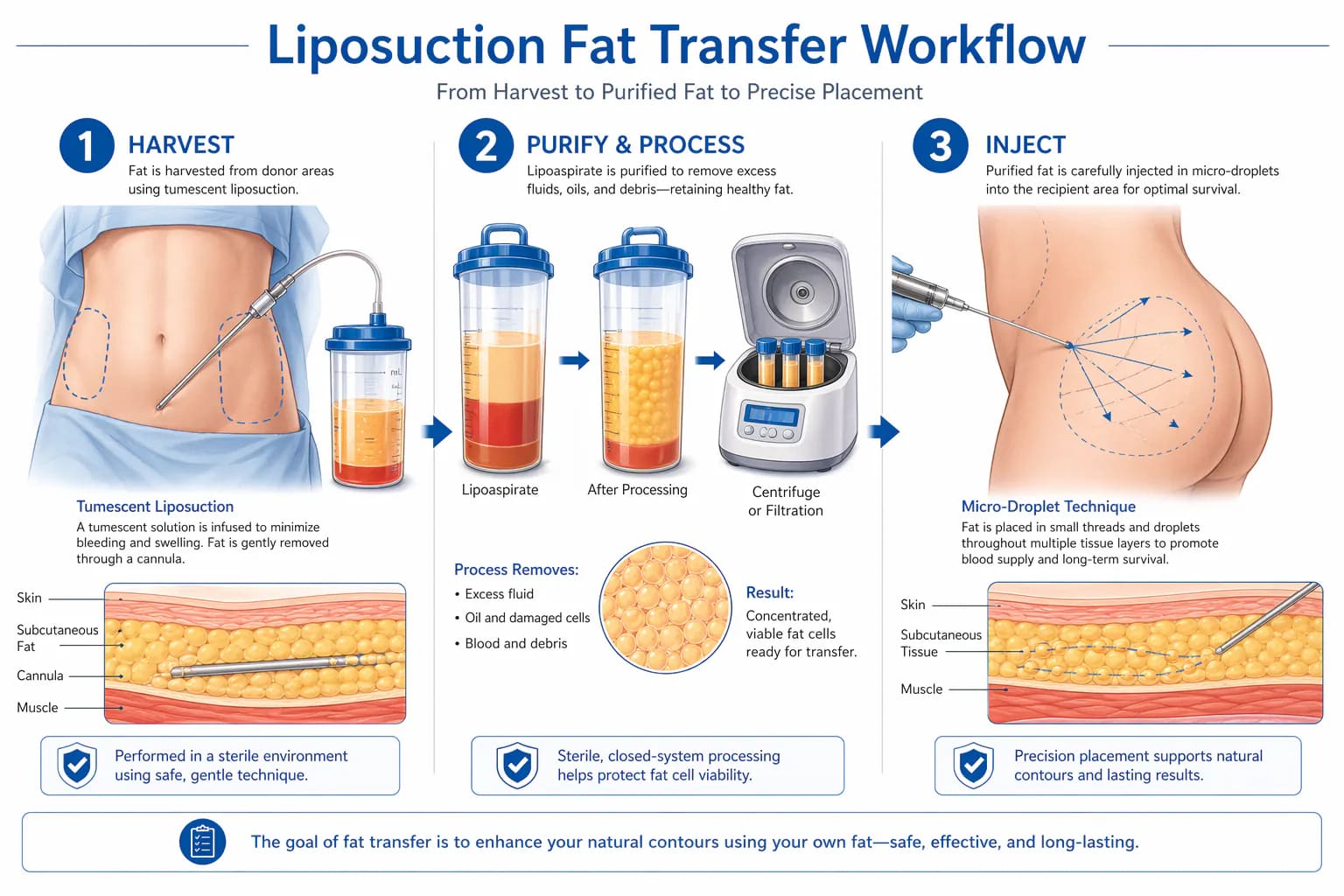
Liposuction fat transfer is a two-part operation. First, the surgeon removes fat from a donor area with liposuction. That fat is then processed and reinjected into a different treatment area to add volume, smooth contour, or improve proportion — body contouring plus volume restoration in one procedure.
The workflow matters. Modern fat grafting is built around surgical precision: harvest fat gently, refine it, and place it back in very small parcels so it can establish blood supply. The technique uses low-pressure aspiration with large-bore cannulas, wet or tumescent harvesting, careful processing, and injection through small cannulas in multiple passes rather than one large deposit. That is how surgeons protect cell viability.
Most donor fat comes from the abdomen, flanks, and thighs, although almost any area with adequate subcutaneous fat can be used.
| Step | What happens | Why it matters |
|---|---|---|
| Harvest | Fat is removed with liposuction from a donor site | Gentle harvest helps preserve viable fat cells |
| Process | Blood, oil, and fluid are separated from the lipoaspirate | Cleaner graft material improves handling and placement |
| Inject | Fat is placed in tiny parcels through a cannula | Small parcels revascularize better than large deposits |
The Fat Survival Reality: 40–70%
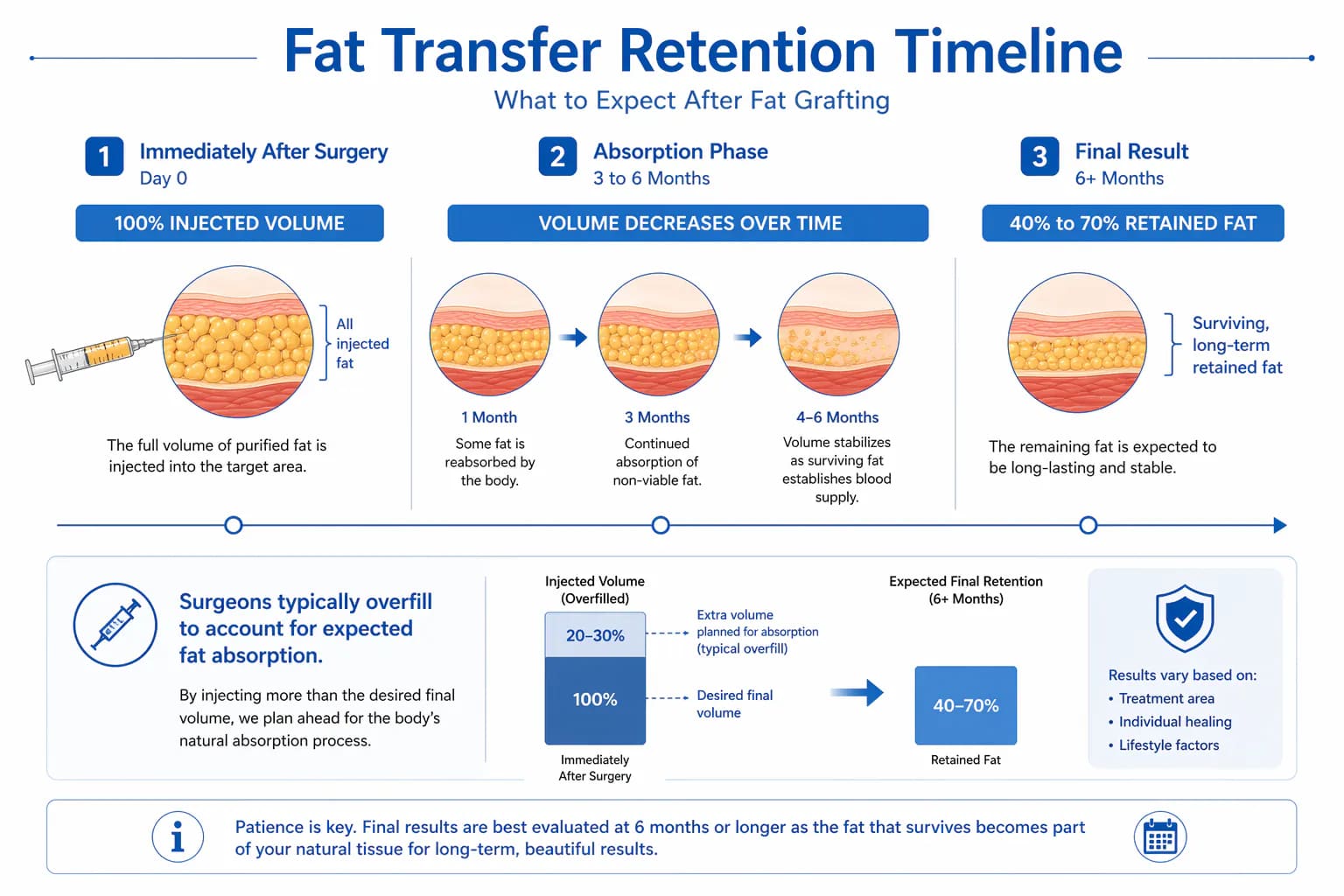
The number patients actually care about: long-term retention is not 100%. Across reviews, fat survival is variable, with resorption commonly reported in the 30% to 70% range — meaning a practical long-term survival range of roughly 40% to 70% is a fair patient-facing expectation.
That broad range reflects real variation by treatment area, surgical technique, processing method, patient biology, and surgeon expertise. ASPS patient guidance notes that about 50% of injected fat survives in general facial use; a 2023 meta-analysis of breast fat grafting found pooled volume retention of 54%; and a 2024 ultrasound-assisted gluteal study reported 77.9% retention at 3 months and 64.7% at 6 months.
This is also why the immediate post-op look can be misleading. Experienced surgeons often build in overcorrection because they expect some absorption — published fat-grafting protocols commonly describe about 30% overcorrection. Patients should know this before surgery so they are not alarmed when the treatment area looks smaller once swelling falls and some graft is absorbed. What remains after that 3-to-6-month window is stable and long lasting.
| Time after surgery | What patients usually see | What surgeons are judging |
|---|---|---|
| First 2 weeks | Swelling, bruising, and early fullness | Graft protection and healing, not final volume |
| Weeks 2–6 | Swelling drops and some volume softens | Early absorption starts to show |
| Around 3 months | Shape looks more honest | Much of the non-surviving fat has declared itself |
| 3–6 months | Result looks relatively stable | Whether a touch-up is needed |
Where Fat Can Be Transferred
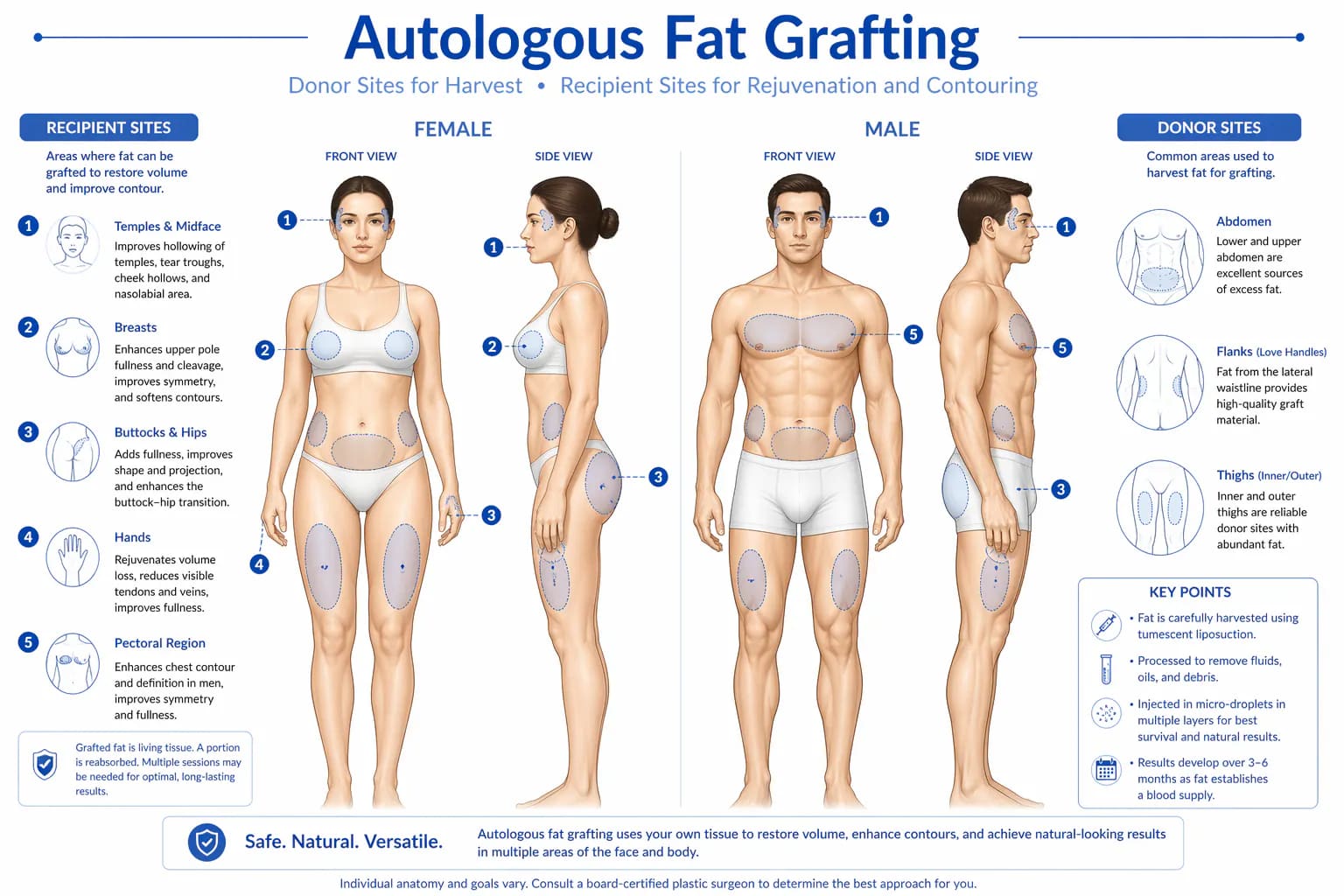
The buttocks get the headlines, but they are not the whole category. Fat can be grafted to the breast, face, hands, lips, gluteal region, and other contour-correction settings. More recent literature also covers temporal hollowing and male pectoral enhancement.
| Recipient area | Why patients choose it | Biggest limitation |
|---|---|---|
| Buttocks and hips | More projection, rounder hip transition, waist-to-hip enhancement | Needs meaningful donor fat and careful positioning during recovery |
| Breasts | Modest natural-looking volume and shape correction | Usually not a large implant-like size jump |
| Face and temples | Softer facial rejuvenation and correction of hollow areas | Small errors matter more, and repeat sessions may be needed |
| Hands | Rejuvenation and soft-tissue padding | Fine-volume adjustments may still need touch-up |
| Pectoral region | Male chest definition or contour enhancement | Niche procedure, usually for selected body contouring goals |
For men, this is one of the most under-covered parts of the fat transfer conversation. Published MRI-based studies describe autologous fat grafting to the pectoralis major during high-definition VASER-assisted liposculpture to improve chest definition. For more on the contouring side of that equation, see our HD liposuction guide.
BBL Safety: How the Procedure Changed After 2017
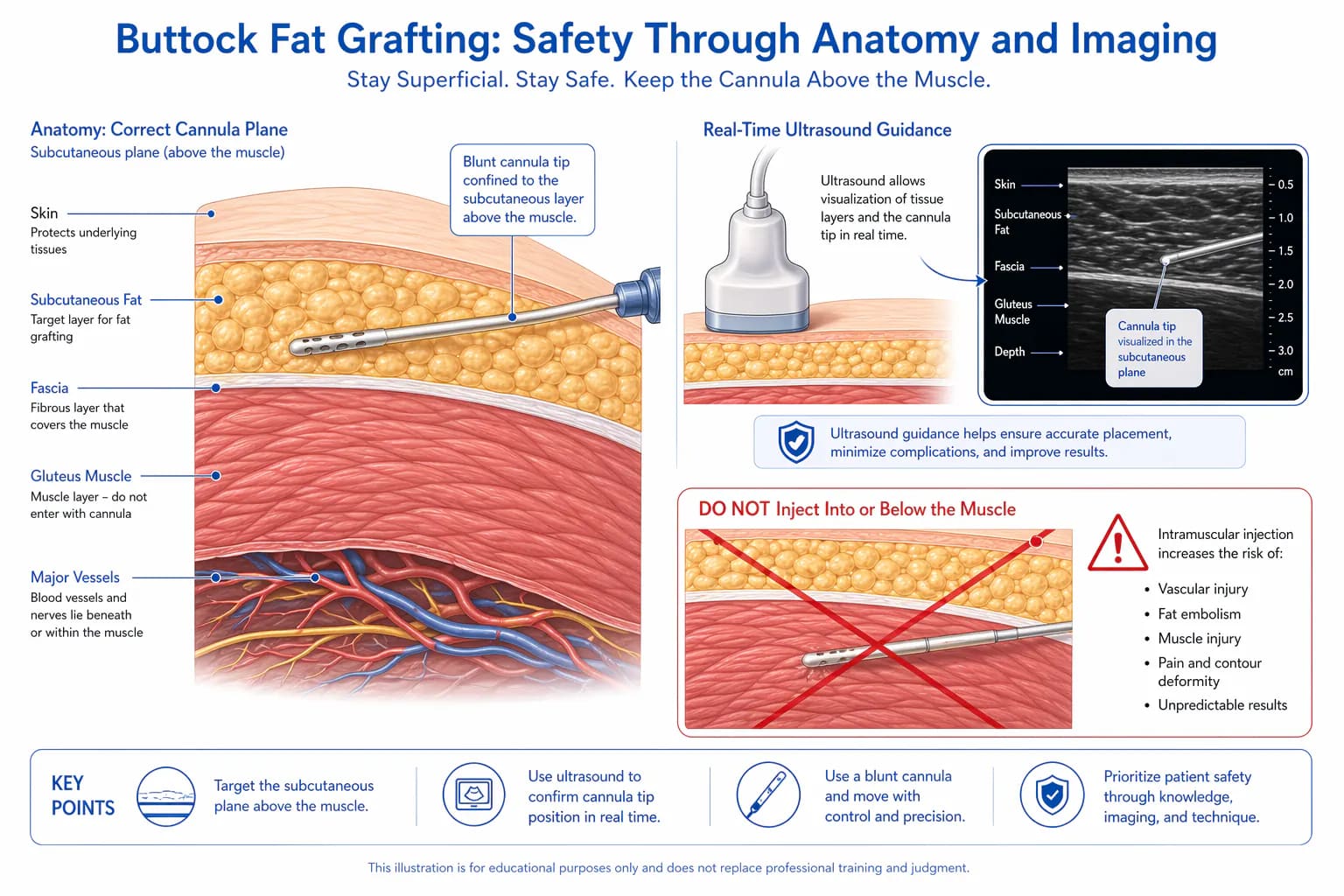
Patients deserve a direct answer here. BBL did have a serious safety problem. Earlier gluteal fat grafting techniques allowed fat to enter or pass through the muscle, where it could reach large veins and cause pulmonary fat embolism. ASPS task-force reporting described mortality estimates as high as roughly 1 in 3,000 in that era.
The procedure got safer because the technique changed. Modern recommendations emphasize staying in the subcutaneous space above the muscle, avoiding deep downward angulation, using appropriate cannulas, and injecting only while the cannula is moving. Ultrasound guidance adds another layer of safety because it lets the surgeon verify where the cannula tip is in real time instead of relying on feel alone.
The numbers reflect that shift. In survey-based follow-up after the new recommendations, mortality trended down from 1 in 3,448 in 2017 to 1 in 14,952 in 2019, while reported deep-muscle injection dropped sharply. In a 1,815-patient ultrasound-guided series, the overall complication rate was 4%, with seroma and local skin ischemia each at 1.2%, infection at 0.8%, and no macroscopic fat emboli or deaths.
That improvement matters. But "safer" does not mean "safe no matter who does it." South Florida mortality analyses argue that deaths continued even after the guidelines changed, concentrated in high-volume, low-cost clinics where fat was still being placed into muscle despite supposed subcutaneous-only claims. Surgeon choice, setting, case volume, and real adherence to ultrasound-guided subcutaneous technique matter. For broader risk screening, read our liposuction risks and safety guide, and for butt-focused planning, see our 360 lipo and BBL guide.
Natural Breast Augmentation via Fat Transfer
Breast fat grafting is best for patients who want a modest increase and a natural feel — not a dramatic implant-style size change. It is also useful for softening asymmetry, smoothing upper-pole hollowness, or refining shape after pregnancy, weight loss, or previous surgery.
The obvious advantage: no implant device — no implant rupture, no capsular contracture, no implant-associated lymphoma risk profile. But honest counseling matters here. Fat transfer brings its own tradeoffs: variable take, oil cysts, calcifications, fat necrosis, and the possibility that a second grafting session will be needed to reach the goal.
The published retention data sets realistic expectations. A 2023 meta-analysis found pooled volume retention of 54%, while an earlier systematic review reported mean retention of 62.4%. Breast fat transfer can work very well, but it is a moderate-volume procedure — not a guarantee of a one-and-done cup-size jump.
| Feature | Fat transfer | Implants |
|---|---|---|
| Material | Your own fat | Silicone or saline device |
| Best for | Modest, softer augmentation and contour refinement | Larger, more predictable size increase |
| Main tradeoff | Variable survival, possible touch-up | Device-related complications and future maintenance |
| Foreign body | No | Yes |
| Imaging considerations | Can create oil cysts or calcifications | Implant-specific follow-up and rupture monitoring may be needed |
Facial Fat Grafting, Temple Hollows, and Smaller-Area Rejuvenation
Facial fat grafting is often the most elegant application of the technique — small amounts can change the face without making it look "done." Common cosmetic targets include temples, cheeks, tear-trough-adjacent hollows, jawline transitions, and lips.
Temples deserve special mention because they are frequently ignored in consumer content. A 2024 systematic review of cosmetic temporal augmentation found autologous fat grafting effective with high patient satisfaction, but also noted variable retention — studies showed temporal fat loss of 20% to 90% by one year. Small-volume work is not automatically more predictable work.
Facial grafting is where patients often hear the word "permanent" and misunderstand it. The portion that survives can last a long time, but the face is a dynamic area and multiple sessions are often needed to reach the desired result. On the hands, the principle is similar: fat can soften visible tendons and restore soft-tissue padding, but precision still beats volume-chasing.
Who Is a Good Candidate
A good candidate has three things: enough donor fat, realistic volume goals, and a surgeon who can match technique to anatomy. The best candidates do not just "want more" — they want a result that fits what fat transfer can actually deliver.
The donor-fat question is where many consultations turn. There is no universal minimum because facial fat grafting uses much less volume than buttock or breast transfer. But for body transfer, meaningful harvestable fat is required. In a recent gluteal study, the median volume transferred was 360 mL per buttock, with a range of 250 to 520 mL. Very lean patients may not have enough available fat for a noticeable BBL or large-volume body transfer.
Most patients need only one operative session covering both harvest and grafting. A second round is considered when the volume goal is aggressive, the recipient site is challenging, or retention ends up lower than expected.
One more honest point: fat transfer is not the right tool for every goal. If you want the largest possible breast size increase, implants may still be the more predictable option. If you want dramatic gluteal projection but have very little donor fat, the consultation has to be honest about that limit — surgical artistry cannot manufacture tissue that is not there.
Cost Breakdown
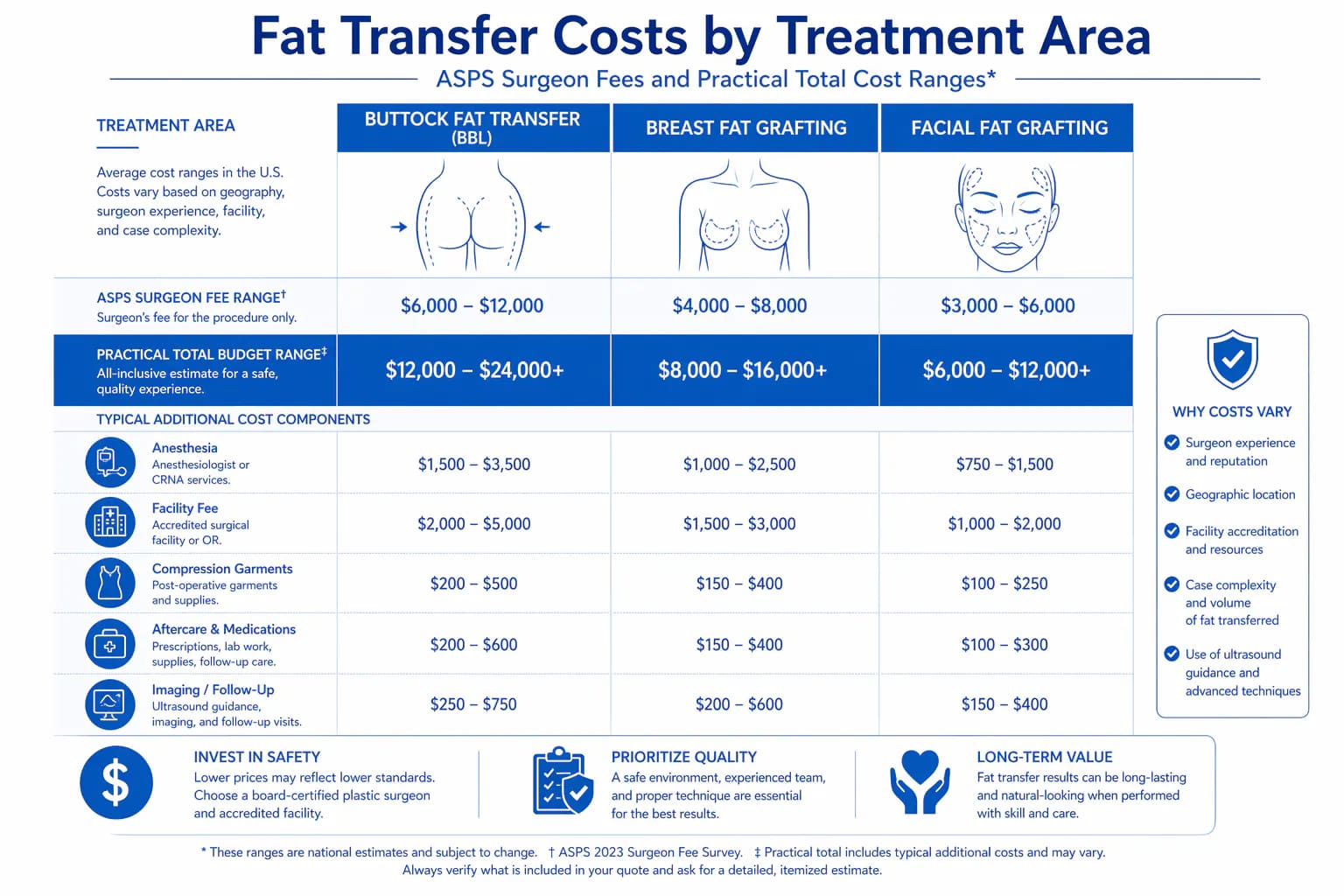
The cleanest way to discuss fat transfer cost is to separate surgeon-fee data from real-life patient budgeting. ASPS's 2024 report gives projected surgeon-fee ranges — useful benchmarks, but they do not include anesthesia, facility fees, garments, medications, or aftercare.
| Recipient site | ASPS 2024 surgeon fee range | Practical patient budgeting range | Main price drivers |
|---|---|---|---|
| Buttock fat transfer / BBL | $7,000–$11,500 | $8,000–$18,000 | Large-volume liposuction, ultrasound guidance, OR time, aftercare |
| Breast fat grafting | $5,500–$9,500 | $6,000–$12,000 | Possible second session, facility and anesthesia, follow-up imaging |
| Facial fat grafting | $3,000–$5,500 | $3,500–$7,000 | Multi-area finesse work, OR vs office setting, touch-ups |
The budgeting ranges reflect surgeon fees plus the non-surgeon costs patients actually pay. ASPS reporting on safe BBL pricing notes that a properly performed board-certified BBL often runs $12,000 to $18,000 in much of the country — a useful sanity check against suspiciously low quotes.
For facial work, bundling matters more than people expect — a facial fat transfer quote can rise quickly when combined with facelift work, eyelid surgery, or submental liposuction. For BBL, the quote also reflects whether the surgeon uses real-time ultrasound, how much liposuction is involved, and how much aftercare is built in.
The cheapest fat transfer quote is not automatically the best value — especially in gluteal surgery, where the modern safety gains came from stricter technique, better cannula control, ultrasound use, and more disciplined case selection. Low-cost, high-volume shortcuts are exactly the pattern the safety literature warns about.
What is liposuction fat transfer? A procedure that removes your own fat from one area, processes it, and injects it into another to improve volume and contour. A BBL is one version of this, but breast, facial, hand, temple, and pectoral fat transfer are also established uses.
How much fat survives after transfer? About 40% to 70% is a realistic long-term range for most patients, with the rest absorbed over time. That early loss is why surgeons often overcorrect modestly at surgery and wait 3 to 6 months before judging the final result.
How much does fat transfer cost? Typical real-world ranges are about $8,000 to $18,000 for BBL, $6,000 to $12,000 for breast fat grafting, and $3,500 to $7,000 for facial fat grafting. ASPS's published surgeon-fee ranges are lower because they do not include anesthesia, facility, garments, medications, and other case costs.
What areas can receive fat transfer? Common recipient sites include the buttocks, breasts, face, temples, hands, and pectoral region. Donor fat usually comes from the abdomen, flanks, or thighs — wherever there is enough subcutaneous fat to harvest safely.
How long do fat transfer results last? The portion that survives and establishes blood supply is long lasting and behaves like your own tissue. The portion that absorbs usually does so during the first 3 to 6 months, and the final result can still change with significant weight gain or loss.
Is fat transfer safer than implants? For breast augmentation, fat transfer avoids implant-specific risks such as rupture, capsular contracture, and BIA-ALCL, but can require repeat sessions and can cause fat necrosis or calcifications. For buttock augmentation, safety depends heavily on technique — modern subcutaneous-only, ultrasound-guided BBL is much safer than older approaches, but not risk-free.
How many lipo sessions do you need for fat transfer? Usually one operative session. A second session becomes more likely when the volume goal is large, the patient is lean, or graft survival ends up lower than hoped.
What is the difference between fat transfer and a BBL? Fat transfer is the umbrella term for moving fat from one body area to another. A BBL is a specific fat transfer procedure in which the recipient area is the buttocks and hips.
