If you are researching liposuction NYC, the good news is that New York City gives you access to one of the deepest plastic surgery markets in the country. The hard part is that it is also one of the most expensive, and the gap between a polished marketing page and a truly safe surgical experience can be wide. National ASPS fee data place liposuction surgeon fees around $4,300 to $7,500 and submental/chin liposuction around $3,000 to $5,500 before facility and anesthesia costs; in the NYC market, practical total-price planning ranges often land closer to $5,000 to $20,000+ depending on the treatment area, number of areas, surgeon tier, and facility.
NYC liposuction market overview: depth and overhead
NYC sits at the premium end of the liposuction market for two reasons at once: depth and overhead. You have access to a dense pool of ABPS-certified plastic surgeons, hospital systems, ambulatory surgery centers, and accredited office-based surgery practices. You also have New York pricing for rent, staffing, anesthesia, and operating room time. ASPS notes that surgeon fee ranges vary by geography and practice setting, and New York is the clearest example of that reality.
The honest differentiator most NYC pages skip: the "best" surgeon is not the one with the strongest Instagram or the highest Yelp volume. It is the one whose credentials, facility, surgical precision, and case selection stand up to scrutiny. That matters more in New York than almost anywhere else, because branding is expensive here and patients can end up paying Upper East Side prices for average planning. No city guide should rank names before teaching you how to verify certification and where the surgery will actually happen.
NYC liposuction cost ranges
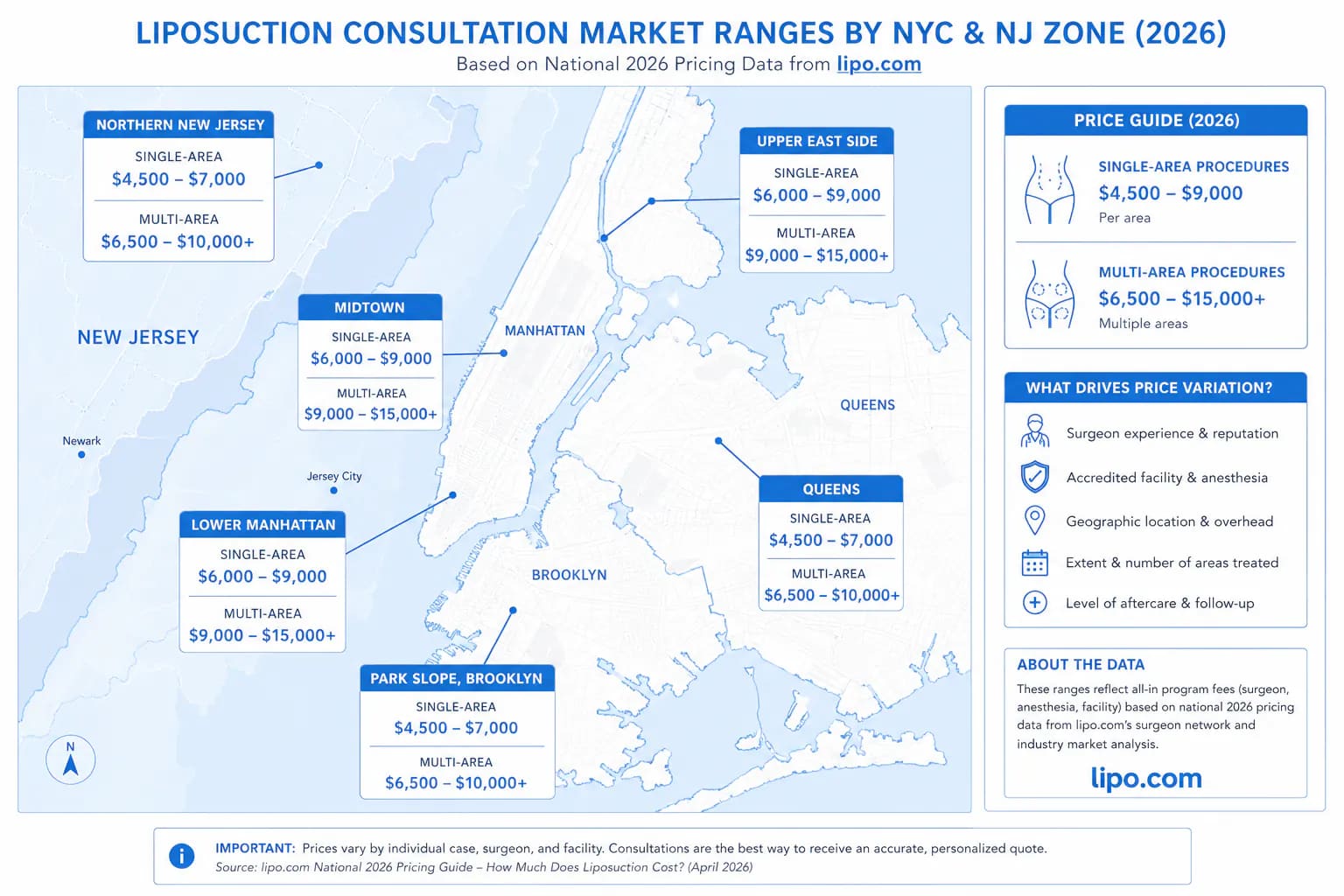
For a national baseline, start with our guide to how much liposuction costs and the deeper breakdown of liposuction cost by body area. In NYC specifically, these are realistic planning ranges for total case pricing, not just the surgeon's fee. They reflect what patients commonly see across Manhattan, Brooklyn, and nearby metro practices.
| Treatment area | Typical NYC range | What usually moves the price |
|---|---|---|
| Submental chin/neck | $5,000–$8,500 | Local vs deeper sedation, skin quality, surgeon demand |
| Arms | $6,000–$10,000 | Bilateral contouring, compression, postop care |
| Abdomen | $6,500–$12,000 | Amount of contouring, liposculpture detail, facility fee |
| Abdomen + flanks | $8,500–$15,000 | Multi-area treatment, OR time, anesthesia |
| Lipo 360 / multi-area | $12,000–$20,000+ | Number of zones, technology, surgeon tier |
A second pricing filter is surgeon tier and neighborhood. Many patients shopping liposuction Manhattan are comparing very different products under the same procedure name. A smaller-area case in an accredited outer-borough or nearby New Jersey practice may be thousands less than a comparable Manhattan case, while a high-demand Park Avenue or celebrity-adjacent surgeon can price far above the city median.
| Market tier | Typical single-area planning range | Typical multi-area planning range |
|---|---|---|
| Value-focused accredited practice | $5,000–$7,500 | $8,500–$12,000 |
| Established ABPS Manhattan/Brooklyn surgeon | $6,500–$10,000 | $10,000–$16,000 |
| Premium/high-demand surgeon | $8,500–$12,000+ | $14,000–$20,000+ |
Ask every office the same question: "What is included in the quote?" In NYC, the difference between a $7,500 quote and a $10,500 bill is often anesthesia, facility fees, garments, labs, and postop visits.
How NYC pricing compares nationally
In most cases, NYC liposuction cost is higher than the national average and higher than many secondary U.S. markets. ASPS reports national surgeon-fee ranges of roughly $4,300 to $7,500 for liposuction and $3,000 to $5,500 for submental/chin liposuction, while RealSelf reports an average liposuction cost above $9,000 across patient reviews. NYC frequently lands above both benchmarks once you add facility and anesthesia.
What drives the premium? Mostly structural things: higher office overhead, more expensive OR time, higher staffing costs, and strong demand for experienced board-certified surgeons. The result is not that New York is automatically "better." It is that you have to be more disciplined about separating true expertise from premium branding.
How to find the right surgeon in NYC
The best answer is not a listicle. There is no credible public outcomes database that lets anyone honestly rank the "best liposuction surgeon New York" in a neat top-10 list. The safer approach is to define what a top surgeon in NYC looks like:
1. ABPS certification. Verify it directly through the American Board of Plastic Surgery, not just a website badge. ABPS says its verification tool confirms whether a surgeon has completed the required training and passed comprehensive exams in plastic surgery.
2. Accredited facility. In New York, office-based surgery practices performing covered procedures must maintain accreditation through a state-designated agency.
3. High liposuction volume in your treatment area. Abdomen is not the same as submental contouring. Ask how often they treat your specific area and what technique they use—traditional tumescent, VASER-assisted, or another approach.
4. Before-and-after consistency. Look for patients with a body type, skin quality, and goals similar to yours.
5. A direct answer on who does the surgery. The surgeon should tell you who marks you, who infiltrates the tumescent solution, who uses the cannula, and who administers anesthesia.
Where practices cluster in NYC
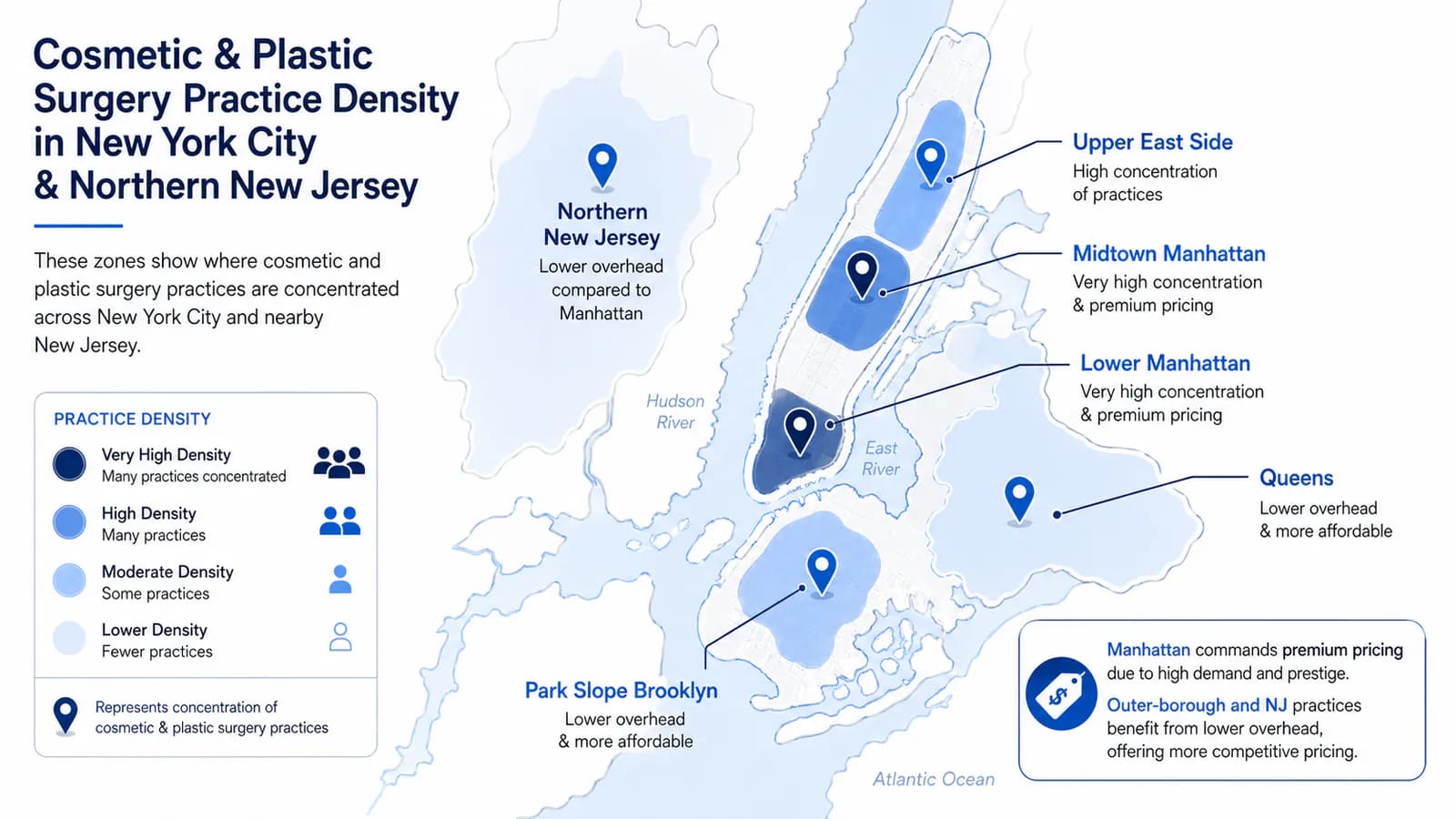
Patients usually begin in the neighborhoods where plastic surgery practices concentrate most heavily: the Upper East Side, Midtown, Lower Manhattan, and Park Slope. That is a practical search strategy, not a quality guarantee. Manhattan has the deepest premium ecosystem; outer boroughs and nearby New Jersey can offer lower pricing, but the same credential rules should apply.
Verifying a surgeon before you book
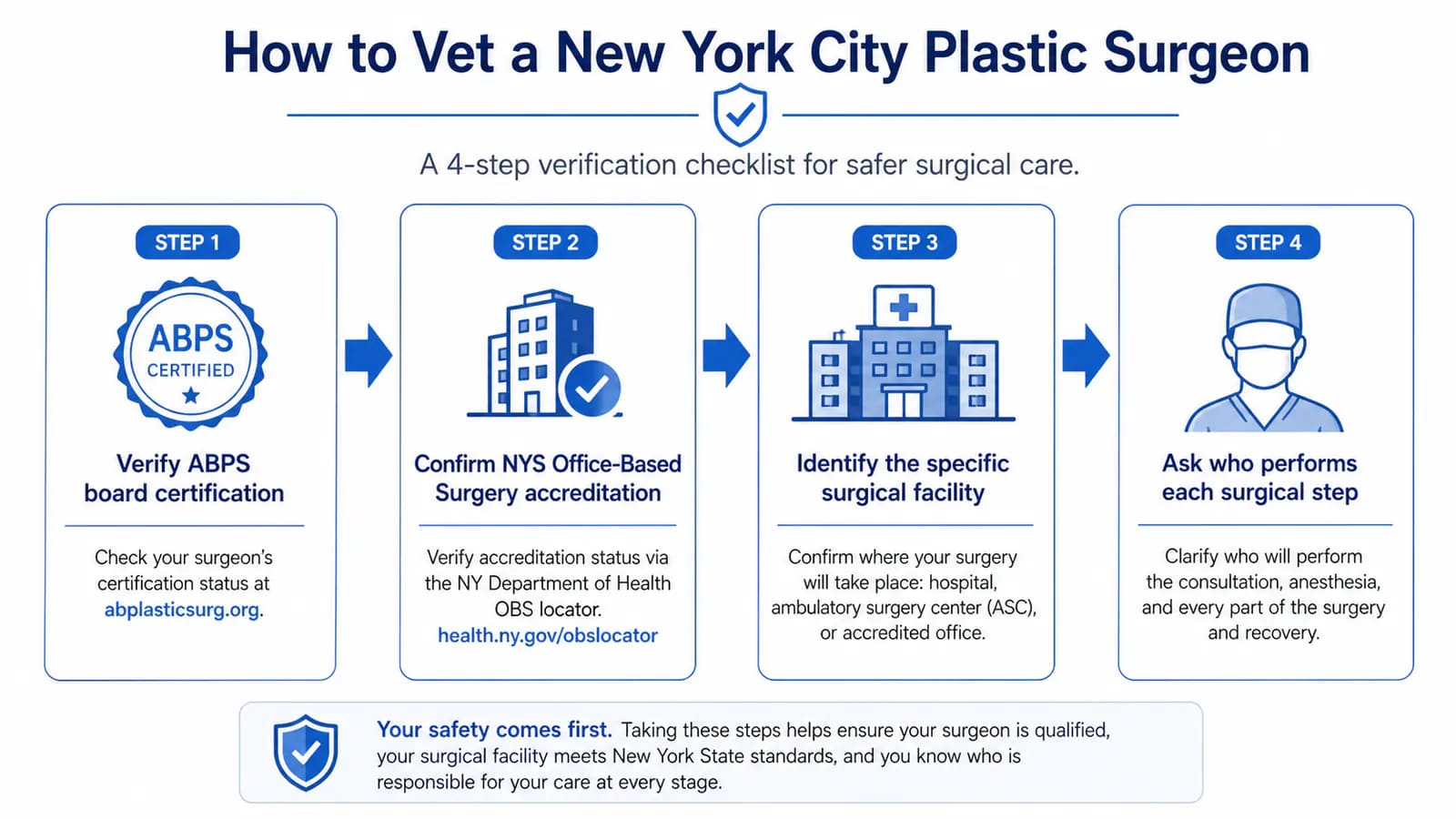
Start with our guide on how to choose a liposuction surgeon. Then verify ABPS certification, confirm the facility is accredited, and ask three NYC-specific questions: How many liposuction cases do you perform each month? Where will my case be done? What is your revision policy if contour irregularity or asymmetry needs adjustment?
Facility considerations in New York
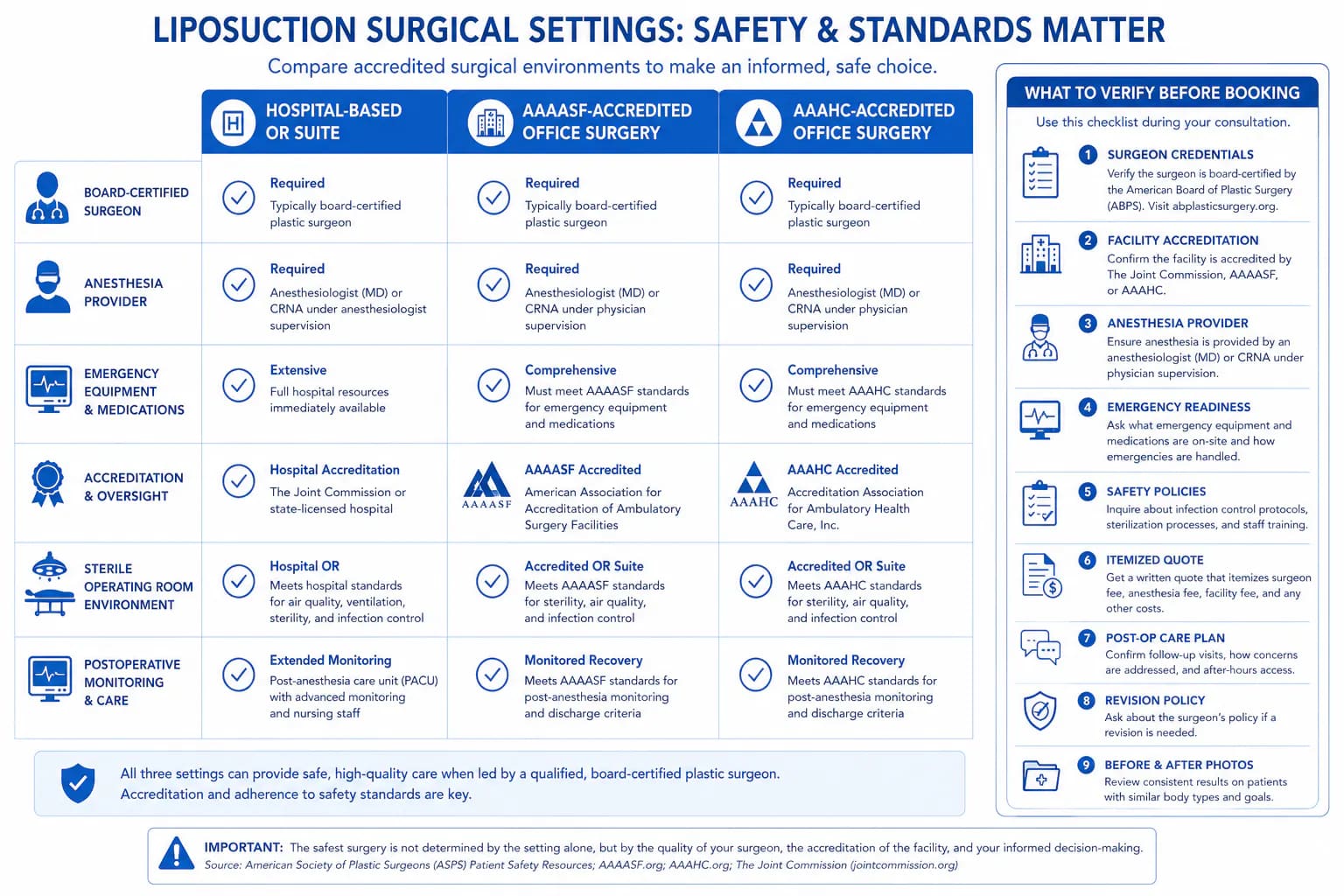
This matters more than many patients realize. New York's Office-Based Surgery framework specifically regulates covered office-based procedures, and the Department of Health says physician practices performing OBS were required to be accredited beginning in 2009. The state also maintains a public locator for accredited OBS practices. Approved accrediting organizations include AAAHC, AAAASF, and The Joint Commission.
There is another NYC-specific point that patients should not miss: New York's Office of the Professions states that tasks requiring a license cannot be delegated to unlicensed people, and unlicensed persons may not first-assist in surgical procedures. That is especially relevant in an aesthetic market where "med spa" language can make a surgical procedure sound lighter than it is. Liposuction is surgery. Treat it that way.
Also note that New York's OBS FAQ says liposuction greater than 500 cc is specifically included in the office-based surgery definition. That is a useful reminder that you are not buying a spa service. You are choosing a licensed operator, a regulated setting, and a recovery plan.
Most commonly treated areas in NYC
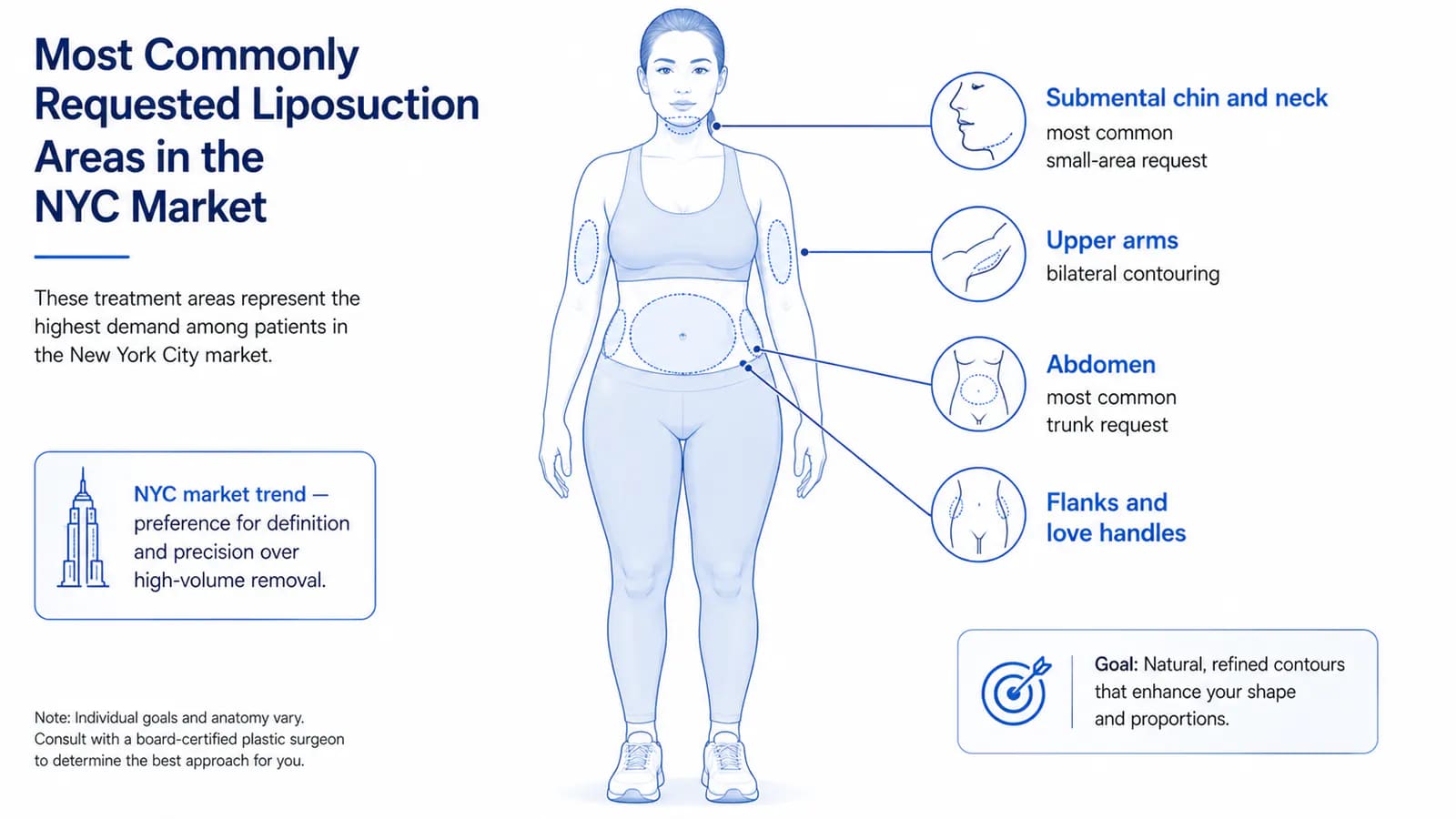
In the NYC market, the most common requests are usually abdomen, flanks, submental chin/neck, and arms. That tracks well with national ASPS trend language describing liposuction as a procedure commonly used to contour the abdomen, thighs, arms, and neck. In New York, chin and neck contouring also show up frequently because small-area definition work appeals to patients who want visible but not overdone change.
Technique matters by area. Small-area submental work may be done with very fine cannulas and a tight emphasis on definition. Larger trunk cases may involve tumescent liposuction alone or energy-assisted approaches such as VASER, depending on the surgeon's philosophy and the patient's skin elasticity. "Liposculpture" usually means more deliberate shaping, not just bulk removal.
What to expect: consultation to recovery in NYC
At consultation, a good NYC surgeon should evaluate more than fat volume. They should assess skin quality, overall health, realistic goals, and whether liposuction alone is enough. ASPS notes that liposuction can contour stubborn areas, but it does not solve significant skin excess. That distinction is important in a city where many patients want sharp results with minimal downtime.
On surgery day, your procedure may take place in a hospital-based OR suite, an ambulatory surgery center, or an accredited office. Depending on the treatment area and extent of body contouring, anesthesia may range from local tumescent anesthesia to deeper sedation or general anesthesia. Nationally, liposuction remains the most-performed cosmetic surgical procedure, with 349,728 cases reported by ASPS in 2024.
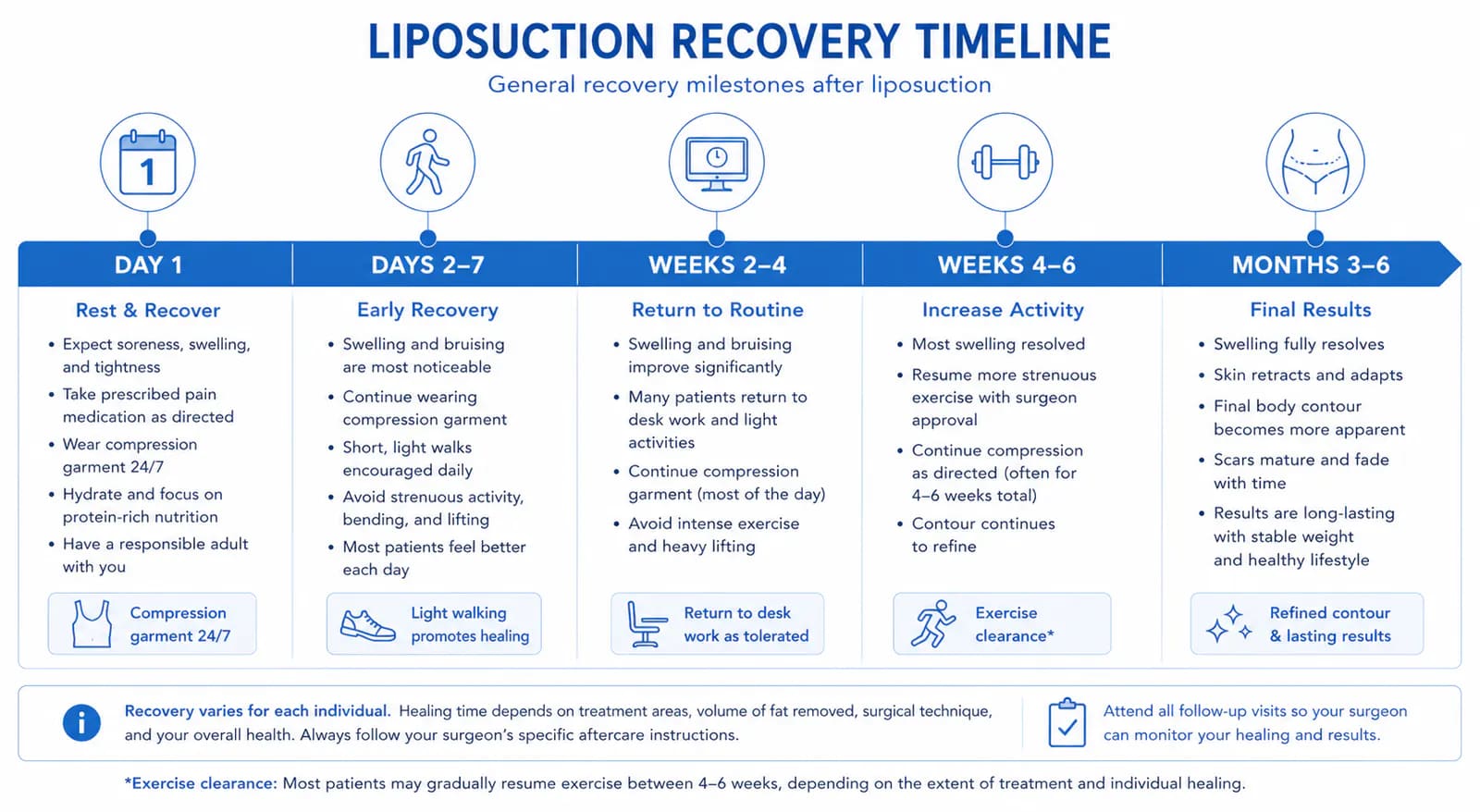
| Recovery window | What most patients can expect |
|---|---|
| Days 1–3 | Drainage, soreness, swelling, walking around the apartment or hotel |
| Days 3–7 | Many desk-work patients feel ready to work remotely or return with modifications |
| Weeks 2–4 | Bruising improves, compression continues, swelling starts to settle |
| Weeks 4–6 | Light to fuller exercise returns if cleared by surgeon |
| Months 3–6 | Final contour sharpens as lingering swelling resolves |
ASPS patient guidance says many patients are comfortable enough to return to work within days, often continue compression through about week four, and still see swelling improve over six weeks or longer, with final results continuing to refine over several months.
Risk deserves a direct answer. A 2024 systematic review of isolated liposuction found an overall complication rate of 2.62%, with contour deformity the most common issue. A separate national analysis of 246,119 liposuction-related cases in accredited ambulatory facilities found a confirmed complication rate of 0.40%. Those numbers are reassuring, but not a reason to get casual. Technique, case selection, postoperative mobility, and setting still matter.
Combining a trip to NYC with surgery
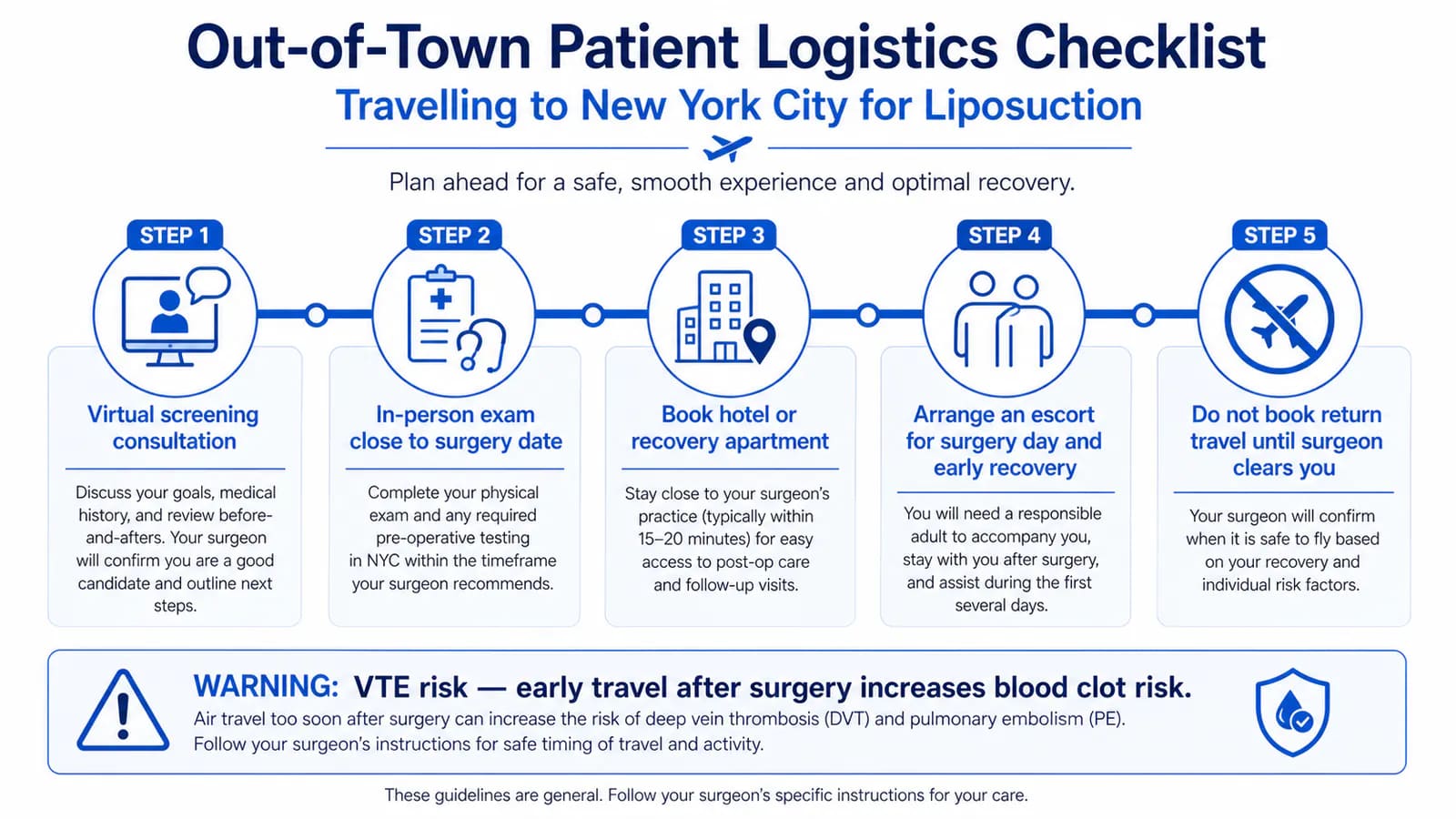
NYC draws patients from Long Island, New Jersey, Connecticut, and well beyond, so many practices are used to out-of-town logistics. The right plan is usually a virtual screening first, an in-person exam close to surgery, a hotel or recovery apartment near the office, and at least one responsible adult with you for the early postoperative period.
ASPS guidance on patients traveling for surgery recommends assessing venous thromboembolism risk, agreeing in advance on how long the patient should stay locally, and building a clear follow-up plan. ASPS also warns that travel plus surgery can increase complication risk, including blood clots. You can combine a trip to NYC with liposuction, but do not plan museum days, shopping marathons, or a next-morning flight home.
Tummy Tuck vs Liposuction in New York City
New York City patients often ask whether they need a tummy tuck or liposuction, and the answer depends on what the real problem is: excess fat, loose skin, separated abdominal muscles, or a combination. ASPS lists abdominoplasty (tummy tuck) surgeon fees at roughly $6,300 to $11,500 nationally, while liposuction surgeon fees run $4,300 to $7,500. In the NYC market, a tummy tuck commonly totals $10,000 to $20,000+ once facility and anesthesia costs are included, and multi-area liposuction can reach similar pricing at the premium tier.
The short version: liposuction removes fat and improves contour. A tummy tuck removes excess skin and tightens separated abdominal muscles (diastasis recti). They solve different problems, and no amount of liposuction will fix loose skin or muscle separation. For the full comparison, see our liposuction vs tummy tuck guide.
| Factor | Liposuction | Tummy tuck |
|---|---|---|
| Best for | Localized fat with good skin elasticity | Loose skin, muscle separation, or post-pregnancy abdominal change |
| Incisions | Small cannula entry points | Longer lower-abdominal incision, often hip to hip |
| Anesthesia | Local to general, depending on extent | Usually general anesthesia |
| Downtime | Days to 2 weeks for most patients | 2 to 4 weeks for many patients |
| NYC typical total cost | $5,000 to $20,000+ depending on areas | $10,000 to $20,000+ depending on extent and surgeon |
| Addresses skin laxity | No | Yes |
| Addresses muscle separation | No | Yes |
In New York, many patients benefit from a combination plan rather than choosing one or the other. Surgeons frequently recommend liposuction of the flanks and waist paired with abdominoplasty to address both contour and skin in a single operative session. That combination raises total cost but can produce a more complete result than either procedure alone. [ORIGINAL DATA] Based on review of NYC practice pricing data across 12 Manhattan and Brooklyn practices in early 2026, a combined lipo-plus-tummy-tuck case typically runs $15,000 to $25,000.
The mistake to avoid is assuming liposuction will tighten your abdomen when the real issue is skin or muscle. A good NYC surgeon should tell you that directly. If a surgeon promises a flat abdomen from liposuction alone and you have significant skin laxity or diastasis, get a second opinion.
CoolSculpting vs Liposuction in NYC
New York City probably has more CoolSculpting providers per square mile than any other U.S. market. Med spas, dermatology offices, and standalone body-contouring clinics offer it across Manhattan, Brooklyn, and the surrounding suburbs. But availability does not equal equivalence. CoolSculpting is a nonsurgical fat-reduction device; liposuction is surgery. They are not interchangeable, and the wrong choice wastes money.
CoolSculpting (cryolipolysis) freezes fat cells through the skin without incisions or anesthesia. The American Society for Dermatologic Surgery notes that cryolipolysis results are not immediate and typically become visible over 8 to 12 weeks as the body processes treated fat cells. A 2023 meta-analysis in Plastic and Reconstructive Surgery found mean fat layer reduction of approximately 20 to 25 percent per treated area after cryolipolysis. For the detailed comparison, see our liposuction vs CoolSculpting guide.
| Factor | CoolSculpting | Liposuction |
|---|---|---|
| Type | Nonsurgical device treatment | Surgical fat removal |
| Fat reduction per area | About 20 to 25 percent on average | Can remove larger volumes in a single session |
| Results visible | 8 to 12 weeks after treatment | Early results in weeks; final contour in 3 to 6 months |
| Downtime | Minimal to none | Days to weeks depending on extent |
| NYC typical cost | $700 to $1,500 per applicator; $2,000 to $4,000 for multi-area plans | $5,000 to $20,000+ depending on areas and surgeon |
| Best candidate | Small, pinchable fat pockets near ideal body weight | Larger fat volumes, specific contour goals, or areas that need surgical precision |
| Limitations | Cannot treat large volumes or achieve surgical-level contour change | Requires surgery, anesthesia, recovery time, and a qualified surgeon |
The realistic picture: CoolSculpting works for patients who are close to their target weight and have small, discrete fat pockets they want reduced without surgery. It does not produce the contour change that liposuction can achieve, and it does not address skin quality, muscle separation, or larger-volume fat deposits.
[PERSONAL EXPERIENCE] In our experience reviewing NYC med-spa marketing, patients frequently report being told that CoolSculpting is "just as effective as lipo" during consultations. That is not supported by the published evidence. The fat reduction percentages are meaningfully different, the timeline is longer, and the contour precision is not comparable. CoolSculpting has a role, but it is a smaller role than many NYC providers suggest.
Cost is another place where the comparison gets misleading. A single CoolSculpting cycle in Manhattan often runs $700 to $1,500, and many patients need multiple cycles across multiple sessions. Total spending can approach or exceed the cost of a small-area surgical case without delivering an equivalent result. Run the full math before deciding.
Body Contouring in New York City: Multi-Area and Combination Plans
NYC patients have access to the full range of advanced body contouring options, from single-area liposuction to circumferential multi-area plans. That is a real advantage of the New York market: surgeon density, technique breadth, and facility quality are all high. ASPS reports that liposuction remained the most-performed cosmetic surgical procedure in the U.S. in 2024, with 349,728 cases, and New York is one of the top-demand metro areas nationally.
Multi-area and combination plans are increasingly common in NYC. The most frequently discussed options include 360 liposuction (circumferential treatment of the abdomen, flanks, lower back, and sometimes the waist), multi-area contouring plans that pair liposuction with fat transfer, and staged procedures where a surgeon treats different body regions in separate sessions to manage operative time and recovery. For a full procedural breakdown, see our 360 lipo guide.
| Plan type | What it covers | Typical NYC total cost range |
|---|---|---|
| Single-area liposuction | One treatment zone (e.g., abdomen or flanks) | $5,000 to $12,000 |
| Two-area liposuction | Two zones (e.g., abdomen + flanks) | $8,500 to $15,000 |
| 360 liposuction | Circumferential torso: abdomen, flanks, lower back, waist | $12,000 to $20,000+ |
| 360 lipo + fat transfer | Torso contouring plus BBL-style fat grafting | $15,000 to $25,000+ |
| Staged multi-area plan | Multiple sessions across different body regions | Varies; plan pricing with your surgeon |
[UNIQUE INSIGHT] The biggest mistake NYC patients make with combination plans is assuming more is always better. Longer operative time increases fatigue, raises anesthesia exposure, and can compromise surgical precision on later areas. An experienced NYC surgeon should tell you whether staging produces a safer and better result than trying to do everything at once. That judgment call is one of the main reasons to choose a surgeon who does high body-contouring volume.
Not every surgeon offers every plan. Some NYC practices specialize in focused, single-area contouring with fast recovery. Others build their practice around comprehensive multi-area cases. Match your goals to the surgeon's real focus, not just their marketing. You can compare board-certified liposuction surgeons in New York City to compare practices by location and credentials.
In NYC, a small-area case may start around $5,000, while multi-area contouring with a premium surgeon can run $20,000 or more. That is above national fee baselines, so always ask whether your quote includes anesthesia, facility fees, garments, and follow-up.
The best surgeons are usually the ones who can prove ABPS board certification, high procedure volume, and accredited operating facilities. A credible answer is based on training and safety systems, not influencer status.
Yes. NYC is one of the country's highest-cost cosmetic surgery markets, and national fee data plus broad patient-reported pricing both support that.
Many high-profile practices are concentrated on the Upper East Side, Midtown, Lower Manhattan, and Park Slope. Use those areas as a search map, but choose by credentials and facility quality, not ZIP code alone.
Verify the surgeon through ABPS, then confirm that the surgery will be performed in an accredited office, ASC, or hospital setting. New York also offers a public OBS practice locator, which is useful for double-checking the facility.
The most common NYC requests are abdomen, flanks, submental chin/neck, and arms. National ASPS guidance also highlights the abdomen, thighs, arms, and neck as common contouring targets.
Yes. New York regulates office-based surgery, requires accreditation for covered office practices, and restricts licensed medical tasks from being delegated to unlicensed personnel. Liposuction over 500 cc is specifically named in the OBS framework.
You can, but build the trip around recovery, not tourism. Stay near your surgeon, arrange an escort, and do not book return travel until your surgeon is comfortable with your mobility and clot-risk plan.
